Grounding Through Anxiety With Senses
Sean Fargo answers a listener’s question about supporting someone who dissociated during a loving-kindness meditation, with sensory anchors, sound, touch, walking and self-compassion for anxiety and overwhelm.
Category · Mindfulness Exercises
Browse 144 mindfulness exercises and articles in the Learning Mindfulness category from Mindfulness Exercises.
144 articles

Sean Fargo answers a listener’s question about supporting someone who dissociated during a loving-kindness meditation, with sensory anchors, sound, touch, walking and self-compassion for anxiety and overwhelm.

If you have ever decided you were “bad at meditating” because your mind will not stop thinking, this talk with Susan Piver offers another way to see it. She explains Shamatha Vipassana as noticing where attention has gone and returning to it.

Sean Fargo talks with Buddhist teacher and author Lodro Rinzler about basic goodness, the stories behind feeling “not enough,” and how meditation and acceptance work with shame and self-doubt.

Sean Fargo leads a live community session on staying human in a digital age: a participant on her fears about technology and AI, starting a neighborhood mindfulness group, elder teachers, podcasting as a way to meet people, and Sean’s suggestions for mindfulness with ADHD.

A short guided morning practice: a few deep breaths, a body scan from the feet to the head, the words “calm, strong, focused,” and imagining the day ahead with warm intentions.

A short guided gratitude meditation: noticing one present sensation, thanking people who support your day, a loved one, a small blessing from today, and a minor challenge, then closing with thanks for body and mind.

Sean Fargo talks with Buddhist teacher and author Lodro Rinzler about basic goodness, working with shame and self-doubt, and a loving-kindness practice for someone you find difficult.

A guided loving-kindness meditation of about three minutes, from wishes of well-being for yourself to a loved one, someone in a hard time, a difficult person, and all beings.

A conversation with leadership coach and author Jan Hoath on “joy anyway”: how mindfulness, small daily moments she calls micro joy, and emotional honesty fit together, including in hard seasons.

Susan Piver, Buddhist teacher and founder of the Open Heart Project, on how mindfulness and awareness differ, why you don’t need to stop thinking, eyes-open practice, and how to structure a meditation class.

Sean Fargo on moving mindfully during meditation, working with discomfort, sitting on the floor or in a chair, and starting a loving-kindness practice, with questions from the community.

A short guided gratitude and breath practice from Sean Fargo for evenings when the mind keeps going: bring to mind something you appreciate, then rest with each breath and a sense of ease and safety.

A short guided reflection that begins with a quote on heartfelt gratitude, then asks how your heart expresses thanks, how gratefulness has nurtured your love, and how others express gratitude from the heart.

A short guided loving-kindness meditation that starts with the breath and body, then offers wishes of well-being to yourself, someone you love, someone going through a hard time, someone you find difficult, and all beings.

A short guided gratitude meditation that moves through health, relationships, money, and protection, asking where gratitude has been present and where it has been unrecognized or forgotten.

Margaret Cullen, psychotherapist, mindfulness and compassion teacher, and author of Quiet Strength, on what equanimity is not, why choosing it doesn’t mean giving up passion, how feeling tone (vedana) works as a gateway, and her working definition of equanimity.

Equanimity for parents, caregivers and helpers: the “not my emergency” boundary, feeling tones as an anchor for awareness, and equanimity as a skill that can be trained. Includes resources from Margaret Cullen, author of Quiet Strength.

Sean Fargo talks with Margaret Cullen, author of Quiet Strength, about equanimity as steadiness and care rather than numbing out or detachment.

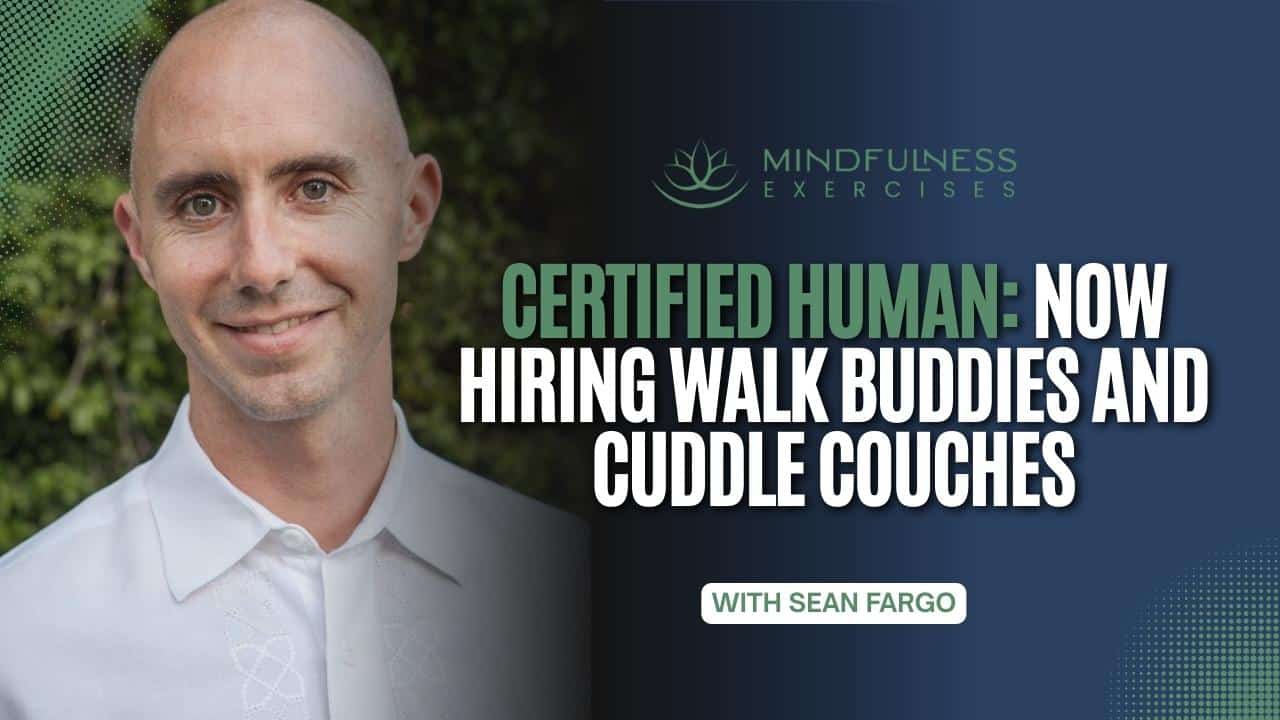
Sean Fargo, in a live community session, on why he expects demand for human mindfulness teachers to keep growing, what embodiment means, a family cuddle couch, and a participant's question about market data.

In this article we explore the Mindfulness of Eating — what it means, why it matters, and how to practice it daily to cultivate awareness, enjoyment, and a healthier connection with your body and food.

A guided gratitude practice in which most affirmations are repeated seven times: gifts received from others, gratitude toward others, ourselves and the greater good, openness to love, releasing hurts with compassion, and gratitude for health.

A seven-day mindfulness series on the inner critic, guided by Sean Fargo. Each day takes up one practice: naming what the critic targets, competence, worth, acceptance, a good friend's voice, sensory grounding for rumination, and loving-kindness.

A live-session conversation about fear of AI and starting a mindfulness group close to home. A longtime meditator in the group describes her doubts about training to teach online, and Sean Fargo answers a question about mindfulness for ADHD and points to teachers Mark Coleman and Loch Kelly.

Sean Fargo talks with Anthony Abbagnano, founder of Alchemy of Breath, about conscious connected breathing: how it relates to the Buddhist practice of anapanasati, how facilitators are trained, and how Anthony uses breath with couples and in a classroom.

Two hosts discuss author and teacher Anne Cushman’s work on mindfulness and creativity: her roller-skating dream, the Spirit of Creativity retreat at Spirit Rock, and six principles shared by contemplative and creative practice.
Sean Fargo answers a question from a live session about spiritual bypass: what it looks like, why resisted emotions tend to persist, and a short flow of noticing, sensing, and breathing with a difficult feeling.

Sean Fargo opens a live community session with his view that demand for human mindfulness teachers is rising because people want real connection. A participant asks what market data supports that, and the session includes a head, heart, and body awareness invitation and Sean's family cuddle couch.

A conversation about where AI can support mindfulness practice (personalization, accessibility, practice between sessions) and what it cannot replace (human presence, shared reality), with a look at ethics when AI enters wellbeing spaces.

A short practice for approaching big feelings in small steps: ground in the body, call to mind a mild emotion, notice what happens, and build an emotion inventory sorted by intensity.

Anthony Abbagnano, founder of Alchemy of Breath and author of Outer Chaos, Inner Calm, describes how he uses conscious breathing for anxiety: a four-count inhale with a longer exhale, a personal breath catalog, and why he says hyperventilation needs an expert present.

Nicholas Bradford, founder of the National Center for Restorative Justice, describes the questions he uses after student conflict (what happened, what were you trying to accomplish, who was impacted), what repair and reentry circles can look like, and why he says adults go first.

What to do when mindfulness practice feels inaccessible: the difference between courage and capability, staying within a workable window, testing the thought “I can’t handle this,” and the cue “I can meet this.”

A two-host discussion of interpersonal neurobiology (IPNB), the framework associated with psychiatrist Dr. Dan Siegel: mind, brain, and relationships as one system, epigenesis and neuroplasticity, emotion and the middle prefrontal cortex, memory and trauma, attunement, and the Wheel of Awareness.

Sharon Salzberg guides a short practice of resting attention on a home base, usually the breath: feeling one breath at a time, using quiet notes if they help, choosing another sensation if the breath is not restful, and beginning again when the mind wanders.

Sean Fargo, a former Buddhist monk, explains why he left the monastery, how senior leaders at the Environmental Protection Agency came into the Mindfulness Meditation Teacher Certification, and why he sees reason for hope in mindfulness reaching federal agencies.

A two-host discussion of Richard Rudd’s The Gene Keys: Embracing Your Higher Purpose, a system that pairs the 64 hexagrams of the I Ching with the 64 codons of DNA. Covers shadow, gift, and siddhi, Gene Keys 25, 46, 55, 61, and 63, and the hologenetic profile. The claims about DNA, frequency, and human evolution are the book’s own, as the hosts present them.

James Baraz, co-founder of Spirit Rock Meditation Center and co-author of Awakening Joy, talks about the kind return in meditation, real silence in guided practice, two rules from his teaching path, secular teaching grounded in ethics, and an intention practice.

Sean Fargo sits at the roots of a redwood in his Berkeley backyard and talks about practicing mindfulness outdoors: sensing the elements in the body and in nature, practicing at a park or campground, and teaching outside.

Driving from Bakersfield to Berkeley through California’s Central Valley, Sean Fargo describes how his practice changed the way he feels on the road, and asks a few questions about feeling at home in the body, on the earth and in the air around us.

Sharon Salzberg, co-founder of the Insight Meditation Society, says forgiveness is not amnesia. She leads a loving-kindness practice built on the phrases “May I be safe, be happy, be healthy, live with ease,” offered to ourselves, a benefactor, a neutral person and all beings.

Austin Hill Shaw, a designer and teacher who speaks about creativity, asks what we need in order to be happy and names three core human needs: connection, contribution and meaning. A clip from his talk Feeling at Home in the World.

The holidays can bring joy and stress at once. This episode covers mindful listening, silent loving-kindness for a difficult relative, boundaries, mindful giving, receiving and spending, the STOP pause, savoring the senses, and giving your full presence.

A participant in a live session asks Sean Fargo how to coach people who are overwhelmed or neurodivergent and build a wall of perfection. Sean starts with safety and self-compassion, then offers mindful walking, breath awareness and a choice of pleasant practices.

Sean Fargo describes how he begins a sitting: grounding, sensing into the body, getting curious about the predominant sensation, and letting it guide what he does next.

Insight Meditation teacher and author Justin Michelson talks with Sean Fargo about The Dharma of Healing: bowing to what scares us, leading with compassion instead of aversion, the four turnings of healing, nature as support, and his native edible plant nursery.

A short talk on marking the turning points of the day (dawn, noon, mid-afternoon, dusk and bedtime) with small pauses, such as stopping at the door or taking off your shoes, and on gratitude as a way of feeling at home.

Sara-Mai Conway, a yoga and meditation teacher and writer, shows how to structure a yoga class like a guided meditation, with an intention, a body of practice and a closing dedication, and how to use silence, rest and savasana.

A guided practice of about five minutes for waiting in line: breathe, notice tension in the jaw, shoulders and belly, feel your feet on the ground, and wish yourself, the people around you and the staff patience and kindness.

Sean Fargo introduces a series of mindfulness exercises for PTSD in three stages (self-soothing, reconnecting with emotions, longer-term healing) and leads a short breathing and body-softening practice. Includes safety guidance.

A two-host audio discussion of Joseph Goldstein's book The Experience of Insight, covering the Three Refuges, bare attention, breath anchors, walking and eating meditation, the Eightfold Path, the Five Hindrances and how to keep practicing in daily life.

Sean Fargo's three-minute talk on making mindfulness relevant to the people you teach: asking about their challenges and experience, finding wording and practices they can relate to, and his 900-minute teaching curriculum.

Austin Hill Shaw, a designer and teacher who speaks about creativity, asks what we need in order to be happy and names three core human needs: connection, contribution and meaning. A clip from his guest teacher talk.

George Mumford, mindfulness teacher and author of The Mindful Athlete, leads a short practice of arriving in the body: sitting with the sternum open, feeling the body's contact with surfaces, and breathing and knowing it.

A guided concentration practice built on counting exhales, with the anchors the guide names, why a silent practice helps, and a participant's question on how concentration differs from mindfulness.

Sean Fargo, recorded in the wake of a week of school shootings in Texas, says it is important to feel what we feel, and asks a few questions for meeting anger, sadness, depression, and fear without judgment.

William Edelglass, Director of Studies at the Barre Center for Buddhist Studies, lays out common ethical and political critiques of mindfulness, including commercialization and the claim that it individualizes distress, and some possible responses.

Sean Fargo hosts George Mumford, author of The Mindful Athlete, in a live session for mindfulness teachers and trainees. George, who has taught mindfulness to elite athletes and executives, covers his five superpowers, right effort, working with emotions through the Four A's, flow, and practice in daily life.

Anne Cushman, author and senior retreat teacher at Spirit Rock Meditation Center, leads a live session for mindfulness teachers and trainees on mindfulness and creative expression. She guides a short meditation, tells how she reclaimed her own creativity, and teaches principles with practices in sensory writing, movement, mandala drawing and an I am free-write.

Sean Fargo talks with James Baraz, co-founding teacher of Spirit Rock Meditation Center and creator of the Awakening Joy course, about teaching mindfulness. The video includes a 15-minute guided meditation, the puppy mind analogy, teaching in secular settings, and an intention practice for teachers.

Sean Fargo, a former Buddhist monk and founder of Mindfulness Exercises, shares eight keys to teaching mindfulness, from compassion and working with self-doubt to trauma-sensitive guiding and community.

Sean Fargo talks with Julie Lythcott-Haims, author of How to Raise an Adult and Real American, about the body-awareness practice she learned in her late 30s, shame and fear as obstacles, writing her memoir, helicopter parenting, and finding common ground with strangers.

Sean Fargo shares an excerpt from a live Q&A call in which a student who has practiced for about five years describes feeling stuck. Sean answers with an update to your inner blueprint, listening to stuck emotion, asking for support, and returning to this moment with curiosity.

Sean Fargo talks with Loch Kelly, a meditation teacher, psychotherapist and founder of the Effortless Mindfulness Institute, about effortless mindfulness: short “glimpses” of awareness, a guided glimpse practice, releasing inner barriers, and imposter syndrome among teachers.

Sean Fargo, a former Buddhist monk, talks about how concentration and mindfulness support each other, using an image from a teacher in his lineage, Ajahn Chah: two ends of the same stick. He describes concentration practices from a live session and answers listener questions about the five hindrances, grasping, and choiceless awareness.

In this episode of the Mindfulness Exercises Podcast, Sean Fargo answers a certification student’s question about where to begin as a new mindfulness teacher. He suggests starting with who you feel called to serve and teaching from your own practice, and draws on his early teaching work in prisons, healthcare and corporate settings.

Sean Fargo talks with Dr. Steve Haberlin, an assistant professor at the University of Central Florida who studies meditation and mindfulness with college students. They cover student stress, the practices Haberlin has used in class, what his research found, and the risks of introducing mindfulness too quickly.

In this episode of the Mindfulness Exercises Podcast, Sean Fargo speaks with Dr. Dan Siegel—psychiatrist, bestselling author, and pioneer in interpersonal neurobiology—about redefining the mind, the power of integration, and how practices like the Wheel of Awareness can support healing, resilience, and wholeness.

Sean Fargo talks with Inna Segal, internationally bestselling author of The Secret Language of Your Body, about her account of healing from back pain, psoriasis, and anxiety, and the practices she teaches for listening to the body. Her healing accounts are her own experience and are not medical advice.

Sean Fargo talks with Ariel Garten, co-founder of Muse, the brain-sensing meditation headband. They cover how its real-time EEG feedback works, what the app measures, and what she says the birds-and-storm soundscape teaches about equanimity.

Francesca Maximé, a psychotherapist and meditation teacher, talks with Sean Fargo about decolonizing mindfulness, somatic awareness, and collective care, and how trauma, racial justice, and embodied practice relate to safety in the body and in community.

Sean Fargo looks at how mindfulness teachers can recognize spiritual bypassing, adapt language and cues for trauma-sensitive teaching, and keep learning as teachers.

Sean Fargo and a guest discuss the Satipaṭṭhāna Sutta through Venerable Anālayo’s book Satipaṭṭhāna: The Direct Path to Realization, covering the four foundations of mindfulness, non-reactivity, and teaching from direct experience.

Leon Logothetis, author of The Kindness Diaries, talks with Sean Fargo about leaving a finance career in London, traveling the world on the kindness of strangers, and the inner work he describes behind it.

Sean Fargo talks about what he took from his conversations with Sophie Chiche and Anthony Abbagnano on purpose, self-love and breath, and leads a short conscious, connected breathing practice.

Rhonda V. Magee, professor emeritus of law and author of The Inner Work of Racial Justice, talks with Sean Fargo about her grandmother's centering practice, bringing meditation into law school, choosing words for this work, and building community.

Sean Fargo talks with Emily Fletcher, founder of Ziva Meditation and author of Stress Less, Accomplish More, about the Ziva Technique, the difference between mindfulness and meditation, manifesting, and meditation for people with busy lives.

Part 2 of Sean Fargo's conversation with Vidyamala Burch of Breathworks: whole-body breathing, breath-holding with pain, resting into gravity, and a short Five B's body scan.

Vidyamala Burch, co-founder of Breathworks, tells Sean Fargo how a spinal injury at 16 and a night in intensive care led her to mindfulness, and explains primary and secondary suffering in pain and illness.

Danny Grieco explains why B2B sales is not linear, why to hold off on sending pricing, and what the six-module Mindful Sales Course covers, with feedback from course participants.

Sean Fargo talks with Stephen Schettini, a former Buddhist monk and author of The Novice, about death meditation, befriending yourself, and why mindfulness needs community.

Sean Fargo talks with writing coach Marni Freedman about how mindfulness can help artists work with fear, self-doubt and resistance, from her golden door image to sensing the body in small steps.

Sean Fargo talks about how mindfulness can change a person’s relationship to chronic pain: separating sensation from thought, softening resistance, and taking small steps. He presents it as a complement to professional medical care.

Sean Fargo talks about common misunderstandings of mindfulness: using it to feel calm, fix discomfort, or escape difficult emotions. He describes mindfulness as meeting life as it is, including discomfort, fear, and anger, and what that means for teachers and coaches.

Baba Mendoza, a healer, activist, and peacemaker, continues his conversation with Sean Fargo about turning to Mother Nature in meditation, learning with humility, and acting with compassion and unity.

Baba Mendoza, a healer, activist, and peacemaker, talks with Sean Fargo about mindfulness and our relationship with nature: nature as ancestor and source, how disconnection leads to harm, and simple ways to begin reconnecting.

Pamela Ayo Yetunde, an author, pastoral counselor, and chaplain, talks with Sean Fargo about mindfulness, ethics, and social justice, drawing on her background in advocacy, law, chaplaincy, and Buddhist practice.

Erik Ireland, a mindfulness teacher and the creator of the Listen To Sleep podcast, talks with Sean Fargo about resistance, yielding, storytelling, and his MYTHS method.

Sean Fargo explains how mindfulness practice can change a person’s relationship with pain, including how to start gently, how much to practice, and when to adapt.

Sean Fargo reviews research he cites on mindfulness meditation and chronic pain, including figures that compare it with morphine, and how mindfulness can change a person’s relationship with pain.

Sean Fargo addresses a common concern among meditators: what to do with distractions such as physical discomfort, racing thoughts, and outside noise.

A talk on making mindfulness relevant to daily life: connecting it to what people care about, adapting it to the audience, keeping practices small, and using everyday language.

Sean Fargo asks how long mindfulness takes to bring a sense of safety, then plays a clip about recognizing when you feel unsafe and how teachers can help people feel safe.

Sean Fargo records from a trail in Yosemite National Park with a 50-pound backpack and talks about not resisting what he feels, one step at a time.

Sean Fargo records at the end of a long day hiking in Yosemite and talks about meeting judgments of pain and fatigue with the care we would offer a loved one.

Sean Fargo explains the most common myth he sees in new meditation teachers, that you must make people feel calm, and leads a short outdoor meditation that shows the alternative.

George Thompson, a filmmaker and Tai Chi teacher, talks with Sean Fargo about Tai Chi, Taoism, his teacher Master Gu, the inner critic, and his film The Subtle Art of Losing Yourself.

Zen teacher and author Henry Shukman talks with Sean Fargo about his book Original Love, the four inns of meditation practice, and the role of love in mindfulness.

Sean Fargo talks with Danny Grieco, a sales trainer and mindfulness teacher, about how mindfulness teachers can pitch and sell workshops to organizations with authenticity.

Brian Johnson, founder and CEO of Heroic, talks with Sean Fargo about his book Areté, its seven objectives, and what he means by being a hero.

Lynda Caesara, a bodyworker and energy practitioner, guides five practices she calls The Basics, which work with attention to the body and its energy.
Showing 100 of 144 articles