A free guide · no experience needed
How to Teach Mindfulness & Meditation
Teaching with confidence and credibility
8 lessons · 3 ready-to-teach scripts · a trauma-safety checklist
Internationally accredited teacher training · CPD & IMMA accredited · Lead teacher IMTA-certified
Before we begin
The world needs more mindfulness and meditation teachers
Maybe you've felt a quiet pull toward a calmer, kinder way of being — the kind the people around you could use more of. This guide is about turning that pull into the confidence to teach. And the timing has rarely been better: since the pandemic, the demand for mindfulness teachers has grown in places most of us never expected — schools, hospitals, corporations, coaching practices, the military, local communities, and online.
This guide gathers the foundational trainings and tools we've accumulated over years of teaching mindfulness in some of the most demanding settings imaginable — maximum-security prisons, children's programs, healthcare systems, and global corporations. The aim is to save you from spending hundreds of hours and tens of thousands of dollars before you ever help your first person.
One idea runs through everything that follows: teaching mindfulness is simple. Not always easy, but simple.
Anyone can teach mindfulness who brings sincerity, compassion, and a few solid tools — you don't need to be a master, or calm all the time. You need to care, and to keep learning.
What this guide covers
- The foundation of all effective mindfulness teaching
- Overcoming self-doubt, fear of judgment, and imposter syndrome
- The essential fundamentals for introducing mindfulness to anyone
- Three techniques to make mindfulness practical and relevant
- The templates and credentials used by respected professionals
- How to lead guided meditations with authenticity and creativity
- Simple trauma-sensitive methods to keep people safe
- The number-one ingredient for lasting impact
📄 Prefer to read offline or print it? Download the whole guide as a free PDF →
Each chapter follows the same shape: first the story of how I learned the lesson, then how we can put it into practice today. And if you're in a hurry, the three ready-to-read scripts are near the end — start there. Let's begin.
Chapter One
The Foundation of All Effective Mindfulness Teaching
Mindfulness is simply gentle awareness of our moment-to-moment experience — noticing our thoughts, emotions, and sensations as they unfold, without judging them to be good or bad, right or wrong. We are being present with what is, whether it's pleasant or not.
Meditation is usually a more formal way of cultivating that same awareness: mindfulness of breathing, the body scan, mindful walking, mindful eating, self-compassion practice, and so on. Thousands of clinical studies link mindfulness to improvements in mental and emotional health, focus, physical health, self-awareness, workplace wellbeing, and relationships.
But underneath all of those techniques sits one quality that makes a mindfulness teacher effective. Here is how I learned what it is.
From 2006 to 2009 I lived in Thailand and China doing business. I was burned out — working seven days a week, on the other side of the world, doing something that didn't align with my values. Searching for clarity, I stumbled upon an old Taoist hermit on the outskirts of Beijing who was known for teaching a few foreigners how to meditate. He barely spoke English. His name was Wei, which means power in Mandarin.
Our first meeting, he made tea and we sipped in silence for an hour. Our second, we walked slowly in figure-eights through an old forest grove, again in silence. There was very little teaching through words — it was teaching through presence. In our third meeting he asked me to count my exhales from one to ten and back again. I couldn't even reach ten. My mind was that scattered.
On our fourth meeting he asked me to sit for thirty minutes and simply sense into my body breathing. After ten minutes my legs were on fire. After fifteen, my body wanted to burst from the stress I'd been carrying. After twenty, I was judging him — who is this guy, this is stupid. After thirty, he rang a bell, the most beautiful sound I'd ever heard, because it meant I could finally move.
I wanted to escape. Then I looked into Wei's eyes. They were the eyes of a wise grandfather who knew exactly what I had just been through, as if to say, I'm proud of you. It takes great courage to look within. And something clicked. The difficulty was part of the practice. It wasn't supposed to be easy — it was supposed to be revealing. The compassion he showed me was teaching me how to be compassionate with myself.
Putting it into practice
When we teach, our first job is to embody and make explicit the three ingredients of self-compassion. People absorb these far more from how we hold the room than from any definition:
- Kindness rather than judgment — meeting what arises with warmth instead of criticism.
- Common humanity rather than isolation — remembering that struggle is part of being human, not a personal failing.
- Present-moment awareness rather than over-identifying — holding thoughts and feelings without being swept away by any one of them.
It also helps to gently dismantle the myths people carry about compassion — the quiet beliefs that keep them from being kind to themselves: that it will undermine their motivation (it tends to build it), that it means letting themselves off the hook, or that it's the same as self-esteem, selfish, or weak. Naming a myth out loud is often enough to loosen its grip.
A practice you can guide: meeting a difficult feeling with compassion
- Choose a memory. Invite people to recall something mildly difficult — a frustration, sadness, or stress. Start mild, never the hardest thing.
- Rate it. On a scale of one to ten, how intense is it? Working with the milder end keeps everyone within their window of tolerance.
- Feel it in the body. Where does the emotion actually live? Notice its temperature, weight, and texture — the felt sense, not the story.
- Separate sensation from story. Gently distinguish the raw physical feeling from the thoughts and judgments wrapped around it.
- Soften with curiosity. Breathe with the sensation, letting kindness be present alongside the discomfort. Nothing has to change for this to help.
Mindfulness is gentle moment-to-moment awareness; compassion is that same awareness plus common humanity and kindness. When we bring mindfulness to our own stress, a seed of self-compassion is already there.
Take it further
Deepening this quality of self-compassion is the first thing we practice together inside the Mindfulness Meditation Teacher Certification — it's the ground everything else is built on. Explore the certification →
Chapter Two
Overcoming Self-Doubt, Fear of Judgment, and Imposter Syndrome
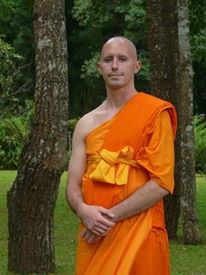
After meeting Wei, I gave away my possessions, said goodbye to my parents, and entered a Buddhist monastery. I was ordained for two years — in rural Thailand and later in Northern California. I shaved my head, wore robes, slept on a hardwood floor with no pillow, and walked villages with an alms bowl for my one meal a day. It was the hardest and most beautiful thing I've ever done.
By the end of two years I wanted to share mindfulness with others. But my monastery required ten years before they would even consider letting me teach. I felt trapped, and I felt like an imposter. I'm not a full master. Will people accept me — just Sean Fargo from Bakersfield, who drank a little in college? I compared myself to famous teachers and thought maybe I needed to sound like Jack Kornfield or Thich Nhat Hanh or Tara Brach.
I had a recurring nightmare: I bump into the cart of a very senior, well-respected teacher in a grocery store. He looks at me and says, “I heard you want to teach mindfulness. Who do you think you are?” And I'd wake up sweating, terrified of being found out.
After enough of these nightmares, I did something a little scary: I brought mindfulness to the fear itself. I imagined the grocery store, let the fear arise, and felt it in my body — heat in the forehead, constriction around the heart. Instead of reacting with shame, I stayed with the sensations with gentle awareness. Breathing in, I feel the fear. Breathing out, I feel the fear. Over time it began to subside.
Then I had the nightmare again. Same store, same question. But this time the fear was gone, and I had an answer: A lot of people are suffering and want help. I feel called to help them, and I know a few simple practices that can. So who am I not to help them? The teacher in the dream had nothing to say. The dream dissolved, and I felt free. That was the shift — from fear to service.
Putting it into practice
When fear, doubt, or that imposter feeling shows up, we can meet it the same way I learned to — not by arguing with the thoughts, but by befriending the sensations underneath them.
A practice for imposter fear
- Picture the moment. Imagine yourself teaching, or being questioned, and let the fear arise on purpose.
- Locate it. Find where it lives in the body — the chest, the throat, the belly — and notice its temperature, shape, and size.
- Drop the label. Instead of “fear” or “shame,” call it simply energy or sensation, and breathe with it.
- Remember common humanity. Nearly every teacher you admire has felt exactly this. You're not uniquely unqualified — you're human.
- Offer yourself kindness. Give yourself the same encouragement you'd give a dear friend who felt this way.
It also helps to take the pressure off. We're not trying to convince anyone of anything — we're simply offering tools for people to try. And one reassurance worth holding onto: among senior teachers there's a quiet rule of thumb. When a student is unsure whether they're ready, that's usually a good sign — it points to humility and care. So the doubt you may be feeling right now is not a disqualification.
Take it further
The certification's mindset training is built for exactly this — moving from self-doubt to a steady sense of service. And if you're still wondering whether you're ready, that's often the surest sign you are. Book a free 15-minute call →
“
Sean is the absolute gold standard for mindfulness training and coaching. He has tremendous depth and breadth — and bone-deep integrity.
Dr. Rick Hanson · New York Times bestselling author of Resilient & Hardwiring Happiness
Chapter Three
The Essential Fundamentals for Introducing Mindfulness to Anyone
When I left the monastery, I was hired at Spirit Rock Meditation Center to coordinate classes for teachers like Jack Kornfield, Sharon Salzberg, and Tara Brach. I wasn't teaching — I was supporting more than fifty revered teachers and over a hundred thousand students.
One day I saw a flyer in the hallway: a call for people who wanted to learn to teach mindfulness to inmates in maximum-security prisons. I was terrified — and it looked like my first real chance to learn how to teach. The trainer, Jacques Verduin, gave me the most important teaching before we went in: introduce mindfulness through experience, not long explanation. Keep it simple and experiential. If people voice skepticism or boredom, welcome it, validate it, honor it.
Then we walked into San Quentin. We sat in a circle with about thirty inmates, introduced ourselves, and led a few short meditations, gently dismantling common misconceptions: that mindfulness means clearing the mind of all thoughts, that you have to be religious, that it requires incense and silence and years of practice. A few men said it was the first time they'd felt peaceful in a long time.
Putting it into practice
A few fundamentals carry almost any first encounter with mindfulness:
- Welcome skepticism. We're not here to convince anyone — we're inviting people to try a practice and notice what works for them.
- Make it non-religious and additive. Mindfulness isn't a belief system; it can enhance whatever someone already believes.
- Lead with experience, not concepts. Keep it informal. It often helps not to announce how long we'll practice — it keeps people with the actual experience.
- Use “story, teach, tool.” Begin with a short story, name the lesson inside it, then offer a simple tool people can use right away.
And for those who want a rigorous map of what skillful teaching actually involves, the Mindfulness-Based Interventions: Teaching Assessment Criteria (MBI:TAC) — developed by Rebecca Crane and colleagues at Bangor University — describes six domains of competent teaching.
The six domains of skillful teaching · MBI:TAC
- Coverage, pacing & organization. Hold a clear plan for the session — lightly and responsively — so the right things are covered, at a humane pace.
- Relational skills. The quality of connection: authenticity, warmth, curiosity, and respect for each person in the room.
- Embodying mindfulness. Actually living the qualities you teach — present, unhurried, responsive — in how you speak and listen.
- Guiding practices. Leading meditations clearly and from your own experience, with language and pacing that invite rather than instruct.
- Conveying themes through inquiry and teaching. Drawing out the learning through dialogue, and offering clear, well-timed teaching points.
- Holding the group. Creating a safe, inclusive container where people feel able to learn together.
You don't have to master all six at once. Treat them as a compass for where to grow next.
Take it further
Our self-paced Mindfulness Teaching Fundamentals course walks through all of this step by step — for groups or individuals, online or in person. It's included in the certification. Explore the certification →
Chapter Four
Three Techniques to Make Mindfulness Practical and Relevant
After teaching in a couple of prisons, a colleague at Spirit Rock asked if I'd help share mindfulness with children in their family program. I said yes — and then panicked. So before my first session, I asked a lot of questions: what has worked for other teachers with these kids? What hasn't? What do they want and need?
In my first class, I listened to the energy each child brought, asked how they were feeling, and we brought mindfulness to whatever was actually present. I offered options: sense the belly rising and falling, feel an emotion in the body, or name five sounds, five colors, five sensations. They appreciated it far more than a rigid curriculum. Preparing, listening, and asking turned each session into a better one.
Putting it into practice
Three movements make our teaching far more relevant than almost anyone else's: prepare, listen, and ask.
Prepare — before you teach
- Sketch your avatar. Get specific about who you're serving: their age and background, their values and lifestyle, and the daily challenges they're actually facing.
- Learn their language. Note the exact words they use for their struggles and goals — “overwhelmed,” “wired and tired,” “stuck” — and use those words back to them.
- Adapt the practice. Choose and frame techniques for their world, not yours. The same breath practice lands very differently for nurses, executives, and teenagers.
Listen — while you teach. Meet people exactly where they are. Bring mindfulness to whatever is actually present in the room — the restlessness, the skepticism, the tiredness — rather than marching through a fixed plan.
Ask — after you teach
- Gather a number. “On a scale of one to ten, how would you rate your stress right now?” — asked before and after — lets you see change over time.
- Gather a story. “In your own words, what did you notice?” surfaces the human detail that numbers miss.
- Use what you learn. Let the feedback shape your next session. Most teachers never ask — doing it consistently is what makes you stand out.
Take it further
Inside the certification you'll get the templates, practice sessions, and personalized feedback that make “prepare, listen, ask” second nature. Explore the certification →
Chapter Five
The Templates and Credentials Used by Respected Professionals
I grew curious about how teachers from Spirit Rock were working in healthcare, corporations, schools, and global organizations. So I asked one of my teachers how he taught at Google. He'd started by getting certified through an accredited coaching program called New Ventures West. I applied, received a scholarship, and over two years earned an accredited certification. Around the same time, I met Meng Tan, the founder of Search Inside Yourself, and within a year I became an instructor for the program.
Both programs were roughly $10,000, in-person, and time-intensive. They taught beautifully — but in retrospect, what they really gave me boiled down to two things: teaching templates that provided accepted, engaging structures, and accredited certification that opened doors and gave me credibility. Those two things springboarded my confidence and my career.
Putting it into practice
You don't need to spend $10,000 to get what matters. Aim for the same two things those programs really gave me: solid teaching templates, and a credential people trust. A Clinician's Guide to Teaching Mindfulness by Christiane Wolf and J. Greg Serpa offers a complete, session-by-session program; and the MBI:TAC framework doubles as a self-assessment tool after each class.
What to look for in a certification
- Real accreditation. Is it recognized by an independent body (for example CPD or IMMA) that your setting will accept?
- Templates you can use. Does it hand you scripts, slides, and session structures — not just theory?
- Ongoing support. Is there mentorship and a community, or are you on your own once the course ends?
- Lifetime access and fair cost. Can you revisit the material later, without recurring fees you'll resent?
Take it further
This is exactly why we built our program: premium teaching templates and an internationally accredited credential (CPD and IMMA) in one place — at a fraction of the cost of the $10,000 trainings. See what's included →
“
Having collaborated with Sean Fargo, I can attest that he is a visionary who brings scope, insight and compassion to his teaching and support of others on the path of meditation.
Gabor Maté, M.D. · author of The Myth of Normal
Chapter Six
How to Lead Guided Meditations with Authenticity and Creativity
With new certifications and templates, I was ready to teach full-time. A healthcare startup, WellBrain, hired me to write and record hundreds of evidence-based meditations that doctors could prescribe to patients. Writing a meditation to be spoken is very different from writing to be read. The more I practiced, the more I realized there are really no rigid rules: as long as you invite gentle awareness of moment-to-moment experience, you can be as creative as you like.
The most useful habit was meditating myself, in the dark, before recording — so my voice came out natural and heartfelt. I eventually shared hundreds of meditations with thousands of doctors, and posted many to YouTube — now over 130,000 subscribers and nearly 7 million views.
Putting it into practice
Here is a simple sequence that will carry almost any guided meditation:
- Welcome people in and let them settle.
- Introduce the topic and the intention for the practice.
- Remind them mindfulness is about noticing what's here, not forcing anything.
- Ground into the body — the breath or a physical sensation.
- Invite awareness of the main theme; notice what arises with non-judgment and care.
- Segue into self-compassion or loving-kindness.
- Close with an intention, a brief summary, and a gentle next step.
Recording your own meditations
- Keep it simple. A basic USB mic and a small, soft-surfaced space (even a closet) is plenty.
- Meditate first. Sit for a few minutes before you record, so your voice comes from a settled, embodied place.
- Record line by line. Speak each line until it feels true; an editor can clean up the pauses later.
- Gather feedback. Share a few recordings with trusted listeners (or a site like Insight Timer) and learn from what resonates.
After the practice: the art of inquiry
Leading the meditation is only half of teaching. The other half is inquiry — the gentle conversation afterward that helps people discover the lesson for themselves.
A simple way to lead inquiry
- Start with direct experience. Invite someone to share what the practice was actually like — the felt experience, not the backstory.
- Stay with “how,” not “what.” Steer gently from what happened to how they related to it.
- Deepen, with consent. When you feel a pull of curiosity, ask whether they'd be willing to say a little more.
- Link it to life. Then ask whether this feels familiar in daily life — pointing lightly to how the mind tends to work.
Take it further
The certification includes a full self-paced course on guiding meditations — plus 200+ done-for-you scripts you can use and adapt from day one. Get the 200+ done-for-you scripts →
Chapter Seven
Simple Trauma-Sensitive Methods to Keep People Safe
A respected nonprofit once invited me to co-lead a meditation retreat for urban teens in the mountains. About thirty teens arrived, many carrying unresolved trauma — abuse, recent loss, severe depression. We had no therapists on site, just a few meditation teachers asking these young people to bring awareness to their bodies, which is exactly where trauma tends to live. My co-teachers gave me invaluable guidance, and no one was overwhelmed — but the experience sent me to learn trauma sensitivity properly.
First, an important distinction: trauma-sensitive mindfulness is not the same as trauma-focused work. Most of us are not therapists working directly with someone's trauma. We are compassionate people sharing mindfulness while staying sensitive to the trauma others may carry — and a few simple habits keep people safe.
Simple ways to keep people safe
- Set expectations kindly. Let people know mindfulness isn't a substitute for therapy, and that they're always free to adjust or stop.
- Offer choice, not commands. Give a few options — eyes open or closed; attention on the breath, the feet, or a sound — rather than one rigid instruction.
- Anchor in safety. Invite people to find a neutral or pleasant place in the body, or a sound in the room, they can return to if things feel like too much.
- Stay within the window of tolerance. The aim is gentle contact with experience, never overwhelm. Slower and softer is almost always better.
- Normalize backing off. Remind people that opening the eyes or shifting attention isn't failing the practice — it's practicing wisely.
To go deeper, two books are excellent: Trauma-Sensitive Mindfulness by David Treleaven, and Waking the Tiger by Peter Levine.
Take it further
A 15-Hour Trauma-Sensitivity Certification ($297 value) is an enrollment bonus with the teacher certification, included for three days from your first visit, and throughout every pricing window, so you can hold space safely and with confidence. See the certification and its bonuses →
Chapter Eight
The Number-One Ingredient for Lasting Impact: Community
When I finally started my own business, I leaned on my certifications and templates and offered to teach at large companies for free in exchange for feedback. But I was doing all of it alone, and it took a toll. Even as a mindfulness teacher, my mental health declined.
Then I remembered what my own teachers had said made them successful: they had learned to lean on each other. The senior monks at my monasteries gathered regularly, and so did the senior teachers at Spirit Rock. To a person, they named community and ongoing teaching practice as their number-one ingredient for long-term growth and impact. So community became central to how I built Mindfulness Exercises — a community that has since included people from organizations like the EPA, Kaiser Permanente, the Veterans Administration, Dell, Tesla, Duke University, and Canadian Olympic teams.
Ways to find your people
- Ask around locally. Introduce yourself at meditation centers and wellness groups, and ask local teachers how they stay connected.
- Look for existing circles. Mindfulness-based book clubs, sitting groups, and coaching programs are full of potential peers.
- Find a practice partner. Even one person to teach with, swap feedback, and stay accountable changes everything.
- Or start your own. A simple monthly call or a small online group is enough to begin.
Take it further
Enrollment includes lifetime access to our global teaching community, optional weekly mentorship calls, and monthly live workshops with renowned teachers like Gabor Maté, Byron Katie, and Richie Davidson. See the mentorship & guest-teacher calls →
In closing
Bringing It Together
Meeting myself with compassion taught me to teach others with compassion. Shifting from fear to service let me take the first step. Focusing on simple, experiential practice let me reach anyone. Listening to what people actually wanted made my teaching land. Templates and credentials grew my confidence and my career. Finding my own voice let my meditations reach far more people. Sensitivity to trauma kept my teaching safe. And practicing in community fueled everything else.
None of this requires you to be a master. It requires sincerity, compassion, and a willingness to keep learning alongside others. If people are hurting, and they want help, and you feel called and able to offer even a little — who are you not to help them? That question changed my life. Wherever you are right now is enough to begin.
Not ready to enroll?
Keep practicing with us, free — a mindful quote and teaching tips by email (Mindful Musings), and a free community of fellow teachers to practice alongside.
About your teacher
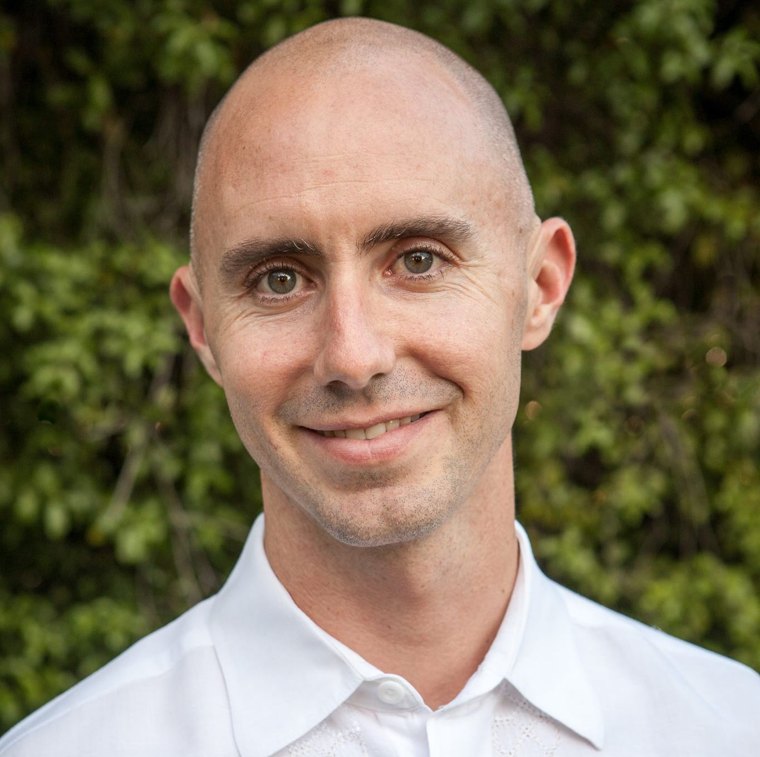
Sean Fargo is the founder of Mindfulness Exercises and the lead teacher of the Mindfulness Meditation Teacher Certification. A former Buddhist monk of more than two years, he is a trained instructor for Search Inside Yourself — the mindfulness program developed at Google — and has served as a mindfulness consultant for the U.S. Environmental Protection Agency, NOAA, two Olympic teams, the American Red Cross, Ernst & Young, and Kaiser Permanente. Since 2015, he and the team at Mindfulness Exercises have helped more than 2,000 people in over 30 countries get certified to teach, and shared free mindfulness practices with more than 20 million people.
If you're ready to move from practicing mindfulness to confidently teaching it, here's the path thousands have taken.
When you're ready to go further
Become a Certified Mindfulness Meditation Teacher
Everything in this guide — and far more — lives inside our internationally accredited certification. Since 2015, it has helped thousands of compassionate people teach mindfulness with confidence, in their own voice, in settings from healthcare and corporations to schools and private practice.
One certification, everything included
Lifetime access, optional weekly mentorship with Sean, monthly guest-teacher workshops, a supportive community, and a 30-day money-back guarantee. Payment plans available; current tuition is on the certification page.
- Accreditation & credentials
- Training in the 7 core mindfulness practices
- Mindfulness Teaching Fundamentals course
- Guiding-meditations course + 200+ scripts
- 300+ worksheets
- Weekly live mentorship & Q&A with Sean
- Monthly guest-teacher workshops
- Private community + lifetime access
- Fully customizable, brandable curriculum
- 10-week course with 500+ teaching slides
- Student workbooks & teacher guides
- 37.5 CE hours for licensed professionals (pay in full)
Included with enrollment
- Bonus: 15-Hour Trauma-Sensitivity Certification ($297 value) and a 1-Year MindfulPro Founding Membership ($468 value)
- Pay in full: a 1-hour session with Sean (1:1 coaching or team training), priority review of your submission, and 37.5 CE hours
- All four enrollment bonuses are included for three days from your first visit, and throughout every pricing window
- 30-day money-back guarantee · No annual renewal fees · Scholarships available
Payment plans available · need-based scholarships are available if cost is the barrier.
Not sure yet?
Book a free 15-minute call with our team — no pressure, no pitch.
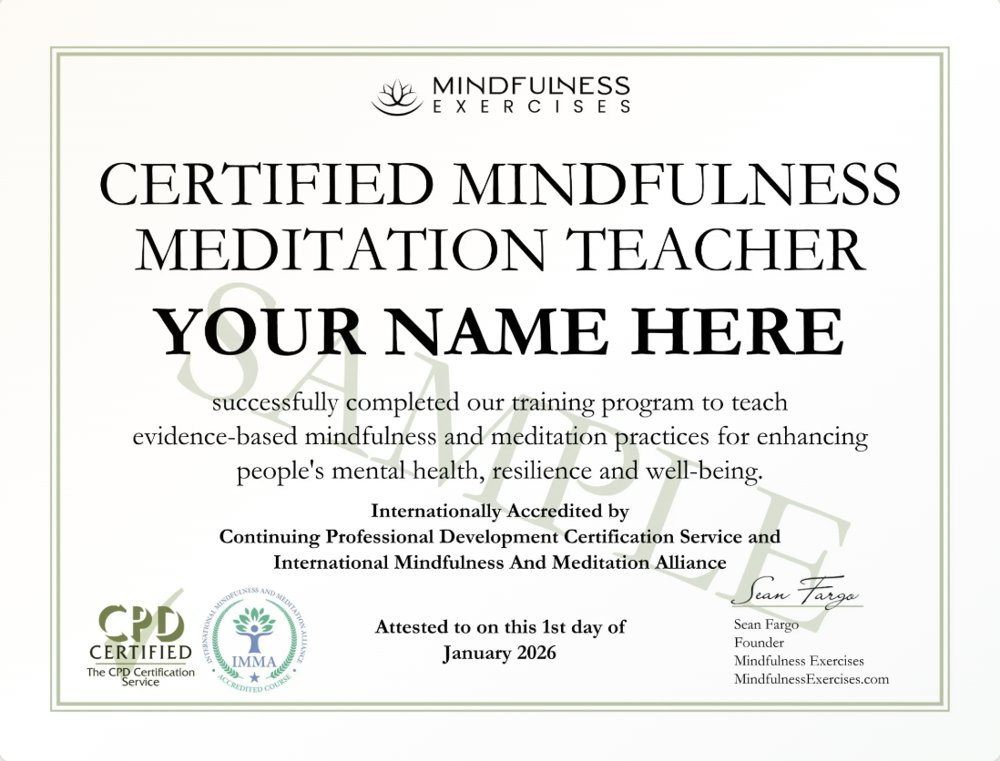
Accredited program: recognized by the CPD Certification Service (UK) and the International Mindfulness & Meditation Alliance (IMMA).
Lead teacher: Sean Fargo is individually certified by the International Mindfulness Teachers Association (IMTA).
Continuing education: sponsored by Mindful CECs, an APA-approved CE sponsor — 37.5 CE contact hours for licensed professionals (psychologists, MFTs, LCSWs, LPCCs, LEPs, nurses & more), included with pay-in-full enrollment. Acceptance varies by board.
Credential earned: graduates use the post-nominal CMMT — Certified Mindfulness Meditation Teacher.
Endorsed by leaders in mindfulness
From personal practice to professional impact
Yoga practitioner → corporate facilitator
Sarah meditated for ten years but felt like an imposter. Within four months of certifying, she was leading weekly mindfulness sessions at two corporate offices and a yoga studio.
Nurse → clinic program director
Burned out in healthcare, James launched a stress-reduction program that became a core part of patient care within six months.
School counselor → district wellness director
Priya wanted to bring mindfulness to students but lacked the credentials. She designed a district-wide student wellness program now adopted by twelve schools.
Start your teaching journey today
mindfulnessexercises.com/certification
Payment plans available · Scholarships available · 30-day money-back guarantee
Not sure yet? Book a free 15-minute clarifying call — no pressure, no pitch.
Whether or not you ever enroll, thank you for wanting to help others. The world needs more compassionate teachers — and that may well be you.
— Sean
A gift to get you started
Three complete practices to teach — or try
Reading a meditation aloud is the simplest way to begin. Here are three full, evidence-informed scripts you can read to others — or to yourself — today. Speak slowly, pause often, and let the silences do some of the teaching. Each “…” is an invitation to rest for a breath or two, and “(Long pause.)” means give it real, unhurried space.
Practice One · about 6 minutes
A Settling Breath
Let's begin by finding a comfortable position … sitting in a way that feels both relaxed and awake. … Let the feet rest on the floor, and the hands settle in the lap. … And if it feels okay, allow the eyes to gently close … or simply soften your gaze toward the floor. …
Take a slow breath in through the nose … and a long, easy breath out. … Once more — breathing in a little fuller than usual … and letting the exhale be slow. … And now letting the breath return to its own natural rhythm. … Nothing to control, nothing to fix. …
There is nowhere else you need to be right now … and nothing else you need to do. … Just this breath … and then the next one. …
Begin to notice the simple sensations of breathing. … Perhaps the cool air as it enters the nostrils … and the warmer air as it leaves. … Perhaps the gentle rise of the chest or the belly … and the soft falling away as you exhale. … Let your attention rest wherever the breath is easiest to feel. …
And at some point — maybe already — you'll notice the mind has wandered … off to a memory, a worry, a plan. … This is completely normal; it's what minds do. … The moment you realize you've drifted is the moment of mindfulness. … Just gently, kindly, escort your attention back to the next breath. …
Let's stay here together for a few more breaths … resting in the simple, steady rhythm that is always available to you. … (Long pause.) …
And now, gently widening your awareness to the room around you. … Noticing any sounds … the support of the chair … the light beyond your eyelids. … When you're ready, allowing the eyes to open … and carrying a little of this calm and steadiness with you into whatever comes next.
Practice Two · about 9 minutes
A Body Scan for Coming Home
Find a position where you can be comfortable and alert — sitting or lying down. … Let the body be heavy, supported by whatever is beneath you. … Allowing the eyes to close, if that feels right. …
Take two or three slow breaths … and with each exhale, let yourself arrive a little more fully — here, in this body, in this moment. … There's nothing to achieve in the next few minutes. … We're simply going to visit the body with curiosity and kindness. …
Begin by bringing your attention all the way down to the feet. … Notice whatever is there — warmth or coolness, contact with the floor, tingling, pressure, or perhaps very little at all. … There's no right thing to feel. We're just noticing. …
Now let your attention move slowly up into the lower legs … the shins and the calves … and the knees. … If you notice tension anywhere, you don't have to fix it. … See if you can simply breathe toward it, and let it be a little softer. …
Up into the thighs now … and the hips. … Bring your awareness into the belly … notice it rising and falling with the breath. … And into the lower back … and the long length of the spine. …
Now the chest … perhaps sensing the heartbeat, or the breath moving in and out. … And the shoulders — which so often carry more than we realize. … On your next exhale, let them drop, just a little. … Down the arms … the elbows … the forearms … all the way to the hands and the fingertips. …
Bring a gentle attention to the face. … Letting the jaw be loose … the lips soft … the space between the eyebrows smooth. … And now, for a few moments, sensing the body as a whole … one complete, breathing body … alive, present, here. … You are already home. … (Long pause.) …
When you're ready, deepen the breath a little … wiggle the fingers and the toes … and gently open the eyes, bringing this sense of presence and ease with you.
Practice Three · about 7 minutes
A Self-Compassion Practice
Settle into a comfortable position … and take a few slow, easy breaths. … Letting the body soften, and the eyes close, if that feels okay. …
Bring to mind something that's been weighing on you lately. … Not the very hardest thing — let's choose something mild to moderate. … Picture it for a moment: who's there, what's happening. … Now notice how it shows up in the body. … Maybe a tightness in the chest … a heaviness in the shoulders. … Just letting yourself feel it, as best you can, without pushing it away. …
We're going to offer ourselves three simple acknowledgements — the heart of self-compassion. … The first is mindfulness. … Quietly say to yourself: This is a moment of difficulty. … Naming it plainly, without drama, is its own small relief. …
The second is common humanity. … Difficulty is part of being human. … You are not alone in this. … In this very moment, countless other people are feeling something like what you feel. …
And the third is kindness. … If it feels comfortable, place a hand gently over your heart, and feel its warmth. … And offer yourself a few quiet wishes: … May I be kind to myself. … May I give myself what I need. … May I be as patient with myself as I would be with a good friend. …
Take one more slow breath. … And notice this: turning toward our own pain with kindness doesn't make us weak or self-indulgent — it's exactly what allows us to stay present, and to keep showing up for others. … (Long pause.) … When you're ready, let the hand rest, take a slightly deeper breath, and gently open the eyes.
Take it further
Want 200+ done-for-you scripts like these — plus slides, workbooks, and a fully brandable curriculum? They're all included in the certification. See what's included →
Common questions
Frequently asked questions
Do I need years of experience to teach mindfulness?
No. Teaching mindfulness is simple — not always easy, but simple. Anyone who brings sincerity, compassion, and a few solid tools can teach it. You don't need to be a master or calm all the time; you need to care, and to keep learning.
How do I get past imposter syndrome about teaching?
Meet the fear the same way you'd guide a practice: notice where it lives in the body, breathe with the sensation rather than the story, and remember that nearly every teacher you admire has felt it too. Among senior teachers, doubt about whether you're ready is usually a sign of humility and care — often a qualification, not a disqualification.
Do I need a certification to teach mindfulness?
You don't need one to start sharing simple practices. But two things meaningfully accelerate a teaching career: solid teaching templates (scripts, slides, session structures) and an accredited credential people trust. A good certification gives you both, plus mentorship and a community so you're not learning alone.
How do I lead a guided meditation if I've never done it?
Follow a simple sequence: welcome people in and let them settle, introduce the topic and intention, ground into the body, invite awareness of the main theme with non-judgment, segue into self-compassion, and close with a gentle next step. There are no rigid rules — as long as you invite gentle, moment-to-moment awareness, you can be creative. You can also read one of the three scripts above word-for-word to begin.
Is it safe to teach mindfulness to people who've experienced trauma?
Yes, when you stay trauma-sensitive — which is different from trauma-focused therapy. Set expectations kindly, offer choice rather than commands, anchor people in a safe sensation they can return to, keep practices within the window of tolerance, and normalize backing off. Your job isn't to dig into anyone's trauma, but to offer presence gently enough that people stay safe while they practice.
Keep practicing & teaching
Free resources to take with you
Everything here is free on MindfulnessExercises.com — no purchase needed. Bookmark these to keep deepening your own practice and growing your teaching. And you can always download this whole guide as a PDF.
Connect with fellow teachers and join live sessions.
A mindful quote, practice, and teaching tips — gently, by email.
230+ searchable, read-aloud scripts for every setting.
Printable PDFs to use with clients, students, and classes.
15 self-paced courses, 265+ lessons.
A free guide to guiding others with skill and care.
Sean’s free 1 hr 44 min training, with this guide viewable page by page.
Downloadable guides on practice and teaching.
Conversations and practices with leading teachers.
When you're ready
Ready to teach for real? Become a Certified Mindfulness Meditation Teacher — with everything in this guide and far more. Explore the certification →