📖 Free guide: How to Teach Mindfulness & Meditation

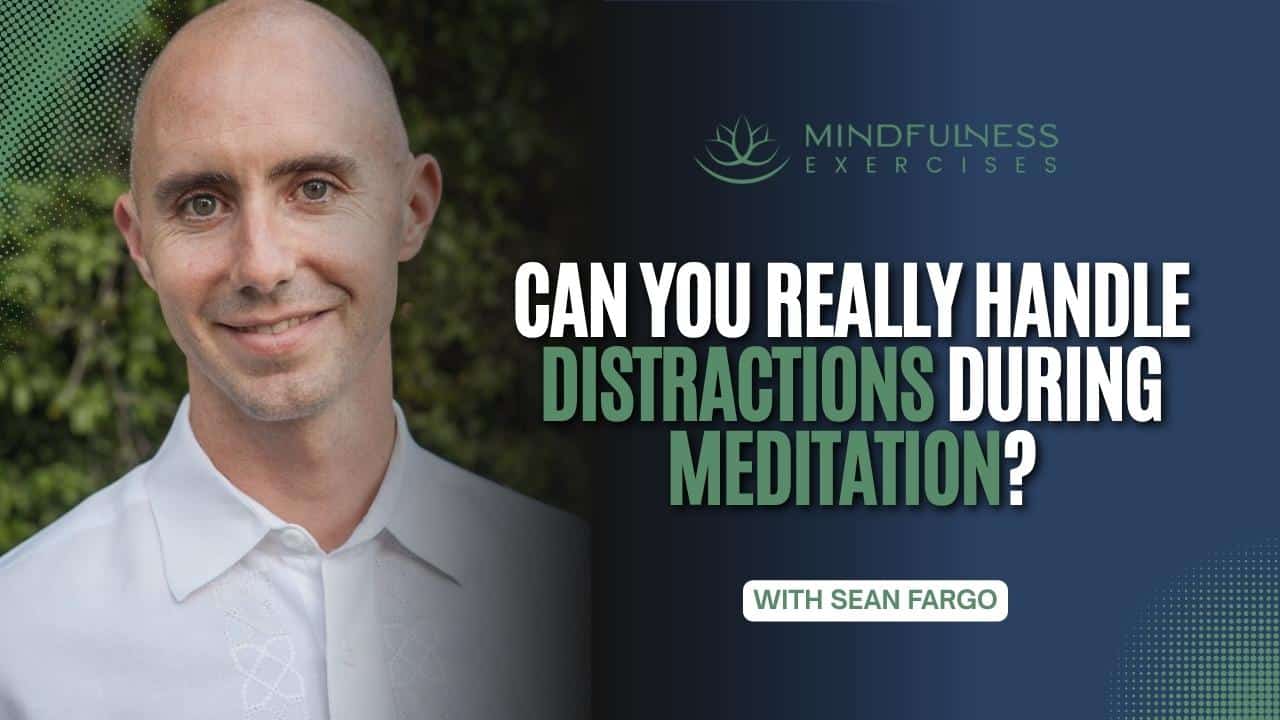
    Can You Really Handle Distractions During Meditation?

    SF
    Sean FargoPublished October 27, 2024 · Updated November 4, 2025 · 2 min read
    Can You Really Handle Distractions During Meditation?

    Loading episode player

    Can You Really Handle Distractions During Meditation? — Tunein Logo

    TuneIn

    Can You Really Handle Distractions During Meditation?

    In this practical and reassuring episode, Sean Fargo addresses one of the most common concerns among mindfulness practitioners: What do I do with distractions during meditation? Whether it’s physical discomfort, racing thoughts, or outside noise, distractions can feel like obstacles. But as Sean gently reminds us, these moments are not interruptions to the practice—they are the practice.

    Through stories and insights from years of teaching and personal experience, Sean offers encouragement to meet whatever arises with presence and compassion. This episode will shift your perspective on distraction and help you build resilience for both meditation and daily life.

    Sponsored by our Mindfulness Meditation Teacher Certification Program MindfulnessExercises.com/Certify

    What You’ll Learn in This Episode:

    • Why distractions are not failures—but opportunities for practice
    • How to respond to discomfort and restlessness with kindness
    • Simple techniques for working skillfully with distractions
    • The surprising value of practicing through chaos
    • How to build trust in your ability to stay with the practice

    Show Notes:

    Why distractions are not failures—but opportunities for practice

    Many people think they’re “doing it wrong” when distractions show up during meditation. But Sean reframes this common belief by showing how these moments are natural, expected, and even necessary. Meditation isn’t about eliminating thoughts or sensations—it’s about how we relate to them. Every time you notice a distraction and gently return to your anchor, you’re strengthening the muscle of mindfulness.

    How to respond to discomfort and restlessness with kindness

    Physical sensations like itches, tension, or restlessness can feel like interruptions. But instead of resisting them, Sean encourages us to turn toward these experiences with gentle curiosity. Can we feel what we feel without needing to change it? This shift can be profoundly liberating. By learning to sit with discomfort during meditation, we develop the capacity to sit with life’s challenges more gracefully.

    Simple techniques for working skillfully with distractions

    Sean offers practical strategies for how to handle distractions when they arise. Whether it’s using your breath as an anchor, labeling thoughts gently, or noting body sensations, these tools help you stay present without judgment. Even a few seconds of awareness amid distraction is meaningful—it’s not about perfect focus, but consistent, compassionate redirection.

    The surprising value of practicing through chaos

    While quiet settings are supportive, Sean reminds us that noisy, distracting environments can be powerful teachers. Meditation in less-than-ideal conditions helps us strengthen focus, patience, and adaptability. In this way, life itself becomes our meditation cushion, and the unpredictable nature of the world becomes part of our training in mindfulness.

    How to build trust in your ability to stay with the practice

    Over time, as you continue practicing—even in the face of distractions—you begin to trust your own ability to return. This trust isn’t based on achieving a specific state; it’s rooted in your willingness to begin again, no matter how many times your mind wanders. That trust becomes a quiet source of strength both on and off the cushion.

    Additional Resources:

    Transcript

    Show transcript· 4 min read

    Speaker 1 · 0:00How do we teach mindfulness and meditation to people whose hearts are feeling closed, or if the energy in the room is feeling a little bit dark or down? How do we help people to be present in the midst of these energies? How can we be impactful in a way that's caring but also effective? A lot of new mindfulness and meditation teachers have this challenge. How to meet these energies of closed hearts and down energies, especially in our world today, where there's a lot of things going on in a world that can lead to stress and overwhelm, depression, trauma, addiction. How do we meet these energies in a way that's going to be helpful? I've been helping thousands of new mindfulness and meditation teachers face this challenge through our mindfulness teacher certification program. I a former Buddhist monk of two years. I'm a mindfulness teacher for the program born at Google, and I've been working with a lot of therapists, counselors, yoga teachers, coaches around the world for the last 10 years. And this question is coming up more and more. In fact, I want to show you a video of an interaction that I had with someone last week. Um, someone who wants to teach mindfulness and meditation, but um had this concern that I'm talking about now. And um I want to share this video with you to help you to be able to teach meditation and mindfulness in a way that's not going to be resistant to what people bring, um, to not be judgmental of however people are feeling, but rather to embrace the energies that they're bringing and to help them to navigate those energies in a way that's going to be sensitive to the possibility of trauma and to the sensitivity of however they're feeling in that moment, uh, so that we're not harsh or pushing our agenda. Um, so I hope that you get a lot of value from this video that I want to play for you. Um, I'd love to hear what you think and how you navigate these challenges of um helping people be present in the midst of their pain and suffering. So um be honored to support you on your path in the future. If you'd like some uh further support or training or certifications, we have links uh down below. And I hope you like this video. Thank you.

    Speaker 2 · 2:49Have you ever been in a room with a group that you've really felt the energy of a closed heart where you had to pivot what you were doing to address that energy in the room?

    Speaker 1 · 3:01All the time. The pivot is not one of resistance, but rather compassion. We're also busy, we're trying to do our best in a busy world. Most people are living with a lot of fear to different degrees. Like most of our hearts are at least partially closed, a little bit. Most of us are not completely free of judgment. At the end of a meditation session or a mindfulness workshop or a wonderful, you know, mindful gathering, hearts are more open than they were, usually. But you know, in a space of five plus people, someone's heart's going to be quite closed, usually, if not most people's in the beginning. May not be filled with hate or rage, but may not be fully open either. And there's for me kind of a bias towards self-compassion, which for me, there's kind of this underlying assumption that most people are suffering in some way during the practice. And so that's why I bring out you know self-compassion practice. It's becoming more and more clear to me, too, that over the last few years I myself was maybe suffering a little bit more than I thought. And I was kind of meeting myself with self-compassion during the practice, during the guidance. Um, and now I feel like I'm sort of in a place in my life where I'm saying suffering less. And so now there's a bit more of a lightness and a joy and uh ease. And so it'll be interesting to see how that influences our guided meditations here and elsewhere, um, in terms of um cultivating other heart qualities or meeting a moment with gratitude, forgiveness, joy, love, etc. Yeah, maybe this is a long-winded way of saying that, yeah, most a lot of hearts are closed during practice to different degrees. And so, as guides, as teachers, you know, may we meet that with compassion, not to like force it to be different, but to honor the closed heart because it's it's usually a way of coping. They meet that with presence, with say curiosity as to what a closed heart feels like to allow it to be closed and just kind of stay with it, like a like a really good friend. It's okay. And I'll just kind of sit with you for a while, closed heart, a very gentle tenderness. And usually that's a recipe for healing, maybe always a recipe for healing.

    Share

    Continue reading

    • Grounding Through Anxiety With Senses

      Grounding Through Anxiety With Senses

      Read
    • Shamatha Vipassana Explained For Modern Minds

      Shamatha Vipassana Explained For Modern Minds

      Read
    • How To Stop Believing You Are Not Enough

      How To Stop Believing You Are Not Enough

      Read

    Professional training

    Accredited mindfulness teacher certification

    Trusted by teachers in 100+ countries

    Structured training, CE credits for eligible pay-in-full registrants, and support for teaching without self-doubt — after you have explored this episode.