There’s a quiet story many of us carry beneath the surface of our lives:
I’m not good enough.
I’m behind.
I’m too much.
I’m not enough.
Sometimes it sounds loud and relentless. Other times it whispers softly in the background, shaping our relationships, our work, our choices, and the way we see ourselves.
It can show up when we scroll through social media and compare our lives to everyone else’s highlight reel. It can emerge after a difficult conversation, a mistake at work, or a season of emotional exhaustion. It often appears in moments when we’re trying hardest to prove our worth.
And over time, if left unquestioned, that inner narrative can start to feel like truth.
But what if the loudest voice in your head isn’t actually telling the truth?
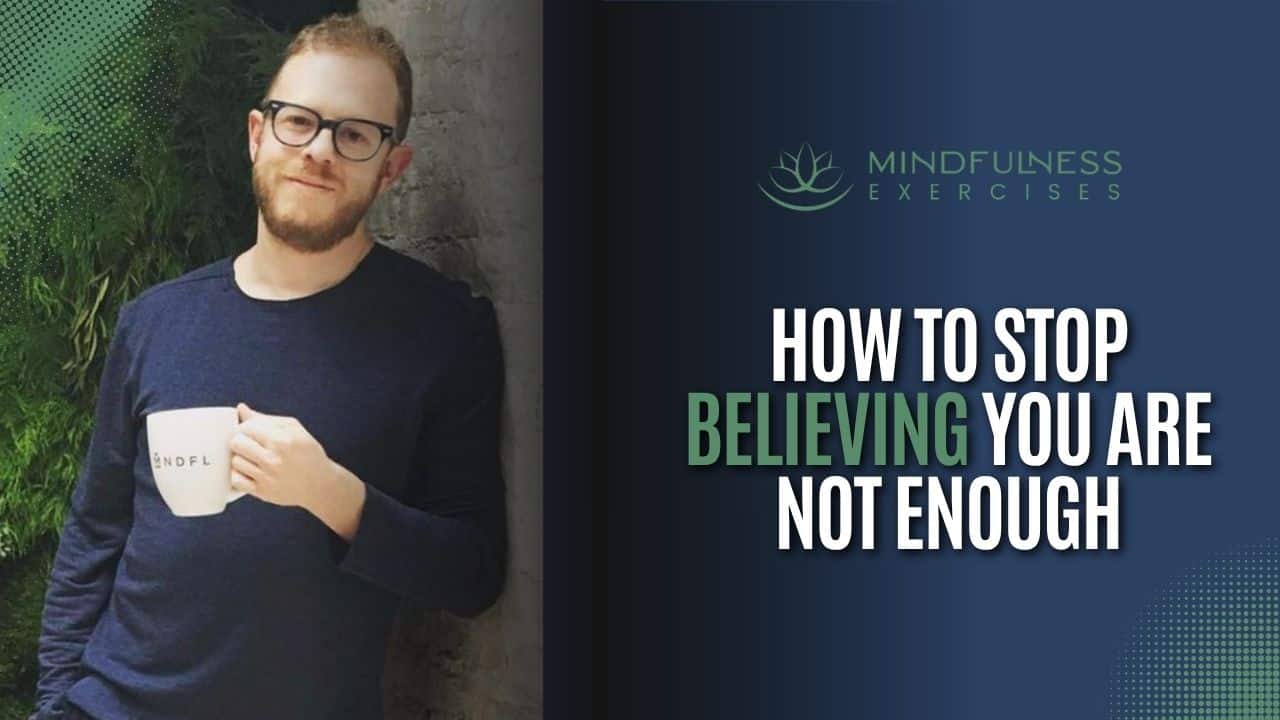
In a thoughtful conversation with Buddhist teacher and author Lodro Rinzler, we explore a radically compassionate idea: that beneath our anxiety, shame, fear, and self-judgment, there is something fundamentally whole within us.
In Buddhist teachings, this is sometimes called basic goodness.
Not perfection.
Not constant positivity.
Not pretending life is easy.
But a grounded recognition that, underneath the layers of conditioning and self-protection, there is nothing inherently wrong with you.
This conversation offers practical mindfulness tools for breaking free from “not enoughness,” softening harsh self-beliefs, and reconnecting with the present moment in a more honest and compassionate way.
Sponsored by our Mindfulness Meditation Teacher Certification Program
certify.mindfulnessexercises.com
Episode Overview:
In This Episode, We Explore:
- Why the inner critic often feels believable
- The Buddhist concept of “basic goodness”
- How shame shapes identity and behavior
- Why thoughts are not facts
- Mindfulness techniques for observing self-judgment
- The connection between acceptance and emotional resilience
- How Acceptance and Commitment Therapy supports mindfulness
- Why consumer culture profits from insecurity
- The role of meditation retreats in self-awareness
- Practical ways to reconnect with the present moment
- How to loosen identity labels like “I’m an anxious person”
- Building self-worth through awareness rather than achievement
Key Takeaways
1. Your thoughts are not your identity.
Mindfulness helps create distance between awareness and mental narratives.
2. Shame thrives in isolation.
Compassion and presence help reconnect us with ourselves and others.
3. Acceptance is active, not passive.
Seeing reality clearly allows for more grounded action.
4. Consumer culture often amplifies insecurity.
Mindfulness helps reveal the unconscious conditioning shaping self-worth.
5. Basic goodness already exists within you.
You do not need to earn your humanity.
Show Notes:
The Hidden Cost of “Not Enoughness”
Many people live with a low-grade sense of inadequacy without even realizing it.
We become achievement-driven, perfectionistic, overly self-critical, or emotionally avoidant because somewhere deep down, we believe we need to earn our worthiness.
The painful part is that these patterns are often socially rewarded.
Overworking is praised.
Constant productivity is admired.
Self-sacrifice is normalized.
Busyness becomes a badge of honor.
Yet internally, many people feel disconnected, anxious, and emotionally exhausted.
The belief that we are not enough doesn’t just affect self-esteem—it affects intimacy, creativity, resilience, and joy.
When shame takes over, we begin constructing identities around our pain:
- “I’m an anxious person.”
- “I’m bad at relationships.”
- “I always fail.”
- “I’m broken.”
- “I’ll never change.”
Over time, these labels harden into what Lodro describes as a kind of cocoon—a protective story we wrap around ourselves that simultaneously keeps us safe and keeps us stuck.
The problem is not that thoughts arise. The human mind naturally generates stories, judgments, fears, and interpretations all day long.
The problem begins when we mistake those thoughts for our identity.
Thoughts Are Not Facts
One of the most powerful mindfulness practices is surprisingly simple:
Learning to see thoughts as thoughts.
Not commands.
Not permanent truths.
Not accurate reflections of reality.
Just mental events passing through awareness.
This shift may sound small, but it can fundamentally change how we relate to suffering.
Instead of becoming fused with every fearful thought, mindfulness teaches us to observe the mind with curiosity.
You might notice:
- “Ah, self-criticism is here.”
- “Comparison is showing up.”
- “Fear is present right now.”
- “My mind is telling the old story again.”
That subtle change in perspective creates space.
And in that space, freedom becomes possible.
Why Shame Thrives in Disconnection
Shame grows strongest when we feel isolated from ourselves and others.
When we believe we must hide our imperfections to be loved, we stop showing up authentically. We become guarded. Defensive. Emotionally distant.
Ironically, the more we try to protect ourselves from rejection, the more disconnected we often feel.
Mindfulness interrupts this cycle by helping us return to direct experience rather than staying trapped inside mental narratives.
Instead of endlessly replaying stories about who we are, we begin reconnecting with what is actually happening right now:
- The feeling of breath moving through the body
- The sensation of feet touching the ground
- The emotions rising and falling moment to moment
- The sounds, colors, and textures of ordinary life
This grounded awareness gently loosens the grip of shame because we stop living entirely inside conceptual identity.
We begin inhabiting our lives again.
Acceptance Is Not Giving Up
One of the most misunderstood ideas in mindfulness practice is acceptance.
People often assume acceptance means passivity:
“If I accept this anxiety, won’t I stay stuck?”
“If I accept myself, won’t I lose motivation?”
“If I stop fighting my emotions, won’t they take over?”
But true acceptance is not resignation.
Acceptance simply means acknowledging reality clearly before deciding how to respond.
This perspective closely aligns with principles found in Acceptance and Commitment Therapy (ACT), which teaches that resisting painful emotions often intensifies suffering.
When we constantly battle our internal experience, we become exhausted.
But when we pause long enough to honestly acknowledge what’s here, something shifts.
We gain clarity.
And clarity allows for wiser action.
Acceptance says:
- “This is what I’m feeling right now.”
- “This is the situation I’m in.”
- “This is hard.”
- “I don’t have to pretend otherwise.”
From there, we can move forward more skillfully—not from panic or self-hatred, but from awareness.
The Practice of Returning to the Present Moment
Most of us spend a tremendous amount of time mentally living somewhere else:
Replaying the past.
Anticipating the future.
Imagining worst-case scenarios.
Comparing ourselves to others.
Mindfulness gently trains the nervous system to return to the immediacy of the present moment.
Not because the present is always comfortable, but because it is the only place where life is actually unfolding.
A simple mindfulness practice can begin with just a few minutes:
A Simple Grounding Practice
- Sit comfortably and allow your body to soften.
- Bring attention to your breathing without trying to change it.
- Notice the rise and fall of the breath.
- When thoughts arise, gently acknowledge them.
- Return attention to the breath or bodily sensations.
- Repeat with patience rather than force.
The goal is not to stop thinking.
The goal is to stop being unconsciously carried away by every thought.
Each time you return to the present moment, you strengthen awareness, compassion, and emotional resilience.
Consumer Culture and the Business of Insecurity
Modern culture often reinforces the belief that we are incomplete.
Advertising subtly teaches us that happiness, beauty, confidence, success, and belonging are always one purchase away.
You need a better body.
A better career.
A better routine.
A better personality.
A better life.
Insecurity becomes profitable.
This constant pressure keeps people trapped in cycles of striving and self-comparison, always chasing a future version of themselves that finally feels worthy.
Mindfulness practice offers a radical interruption to this conditioning.
When we slow down and become more aware, we start recognizing the water we’ve been swimming in all along.
We begin asking deeper questions:
- Who would I be without constant comparison?
- What if my worth isn’t something to earn?
- What if enoughness isn’t a future achievement?
- What if I’m already fundamentally whole beneath the noise?
These questions can feel both uncomfortable and liberating.
Because they challenge the entire framework many of us have built our lives around.
Meditation Retreats and Seeing More Clearly
Lodro also speaks about the transformative power of deeper meditation practice and retreats.
In everyday life, we are constantly stimulated—notifications, conversations, responsibilities, media, deadlines, advertisements, and endless streams of information.
Silence can feel unfamiliar.
Stillness can feel uncomfortable.
But stepping away from constant distraction allows us to see our minds more clearly.
Meditation retreats are not about escaping reality. They are about reconnecting with it more honestly.
Without the usual noise, we begin noticing:
- habitual thought patterns
- emotional avoidance
- unconscious fears
- moments of tenderness and compassion
- the simplicity of being present
Many people discover that beneath all the mental activity, there is a steadier awareness available to them—one that is less reactive, less judgmental, and more deeply connected to life.
You Do Not Have To Believe Every Story Your Mind Tells You
Perhaps one of the most healing realizations in mindfulness practice is this:
Thoughts are experiences—not identities.
You can experience self-doubt without becoming self-doubt.
You can experience fear without becoming fear.
You can experience shame without being shameful.
This creates room for a gentler relationship with yourself.
Not because life suddenly becomes easy, but because you stop turning every difficult moment into evidence that something is fundamentally wrong with you.
Over time, mindfulness helps cultivate:
- emotional flexibility
- self-awareness
- compassion
- resilience
- courage
- presence
- inner steadiness
And slowly, the belief “I am not enough” begins losing its authority.
Reflection Questions
- What stories about yourself do you repeat most often?
- When did you first begin believing you were “not enough”?
- How would your life change if you stopped treating every thought as truth?
- What helps you reconnect with the present moment?
- Where might greater self-compassion be needed in your life right now?
Final Thoughts
Healing the belief that you are not enough is not about becoming a different person.
It’s about learning to relate differently to your thoughts, your emotions, and yourself.
Mindfulness does not erase pain, uncertainty, or struggle. But it changes the way we hold them.
And sometimes, that shift changes everything.
Underneath the noise of self-judgment and fear, there may be something quieter waiting for your attention:
A simple recognition that your worth was never missing in the first place.
Additional Resources:
- Free Training with Sean Fargo: How to Teach Mindfulness With Confidence & Credibility
- Certification: Mindfulness Meditation Teacher Certification Program
- Blog: Learning the Secret Language of Your Body – with Inna Segal
- Blog: Your Mindfulness Update: New Community Connections & Masterclass Wisdom