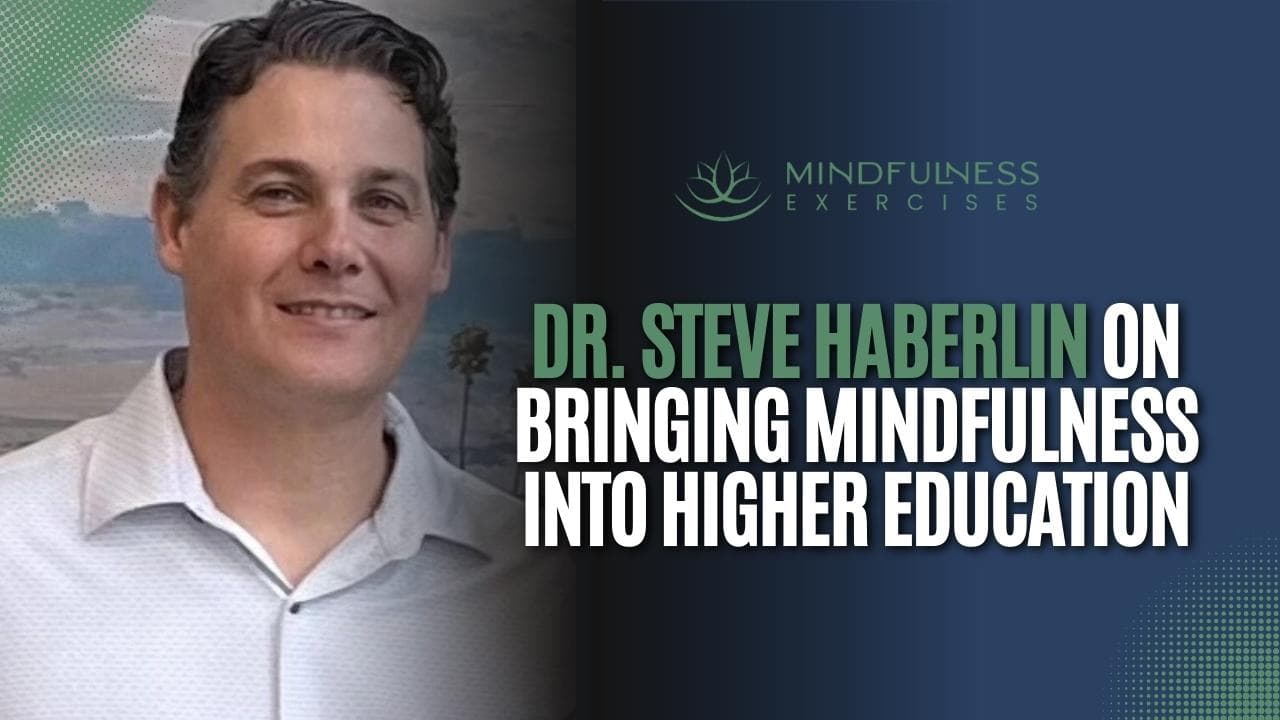
Speaker 1 · 0:03Welcome everyone to the Mindfulness Exercises Podcast. My name is Sean Fargo. Today I have the honor of speaking with Steve Haberlin. He is an assistant professor in the Department of Learning Sciences and Educational Research at the University of Central Florida, where he studies the impact and experiences of meditation, mindfulness, and other mind-body practices with higher education students. He's the author of Meditation in the College Classroom, a pedagogical tool to help students de-stress, focus, and connect. He's also the author of Calming Student Stress, Mindfulness, Meditation, and Other Strategies to Reduce Anxiety, and the author of Enhanced Learning in K-12 Classrooms. Dr. Haberlin has published research in a number of peer-reviewed academic journals, including the Journal of American College Health and the International Journal of Doctoral Studies. He serves as an editor for the Journal of Contemplative and Holistic Education and co-program chair for the American Educational Research Association's Holistic Education Special Interest Group. He also works as a consultant for Meditation App Development. Dr. Haberlin has personally practiced meditation for 29 years. And I'm really looking forward to discussing with you, Steve, about mindfulness and meditation in universities and colleges, and how it can impact college students' stress and mental health in this time of this mental health crisis. So, Steve, welcome to the podcast.
Speaker 2 · 1:57Great to be here, Sean. Thank you.
Speaker 1 · 1:58Yeah, thank you for coming. You know, we have a lot of people in our community who are parents of college students. Maybe some of us are in college right now. A lot of our community are educators in different levels of academia. So I'm really looking forward to exploring this topic. And I just can't imagine being a college student today with cell phones and pandemics and you know everything that's going on in the world. So I really appreciate Yeah, yeah. It's a whole nother ballgame, it seems like. So I really appreciate what you're doing for these, you know, emerging adults. But Steve, I'd love to explore a little bit about your background with mindfulness and meditation and what got you interested in in these practices.
Speaker 2 · 2:51So, Sean, my meditation journey, I guess, would begin about maybe about 12 years old. So when I was 12 years old, it was a big karate phenomenon. The karate kid had come out and Ninja Turtles and you know, karate and martial arts was all the age. So I signed up at the local dojo, like most of my friends, and we had a sensei there, or the teacher would come up and he told us to meditate. He said, sit, well, actually, we kneel, kneel down, facing the wall, and block everything out. That was the meditation instruction. Just block all your distraction, all your noise out. The problem is when I tell the story, the problem is next door was an aerobics studio back then. Aerobics was also all the rage. So the you know, music from Gloria Stefan and all the eight years was like blaring, was like shaking the wall, and I'm sitting there trying to everything out.
Speaker 1 · 3:36Yeah.
Speaker 2 · 3:38And so you're trying to block everything out. And I said, I I couldn't do it. I I was more interested in the physical aspect of the martial arts, and I said, This is but this is interesting, you know, it caught my attention. I wondered what that was. And I read a lot of books about uh Zen Buddhism, and I was interested in things like the samurai, you know, all connected to martial arts. And so I was always interested as a teenage meditation, but I wouldn't say I did it formally until about undergrad age in my early 20s. I was like a lot of these, I think, students today, stressed out and overwhelmed. But I didn't have, like you said, Sean, I didn't have a cell phone, we didn't have social media, but we had just the common adulting type things that they would call, like, you know, I've got to get a good job. What am I gonna be able to afford a home? Should I get married? I had like those kind of questions circling through my head. And I felt pretty overwhelmed and stressed. So I heard on a recording, it was Deepak Chopra was talking about something called transcendental meditation. And I said, What is what is that? I opened the phone book up and sure enough, there was a transcendental meditation school. I was in Providence, Rhode Island. So on the east side of Providence, there was a school which was a big old house, and you go there and you learn over four days. It's a four-day program, and they teach you a mantra, a sound, and then they teach you how to properly use it and what your experiences would be. And that was my introduction. I was hooked on meditation. I felt my my, you know, it's like an advertisement, but my stress went down. I felt clearer. People said I was calmer. I just like something changed. I felt a physiological change. And so I just kept with it. And then, you know, 15, 20 years of it, and then I got interested in mindfulness, became very popular. I started saying, What is mindfulness meditation? I learned Zen meditation. I looked into uh like Tibetan Buddhist traditions. I just wanted to expand my meditation repertoire personally. So that's that was my journey. It all started with karate school at 12 years old.
Speaker 1 · 5:30So did you sense a chop up pizzas with the sword?
Speaker 2 · 5:33No, he did. That that mencha turles was big too, but uh no, he didn't do that. He did wear the band. I'm not making this up. He wore the the band dinner every day, you know, like uh Johnny and Cobra Kai or the karate kid, you know, Ralph Machi was that maybe the rising sun. He did wear that every class or every day, so that was that was true.
Speaker 1 · 5:51Yeah, I think the karate kid inspired me too. Yeah, like all the Mr. Miyagi uh wisdom that he shares like, ooh, like where can I get some of that? You know, right. And I love how you kind of connected the dots and actually pursued that type of wisdom and the practices that you know sensei Miyagi probably did. That's great. And so over time, like it sounds like a TM was you know one of your first you know practices, and you did a little bit of Zen, you know, before we started our our you know formal interview today, you mentioned you know, interest in some Taoist practices that I had done in my past. Yeah, and and so I'm curious how your personal practice has evolved over the years, or maybe some key takeaways or key practices that you found super helpful for you in your personal life.
Speaker 2 · 6:48Yeah, it really that's a good question. So it really has evolved my practice. So I would do a mantra meditation and then I started learning breath meditation. But I think my conception, like my understanding of what meditation could be, really expanded. So including things like physical practices and combining meditation, you know, doing heart coherence type meditation where you're using the breath, but you're also bringing in positive emotion. So you have and then physical practice. The reason I asked about the Taoists is because I started training or learning from a guy, I'm not sure if you're familiar with him, Dr. Barry Morgillin. He's he has a program called Energy for Success, and he had trained under a grandmaster in China and brought back this discipline, which is kind of predates Daowa, predates like Tai Chi and Qigang and a lot of it is physical practices where you're using the breath and you're also moving, and a lot of it is based on you know expanding the energy. The Chinese will call it qi, we just call it energy, but you know, and using the breath more, breathing into the body, using the breath, using movement. So more, I think it's evolved in the sense of my practice today, it's much more holistic than it was years ago, where I would just sit there and it was like very much in my head. Now it's now it's very much in my life. Like in between, you know, right before this call, I'm doing some of these practices so that I can be more in a flow and more focused and relax, you know. So, and then I'm doing them before I teach class and I'm working breathwork when I first get up. So I think it's it's just become more of a part of my daily routine and just my whole approach to life rather than oh, I'm gonna sit there now for 15 minutes and I'm gonna, you know, and then the rest of my day goes on and I never think of meditation. So, like your whole life, it's kind of sounds cliche, but your whole life becomes a practice, I think, as you get deeper.
Speaker 1 · 8:31Is that yeah, yeah, that's really well said. Yeah, it's kind of like a great like sound bite, though. Like it's not, you know, before I was just in my head, you know, now like it's in my whole life. Yeah, it feels much more integrated that way. And I think that's one of the things that a lot of us find through mindfulness practices that in the beginning it can seem a little heady, like you know, focus on say you're breathing at the nostrils or focus on something and and maybe we visualize something, but really the intention is to bring this embodied awareness to everything, you know, all the time. And you know, the Buddha said that there's only one thing you you can do here with all these practices that I teach, only one thing you can do 24-7, and that's mindfulness, you know, this gentle awareness of our experience. So it really is meant to be fully integrated. And I love how it sounds like you're you don't have a like one practice that you only do. It sounds like you're open to anything that works. It sounds like in incorporating these different practices from ancient wisdom traditions as well as things that have kind of been more popular lately. You know, we you and I talked about muse headbands and you know, even using AI to support us. So I'm looking forward to to learning about some of your research and and practice with with those things too. But I'd like to segue first into like how you got involved in bringing mindfulness to academia and what your interests are in bringing mindfulness to students and teachers and what you're seeing these days with that.
Speaker 2 · 10:15Sure. So it started with in graduate school, but it was during my master's degree work that I did a pilot study with a professor where we looked at using mindfulness meditation. They did some yoga, and it was with elementary students that I was teaching at the time. So it started there, and we did a pilot with elementary students to see how it would help them with their stress and their focus. And it was a very small, I don't think it was a like a well-constructed study, but it was a start. And then in my dissertation, when I went for my doctoral degree at University of South Florida, my dissertation involved mindfulness. As I was working with student teachers, I was I was coaching student teachers or what they say, supervising them to go into the classroom, and I was incorporating mindfulness techniques into that practice to see how that would help me prepare the teachers. So then that continued. But I think I really found my research agenda, my focus, my calling, if you will, was I went my first academia job was at a private college in Georgia, and I taught a lot of undergrad classes, and they would come in and they were very, very stressed out. They were just, you know, overwhelmed. They looked at like very tense in their face, and they come on and they're on their cell phone, they're very distracted. And I immediately realized I needed to do something before I started class. I had to kind of create like a segue, right? Or a space for them to maybe decompress, to center. I need to do something. So I just drew on my background. My background was, hey, I've been meditating for a couple of decades, you know, at least 20 years at that point. I said, let me let me try some meditation, some techniques and mindfulness to see how that works with them. So I took out, I have it behind me, but I took, you know, like a singing bowl or you know, one of the little meditation bowls, and I and I just rang it. You know, they would come to class and I rang it and I told them to just listen. I said, just stop and listen, you know, like you listen to nature or something. Like just stop, just stop everything. Put your cell phone down and just just listen. I invited them. I'm inviting you to just listen. And and they looked at me really weird. It didn't go over, like, you know, this was very non-traditional. So they looked at me like, oh, it's with the skies, a little bit, you know, a kooky professor. But I stuck with it. Then I would come in and ring the ring the bowl and then Sean, what I would do is tell them, pay attention to your breath. Like just bring awareness to your breath. You know, don't try to do anything, don't try to manipulate it, but just be aware of the breath going in and out. So then I would do that for a couple of minutes, and then that seemed to help some of them, and then they would just seem a little bit more settled when we started class, and they just evolved. And I would try maybe a love and kindness meditation, or we would go outside, do a walking meditation through the quad. So it evolved like that. But what kind of happened organically was other faculty saw what I was doing, and I was starting to collect data. I was starting to interview them and collect data on their experiences, the students that is so the faculty said, Hey, I want to try that. So probably about six, seven other faculty started doing it in their classes, and they also collected data. And then we would compare notes. We would say, What are they experiencing? You know, what's working, what's not working? That formed the basis of my first book, was kind of like a field guide of like, okay, I want to put meditation in my classroom on a simple mindfulness exercise. Where do I begin? What do I say? What do I do if they resist? If they don't want to do it, what do I do? You know, what's plan B? So that became the book. And then that continued to expand where I said, okay, I started to realize undergrads everywhere have a lot of mental health challenges. They have higher rates of stress these days, high rates of depression, higher rates of anxiety. I said, these are tools. And I started realizing other people were doing, you know, mindfulness interventions with undergrad undergraduates. So then I expanded. And then when I got to the University of Central Florida, I really pushed to continue to do the same kind of research of students in the classroom, but also mental health outcomes, like let's measure their stress level, let's measure their anxiety, let's measure their well-beings, you know, these kind of statistical outcomes, as well as their experiences, meaning how do they perceive these practices, what are the potential barriers that they see coming. So I just really continue to expand and trying different things, love and kindness, like you had mentioned, so we brought in the Muse. So trying what we would call digital mindfulness, where they would wear a neurofeedback headband, and that would guide them through a meditation with an app, and then we would collect data on that and see how that's working. I have grants in for virtual reality. We haven't got that equipment yet, but I wanted to test um some of the virtual reality meditations with them. So just really, you know, expanding and just saying, how can we use these ancient tools, these ancient traditions in a way, in a way in the current context that helps these students not just not just de-stress, but I want them to awaken their potential. I tell these young people, I say, you have incredible energy, you have credible awareness, you have incredible potential. You might have not been told that, right? You may have not, the culture might have not nurtured that, but you have that. And let me show you some tools that if you consistently do them over time, like I found in my own life, then that will, you will grow. You will you will start to tap some of that hidden, you know, that inner potential. Like Miyagi, back to Mr. Like Mr. Miyagi told Daniels, son, right? But I mean, really, I really do. I mean, the science shows it. The science shows that these kind of practices tap parts of the brain and parts of the nervous system and the physiology that are maybe lying dormant, you know, that we're just not we're not using to the extent or capacity that we could use them. So I want these young people to feel empowered.
Speaker 1 · 15:54Beautiful. Well, Steve, so I love that you gather data as a part of this, and I think that data collecting goes a long way in academia and also in organizations and most secular situations, you know, the powers that be are gonna want to see data that like there's some benefit here, and that it's not just you know, some rogue teacher talking about, you know, stillness. It's it's you know, like what are the benefits here? Are this what what are the say more objective or quantitative based data? And then what are what's the qualitative, like experiential, subjective, perceptual data? Like, and you know, is this worth investing five minutes at the beginning of every class to do? And how does the data even align with our mission, with whatever our mission is? So I'm curious if you'd be able to share, say, just a couple bullet points on like some of the data that you've found either in that first iteration or since then, like what was maybe surprising? Did it impact grades? Um, is there a sweet spot in terms of how much you know time you meditate in the beginning of a class? Anything that you can kind of share that might be helpful for our audience?
Speaker 2 · 17:15Sure. So my graduate assistant, she's she's graduated and moved on, but we we went through probably, you know, 60 studies or so looking at the my what we would call mindfulness-based interventions with undergraduates. And the conclusion, what we found was it was definitely effective in reducing stress. What we would call, we they measure what we call perceived stress. So the outcome of stress went down or improved, anxiety was reduced, depression was generally reduced. So as far as the mental health benefits, mindfulness interventions in college, you know, college-based seem pretty effective. They they have they have a positive outcome on students' mental health. That's not just my review, but if you look at other systematic reviews, mindfulness has been found to be maybe the most potent intervention in higher ed. It's a it's definitely uh in the top one or two. But as far as academics, it's a little shakier. It's hot what we found in our review is it was hard to say that it improved grades or quiz scores or tests. In some studies it did, and then in some studies they couldn't replicate it and it didn't. So it was a little bit more on, you know, not as less conclusive as far as like, does it improve academics? And I think additional research has to be done there. There hasn't, and there hasn't been as much research focused on the academics as the mental health, and it's probably just because of you know, mental health rates, you know, kind of skyrocketing from pre, you know, the pandemic times. So more work needs to be done on the academic side. As far as qualitative, students do report a lot of the same experiences as the mental health outcomes. So they'll say things like, I feel calmer, I feel more relaxed. And this is whether they do it in like a classroom setting, or maybe they do it like at a workshop, you know, a workshop as part of the college wellness center. They'll generally report very positive experiences for the most part, you know, calmer, less anxiety, I feel more focused, I feel more centered. There is only a small percent that would have what we would call adverse effect. I mean, that can happen. There are some where it almost backfires, or it doesn't seem to work for them, but it's a small, I don't have the exact number in front of me, but it's a small, smaller percentage. Uh what we what we do find in that literature, though, the qualitative, is they do describe a lot of barriers, what we call barriers to practice. So the number one is they'll say things like lack of time. College students will say, I don't have time to do mindfulness, I don't have time to sit there and meditate. They will also not perceive the value of it. So they'll see it. One study that I'm on the third year of following some of the same students at the small college. And they're, as far as at least last year, what they told me was they did not have time to sit there. They have homework, they have friends, they have work, right? They're like, I don't have time for this stuff. So they what we the way we interpret that is they don't see the value in it. Because someone could make the same argument, say, I don't have time, I don't know, to go to the gym, I don't have time, you know, to go for a run or something. You can make that argument for almost anything that's beneficial to you. So they don't see the value in mindfulness meditation. They understand it in a way where it's going to be giving back results or improving their life in some way. And then other barriers would be it's difficult. I can't sit there with my thoughts. It's too much distraction. I can't find a quiet place to do this. And less this happens less now, but it could be like a conflict with religion or this is weird. My friends or family think I'm weird, right? I'm strange because I practice this esoteric. You know, that's less common now because it's become you know much more mainstream. So you have like these positive outcomes, but you still have why I pointed it out, Sean, is that you still have these barriers that young people face that you know, whether they're actual barriers or men or perceived barriers, they they do have barriers to practicing meditation and mindfulness.
Speaker 1 · 21:20Yeah, yeah, it's it's pretty common as it you know becomes more mainstream. I think um you know, we see a little less of that. But thanks for for sharing all that. I'm curious what kinds of practices have you found to be say welcoming by the college students? Which practices have say produced some of the more the better data or like the increased scores or the improvements, you know, data-wise, either quantitative or qualitative. And how like which practice would practices would you recommend? Say either college educators and or just any educator, say post-puberty or something.
Speaker 2 · 22:08Yeah, as far as like the outcomes that I laid out, the most commonly practiced or or studied intervention is is John Cabot Zinn's mindfulness-based stress reduction. So what the techniques that that includes, like sitting meditation, mindfulness meditation, maybe some yoga, body scanning is a big that's the most commonly studied one and probably intimate, implemented one in college settings. My work in the last year or two, we've looked at, we've looked at this at for graduates, undergraduate students, and graduate students. There's love and kindness meditation. It's very interesting because you're moving from just having students, you know, and we've done this where they come into class and do this at the start of class, where they're moving from just being aware of the breath. Now they're using visualization and they're generating like that positive intention. So you're adding like it's interesting as you add layers how people respond to that. And overall, we've had some good results with stress and mindfulness increasing and stress going down, and students responding positively to it overall, just in general. But one caveat is when we did it with graduate students, we had to come in and we had these, you know, the grad student doc they're doctoral student, doctorate of education students, and we had them do it at the first part of class. And I was the one that facilitated, let them through. When they did the love and kindness for what we might call like level one, right? Tier one, where they chose what we call an easy target, I don't know, the family member or pet, a friend, you know, someone that could just generate positive emotion very easily, that produced their their experience with that was of calmness and focus, and they had this positive energy going into class. But as soon as we moved Sean to like a higher, like a more difficult tier where they had to do love and kindness to like a stranger, what they call neutral, I believe in the Buddhist tradition, and then and then a difficult person, forget it, they they really struggle to. So, like, I don't even like this person, and you want me to wish them well and may you be happy. So it almost backfired. And the reason I bring that up is because if educators want to put it in their classrooms, they have to be very careful of the method or the technique that you use. If you're just trying to get students like to acclimate to class, maybe feel more connected, or maybe you just want to calm them down a little bit from their busy hectic day. Then you got to be very intentional about what technique you use. And some of them, like this one in this case, what might actually backfire. It might actually create more tension and stress because they don't have that level of training. It is it they could benefit and it maybe increase, uh, let's say they could increase compassion over time, but not necessarily in their first couple minutes of class, right? It just might be too much. You're throwing like a, you know, you're throwing an avalanche. This is an avalanche coming at them, and you're telling them to calm down. So yeah, that that's why I want to bring that example up because that didn't work so well. And the only time I've had an adverse effect, and I've taught probably dozen, maybe at this point, hundreds of students, different forms of meditation was with a loving kindness. And the student was told to do an easy target, but I think they brought up someone who had passed away, maybe, maybe grandma or someone had passed away and had a complete, you know, emotional meltdown, just complete reaction, and left the class and went to the student and had to talk to them about what had happened. So you have to be very aware, like the way you've the instructions you give, and to be prepared and then let students know if they start to feel overwhelmed or too much emotion or flooding, what they call flooding, that they have to maybe stop the meditation. So there's a lot of nuances to it. And then I'll just end with this, Sean. Not a lot of research behind it, but box breathing, something simple as breath work, like box breathing. The graduates have noted that box breathing was very helpful. So now this semester, we actually we just did consent starting next whatever Wednesday, we're gonna start collecting data on that. We're gonna have them do box breathing at the beginning of class for a couple of minutes, and we're gonna see how that works in uh several outcomes. We're gonna look at stress, anxiety, well-being, and I think they're somatic, you know, like physical ailment, you know, physical ailments, like do they have an ache or something like that? So box breathing, something as simple like that might be recommended for to start right your classes, just have them breathe deeply.
Speaker 1 · 26:21Yeah, absolutely. And that can be paired with mindfulness in the sense that we can just sense the inhale, the pause, sense the exhale, the pause, you know. So bringing mindfulness to the experience of box breathing and notice what's happening in the body as we do that, what's happening with you know the mind, and you know, notice the the change over time. Yeah, I I think breath work is so powerful, and it's something that I'm increasingly interested in in incorporating into you know my teachings and my own personal practice, and I think it complements mindfulness practice really well because you can do both at the same time. And yeah, so yeah, box breathing, loving kindness. I love what you said around, you know, just being careful in how we frame the teachings, that we're not, you know, trying to overwhelm them or flood them, and that if it does start to feel overwhelming or highly sensitive, you know, just back off, you know, just do what feels safe and comfortable to you, you know, let us know if if things are coming up for you. And yeah, sometimes if we do compassion work or self-compassion work for others, you know, it's it's not easy because it it it inherently implies that there's some some degree of suffering involved for us to have compassion for. And so, you know, for introductory practices, you know, just a simple sense of care for others, wishing them well, and maybe starting with people who are not necessarily going through, you know, traumatic experiences or anything that's too painful. Yeah. And I like your approach of experimenting with different practices and just kind of seeing what works for different populations. You touched on something earlier that I I'd like to follow up on, which is that a lot of students don't see the value of say mindfulness. And, you know, why would I spend five minutes on this if I don't feel like I have five minutes in my day? Like I'm trying to catch up on, you know, a million things in life. Why would I sit there and devote five minutes to something that, you know, doesn't seem obviously beneficial to me. And so I'm curious if you found any languaging around or techniques of communicating what the value is for some of these college students who feel like they don't have time for this.
Speaker 2 · 28:58That's a good question. And that's still a challenge, I think, that I face. I've tried all kinds of things, and some things seem to work a little better than others. The the problem, the underlying problem is mindfulness, like a lot of things that are worth your time, don't always produce immediate benefit. And we're in a society, right, where we're in a quick, you know, we're in a super accelerated society, right? We want everything, you know, fast food and fast internet. So they want fast results. And sometimes that's not just not the way the mind-body system works. It can take some, you know, consistent training or practice. So you can use analogies like if you were to get fit, you would maybe not go to the gym a day or two or even a week, right? And then notice results. But there is kind of that tipping point where all of a sudden you start noticing, I don't know, more tone muscle or your aerobic capacity expands. So you can use analogies like that. You can tie it to academics and you could kind of show them maybe the benefits of being able to sit in class and to focus. And to rein their awareness in. So you can tie, like if a student's interest in academics, you can tie it. So you tie it to whatever that celebrities help too. They're very much into, you know, entertainment and celebrities. So if there is, I think it was LeBron James maybe was sitting there meditating between, you know, he was maybe doing some kind of breath work or something. When you can bring in high-profile people, and I'm not saying they know, I'm not saying they're meditation masters, but they are, they are icons. They're people to young, they're people that attract young people's attention. So if you can show them that this celebrity or this pop singer has this grueling schedule where she travels around the country doing concerts, but she sustains herself through this meditation or mindfulness practice, sometimes that helps because they go, oh, okay, this must be now this is valuable. So I've used everything like that. So I've tried all kinds of things. Anecdotes, other student testimonies as good. So if you have a student that has benefits and they start to feel less stressed and they start to feel like things are getting better in their life, and they talk to the student. So student to student works really well, almost like a testimonial. I've done that, and sometimes they listen to that. And then I'd also like to throw in, we have to keep so with that in mind, it's good to maybe introduce practices that are brief, that maybe are powerful, like a breath, like a deep breathing, a box breathing, or just breath work, where they just kind of feel an immediate sense of calmness or a change. And it only maybe took a couple minutes because then they might be more apt to stick with that and try that a little longer because they felt some immediate relief. And then also things like yoga, what they call like meditation on wheels, right? So movement-based practice like yoga. Tai chi doesn't seem to sink too well because it's too slow and they have this stigma that it's like just for old people. I think it's those kind of practices are fantastic for mindfulness, but I don't, I don't think, see, college students like in the quad doing Tai Chi, but they a lot of them do yoga. A lot of them take yoga classes and then they'll do like a mindfulness, you know, that what is it where they lay down at the end, you know, and just kind of feel the body and emotions and that posture. So those kind of practices too might be almost like a vehicle, a modern day vehicle to get them to develop awareness and mindfulness. So I think we just have to be super flexible to try to make like a soft sell, yeah.
Speaker 1 · 32:25Yeah. Well, speaking of say modern practices, you know, we've touched on them use headband, you know, AI is there's different applications for therapy, coaching. You know, I was using AI last night for support with some things that I've been dealing with. So what's your take on that? Because I know, you know, for a lot of young people, there's a real addiction with screens and technology. And yet, you know, and so part of mindfulness and meditation is, you know, sensing inward, kind of dropping connection with our phones and screens, and yet there are some positive effects of some of these, you know, more technological applications. So I'm I'm curious what your take on that is, what you've seen helping college students, any considerations that you'd like to share for college students who maybe have this question of how much tech should I use for mindfulness and meditation?
Speaker 2 · 33:30That's that's a great question. It's a big, you know, that's a fast moving and highly evolving topic. So I've written a book, I have a book coming out on that because I researched it because I knew this is really evolving. Like this is, I really do think it is going to be the future. Now, when I say that, it doesn't mean I think that technology-assisted meditation or prime body practice using technology is necessarily going to be better or always the way to go. It's just more prevalent. So, in other words, meditation apps, I was just reading, they make up like 96% of the mental health wellness apps. They dominate the mental health app industry right now, meditation apps. Now, that doesn't mean that that's you can't build it, bake into that though, the statement that they're more effective or that's the way to learn meditation, right? Or and a lot of people drop out. I think it's like half of them that start the app, though, they don't stick with the app. So you have to be careful to say, like, this is the wave of the future. I say this is the wave of the future, but it's very unknown. It's very uncharted, and we don't, and I don't know if it's the most always the most beneficial way to go. So it's like a double-edged sword. Yeah.
Speaker 1 · 34:36Absolutely.
Speaker 2 · 34:37So, so, so some some data on that or just some findings are meditation apps do seem to work. Like with college students, there are some positive outcomes as far as reduced stress and things like that. It's not always as consistent. And I think that body of research is growing, but again, sticking with the apps. There's there's high levels of dropout rates. So it introduces people, like young people get into introduced to mindfulness through apps. That is the way it is now being distributed. Like that's the new game, but they don't always stick with it. One thing we have done that was that I find interesting is the neurofeedback aspect. Some of the apps have, you know, like they hook up to your smartwatch or something like that. But we've tested the neurofeedback headbands. We've done some pilots now with undergrads. And I would say the big difference is when you're sitting there and meditating and/or you're sitting there meditating, listening to a guided meditation, you don't have live feedback. You're listening to it and you're following along, but you might be wondering, am I doing this right? Am I on track? Like, what's going on? And these neurofeedback devices that we tested, they actually read the brainwave activity of the participant, and then they send back live feedback. The way they do it in the one that we used was uh they'll use sound. So you'll hear like rain, and then the rain will increase if you're just you know your brain waves are, I guess, going more towards the beta, you know, kind of high activity. And then when you can bring it down, slow it down to more what we call an alpha state, which is a calmer brainwave state, the rain will slow down. You'll hear it start to calm down, almost stop. So that will give you feedback. So then students say, oh, if I breathe deeper, or if I, you know, slow my thought and breathe deeper, whatever, and change my physiology, I notice the rain slows down. So I'm gonna keep doing that. I'm gonna use that feedback right to adjust my practice. And that was the big takeaway was they can adjust their practice on the dime. And then that said, that's only one type of meditation, though. They're doing just kind of a mindfulness meditation, you know. So that's still kind of in the early stages too, because it's limited in the type of meditation instruction that the students are getting. But it is a whole new, it is a whole new world as far as live feedback. And then AI is now being brought, Sean, into these kind of devices so that AI is now gonna further personalize. So it will collect data, let's say, on your meditation practice and then tailor it or personalize it for your next session. So they'll start working with you almost like a meditation coach. And I think those are also in the early stages, but there is those kind of things are being developed, and I think that's the way it's headed, is where you're gonna have AI basically teaching, directing you, and coaching you towards what you might call more mindful state or meditation state, and then who knows if that's better. Who knows if that's gonna be better or not? I've tried all those. I don't know about if you tried those some of these devices, Sean. I tried them all in them, and I always go back to my old school traditional practice without devices, other than listening to a guided meditation.
Speaker 1 · 37:50Sure, yeah. I think they they all have their place, and I think that it's helpful to try sitting by oneself without anything, try a muse headband, uh, try some guided meditations, try live in-person retreats, and to experiment and see what what's helpful for you in in say the phase of your life right now or how you're feeling these days in general, and to find a balance. I think that having a potpourri of different styles and practices are very helpful. You know, try some loving-kindness practices, self-compassion, concentration practice, mantras can be helpful. So, you know, tai chi. I think just finding that balance is is really helpful. And that's what I do. I I I do different things each day. Um, sometimes I'll go through a phase where I really cultivate one type of meditation for a few weeks at a time, especially on retreat. But if you're only doing a muse headband, I would invite you to consider you know, sprinkling in some other non-muse style practices also, um, so that we don't become like overly dependent on an external device and that we also make room for what you said earlier, is just integrating it with our whole life and not just the moments where I have my headband. Uh, we interviewed uh Ariel Garton, the founder and CEO of Muse a couple weeks ago, and it's really amazing what uh the headband can do these days, and yeah, it can be quite powerful for a lot of folks. So yeah, and I think AIC has its place too. But you know, it's a tool, and you know, let's not get overly dependent on it and remember to find that balance and being able to listen to our own intuition and and find our own wisdom as well. But yeah, I I I resonate with with everything you're saying. Steve, how can people get in touch with you? What are you up to these days? What sort of parting message would you like to share with our community?
Speaker 2 · 39:59Sure. The best way to get in touch with me, I'd say which is just a university email, which is steve.haberlinucf, UCF for uh universitycentralflorida.edu. And that would be the best way if they just want to shoot an email and want to discuss things, or they want to, you know, they're interested in doing a workshop with a book or learning more about the books or something. And the books are on Amazon. You can just look there. As far as what I'm up to these days, is just a lot of research. We have a number of studies, uh, a couple of studies that are going on currently, right now. Uh they involve undergrads and graduates shown with box breathing. And I've collaborated with, are you familiar with Mark Devine? He's the guy that coined box breathing. He's did not, he's an AV SEAL and he created a program called Unbeatable Mind, or he's a former Navy SEAL. So his the story is he supposedly coined the term box breathing, and he also teaches other practices like yoga and meditation. So we're we're testing that with grads and undergrads this fall at the university to see if we can adapt his program to you know college to kind of a college setting. So that's some of the things I'm working on. See how that turns out. But it's a it's it's a it's a fun collaboration.
Speaker 1 · 41:08So yeah. That's exciting. Great. And we will maybe put your email address in the show notes if that's okay. Sure, that'd be great for your Amazon books so that people can check out your work, get in touch with you, you know, to all the college students out there listening. We feel for you. We know it's hard.
Speaker 2 · 41:27Yeah, that yeah, I forgot my parting message, Sean. Yeah, that would yeah, yeah, we feel for you. Yeah, yeah. Um, yeah, I would say it's hard, and the future is uncertain, but you have enormous potential. You have enormous potential. And one of my teachers will say, You're like a redwood tree, you know, that you you start off as a seed and you have this amazing ability to just grow, grow, and grow, right? And in all ways, emotionally and your awareness and your creativity. So I would, I would just, that's my parting message, is you really, you really are a redwood tree. You you have enormous potential. You could just do enormous things in your life, but you have to, you have to find practices to manage the stress, to manage the distraction, to manage all the things that you're juggling in your life so that you can, you know, you can kind of let that energy out and you can focus and do great things, but you can. You can really you can really do amazing things. So don't feel you know beaten down by the culture right now.
Speaker 1 · 42:26Yeah, beautiful. Well, Steve, thank you so much for joining us today. It was a pleasure speaking with you and learning about all the great things that you're doing for students and teachers in uh the college setting. And we're rooting for you. Keep up the great work.
Speaker 2 · 42:43Thank you so much for having me on, show.
Speaker 1 · 42:45Yeah, thank you.
Speaker 3 · 42:51Rince takes your laundry and hand delivers it to your door, expertly cleaned and folded, so you could take the time once spent folding and sorting and waiting to finally pursue a whole new version of you. Like tea time you. Or even this tea time you. Or even tea time tea time tea time you. So update on Dave. It's up to you. We'll take the laundry. Rince, it's a time to be great.