In a world that constantly pulls us toward extremes—overwhelm, outrage, urgency, and emotional exhaustion—there is a quieter, steadier way of being available to us.
It’s called equanimity.
Often misunderstood as detachment or indifference, equanimity is actually something far more alive. It is a grounded, heart-centered presence that allows us to stay open to life without being consumed by it. It’s the ability to care deeply without collapsing, to feel fully without shutting down.
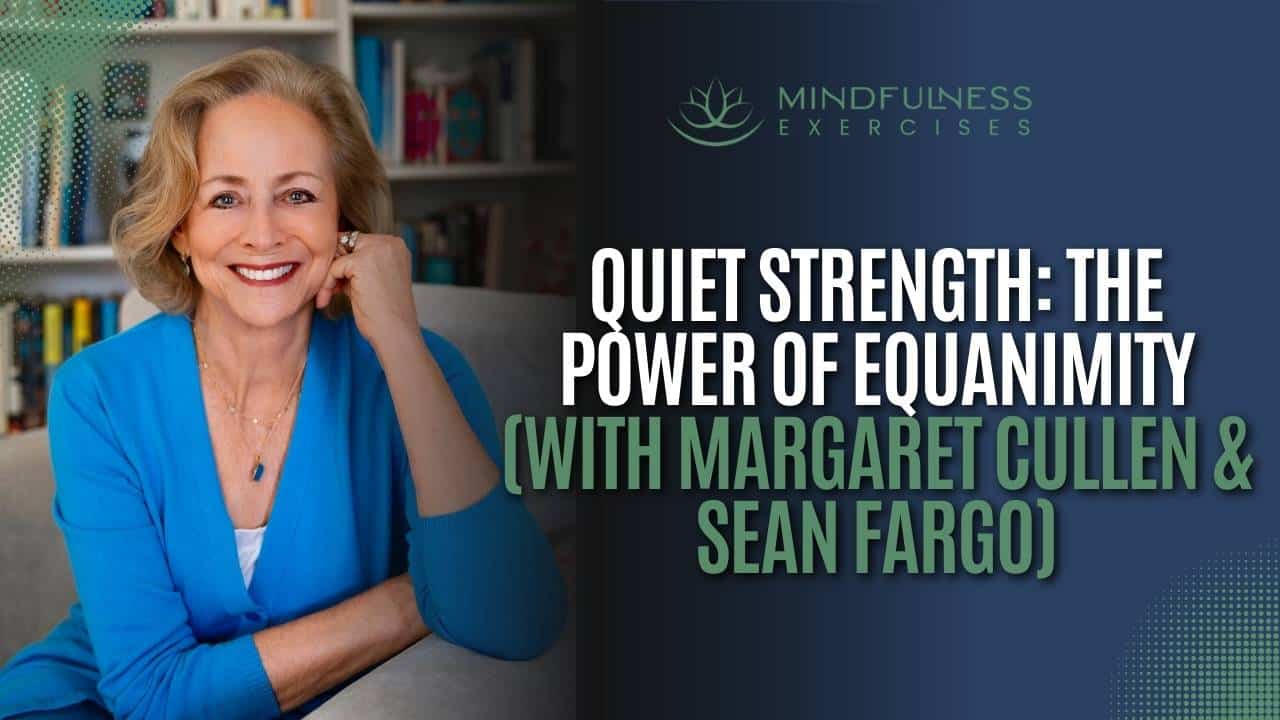
In this exploration of the power of equanimity, inspired by insights from mindfulness teacher Margaret Cullen, we’ll uncover what equanimity truly means—and how we can begin cultivating it in our daily lives.
Sponsored by our Mindfulness Meditation Teacher Certification Program
certify.mindfulnessexercises.com
Episode Overview:
Key Takeaways
- Equanimity is a caring, heart-centered presence—not apathy
- Feeling tone (vedana) is a powerful gateway to balance
- Spaciousness allows us to feel without becoming overwhelmed
- Recovery time is a practical measure of equanimity
- Identity and the “worldly winds” influence our emotional stability
- Vulnerability is a form of strength, not weakness
- Equanimity supports sustainable activism and prevents burnout
- Parenting and caregiving benefit from openness over control
- Simple phrases can anchor us in steadiness
- Equanimity is a natural human capacity we can rediscover
Show Notes:
Redefining Equanimity: Not Apathy, But Caring Presence
Many people hear the word “equanimity” and imagine emotional distance or numbness. But true equanimity is the opposite.
It’s not about withdrawing from life—it’s about meeting life fully, with steadiness.
Equanimity allows us to:
- Stay present with discomfort without reacting impulsively
- Experience joy without clinging to it
- Hold both pain and beauty at the same time
This kind of balance doesn’t make us passive—it makes us resilient.
The Gateway: Understanding Feeling Tone (Vedana)
One of the most practical entry points into equanimity is something called feeling tone, or vedana.
Every experience we have carries a subtle tone:
- Pleasant
- Unpleasant
- Neutral
Most of our reactivity comes not from the experience itself, but from how quickly we:
- Grasp onto the pleasant
- Push away the unpleasant
- Ignore the neutral
By simply noticing these feeling tones as they arise, we create space.
And in that space, equanimity begins to grow.
Spaciousness Over Numbing
When life feels overwhelming, many of us cope by shutting down or distracting ourselves. But equanimity offers a different path.
Instead of numbing, we practice spaciousness.
Spaciousness means:
- Letting emotions move through us without resistance
- Allowing experiences to exist without needing to fix or control them
- Trusting that we can handle what arises
It’s not about reducing intensity—it’s about increasing capacity.
A New Measure of Balance: Recovery Time
What if equanimity isn’t about never getting triggered?
What if it’s about how quickly we return?
A powerful way to measure your equanimity is by noticing your recovery time:
- How long do you stay stuck in frustration?
- How quickly can you come back to center after stress?
Equanimity doesn’t eliminate emotional waves—it helps us surf them more skillfully.
The Worldly Winds: Praise, Blame, and Identity
We are constantly influenced by what Buddhist teachings call the “worldly winds”:
- Praise and blame
- Gain and loss
- Success and failure
- Pleasure and pain
Without awareness, these forces can pull us into cycles of self-worth and reactivity.
Equanimity invites us to step back and ask:
-
Who am I beyond these changing conditions?
When we loosen our grip on identity, we suffer less when the winds shift.
The Courage of an Undefended Heart
Equanimity is not armor—it’s openness.
It asks us to live with what could be called an undefended heart:
- Willing to feel
- Willing to care
- Willing to stay present
This kind of vulnerability isn’t weakness—it’s strength.
It allows us to connect more deeply, while still maintaining inner stability.
Activism Without Burnout
In times of global uncertainty and social tension, many people feel called to act—but also overwhelmed.
Equanimity helps us engage without burning out.
It reminds us:
- You can care without carrying everything
- You can act without being fueled by outrage
- You can contribute without losing yourself
This is sustainable compassion—the kind the world truly needs.
Safe Intensity, Regulation, and Journaling
Equanimity becomes especially important in roles where we care deeply for others.
Whether parenting or caregiving, it’s easy to slip into:
- Over-control
- Emotional exhaustion
- Feeling responsible for everything
Equanimity offers a simple but powerful shift:
Hold with an open hand, not a tight grip.
This doesn’t mean caring less—it means caring wisely.
A helpful reminder in moments of overwhelm:
“This is not my emergency.”
This phrase doesn’t remove compassion—it restores balance.
Simple Equanimity Phrases to Practice
Language can gently guide the mind back to steadiness. Here are a few phrases you can return to:
For Yourself
- May I accept things as they are.
- This too belongs.
- I can care without carrying it all.
For Others
- You are on your own path.
- I care about you, and I trust your journey.
- May you find your way with ease.
These phrases help soften resistance and reconnect us with grounded presence.
Equanimity Is Your Birthright
Perhaps the most powerful insight of all is this:
Equanimity is not something we have to create—it’s something we remember.
Beneath the noise, reactivity, and conditioning, there is already a steady, spacious awareness within you.
Practices like mindfulness don’t give you equanimity—they help you uncover it.
A Gentle Practice to Close
Take a moment right now.
Pause.
Feel your breath.
Notice what’s here—pleasant, unpleasant, or neutral.
And silently say:
“This too belongs.”
Let that be enough.
Additional Resources:
- Free Training with Sean Fargo: How to Teach Mindfulness With Confidence & Credibility
- Certification: Mindfulness Meditation Teacher Certification Program
- Blog: What I learned from Dr. Dan Siegel (and how you can use it today)
- Blog: Healing, Stillness & Aimless Love