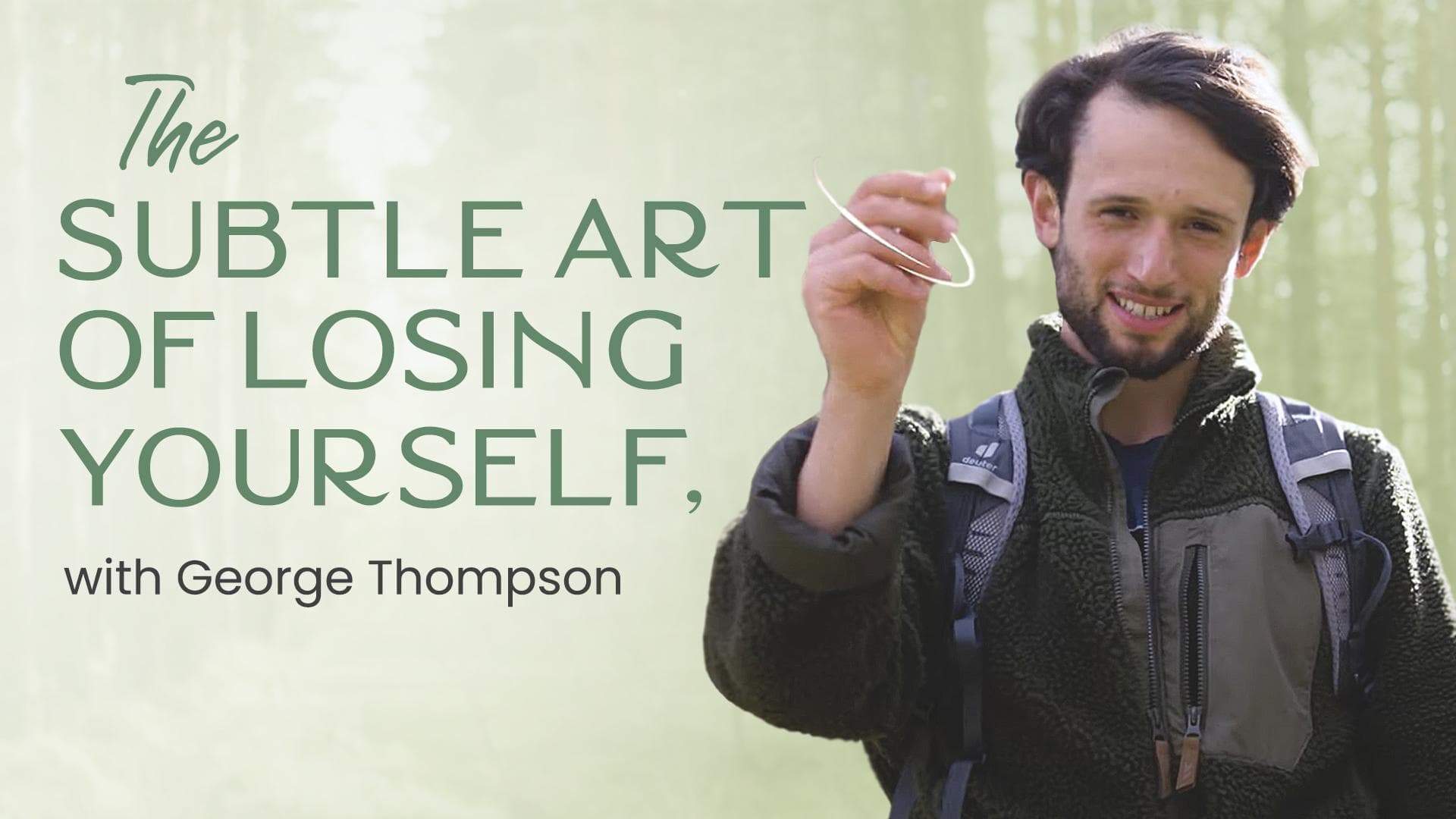
Speaker 1 · 0:00All right, welcome everyone. I'm Sean Fargo with Mindfulness Exercises. Today we're chatting with George Thompson, who is a filmmaker, a teacher of wellness and tai chi and Taoism. He has an upcoming uh film coming out next month called The Subtle Art of Losing Yourself. He's someone who I've been following for two or three years now. Found him online where he was in China for quite a while under a teacher called Master Gu in the Wudang Mountains. And I registered for his online academy at TaoistWellness.online where I went through his course on Taoism, Qigong, wellness, and was struck by a lot of the parallels that we shared, in the sense that I too lived in China for a couple years. I was in Beijing and I found an old Taoist hermit who I called Master Wei, who taught me a few things about Taoism, Qigong energy, cultivating the heart and presence through different forms of meditation and movement, and uh went to various uh temples and monasteries around Northeast China with him. And then I came across you, George, who you studied under Master Gu much more intensively, but I love the way that you were able to document Master Gu's teachings and felt like I kind of saw you grow as a teacher in transmitting the wisdom in your own right, and um have been really impressed by your teachings and your ability to connect with, say, a Western audience and be able to translate a lot of these ancient teachings into modern day life with a sense of sincerity. You know, I could see a lot of people wanting to kind of monetize this or dilute some of the teachings, but I've found a sincerity in your presence and in your ability to teach that I felt very connected with. And so it was a delight when your team reached out, not knowing that I've been following you, to see if we could uh schedule a conversation. It's like, of course, I would love to talk with George. Why didn't I think of this sooner? So I'm really excited to meet you and also really excited about your upcoming film, The Subtle Art of Losing Yourself, which documents a lot of what you've learned in China through Taoism under Master Gu. But it seems like you are integrating a lot of other practices and wisdom into this film and really using this as a way for people to be able to connect with not only themselves, but also nature and our natural world, which is something that's also very important to me. So I'm looking forward to discussing these points with you and learning more about your philosophical adventures over the years. But welcome to the podcast.
Speaker 2 · 3:41Thank you, Sean. Well, yeah, what a pleasure and privilege to be with you and yeah, honoring the work that you're doing to bring these teachings to bigger audiences and all our beautiful viewers and listeners who are also on the way. And yeah, I like to say that I'm a wayfinder. You know, I'm on my unique way, you're on unique, your unique way, and we can support each other. My philosophy of change is insight, practice, community. Insight to help us wake up to our potential and who we really are, practice to help keep those insights alive, and then community to support each other on the way, and then ultimately system change to transform the currently destructive systems into ones that serve harmony and peace. And yeah, I feel very passionate about yeah, sharing what I've been learning and creating films and online education and retreats and events to help share what I've been learning and these ancient teachings that long have been passed down the generations, teacher to teacher. So, you know, you and I and some of our audience are part of that transmission.
Speaker 1 · 4:56Yeah, absolutely. So today, your organization is called Balance is Possible with an exclamation point at the end. And your uh YouTube channel has over 250,000 subscribers, you have over 19 million views across your teachings. Um, you have 19 team members and over 70,000 course students transmitting you know a lot of these ancient teachings. But I'd like to learn a little bit about how you started. What brought you to China in the first place? How did you meet Master Gu and what got this journey started for you?
Speaker 2 · 5:35So I was 21 and I just finished education and I entered into the scary real world. And I yeah, just didn't know what I was doing with my life, didn't have many friends, I was quite disconnected. I was making videos on my YouTube channel that I thought were good, but nobody was watching them. And I equated my value as a human being with the number of likes I got, and I wasn't getting any likes, which meant I wasn't likable. Oh no. So a new character began to dominate my headspace, who I've personified as a troubled wizard who is used to be an evil wizard, but it's now a troubled wizard who yeah, would say, Well, George, you're singles, not many friends, and you're financially insecure. You are pathetic. Oh, and now you're anxious, you're weak for being anxious. You shouldn't tell anyone about this, you should just talk to me, and I'll talk about how bad you are. So that was that was my inner world, and I didn't really know who I was, I didn't know how to relate to that voice, I didn't know how that voice worked. And but what I did know is I was hurting and I didn't want to hurt. I'd watched some videos of some monks doing some backflips at uni. Something as arbitrary as that. And I thought, you know, why didn't I just go join a Kung Fu monastery and become a strong man that doesn't feel like this anymore? You know, that's that's what I was thinking. And I arrived at China and I arrived at a place called the Wudang Mountains, which is this awesome collection of temples and monasteries and kung fu schools and tai Chi schools, all on top of a mountain. And I went up to one of the monasteries, and it's got you know the big courtyard with the roof with the swirly bits at the end, and there's a monk sweeping the floor, and I go up to her and I say, Nihao, Kung Fu. Yeah, Kung Fu. She's like, don't understand what you're saying. I try another monk who's carrying some tea. I say, Nihau Kung Fu. Again, then I just like don't know what I'm saying. It's like as cliched as a Chinese tourist coming to the UK and saying to me, like, fish and chips. So I didn't know any Chinese at the time, you know, which I can now speak. So yeah, that wasn't working. So I asked the locals, can you take me to a Kung Fu school using Google Translate? And one of them volunteered as my guide and took me to what was a Tai Chi school. Uh my ignorance then, I thought, you know, Tai Chi, that's for older people. I was here to, you know, karate chop stuff. But I tried Tai Chi, I fell in love with it. I found Master Gu, who just happened to be, happened to be the only English-speaking master on the whole of the Wudang Mountains that was fluent in English. And he was then my guide into the beautiful culture of Taoism and the Tai Chi culture and the Qigong culture. And my life began to change. I was there for seven months for the first trip, and then I was there for a year on my second trip, and then I've just done my third trip this year. And yeah, I found these ancient practices that began to transform how I related to myself. And I think, yeah, the principles of flow, of trust, a connection to the universe in a way that works with my scientific principles. I've got a strong woo-woo alarm. Woo-woo-woo-woo. And so I, you know, want to share these teachings in a way that really is grounded in science and in the ways that science can support that, although obviously there's limits to it. And so, yeah, I'm being on the way for coming up to eight years and yeah, sharing it what I've been learning with passion.
Speaker 1 · 9:22Beautiful. So before you got to China, it sounded like you had a self-critic or an inner critic, where you were tying a lot of your personal worth to the number of likes you'd get and you know whether or not you had a partner, these types of things. When you were discovering these practices and these teachings in China, can you talk a little bit about how, like what happened to that inner critic? And what were some of the pieces or some of the practices that helped you to soften the inner critic and kind of find a little bit more freedom from that?
Speaker 2 · 10:08So when I began to feel more ease from trying meditation and Tai Chi, it struck me in two main ways that one, you know, I would tell myself I was uniquely messed up, you know, I shouldn't be anxious, I'm weak for being anxious, and I beat myself up. And then actually, wait a sec, these practices, which are thousands of years old, can still help me. And since they're thousands of years old, it meant that, you know, humans have always been hurting. And so that was the really the inklings and the kindlings of building compassion to myself was that when I understand that this isn't just me, it's not personal, like human beings hurt. You know, we we lose things that we want and we gain things that we don't want, and people betray us, we lose people, we get sick, we die, you know, that's part of being human and always has been. So that was really supportive, just wow, I'm not alone with it. And then secondly, these these practices that, yeah, they began to resonate despite me living so many thousands of years later. It really spoke to me that there's something, some fundamental training going on. And I'd say that two key insights is one coming into the body. So I'm not just a disembodied brain in a vat. You know, it's like as Ken Robinson says, it's like for most people in the West, they see their body as a vehicle to move the brain between meetings. And, you know, that was probably me. It's like, okay, I should run, I should eat healthily, but I didn't really see that I was my body and that I could rest in my body and I could rest my awareness in my body. And then, secondly, to then begin to really understand my nature. So, you know, Taoism, I like to say I'm exploring Tao without the ism. Tao is the way of nature, the way, the path. So it can refer to something as big as the universe, the ways of the universe, or something as small as the way of knitting and the way of eating Kit Kat junkies. So when we understand the Tao, understand the way, we are understanding who we are, what we are a part of. And so when I explored these ideas, be it philosophy from the Taoist texts, or meditating, finding through my own experience, I began to really understand the nature, and obviously I'm still on a journey with it, the nature of consciousness, of what it means to be human. Here I am, having thoughts, having feelings. I used to fully define myself with, you know, I'm George and I'm messed up in these various ways and don't like myself for these reasons. And then moving from that total identification with that pain to then moving to, okay, this is called being a human being, embodied consciousness, embodied awareness, thoughts and feelings arising and passing, arising and passing. And so then I began to expand my understanding of myself to find more spaciousness. You know, there's a huge difference between I am anxious and here's anxiety. I am anxious, anxiousness, that's my whole definition. Here's anxiety. Okay, this is an experience arising in my awareness. There's more spaciousness to navigate it. So the underminer, the the my inner critic is still with me. You know, it's like it's part of being human. It's like sometimes, yeah, they I'll go through at the moment I'm working on the film and feeling more and more trusting and surrendering. And also, I've got 19 people in the team and I'm in a bank loan at the moment, and Small George goes, ah, and you know, sometimes doubts myself of, you know, like who, like, can I do this? And like, and actually, you know, so what I've done is made friends with that. Okay, like, okay, underminer, I hear you. You're a little bit worried right now. And I guess, you know, given the state of our bank balance, that's understandable. I send love to you in this situation. And that sort of energy isn't that helpful for right now. So, like, I honor you, I understand what you need, but actually, from my place of wisdom and spaciousness, I am going to actually, you know, show up in the world with a sense of trust and take the action that I need to, and also give my myself permission to rest and to actually enjoy my life, to enjoy the journey of life.
Speaker 1 · 14:17Beautiful. Thank you for sharing that. You mentioned the two say practices that really helped you to release that uh inner critic, one being to sense into the body, have this embodied presence, and then the other sort of this sense of expansion and sensing into the flow and nature of things, and you know, say not taking things too personally or over-identifying with the body or your story. Could you share maybe a few, like I'm struck by, you know, you said that you you saw these these monks doing backflips, you know, and you go up to the Udang mountain steps saying, you know, Nihau kung fu, nihao meaning hello, kung fu meaning kung fu.
Speaker 2 · 15:09And actually it's it's not even kung fu in Chinese, it's gong fu or wuxu. So I was just saying it wrong.
Speaker 1 · 15:15Yeah, and yeah, you know, I know Nihao and Xiao Go, like puppy.
Speaker 2 · 15:22Yeah, yeah, nice, yeah.
Speaker 1 · 15:23Don't know very much Mandarin, but but these, you know, I've been following you for a few years, and there is a physical element to a lot of these teachings of the Tao and you know, embodiment, and you know, that's there's these practices of uh Tai Chi. You know, before I introduced you, we were talking offline a little bit about ecstatic tai chi and what that means, you know, and then there's qigong and uh various meditative practices where we may be sitting and sensing into the body. Could you talk a little bit about what kinds of physical practices you did or meditative practices that you did that helped you to cultivate that sense of embodied awareness?
Speaker 2 · 16:12Yeah, it's such an important question. And Buddhism has been important for me on my journey as well. And the the seated practice, the clarity of Vapasna. And I also think the embodied dimension is a really important dimension that, you know, in my ignorance, I don't know the full Buddhist traditions. Uh, there are, I think that there's an important component that is maybe missing that can be complemented. And the embodiment is really the fundamental aspect of the Taoist form of cultivation. So practice is the path to peace. And that practice is both physical, mental, and spiritual, if that's a word that works for you. They see it as a holistic system. You know, traditional Chinese medicine is all about the energetics of this whole being that you are. Mind and body aren't separate. How you think about yourself is not separate to how, you know, the tension that you hold in your body and the cult is all that may rush through you and cause illness. And there's more and more science showing that that's the case. Then, in terms of you know, the clarity of the mind and how we understand ourselves, is that if we are only meditating in a seated posture, then we are okay, maybe emptying into awareness and spaciousness. And maybe I can speak in this way because I know that most people who are listening to this have tried some meditation. What we miss is to bring that awareness, you know, there may be body scans that we do in that as well, but to move with mindfulness, mindfulness and motion. What a beautiful, beautiful, beautiful gift. And such an amazing way to make friends with ourselves and to come into relationship with ourselves. So I like to share Tai Chi in a way that no matter your fitness, your stiffness, or your headspace, Tai Chi is about coming into relationship with exactly where you are, who you are right here, right now, and moving from there. And so Tai Chi is not just a philosophy, it's not just a movement practice, it's a philosophy for life. Is that can we flow? Can we, through practice, consciously and maybe subconsciously, flow to woo-way, to get out of our own way and allow ourselves to express ourselves with our bodies. So you may know that or have the scene of at a wedding, a grandmother doing a little hip shake on the dance floor. She's dancing in her, you know, restricted movement. But because she's doing her, even though she's not doing, you know, the big expressive moves, she's working the dance floor. People love her, she loves her energy because she is expressing herself as she is. And one of the challenges of us being human is, you know, we want to, we want to belong, we want to fit in the tribe. And so then we're evaluating ourselves like, how's my movement? How's my body look doing? Am I too big? Am I too small? Am I too wide? Am I too narrow? And all these judgments are painful and actually they block ourselves from leading a life of health and wellness. So for me, Tai Chi and Qigong is the training that I have done and is what I share. And it's a way of coming into relationship with ourselves and to embrace ourselves. What and one more thought with that is then moving with the breath, moving with the breath. So when we move with the breath, then we, you know, the breath is already in this cycle of flow. Inhale, exhale, inhale, exhale. And then when we move with the breath, suddenly we're attaching this kind of outward energy, inward energy, and expansion and renewal. And then we get to actually form a deeper relationship with our breath, which is intimately connected to our heart and our mind and our nervous system and our anxiety and our depression, et cetera, et cetera. And when we can move with acceptance, moving with the breath, then it's a really powerful tool to support us to enjoy life and to show up with more energy in life.
Speaker 1 · 20:13Beautiful. Well said. Yeah, like in terms of how that might be reflected in the Buddhist tradition that I uh was a monastic in for a couple of years, you know, there's often these perceptions that monks in the Theravada tradition only meditate sitting down with their eyes closed. But I was surprised to learn in the monastery that there was say an equal amount of emphasis on mindful walking and mindful say movements, especially in nature, in which we're even just doing daily tasks like raking, cleaning, building something at the monastery to bring you know equal amount of mindfulness to those movements. And you know, I love that Taoism has this um connection with the breath that wasn't so emphasized with the monasteries where I was, but but yeah, for those of you listening, you know, there's as much validity to mindful movement, say with Tai Chi, Qigong, mindful walking, as there is with, you know, sitting still with your eyes closed, you know, all are valuable practices to help increase this sense of embodied presence. So, you know, whatever resonates with you or feels like it's healing or supportive for your journey, you know, there's there's no right or wrong with this. So, George, uh, you also talked about this say expansion of consciousness or awareness. And uh you spent a considerable time in the mountains of Wudang province, the Wudang Mountains, your upcoming film, The Subtle Art of Losing Yourself. Uh, there's a considerable amount of time in nature. Can you talk a little bit about the effects of spending so much time in nature, like what that effect had on you, and what that process of say expansion felt like were some of the key moments of your journey?
Speaker 2 · 22:31I grew up in the city like most people do, and yeah, it's easy to forget where humanities come from and what we are a part of when we are bridlocks surrounded by concrete. And yeah, maybe there's a park, but we don't really get to see nature and its wildness and to reconnect with yeah, the the history of the of life on earth and the story of humanity. When I was in Wudang, yeah, I had the privilege of you know walking every day in the afternoons, and each walk I'd go on, I'd meet a new species. And just to give you one example of I was walking in the rain once and I have my raincoat on, and then this toad rivets on the path and sees me and then freezes. And I then go go down and like hang out with him, and I've got my camera and I want to go, you know, chat to him. And I was like, let me, I I know you know that I can see you, and we we both know that, but like you don't need to pretend to be invisible, but like his his his self-protection strategies to freeze, to become invisible because he's he's camouflaged, and even though it's like I'm literally uh this far away from his eye, and we're both looking at each other. So then I thought about you know, my freezing tendencies of due to you know some of the challenges in my upbringing is you know, I'm I'm a flight, not a fighter, I'm a freezer, not a fighter. And yeah, when people are arguing, like even today, I I notice the tendency to like shut down because my strategy in the back in the day is make myself small so I don't add to the problem when there's arguing. So, you know, there there we go. There's some you know programming that that that toad has, and I have. And you know, I've got a brain here if anyone is on the video, and you know, for a gross oversimplification of of how our brain works, you know, there's the croc brain, there's the mammalian brain, and then there's the prefrontal cortex, or the kind of the human brain. The croc brain or the toad brain is you know that fight or flight and more basic emotional reactions and responses, then the mammalian is where we can care and and have you know care for family and the emotions like to play, and then the prefrontal cortex, which is particularly big in human beings, gives us the ability to rationalize and think and to consider and to forgive and to consider other positions. And so, you know, when I go out into nature and I see other animals and I see the plants and I see how they are making their living, living their lives in their own way and with their own awesome, intelligent solutions to life, then I reconnect with what I'm a part of. And it's easy to take the miraculousness of a poodle for granted, or you know, like a shih tzu, a you know, any name you a pet. It's like, okay, we've got used to dogs, and dogs are amazing. I love dogs. But there's something for me that when I see an animal out in the wild, and it can just be a bird or a squirrel, or I see a big beautiful tree, that yeah, I'm struck by the mystery that we are a part of. And for me, the experience is a natural sense of awe and wonder. And with that awe and wonder, a sense of love, sense of love for the planet and humanity and nature and like what we are a part of, this great mystery. And then that takes me to a sense of spirituality. The word spirituality for me is universal and doesn't have to be a woo-woo word. You know, it's like for me, spirituality is a connect, my understanding of my relationship to something bigger than myself, and the extent to which that understanding is a resource that can support me. So suddenly my mindset shifted from like, okay, I'm just George, I've got this inner critic, I'm flawed in these ways, and I'm facing this world outside of me, to moving into, okay, wow, I am a manifestation of the great unfolding miracle that we call life in the universe. And there's been billions of years of evolution, and there's millions of species that have a whole distribution of different types of experiences, including many of the emotions that I feel. And then actually I realize that I'm in connection with all of it, in relationship, because you know, I need the plants to eat, I need the animals to back in the day keep me warm or keep me company today. And then we need the sun to power us, we need the winds to blow the seeds through the forest, et cetera, et cetera. You know, the into being, the the interconnected web of relationships that makes us up. And then that gives me that sense of resourcing. So that's my connection, and I feel a resourcing from that. And so, yeah, being in nature has been one of my biggest teachers, often more than any book or any tradition.
Speaker 1 · 27:22Thank you for sharing all that. Yeah, that interconnectivity that you spoke about just now is uh it seems like that's one of the main messages of your film, the art, the subtle art of losing yourself. You say that at a time when environmental crisis, mental health challenges, and a deep sense of disconnect pervades our world, the subtle art of losing yourself delivers an essential message of hope. It shows how the stories that we construct about ourselves not only shape our lives, but the fate of our planet. And when we connect with our true selves, balance is possible for people and planet. And so yeah, so many people right now have a very deep sense of disconnect, a growing sense of disconnect from our natural world and from themselves. Can you talk a little bit about how your film, The Subtle Art of Losing Yourself, touches on these topics of connecting with our true self and how we can connect with the natural world to find that balance and reconnection?
Speaker 2 · 28:45Yeah, I think anyone who isn't feeling a little bit nervous about the trajectory of our planet and what is happening on our planet is maybe just not feeling, allowing themselves to feel, you know, what's happening. So there are big challenges and there's a lot of forces of ignorance and short-sightedness that are creating economic and political systems that are destroying life, destroying life. Even in my own city of Bristol, 80% of the birds have been killed in the last 30 years. So it's not even in like the last 100 years, it's like the last 30 years that the bird population's gone down. And you know, that's just a very small example of you know the economic systems not only destroying nature, but you know, humanity and so many people living in poverty, and yet there's such riches, and there's there is enough. There is enough to go around. So there is a obviously big challenges and a lot of disconnect that is happening in the world right now. And you know, there's a waking up of the reality of climate change and how our consumption of nature is leading to runaway tipping points and breakdowns. And yet, I do believe there's a challenge with how. We are approaching fixing climate and fixing the environment problem. As if you know, it's like the there's the environment here, and then there's us here. And the environment, you know, it's just a climate's a thing to fix. We can do geoengineering where we put pollution into the atmosphere in order to block out the light, to cool down the planet, and it's a very kind of linear thinking problem. Well, this problem equals that solution. If we do this, then there'll there'll be that thing that we can fix. But in an interconnected web, which we are a part of as the ecosystem, then you know there are ripple effects, and there's loads of challenges that can happen if we don't go a level deeper between a level beneath just the solutions on the surface of symptoms. What's the root cause? And I would argue that the root cause is the fundamental stories about who we are and what we are a part of. We haven't inherited some stories that have been passed from the Greeks through Christianity, through Descartes, through science, that suppose that humanity and nature are fundamentally different, that humanity have a spirit or a soul given by God. And so, you know, the human mind is spiritual and it's contained within the body, which is not spiritual, it's kind of you know the source of sexual desire and and blood and gore, and yeah, that's that's not what is divine or spiritual. And then even for science, they got rid of the spirits, but they still kept the idea that it's only rational, cognitive, thinking minds that is intelligent. And so if that is the case, if that's the only intelligence that exists, thinking, and I'm just stuck in here with this little voice in my head, then it's lonely. I feel alienated because you know, I'm separate from you, and then everything else is dumb. You know, it's just a dog's an automatic machine. It's not actually intelligent. So then how does that change how we interact with the world? Is that you know, if if we're separate from just the dead, inert stuff, you know, if everything's just dead and inert, then it's no problem if I mine it and if I yeah, continually use it and destroy it and put chopping moors over it because I'm separate from it. Now, in the film, what we what we talk about and explore is like, well, let's let's explore who are we, you know, let's go through nature and let's not just like work on dogma, but let's just observe. And we observe the animals and their beauty and their intelligence, and we see that okay, they're not just automatic machines. And then we you know try and work out consciousness and how our thinking works, and like, well, actually, there isn't a separate divine self, like a little capsule of divinity held in the above the third eye to which is the source of our divinity, and then everything else is just base, uh, rubbish stuff. Yeah, we find that's not the case either. And so we didn't find any evidence that humanity and nature are separate. So then we come back to what I was talking about with this idea of interbeing, which is what Techna Hahn coined, is that everything in the universe is is in relationship. You are not a separate self, you are an emergent property of 37 trillion cells coming together. And the outcome is this awesome human being that can think and feel and gets lost and anxious, and also can sing and dance and do tai chi and meditate. Here you are. You're an aspect of the whole, unique and differentiatable, but nonetheless connected. And if we can live from that understanding, then we become sacred, our bodies become sacred, the earth becomes sacred, even our supposed enemies and the racists and the bigots, they are part of this unfolding, yeah, miraculous thing that we call life in the universe. And so even though you know we can say, okay, that's not okay to be racist and to destroy the planet, we need to change. We can still do it from a place of like, look, I see the light in you, I see there is sacredness in you. And I want to create a world where more of us can see that, and you can see that about yourself, and you can see your connection, and you can see that you don't need a lot in order to be happy. You don't always need to be consuming because yeah, we're given all these messages from advertising. Like, if you buy this handbag, then you'll feel a sense of belonging and honor and respect. It's like, well, you know, just give it to yourself already, skip the handbag. And how do we do that? Through meditation, through gaining clarity over who we are, going out into nature, and then coming into community with other people that think and feel and love in the same way. And then that's what a movement is. And, you know, I do have trust and belief that there will be a movement that ultimately calls to and answers the human potential. How quickly we can get there is a question, and that's yeah, really up to us and the actions that we take.
Speaker 1 · 35:11Wilson. When we started this conversation, you were saying that uh one of the ways that you helped dissolve your inner critic was by sort of acknowledging or remembering that your suffering is not just your suffering, that humans throughout time have suffered. A lot of people suffer now, you know, you're not unique or alone in your suffering, and that helped to bring a sense of ease and connection. And, you know, a lot of people listening right now are either mindfulness meditation teachers or thinking about sharing a lot of these practices of bodied awareness, um, greater consciousness, whatever you want to call it, but bringing these practices to other people. And you know, you're touching on the power of storytelling, of helping us remind ourselves of who we are as humans, as a community, of people on this planet, of people who are connected with our ancestors and the people who came before us, and you know, and we're also connected with the people like our children and the generations that will come after. And one of the things that I'm very impressed with, George, is your ability to convey these stories through you know, spoken stories, but also through the power of film and sharing other people's stories and sharing your story. Can you talk a little bit about your process of say feeling safe enough or courageous enough to share your story in a way that's not filled with ego, but rather compassion and humility? And how you might suggest other people approach the art of story in the name of greater connection with themselves and with humanity and the natural world.
Speaker 2 · 37:23Yeah, thank you for speaking to the power of stories because I think it's one of the crucial, crucial things that there's a technology for peace and for for harmony. Yeah, with the environmental movement, you know, we've known about climate for so long, and we've known that, you know, if we keep on this destructive path, we're just going to keep going and into destruction. And yeah, all those facts haven't really changed our trajectory because facts don't really change people. You know, you can always argue this way or that way, this evidence says that. Whereas a story and an emotion, and for me the emotion of love, you know, a love for life, like wow, I'm part of this great unfolding miracle. And just, oh, you know, it gives me a gives me a wow and a sense of love for life. Then that that is itself an energy that can carry action, that can carry meaning, that can carry support and resourcing. And ultimately we get to that energy of love when the story transforms. So the story can carry us there into that energy of love. Because a story, you know, it's like the hero's journey of, you know, you go into the darkness and the pain, and then you find something, and then you come out the other side, and then you you bring back that gift to the world. And so we are all the heroes of our own lives, and we go through those journeys in, you know, every hour, every week, every month, every year, every decade. And so we all have a story to tell. And there is in a world of interconnection, all of it matters, all of it feeds into the whole in ways that can't be measured necessarily, but they can be felt and they are still there. So that's the importance of story. And then I'd say, how do we show up in the world? You know, if we have that energy of love, as you said, you know, beautiful humans in this audience and community who are on the journey to share these practices and are interested in it for themselves. Beautiful. So maybe you've already cultivated that energy of love. Then it's like, how do we show up? It's like, okay, is it to be like the you know, the love appreciation society? Like, hey, like I'm so loved up, like, can you like celebrate me in how lovely I am? You know, like make it the George show or like whatever the story is, versus service, you know, service. Like that's that's the energy that I believe is a lot more powerful and is the energy that that motivates me. It's that, you know, if George is a story that's made up anyway, which it is, as we've discussed, it's like, why should I try and be successful and try and like be aggrandized when you know it's just aggrandizing a little story that I've made anyway? Versus I'm a part of life, I'm part of this great interconnected web, and I have the privilege to contribute my energy in smaller, big ways to be of service to the flourishing of life, so much more exciting. Then people feel that energy energy, you know, people feel that authenticity. It's like, are they coming? Do they want something from me? Do they want money or do they want adulation? Or do they want to give? Do they want to serve? And this is an insight found in all the spiritual traditions and particularly in Taoism as well, is that through serving the needs of others, your own needs are met. Can we, as Lao Tzu says in in the foundational text of Taoism, the Tao de Jing, can we be like the river valley of the world? We are the kind of the spaciousness within which abundance happens. So it's not about leading from the top of the mountain saying, hear thee, hear thee, I've known the way and you must follow me. It's like instead, it's like actually, you know, provide the space to have you know the human ingenuity to be, you know, you're holding people and supporting them through an energy of service to create the space for them to make their own transformation. Because that's the real powerful transformation, anyways. It's not just other people doing what you say, it's them finding the truth, and then you're aligned. Much more powerful. It's not using force and coercion, instead, it's using insight and clarity. Then if just one more idea is that then we may notice like an imposter or like in the inner critic coming back. It's like, okay, you know, I've been on this journey, I want to share meditation, and you know, who am I to share these teachings? You know, like I, you know, I'll speak for myself, is that I a judgment that I've actually done a lot of work on this year that doesn't hit me as much as it did last year. But you know, so it's only last year that I was working with this one, is that, you know, and I still work with it a little bit, but like, George, you're not perfectly at peace at all moments and you share meditation. I really just if you're not always like the Buddha, I don't think you can be a meditation teacher, which is a punishing one. It's a punishing one. And the irony is that peace is embracing the present moment, which includes the imposter syndrome, which includes the insecurity, which includes the the the am I enough to do this? And when we embrace that, that is the peace, that is the teachings, that's the medicine. Because, you know, we do resist, we get lost, we fall over, we do things we regret. That's called being human. And if we can embrace where we are, not in a floppy way of like, okay, I can, you know, I can just do whatever I want because I'm just embracing, you know, that all is welcome. No, the the power of love and compassion doesn't lead us to that floppy place, it leads us to embracing ourselves as we are, and then with that spaciousness, instead of getting stuck in shame and judgment, then we naturally want to be a channel for love with integrity and to show up into the world. So there's space for all of us, our voices matter, and yeah, I invite an energy of flow and ease and to embrace, yeah, riding the waves of showing up with service in the world.
Speaker 1 · 43:17Yeah, not being floppy. Yeah, thank you, George. Uh all this has been uh really inspiring, I think, for everyone listening and watching. You know, whether you're a practitioner or a teacher, hopefully both, I feel like we all have potential to say lose ourselves a little bit more and more, become that old grandmother who shakes off the cane and starts dancing despite the uh shoulds of the world. Yeah, to embrace our inner critic, uh, to connect with ourselves in a deeper way and connect with the interconnectivity of our natural world and other people through these practices, through these ways of reminding ourselves of these important stories of love and connection, common humanity, you know, which is so foundational for sense of compassion and self-compassion. George, thank you so much for everything that you've shared today and uh helping us to connect with ourselves, with the natural world, sharing some of these practices that have supported your journey and dissolving your inner critic, helping you find a greater sense of embodied, loving presence and expansion and uh flowing with the natural world, with nature, with these energies from a more and more of a selfless place. And thank you for creating this documentary and this film, The Subtle Art of Losing Yourself. I highly recommend it to everyone, whether you're a mindfulness practitioner or not, whether you're a mindfulness teacher or not. I think it can be really helpful for finding that inner freedom and for helping us to connect with others and reminding others of their true nature of love and compassion. Please find the film at losingyourself.org. You can connect with George Thompson there or on his YouTube channel at George Thompson. You can also uh find a lot of his uh teachings through Taoistwellness.online, in which he's produced a lot of the wonderful course material there on Taoism and living, these practices that he's been discussing. And if you sign up, you can get a uh free bonus of a motivational poster that says, Do you have the patience to wait till your mud saddles and the water is clear? One of my favorite posters. But George, thank you so much for making this film and for this wide-ranging conversation today. I honor the work that you've done over the years and the work that you've done to helping others to live with inner peace and connection. So thank you.
Speaker 2 · 46:28Thank you, Sean. And yeah, celebrating the organization that you have steered and built and honoring the community and the audience listening. Yeah, like the this is this is the movement, this is the work. So, yeah, really sending my best wishes for us to resource ourselves with resilience so that we can enjoy life and serve life. Thank you for your time.
Speaker 1 · 46:54Thank you, George.