📖 Free guide: How to Teach Mindfulness & Meditation

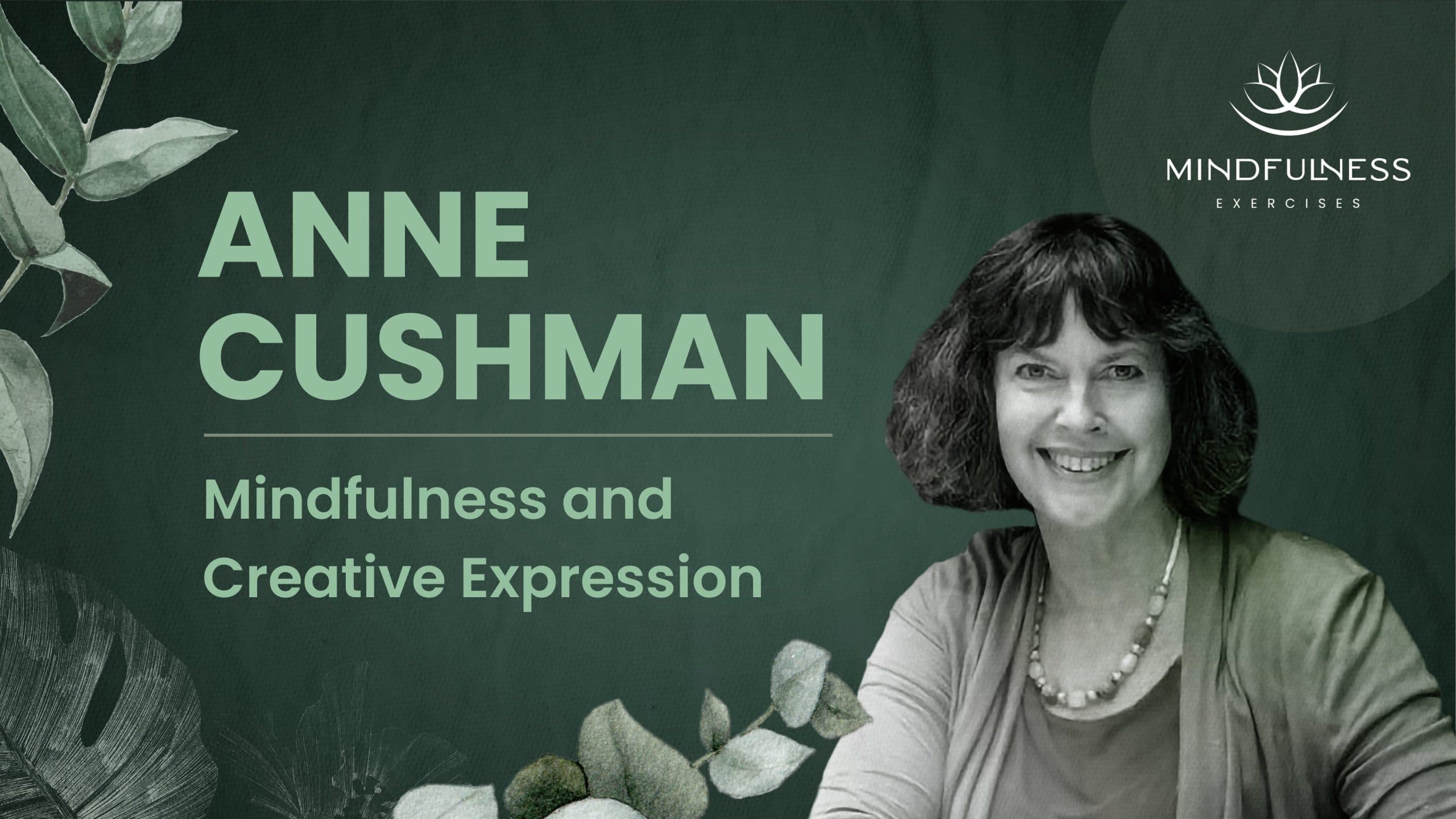
    Mindfulness and Creative Expression with Anne Cushman: How to Reclaim Your Inner Artist

    SF
    Sean FargoPublished November 21, 2025 · Updated November 26, 2025 · 13 min read
    Mindfulness and Creative Expression with Anne Cushman: How to Reclaim Your Inner Artist

    Listen to this episode

    Mindfulness Exercises Podcast

    Enjoying the episode?

    Follow the show in your podcast app. If this conversation supports your practice, a rating or review helps more listeners find it.

    Many mindfulness practitioners secretly carry a second identity.

    On one side, you might feel like “the serious meditator” or “the responsible mindfulness teacher.” On the other, there’s the part of you that wants to write wild stories, dance in your living room, paint messy canvases, sing off‑key, or improvise a ridiculous scene just because it feels alive.

    In this workshop, dharma and yoga teacher Anne Cushman invites those two worlds to sit at the same table – and then lets them play together.

    Sponsored by our Mindfulness Meditation Teacher Certification Program MindfulnessExercises.com/Certify

    Episode Overview

    In this 2‑hour session, Anne Cushman weaves together:

    • Guided meditations
    • Gentle movement and creative play
    • Stories from her own path as a writer and dharma teacher
    • Concrete principles for integrating mindfulness and creativity in daily life and teaching

    The session is especially supportive for:

    • Mindfulness and yoga teachers in training
    • Practitioners who want to be creative but feel blocked
    • Artists who long for a more grounded, contemplative life

    What You’ll Learn

    Inside the workshop, Anne explores how to:

    • Create inner and outer space so creativity can breathe
    • Recognize creativity as an inherent life force, not a rare talent
    • Use mindfulness of the body and senses as a gateway into art
    • Work with difficult emotions as compost for creative expression
    • Carve out sacred time for practice (even in tiny pockets)
    • Listen for and follow the “golden thread” of inner impulse
    • Relax perfectionism and embrace “shitty first drafts”
    • Approach the scary, tender edges of your own experience with care

    Highlights:

    Timestamp Section Title Summary
    00:00 – 05:00 Welcome & Introduction Setting the context for teacher trainees, opening the session, and introducing Anne and her background in creativity and mindfulness.
    05:00 – 19:30 Opening Guided Meditation A guided practice inviting spaciousness, presence, and acknowledgment of inherent creativity within each participant.
    19:30 – 28:30 Creativity as Life Force Exploring creativity as a natural expression of life moving through us, shifting away from the idea that only “gifted” people are creative.
    21:38 – 28:30 Anne’s Roller-Rink Dream Anne shares a symbolic dream that helped her integrate her identities as both an artist and a meditation teacher.
    28:30 – 38:00 Reclaiming Creativity How Anne rediscovered her creative expression after early criticism, including key practices like painting, drumming, dance, improv, and writing.
    32:00 – 38:30 Mindfulness & Creativity Research Discussing scientific links between mindfulness and creativity, and understanding creativity as a form of sacred attention.
    38:30 – 49:00 Principle 1: Returning to the Body Connecting with sensory awareness as a gateway to creativity, including a brief sensory-based writing practice.
    49:00 – 58:00 Principle 2: Being with Emotions Exploring how creativity provides a channel for emotional processing and engaging with feelings mindfully.
    58:00 – 65:00 Principle 3: Sacred Creative Time Reframing creativity as playful and sacred, encouraging small, consistent moments of dedicated creative practice.
    65:00 – 73:00 Principle 4: Listening to Inner Impulse Following the intuitive “thread” through movement meditation and spontaneous creative exploration.
    73:00 – 82:00 Principle 5: Letting Go of Doing It Right Lowering creative perfectionism, embracing imperfection, and keeping the creative energy flowing—especially in writing.
    82:00 – 92:00 Principle 6: Leaning Toward What Scares You Approaching the edges of fear with gentleness, including Anne’s teaching metaphor “See Paris first.”
    92:00 – 106:00 Mandala Drawing Practice A grounding creative exercise using a circular container for coloring and reflection.
    106:00 – 120:00 Group Reflections & Integration Sharing insights, completing the “I am…” writing prompt, and exploring ways to integrate creativity into teaching and daily life.

    Practices Inside the Session

    You’ll be guided through:

    • A short settling meditation on space, breath, and creative life force

  1. A body‑and‑senses awareness practice (seeing, hearing, smelling, tasting, feeling)

  2. A 15‑second sensory journaling drill (one detail from each sense)

  3. A brief RAIN‑like reflection on emotions and how they move through

  4. A movement meditation where you let one tiny impulse spread through your body

  5. A mandala drawing exploration using color inside a circle

  6. A timed “I am…” free‑writing exercise inspired by the poem The Delight Song of Tsoai‑talee

  7. Why Mindfulness and Creative Expression Belong Together

    Anne starts by naming a tension many of us know well:

    The part that wants to be solemn and spiritual… and the part that wants to be playful, messy, and wildly creative.

    In her dream, she’s roller‑skating in a black velvet bikini and white fur‑trimmed skates, delighted with her own fabulousness—until she worries she might bump into Jack Kornfield dressed that way. That image captures the split between “respectable dharma teacher” and “irreverent artist.”

    The heart of this workshop is the realization that these are not two separate people.

    Mindfulness and creativity share a common core:

    • Both ask us to pay attention to life as it actually is
    • Both invite us to stay with our emotional landscape, rather than bypass it
    • Both help us meet the human experience honestly—in the body, in relationships, in the messy details of daily life.

    Research backs this up: studies have found that mindfulness can increase divergent thinking, improve focus, and bolster resilience in the face of setbacks—all essential ingredients for sustained creative work.

    On MindfulnessExercises.com, we’ve explored this territory in other ways as well, from a guided meditation on mindfulness while being creative to reflections on mindful daydreaming and creativity.

    Anne’s contribution here is to show—in a very direct, embodied way—how your meditation cushion, your yoga mat, your sketchbook, and your journal can all be portals into the same awakened life.

    Anne’s Journey of Reclaiming Creativity

    It can be tempting to assume that artists like Anne “just came that way.” She’s a senior retreat teacher at Spirit Rock Meditation Center and a pioneer in integrating mindfulness, embodied meditation, and creative expression.

    She’s also the author of:

    But in the workshop, she describes how her early creativity was shut down. As a child, she was naturally imaginative—curling up and telling herself stories for hours. Then teachers and adults told her she couldn’t draw, couldn’t sing, that her voice wasn’t good enough.

    Once your voice gets knocked out of you, she says, it’s hard to feel you have anything worth saying at all.

    Reclaiming creativity for her meant:

    • Taking process‑oriented painting classes (where the focus was not on producing “good art”)
    • Learning drumming, freeform dance, and 5Rhythms
    • Studying writing with Natalie Goldberg and improv with Nina Wise
    • Treating each form as a way to liberate stuck energy, not as a performance

    Over time, these explorations fused with her meditation and yoga practice. Creativity stopped being a side hobby and became a vital part of her spiritual path.

    7 Mindful Principles for Creative Expression

    The heart of Anne’s teaching can be distilled into a handful of principles you can return to again and again.

    1. Come Back to the Body and the Senses

    First foundation of mindfulness, first foundation of art.

    The more deeply you inhabit your body—its weight, pulse, and sensory world—the more raw material you have to create with. Creativity is a sensuous experience: color, sound, texture, temperature, movement.

    Try this (adapted from the workshop):

    • Let your eyes wander slowly around the room. Notice light, shapes, and colors without naming them.
    • Close your eyes and note: one sound, one smell, the taste in your mouth, the feel of your clothes on your skin, the weight of your bones.
    • On a scrap of paper, jot down one detail from each sense—just fragments, not full sentences.

    If you want to go deeper, you might pair this with a visualization meditation that uses creative imagery to anchor your attention.

    2. Stay Present with Your Emotional Weather

    Both mindfulness and art tune us to the emotional body. As Anne’s son (a musician) points out, a computer can generate incredibly complex music, but it rarely lands the way a human’s heartbreak or joy does in a song.

    Mindfulness practices like RAIN and compassion meditations train us to turn toward our emotions, feel them in the body, and hold them in awareness. Those same skills allow us to transform raw emotion into poems, paintings, songs, or movement.

    Anne tells her students what Joyce Carol Oates once told her college writing class:

    Whatever’s going on—your breakup, your exam stress—put it in your writing.

    Try this:

    • Sit for a few minutes and name your emotional weather: anxious, flat, tender, numb, grateful, confused.
    • Ask: If this feeling had a color, what would it be? A shape? A sound?
    • Let your body curl into a shape that expresses it. Then, if it feels safe, let your body briefly explore the opposite shape.

    You can support this with a gentle self‑compassion meditation to soften around whatever arises.

    3. Carve Out Sacred “Playtime”

    Anne reframes both meditation and creativity as practices that thrive on protected pockets of time, even if they’re small.

    She calls it “playtime” on her calendar—not “work on my masterpiece” but “show up and play.”

    She shares advice she once received from Anne Lamott: in a busy season of life, just send one email a day to a trusted friend about something you’d like to write about. After a year, she had a trove of material to shape into essays.

    William Carlos Williams, a physician, wrote short poems on his prescription pad between patients. One of his tiny poems, “Between Walls,” turns an alley behind a hospital and a shard of green glass into a whole world.

    Try this:

    • Schedule 10–20 minutes of “creative playtime” three times a week.
    • During that time, you might:

    The point isn’t output. The point is showing up so the well of creativity doesn’t dry out.

    4. Listen for the “Golden Thread”

    Once you’ve shown up, the question becomes: Now what?

    Anne encourages us to listen for a subtle inner tug—what poet William Stafford called the golden thread. Maybe:

    • Your hand keeps drifting toward a particular color pencil
    • Your body wants to sway in a certain way
    • A random sentence drops into your mind and won’t leave

    In the workshop, she guides a movement meditation where you:

    1. Feel the body from inside.
    2. Notice one small impulse to move—perhaps a toe, shoulder, or jaw.
    3. Let that movement ripple and travel anywhere it wants to go.

    The art is in following rather than imposing.

    Try this:

    • Before you write or draw, pause and ask: What is this blank page asking for?
    • Maybe it wants a streak of red, or a single line of dialogue, or a list instead of a paragraph. Trust that.
    • In teaching, you might ask the same of your group: What does this room of humans need right now? – and let that shape your next cue.

    For more inspiration, you might enjoy our conversation with Austin Hill Shaw on bringing mindfulness to our creative nature.

    5. Let Go of Doing It “Right”

    This one is tender for many of us.

    Anne grew up in a military family with a bumper sticker that read, “We do things right.” That conditioning can make creative risk feel dangerous.

    She quotes William Stafford’s response when asked what he does when he has writer’s block:

    “I lower my standards.”

    Natalie Goldberg says you have to feel free to write “the worst crap in the universe.” Anne Lamott talks about “shitty first drafts.” These aren’t flippant phrases; they’re strategies for survival.

    When you’re allowed to make a mess:

    • The body relaxes
    • The inner critic loses a bit of power
    • Unexpected honesty emerges

    Try this:

    • Set a timer for 10 minutes.
    • Promise yourself you will write the worst paragraph you can about your day.
    • Don’t cross anything out. Don’t fix spelling. Just keep your hand moving.

    If you notice the perfectionist tightening, you might pair this practice with a gentle mindfulness while being creative script to keep your attention in the present moment, not on imagined future judgment.

    6. Touch the Edges That Scare You (Carefully)

    Sometimes, as we follow the thread, we bump into things we’d rather not see:

    • A grief we’ve been outrunning
    • An anger we were taught is unacceptable
    • A desire or dream we’re afraid to claim

    Anne uses a poem about fearing Paris as a metaphor. If you’re afraid something terrible might be hiding there, you might avoid not just the city but the whole country, then the whole continent—until your life grows smaller and smaller. At some point, a good friend says, “See Paris first.”

    Creativity offers a controlled container for visiting “Paris”:

    • You can write something and promise never to show it to anyone
    • You can paint an image and burn the paper afterward
    • You can dance a feeling in your living room and then bow to it

    Try this:

    • Ask gently: Is there a story I never write about? A scene I never draw? A truth I never speak out loud?
    • Let one tiny fragment of it appear—one sentence, one color, one gesture.
    • Stop if your nervous system feels overwhelmed. There is no rush; the point is choice, not re‑traumatization.

    Practices like self‑compassion and letting go of your story can help hold you as you experiment at these edges.

    7. Make It Playful: Mandalas, Doodles, and “I Am…”

    Finally, Anne brings the inner child directly into the room.

    She introduces a simple mandala drawing practice:

    1. Draw a big, wobbly circle on blank paper.
    2. Spread out colored pencils, pens, or crayons.
    3. Ask: What color does this circle want first?
    4. Stay inside the circle and let color wander for a few minutes.

    The circle gives a soft boundary. Within it, you’re free to be messy and non‑representational. One participant shared that this was the first time since childhood she’d dared to draw, after years of being told she “couldn’t.”

    Later, Anne reads The Delight Song of Tsoai‑talee and invites a timed “I am…” free‑write:

    • Every line begins with “I am…”
    • Let images, metaphors, and odd associations spill out: “I am the crunch of an apple,” “I am the wind in the trees,” “I am the hunger of a young wolf.”

    This kind of playful identity‑shifting is also at the heart of some of our creative mindfulness activities for children, reminding us that grown‑ups benefit from “getting messy with paints” too. 

    Bringing These Practices into Your Teaching

    If you’re a mindfulness teacher or coach, you don’t have to become an art therapist to integrate creative expression.

    You might:

    • Open a class with 5 minutes of sensory awareness, then invite people to jot down five raw sensory details from their day.
    • Add a brief movement exploration—one small impulse, then let it spread—to a session on working with anxiety.
    • Offer a creative closing ritual: a mandala circle people can color in silence at the end of a day‑long retreat.
    • Use the “I am…” free‑write as a way to explore heart qualities or identities people are ready to loosen.

    Mindfulness Exercises already hosts a growing library of talks and resources on this theme, including a podcast episode on the link between mindfulness and artistic expression and another on bringing mindfulness to our creative nature.

    You can also point students to gentle, body‑based explorations like Wisdom to Dance, which reminds us that movement practice can be prayer, play, and meditation all at once.

    About Anne Cushman

    Anne Cushman is a pioneer at the intersection of mindfulness, embodied meditation, and creative expression. She’s a senior retreat teacher at Spirit Rock Meditation Center, where she founded the first multi‑year Buddhist meditation training for yoga teachers and has long served on the Teachers’ Council.

    Her essays have appeared in The New York Times, Yoga Journal, O Magazine, and leading Buddhist publications, and she continues to teach online and in person through retreats, creative writing classes, and individual mentoring.

    Keep Exploring Mindful Creativity

    If this workshop resonates with you, you might also enjoy:

    And of course, you can always return to the workshop video above, try one practice at a time, and let your own inner “golden thread” show you what wants to be created next.

    “May your creative journeys and your meditative journeys and your personal journeys and your journeys as a teacher be richly rewarding, and may the benefits be for all beings.” – Anne Cushman

    Additional Resources:

    Transcript

    Show transcript· 50 min read

    Setting The Space

    Speaker 1 · 0:00Thank you, all of you, for being here. I'm really happy to have this chance to talk with you and share. This is really one of my favorite topics. So when Sean invited me to talk about mindfulness and creativity, I was very excited about that. And I am going to begin with a short guided meditation practice. And then I will be talking a little bit about my own personal journey with mindfulness and creativity, and different principles that I have found that are helpful to practice, different approaches to both mindfulness practice and creative practice that are supportive for this creative and mindful journey that we are on or would like to be on. And as I'm talking, I'll pause periodically for different kinds of experiential practices, which I have found helpful both in my own practice and in my teaching of the intersection of mindfulness and creativity. And then we'll do a couple of more specific, the kind of longer creative experiential explorations. And then at the end, there'll be just time for general conversation and your questions and discoveries. But to begin with, let's just take some time to settle in. Just coming into whatever meditation posture feels most supportive to you at this time.

    Speaker 2 · 1:21So you can be seated or standing, lying down.

    Speaker 1 · 1:32And just opening up a little space between the momentum that brought you onto this live call, or if you're listening later, recorded the momentum of your day up into this point.

    Speaker 2 · 1:50Just opening up a little space between whatever you were doing and this sacred space of exploration and presence that we are entering into together.

    Guided Meditation To Open Space

    Speaker 2 · 2:40Letting your body and your heart and your mind know that you have space. Just silently say to yourself There's plenty of time. Or opening and connecting to inner space, it can be helpful just to soften any extra gripping in the physical body. So you can either keep your hands there or let them relax down. Where might you be holding a little extra unnecessary gripping? That you can invite to soften on the exhale. Maybe it's around the eyes or the jaw. Many of us it's the shoulders and the belly. Letting go of what's extra. Creative life force, universal life force of the breath. Just as you released through the physical body. See if there's anything extra that's gripped in the emotional body. The mental body. As much as you're able. Just relaxing around it. Exhale, releasing what's ready to release. Noticing if there's a little more space with each inhale. A little more room to hold whatever is here in your heart, your mind, your body. From the space of space. Of this matrix of body and breath and spirit and intelligence. All the systems that are regulating themselves, adjusting breath by breath, moment by moment. The heart that's beating, and the organs that are digesting and eliminating. The aliveness of the skin. The sense organs of the eyes and the ears. Honoring all of this as an expression of the generative, creative energy of life moving through you, expressing as you inherent to you. Letting yourself appreciate the creativity of life.

    Inherent Creativity Of Life

    Speaker 1 · 12:33And I often begin either a creative session of my own, or when I'm leading a workshop or a mindfulness meditation on a creativity retreat. I often begin with one or the other or both of those two themes. The theme of opening up space, that sense of inner and outer space, which our mindfulness practice can be so supportive with, and that sense of really honoring and connecting with the inherent creativity of life. And so I thought I would begin that today, just for you to hold for your own practice in your own toolkit as a practitioner and teacher, because I think the theme of space is one that is so supportive for all of us. We lead such busy lives, and often we feel that there's no time or space to be creative. So to realize that space can be opened in a rather short amount of time, that sense of spaciousness can be opened. And then also that inherent life force of creativity, because I think there's such a feeling in this culture that creativity is for the special few, and that the rest of us are doomed to simply be consumers of other people's creativity. And so to take a moment to really feel that life itself is creative and that life moving through us is inherently creative, and that our role is simply to be available for that and to show up for that is something that I know I find really helpful, and students I work with also find very helpful as well.

    Dream Of Split Identities

    Speaker 1 · 14:02So I want to begin by telling you a dream that I had many years ago. And this was a dream that I had, it was I think a month or so before my first novel was about to come out. And at that same time, I was also just beginning to teach the first round of the yoga, the mindfulness yoga, and meditation teacher training that I was leading at Spirit Rock Center. And so these two activities were both very up in my mind. And I was a little nervous about both of them the book coming out, the novel coming out, and also launching this big teacher training. And in the dream, I dreamed that I was in a roller rink. And I was roller skating around this roller rink, kind of gliding and twirling. And I was dressed only in a black velvet bikini and white fur-trimmed rollerblades. And I caught this glimpse of myself in the mirror, and I was first really delighted, like, wow, I look pretty great. And then I had this horrified thought in my dream, but what if I run into Jack Cornfield while I'm dressed like this? So then I woke up with that feeling of like, I'm gonna get caught, right? So clearly in this dream, I was really struggling to reconcile two different parts of myself. There was the part of me that was had the identity of the meditation and yoga teacher. And I think some part of me thought I needed to be solemn and serious and spiritual, certainly not wild and playful, and where it was really about kind of transcendence and solemnity, kind of the archetype of the sage. And then the other part was the artist, the writer, the novelist, kind of wild, playful, creative, little irreverent, kind of the trickster. And I hadn't entirely integrated those parts, right? So I had a little bit of this feeling like with this novel coming out, I'm gonna get caught. It was a novel called Enlightenment for Idiots. And it was my my elevator pitch for the novel was it's a story of a young California wannabe yoga teacher traveling around India and screwing up her life. So it was a pretty irreverent and playful novel. And I just didn't quite know how to combine these two parts of my being. And over the years, I've met many people who feel the same way. They're Dharma teachers or mindfulness practitioners or teachers in training. They also have really rich lives as creative artists, or they want to, and yet they don't quite know how to put those two parts of their lives together. And I wonder, kind of looking at you, if any of you have that feeling, like maybe the artist doesn't belong in the mindfulness teacher seat. Yeah, I'm seeing a few nods here. So, of course, I'm here to say that they do go together. They don't have to be separate. And I was really happy a couple of years after that I had that dream to be able to put that into practice. Because shortly after that, I was invited by a wonderful teacher at Spirit Rock, Anna Douglas, who's one of the founding teachers of Spirit Rock and a real pioneer in so many ways. She was one of the first to bring yoga to Spirit Rock. She was one of the first to do women's retreats at Spirit Rock. And she had founded a retreat called the Spirit of Creativity. And on these retreats, the spirit of creativity, it was in the context of a silent meditation retreat, but she would also bring in artists of different kinds to lead workshops, often in painting and writing. I think sometimes they one year we had improv. So that within the context of the silent retreat, you would also

    Spirit Rock Creativity Retreat

    Speaker 1 · 17:38have the opportunity to go deep into your art. And so this was a really extraordinary retreat where, in addition to the typical things you would see on retreat of people sitting silently and doing walking meditation on the land, you'd also be able to go downstairs, and the downstairs walking hall had been turned into a painting studio, and all the walls would be covered with paper, and people would be painting these amazing wild imagery, this explosion of color and images of snakes and demons and flowers and babies. It really felt when I would walk down into that artist studio as if the meditating minds upstairs had exploded and just spattered all over the walls of the painting room downstairs. And then you'd also have writers sitting off and scribbling away in their notebooks and then coming together to read out loud to one another. And at the end of the retreat, the writers would do a performance where people would get up and read. And again, all these people who looked so solemn, you would see the stories and the poems and the dreams that had been whirling around that whole week. And the year we had improv, you'd be out walk doing your walking meditation, and you could hear shouts and squeals coming from upstairs as people were howling and pretending to be all of these different energies. So it really felt, I think the only retreat I'd ever been on that had that feeling before was the family retreat where you'd go with the kids and there would be an art tent and there would be face painting and there would be a water slide. And again, there was that sense of playfulness combined with the meditation. And we really brought and invited that feeling of the inner child coming into that retreat. And so that retreat was really a revelation for me. And I taught for many years on that retreat. I taught yoga and meditation, and also some of the years I taught the writing. And since then, I have integrated creativity practice into my teaching, not just on creativity retreats, formal creativity retreats, but found that they can be really helpful, even if it's not the main thing that's happening in a class or a practice, that it can be really helpful for people to have someplace to bring in that creative energy, that it can be super supportive for the process of meditation, and that also the creativity can deepen and support the mindfulness. So I want to tell you a little bit about how those go together. But before I do, I also want to pause and say, because when I start talking about this and I start talking about teaching on the creativity retreat and writing and novels and all of this, I'm a little concerned that it makes it sound like, oh, creativity, it's just so effortless and natural for me. I'm just this naturally creative person. No, this has been a journey of reclamation for me. And again, I'm saying this so that if there's anyone on the call or listening later who has that feeling like, oh, I'm just not a creative person, or you've been told that by some teacher or authority figure early in your life. I definitely had that feeling. I was someone who, as a child, I feel as if I was quite creative. The main form that my child my childhood creativity took was storytelling. And I would curl up and just make up stories and tell them to myself for hours on end and entertain myself effortlessly in that way. But very early on, I got told in a couple of different creative venues that I did not have any talent. Definitely was not an artist, was told that, not you know, my drawings were not good. And I also was told that I couldn't sing, my voice was not good. And once you have the voice knocked out of you, it's it is very hard to feel as if you have anything worthwhile to say in any kind of domain. So I didn't begin to correct that and reclaim that until I was a young adult. And I got into yoga and meditation, and around the same time, I began consciously trying to reclaim my creativity. So I began seeking out teachers who taught creativity as a process. So I began taking classes and things. There's a wonderful program called The Painting Experience with Michelle Cassou, and she taught painting as a process. And in fact, it was several of her students, two of her students who became teachers

    Reclaiming Creativity After Doubt

    Speaker 1 · 22:06on their own who used to come to the creativity retreat and teach with me many years later. And I started taking drumming lessons, and again, just drumming, not so that you had to perform, but that you could gather in a group and drum. I began doing dancing and particularly the five rhythms form of dance, which again was very free-form and improvisational. I took writing workshops with Natalie Goldberg, who wrote Writing Down the Bones, and I took improv classes with Nina Wise. And I'm naming some of these people because I just want to bow to them. These are all just amazing teachers of creativity in different forms. And so I dabbled in all of these different forms, not with the idea of becoming good at them, but with the idea that by doing this, I was going to be liberating something in myself. And again, over the years, I found that exploring in this way became a vital part of my practice. It enmeshed with my meditation practice and my yoga practice really in a seamless way. So I found that as I tuned to my own forms of creative expression, like writing, I was really drawing on the things that I learned from all of these different venues. So I just want to name that and again give a great bow to some of these amazing teachers, many of whom are still out there teaching. And there are other wonderful, wonderful teachers I know who I haven't named. The act of continuing to cultivate and free creativity, I feel is it can be seamlessly a part of a mindfulness practice. So I've found that as a practitioner and teacher, that while these paths are distinct and they have their own kind of specialties, they really share a lot of common principles. So these are some of the things I want to talk about now with you. And again, we'll I'll talk a little and we'll do it in an experiential way. There's been a fair amount of research on mindfulness and creativity. And while I don't intend in this talk to dive into all the research and I'm not an expert in it, I do want to name a couple of the ways researchers have found these paths to go together because I can see for your teacher training brain, this is going to be something that you'll want to probably dive into some more. One is that mindfulness switches divergent thinking. In other words, mindfulness opens your mind to new and out-of-the-box ideas. Mindfulness practice improves focus so that you can stay focused on your creative endeavors longer. Mindfulness has been shown to nourish resilience in the face of setbacks, which again is so important for anyone who's on the creative path, because what we think of as failures and setbacks are actually an inevitable part of this journey. And then from my personal point of view, what I would say is that at the most fundamental level, mindfulness and creative expression both support and cultivate the art of paying attention in a truly sacred way, beginning with our bodies and our senses, including our emotional life, our relational life, our connection with the world, our connection with the deep truths of what it is to be human. That creative expression, when performed in what I might call a sacred or intentional way, includes all of these dimensions and deepens us in all of these ways, just as mindfulness practice does. So this is a quote from the poet Jane Hirschfield. She's a wonderful poet if you don't know her work. And she wrote a book called The Heart of Haiku, which was about the 17th century poet Basho, who was also a Zen monk. And Jane Hirschfield writes, in his poems and in his teaching of other poets, Basho set forth a simple, deeply useful reminder that if you see for yourself, hear for yourself, and enter deeply enough into the seeing and hearing, all things will speak with and through you. Zen is not a study of doctrine, it is a set of tools for what is what for discovering what can be known when the world is looked at with open eyes. Poetry can be thought of in much the same way. And so that's what I want to talk more about today is how can we cultivate that sense of open-eyed, open-hearted presence and aliveness that's at the heart of the creative process and that's also at the heart of our meditation practice, whether it's a practice that's in stillness or in movement. And I think this focus on the process and on the ways of being is really key. Because I think, like many of us, I know I have a tendency to judge my creativity in terms of output, the kind of the quantity or the quality of what I'm getting done and putting out into the world. But really, what's much more useful and valuable when I can really land and center myself there is how am I being? What are the practices and the qualities of being that I can consciously cultivate that lead to a creative life moment by moment, a mindful life moment by moment. And so, how can this creativity be cultivated now as a kind of attitude, a way of being? And how does my mindfulness practice

    Research On Mindfulness And Creativity

    Speaker 1 · 27:13support that? And I found that there's a way of thinking about this that can be very opening and liberating, as opposed to a way of thinking about it that can be contracting. There's a way, if I think about my creativity in terms of I'm focusing on the goals and the output, or I'm focusing on my meditation in terms of I have to get to this particular state, where I immediately then start being very hard on myself. And everything can constrict and choke down and block both that sense of aliveness and spontaneity, and also the sense of presence because I'm judging myself for the ways I'm not present, and it can block that free flow of creative energy. So, how can I come into these explorations in this very open and process-oriented way? So, I'm going to talk about a few of these things that I've discovered both in my own practice from talking to other artists a lot on the creativity retreat. What are the things that are really helpful? So, the first thing I'm principle I want to talk about is one that's really familiar to you, I know, from your mindfulness practice, which is this idea of being here in your body, this first foundation of mindfulness, coming back to the body through all the tools that you have through your practice for actually being here and being present will be tremendously supportive to you as well in your creative endeavors. Because the more that we cultivate the sense of a sensuous existence in the sense of alive in our senses, alive in our bodies, the more that can support us in our art. Because creativity is also a sensuous experience. It's intimately entwined with what you hear, you taste, you see, you smell, you feel. Your sense experiences are the building blocks for your art, whether you're a painter or a sculptor or a poet or a playwright or a photographer or a musician or you aspire to any of these things. It's so helpful to do whatever you can to land yourself in your body. And that could be through simply sitting and being present through these practices of mindfulness of the body that you know so well. But it could be through movement meditation like qigang or tai chi or yoga, it could be through walking meditation, it could be through gardening or cooking. Simply being present in your body and alive through your senses is tremendously helpful for the creative journey. And what I think is so important is that whatever activity or embodiment practice we choose, we're inviting ourselves to feel and explore the actual lived experience of being here, to fully experience, touching, tasting, seeing, hearing, smelling, feeling. As artists, we are sensate beings. We feel

    Process Over Product

    Speaker 1 · 30:01the world and then we express the world in intimate, concrete, specific sensory details. So when we start to go into our bodies in the way that we do in our mindfulness practice and feel what we feel, we actually begin to light up in our awareness whole areas of our body or experience that might have been numb or dead or that we might have been cut off from. And life becomes more alive to us. The image I often use is that it's like going into our body is a house, and we're actually going in and inhabiting that. And so in that spirit, I want to read here a poem and just let you close your eyes. And I'm going to do this a fair amount in this talk because turn to the art of poetry because it's such a non-rational way of communicating through language. So just let this body, this poem, wash over you and wash through your body and see what you notice. This is a poem by Lisa Lowitz called Downward Facing Dog. Within my body, there's a city, nameless streets, dead-end alleys of pains and promises, mapless Atlantis cordoned off by years and bones. The muscles pull, the tendons throb, my joints crack out their resistance. Places I've ached undetected for a quarter of a century send out their muted frequencies from an unfamiliar pose. I go down deep to where the muscles pull, the tendons throb, the pain travels its clandestine escape and then retreats into the halfway reach where each breath raises another skyscraper I've aspired to, brings the earth up a little between my toes. So we come into our body and feel with that degree of specificity. And then when we look at our world from that embodied place, we make it extraordinary simply by paying attention. So that as a painter might paint a group of people having a picnic on the grass or a flower blown up enormous. I went to the Museum of Modern Art a few years ago, and one of the sculptures was a huge apple core. It was about six feet tall. So looking at the ordinary with this embodied presence is at the heart of the creative process. So I'm going to pause for a moment here. There's could do a whole workshop just on this, but I again just want you to pause and just take a moment.

    Speaker 2 · 32:35You can let the eyes be open. And just take a moment to let your eyes drift around the space you're in. Just turning the head from side to side.

    First Foundation: Sensing The Body

    Speaker 2 · 32:50Letting the eyes be receptive.

    Speaker 1 · 32:54So you're not kind of if the eyes were windows, you're not pressed up right against them. You're just settled back away from the window.

    Speaker 2 · 33:04Letting sights come to you, looking at light and color shape. If you find a moment of interest where something catches your interest, just linger there and let yourself feel the delight. A space that may be familiar or unfamiliar. Letting yourself see it with fresh eyes. And then closing your eyes and letting the sense gateways of the ears open. Noticing what the sounds are that arise in your space. Noticing if there are smells. Maybe strong and prominent. Maybe faint. You need the nose of a dog to open to the landscape of smells.

    Speaker 3 · 34:58Noticing the taste in the mouth.

    Speaker 2 · 35:44Areas of the body that feel like they're singing out with sensation and areas that are more numb. And then just open your eyes and without thinking about it at all, we're just gonna take fifteen seconds to do this. Write down something you saw, something you smelled, something you felt in your body, something you heard, a taste that you have right now or within the last hour.

    Speaker 1 · 36:27And again, you're not writing a full sentence about this, you're just writing the sense the bare sense data.

    Speaker 2 · 36:32Just 15 seconds here to write that down, jot that down for yourself.

    Speaker 1 · 36:55So I do that because when I'm stuck in the morning about journaling and I feel like journaling is going to be too hard, I do just that. I just write one sense detail from each of the senses, and I write that down, and I figure that's that's my doorway in. And then we can go from there. I also, when I was traveling with my son when he was young, I would ask him to do that as well. I'd say, just write something down, just write something you saw today, something you smell, something you heard. It's the way of tuning the sense the senses and then having a little bit of an avenue of it from your perception into the realm of shared experience. So the next principle first was be present in your body. The next, as you can imagine as mindfulness practitioners, be present to your emotions. Both creativity and mindfulness practice tune us to the emotional landscape. This is a quote from the writer Annie Pruitt. She says, the most demanding part of living a lifetime as an artist is the strict discipline of forcing oneself to work steadfastly along the nerve of one's most intimate sensitivity. So a story, a painting, a poem, a piece of music needs to work on the level of the emotions. And the access to the emotions that you get through this practice of mindfulness of emotions or practices like rain or whatever you do to tune to your emotional life can profoundly help you in your creative process. My son

    Sensory Awareness Mini Practice

    Speaker 1 · 38:25is a musician now, he likes to play guitar. And he was telling me that there are computer programs that can create incredibly complex pieces of music, but that they don't have the emotional impact of something that's written by a human being. So he says the example he used was his favorite band, Muse. He said, they don't move you like Muse does, but you could say it doesn't move move you the way Bach does, whoever your favorite musician is. The computer programs, they can't get at that, no matter how complex the music is that they create. And also what I found is that as artists, the creative expression actually helps dislodge our emotions. It helps us feel them, it helps us unglue or unstick or unfreeze them or move, move them through us. And it gives us somewhere to put the emotions that arise during meditation. My son says that when he's he writes a song about something difficult he's going through, he then plays it over and over again. And it's as if the difficult emotion moves out through the song and out of him. I know I felt have felt that teaching retreats that combine creativity and meditation, that people report that instead of just spinning around or being feeling like they're locked inside with their emotions and stories, they're able to move them out onto the page and able to move them into their painting. I have a friend who's a yoga teacher and a sculptor, and she says she picks up her clay and works her clay. So through the process of meditation and also through the process of creative expression, we get to know ourselves in ways that are surprising. They're not always pleasant, as I'm sure you've experienced in your own practice of mindfulness of the emotion. We can contact places that are frightening within us. We can awaken all kinds of energies that we may not be familiar with. And perhaps this is why there are spiritual traditions that shun and fear the arts, right? That say you shouldn't dance or shouldn't paint or shouldn't sing, because they can awaken things that are uncomfortable and sometimes frightening. But in this path of embodiment, of embodied mindfulness and this path of creativity, we open to our emotions as fuel for our awakening. Even the ones that can be frightening at times, our compost, we can liberate their energy and they can be transformed into inner allies. Their energy can fuel our spiritual journey. And this can be profoundly supportive, both for our creativity and for our sense of connection with ourselves and also with other human beings who may feel the same things that we're touching through our creative expression. I remember when I was in university, I took a writing class with the writer Joyce Carroll Oates. And we would come into our writing class often, we were freshmen or sophomores in college, and we would come in with excuses why we couldn't write, like, well, I'm going through this big breakup, so I can't write. Or I stayed up all night studying this, so I can't write. And Joyce would look at us with these big eyes, and she would just shake her head and say, put it in your writing. Put it in your writing. So there's this sense that we can our artistic expression can be a place where we put all of this. We actually connect with it and then we move it through us in some expressive form. So again, I'm going to pause just for a short meditation here. I'm going to ask you to pause.

    Speaker 2 · 41:55Again, you don't have to be short, so you don't need to get all your whole set up for your meditation camp. But just right where you are, tune into just as you did with the senses. What's the emotional weather? What's here right now? That classic meditation phrase. What's here? Can I be with that? Can I make room for that? Can I touch it and hold it? You might ask yourself, does this emotional quality to the extent that you're connecting with it? Is there a color associated with it? Is there an image that comes to mind? Is there a song? A fragment of a tune that moves through? And if so, is it in a minor or major key? Does it have an instrument? Noticing if you were to communicate to someone right now. This emotion is pink or this emotion is green. It's round. It's some discordant crashing piano. If

    Emotions As Creative Fuel

    Speaker 2 · 44:05your body were to move and express the emotion, what might it be? And if you want, you can even right now curl your body into a shape that expresses it. Just imagine the opposite of that emotion and what might that express as in your body.

    Speaker 1 · 44:36And as you do that, is there a color that goes with that or a shape or a sound?

    Speaker 2 · 44:43Just playing a little. We're just dipping our toes into things here.

    Speaker 1 · 44:53Then go ahead and let your eyes open or step into the space or begin to move, something completely different might emerge. And we need to have the openness for this. This is the quality of following the thread. And I remember Barbara Kaufman, who is the wonderful painting teacher on the creativity retreat, she used to say, you put up the blank white piece of paper, and then you look at it and you say, What does the blank piece of paper want to call forth from me? What is the paper asking for, which may be different from what we think we want to do? My doorway into this was mindful movement meditation because I was really cut off from this at first. I would be in movement meditation classes and they'd say, just move your body the way you want to move. And I would just look around to see how other people were moving because I didn't know what my body wanted. I didn't know how to move from the inside. And it really took me months and years of cultivating that before I got to that space where I felt I could trust the thread of aliveness. Can we trust what's emerging once we've carved out the space? If our story starts going in a completely different direction than we planned, can we trust that? Can we follow that? Can we follow the impulse? This is William Stafford again. He called it following the golden thread. And he said, every detail of our life is like the end of a golden thread. And you can follow it and trust where it leads you. It will lead you to riches. And somebody once asked him, interviewing him, do you feel like certain details are more better threads than others? He said, every thread is important. Every detail you might pick up could lead you somewhere. He said, only the golden string knows where it's going. And the role of the writer is one of following, not imposing. So that sense of trusting what's being called forth and really surrendering into that. We cultivate through this through our mindfulness practice this kind of deep inner listening. And our artistic practice can help us trust. It can help us follow. It can help us follow what's alive. So I'm going to do another little practice here. Again, just a taste of a practice. And this one you can stay seated or you can be standing if you want. But again, I'll be doing this. But the invitation is to be tuning into your own aliveness. So just whether you're standing or seated or lying down, just as you did earlier, feeling the life of your body.

    Speaker 2 · 47:24The pulsation, the weight, the tingling. And just see if there's a part of the body that wants to move. And I'm not going to tell you what part to move. Just see if there's some part of your body. I'm tuning into my body here. That wants to begin to move. And you can keep your eyes closed or softly open. Just feeling from the inside this little bit of movement in the body. Whatever body part it is. And then let that movement move through your body and travel where it wants to go.

    Speaker 1 · 48:25So there's no right body part to be moving, there's no right or wrong way to move. You're just letting the movement start to travel through the body as if it's on its own journey.

    Speaker 2 · 48:41And again, you can just let yourself get out of the way and let the body move.

    Speaker 1 · 48:50And if you're like me, then some little part of your mind will start to say, Oh, I'm doing it wrong. This movement isn't very interesting. And you just let that little voice move to the very back of your mind. You say, Thank you very much, dear, for your opinion. But right now I'm just tending to where this

    Short Emotion Practice

    Speaker 1 · 49:15movement is going in my body. And maybe where it began is back into stillness now. Or maybe there are two parts that are dancing together.

    Speaker 2 · 49:28Or maybe the movement lodges somewhere where it feels a little sticky and it wants to just roll around in that area a little bit. Again, you're just letting the movement follow. And if this is especially if this is new to you, be very patient and tender. You're just letting the movement travel. Maybe it gets very small or still. Maybe it gets bigger or rapid. About a minute more here. Just letting the movement move like a wave. Uncover what it uncovers. Move you the way it moves you. Maybe you're actually moving around your space. Maybe the movement has picked your feet up and taken you somewhere. Maybe you're seated and the movement has stayed in some very small part that it's gotten very interested in. Let the movement subside. Just make your way back to stillness. Just take a moment to feel the reverberations, the echoes of practice in your body. How does it feel now? Just noticing what's there. Receiving. And as you're sitting there, I'll read a poem. This is from Denise Levertov called The Thread.

    Speaker 1 · 51:55Something is very gently and visibly silently pulling at me.

    Speaker 2 · 51:59A thread or net of threads finer than cobweb and as elastic. Not fear, but a stirring of wonder makes me catch my breath when I feel the tug of it, when I thought it had loosened itself and gone.

    Speaker 1 · 52:33Let go of doing it right. And we've been talking about this a little bit all along, but I think it's really worth coming back to. William Stafford again, the poet, wrote a poem every day. And when asked what he did when he had writer's block, he said, I lower my standards. I lower my standards. So for the purposes of this creative playtime, there's no good or no bad. We're not judging ourselves. We're not judging what comes forth. We are letting ourselves play and we're letting go of the idea of getting something right. Now I have to say, this was very hard for me. This one is, it continues to be hard for me. I grew up in a military family, and on our car bumper was a bumper sticker, which had the slogan for the 101st Airborne Division, which was, we do things right. So it was very challenging for me to let go of this and remains like the inner

    Following The Thread

    Speaker 1 · 53:30military, you know, commander that thinks that everything is supposed to be perfect. But that's really an inhibitor to the process of creative exploration. And I know what I have discovered from my yoga practice, from my meditation practice, the greatest power comes not from trying to get it right, but from really opening to exploration, to opening to the spirit of play, to opening to the possibility of disaster. This attitude of permission and allowing rather than judging is central to the practice of creativity. I know the writer Anne Lamotte talks about the power of what she calls shitty first drafts of your writing. Natalie Goldberg talked about feeling free to write the worst crap in the universe. And I think it's interesting that they both use this language of excrement because excrement is, among other things, a really powerful fertilizer, right? It helps living things grow. And so, in the midst of what we think is just this terrible, stinky mess, we may find the compost and the fuel for our creative growth. By giving ourselves to create some the freedom to create something that doesn't have to be perfect or doesn't even have to be good, actually unleashes this power because we're when we're not trying to be perfect, there's room for aliveness to move forward through us, and there's room for a kind of intimacy with our lives to occur. And there's also room for the healing that comes when we accept imperfection. I'm just going to invite here a very brief reflection. And again, each one of these things we could dive into so deeply, but I'm giving you this morgus board. This reflection is when you think about all the different forms of creative expression that you're drawn to and just feel into this. What might you create or what might you try to play with if you were not afraid of failing? If you had zero fear of failing. And just reflect here for a moment and see what comes up. And then you might want to jot that down. What might you play with if you had no fear of failing? It's an interesting thing to reflect on. And the next and related principle is as part of our practice, go into places that we find a little scary, right? So as we follow this creative thread, the thread of aliveness, we move without fear of making mistakes, or at least we set that fear a little to the back of our mind. Sometimes our meditation practice and our creativity might reveal to us places that we have been avoiding. You don't need to dig them up, you don't need to go looking for them, but when they arise, there's often a lot of aliveness there. So the invitation in our creative practice is to stay with, go into the places that we're a little nervous about. What's the thing that we think we shouldn't write about or we shouldn't paint, the story we shouldn't tell? There's often a tremendous amount of energy there. And at a certain point you might feel it quivering there in the corner of your mind. So when that happens, again, dip your toe into it very gently. Again, using our mindfulness practice to know when it's too much, when we're not ready, when there's some wisdom saying this isn't the terrain that I want to move into. But trust that there might be, as you're reaching for that color to put it on the on the page, there might be something emerge that you think, I shouldn't paint that scene, right? I shouldn't, I'm not even allowed to imagine this. Let it come, let it flow through. What is it that wants to come out? You don't need to share it with anyone. Often it's wise not to share it. It's more for our own inner process. But there's often tremendous aliveness, and it sometimes helps to make a little agreement with ourselves. Like I'll go into writing something and I'll say, I'm writing this just for me, and I'm going to erase it later. But it gives that freedom to go in. I found myself sitting on an airplane once and I set my computer screen to white on white so that nobody in the seats next to me could see what I was journaling about. Of course, I couldn't see either. So when I changed the font back later, there were a lot of errors. But there's that sense of, I'm just doing this between it's between me and me. I really felt this when I wrote my novel Enlightenment for Idiots. I was very nervous about my parents reading it. And I remembered that when I was a child, my mother, she wanted to encourage us to read, but she also felt like we were reading way above our age level, and maybe there was material we weren't ready for. So she would give us books, me and my six brothers and sisters, and they would have little tags in them saying, Children skip this. Children skip this part. Of course, the impulse was

    Movement Meditation Practice

    Speaker 1 · 58:10just go right there and read that part, right? Go there immediately. So when I actually wrote my novel when it came out, I gave my parents a version that had little notes in it that said, Parents skip this part. I don't think they did, but that was my way of getting around that. Just an after afterthought. I was very nervous about their reaction. And their reaction was, my father said, It's really amazing how you wrote a novel about someone who is absolutely nothing like you, dear. So I thought that was charming. And my mother said, Your vocabulary has grown a lot since you were five years old. So they had their way of protecting themselves as well. But yes, that sense of letting yourself move into this territory. It's like that wonderful poem that Tara Brock often reads called Fearing Paris. It goes, Suppose that what you fear could be trapped and held in Paris. Then you would have the courage to go everywhere in the world, all the directions of the compass open to you, except the degrees east or west of true north that lead to Paris. Still, you wouldn't dare put your toes smack dab on the city limit line. You're not really willing to stand on a mountainside miles away and watch the Paris lights come up at night. Just to be on the safe side, you decide to stay completely out of France. But then the danger seems too close even to those boundaries, and you feel the timid part of you covering the whole globe again. You need the kind of friend who learns your secret and says, see Paris first. See Paris first. And so again, one more moment to pause here, and just a moment of reflection.

    Speaker 2 · 59:48And just feel into what is your own place that you're wanting to tell the Story, you're wanting to express the truth through some sort of creative form. But maybe it's a little challenging. Maybe it's the Paris that you're afraid to stand on the edge of. And again, letting yourself know you don't need to go there. There's no demand. But it's good to know what that terrain is. Go ahead and open your eyes.

    Speaker 1 · 1:00:59I think what we're going to do now, looking at the balance of time here, I think we'll do a little bit of visual art exploration. So we've done some meditative internal practice, we've done a tiny bit of writing, and we'll do a little more writing. We've done some movement, but just to practice again this kind of deep inner listening and trusting what wants to emerge. One of the tools I found really helpful is what the person who introduced it to me, Anna Douglas, called mandala drawing. And so this is not mandala drawing like you're going to create an elaborate visual yantra which you focus your attention on. But it uses the shape of the circle as a kind of container. When I'm leading this practice on retreat, I have a huge stack of these pieces of paper with big circles on them, which I will pass out or keep up in the art area. But for now, if you just take your blank piece of paper and just draw a big circle on it, it doesn't have to be perfect. It doesn't, it can be as wobbly and egg-shaped as you want. But it's nice to have the circle to begin with. And the reason for having the circle to begin with is that it creates a kind of container for the artistic exploration. It's like a boundary. And then once you have the circle ready, I invite you to also, if you have colored pencils or pens or crayons or anything like that, that you can just spread those out in front of you. Just take a moment as you spread out your tools here. And again, we'll be doing kind of a short version of this, but this is something you can play with more later. Just look at your colors and first just let your eyes play over the colors as we did in the meditation with the senses earlier. Just look at the colors, the ones that feel appealing to you. Again, that kind of childlike. You're not thinking, oh, I'm going to create art. You're thinking, oh goody, I get to color. I get to color. So you're just looking at your colors and then let your eyes come over to your circle. And I always think of Barbara Kaufman when I look at this. Oh, I think the blank circle is calling me. What color is it calling for? And so you don't have to think, oh, I'm going to draw a castle or I'm going to draw a pig or I'm going to draw my grandmother. You just look at your colors and think, oh, I think the circle would like a little bit of red. And then I'm picking up this color that's calling, and I put the only guidance is to stay within the circle. I put it down and I begin to let the color on school

    Lower Your Standards

    Speaker 1 · 1:03:30and I just let it start to move. I'm just enjoying, I'm enjoying the sensation. There's no way of doing it wrong. I'm just looking at that color. And you move with that color until another one calls you, and then you put that down and you reach for another one. I'm gonna set a timer now.

    Speaker 2 · 1:03:46We're going to just let yourself play, let's say, for six minutes. Just in this meditative way.

    Speaker 1 · 1:03:58And then I'll ring a bell at the end. Just let yourself put one color in front of the other, trusting what might want to emerge.

    Speaker 2 · 1:04:06Just playing with color here. There are no mistakes. I'll ring the bell in five and a half minutes now.

    See Paris First: Brave Making

    Speaker 2 · 1:09:48Just about a minute more.

    Speaker 1 · 1:09:50If there's a color that you've been wanting to connect with or a shape that's been wanting to pour out that you haven't gotten to yet, you can touch into that, knowing that we'll have time later in your day as well. If you're really on a roll, feel free to keep coloring while we're talking. But I wanted to take a little time now. We've done a few different kinds of practices. And what are you discovering, or what questions are emerging from for you from the drawing, from the movement, from the other kinds of practices? How is it to color and draw and play? So I first did this mandala practice teaching on the women's retreats at Spirit Rock, and one of the other teachers, Anna Douglas, who also brought in the creativity retreat, the pioneered the creativity retreat, introduced this, and we would introduce it, and then we would just leave stacks of the circles and art supplies upstairs, and people could just go up and draw if they wanted to. Just there as an option. Some really loved it, some didn't find it so helpful, but it it was just another way of moving things through. I experienced this as well. It's the feeling that what we do has to be good, right? That crush of it has to be good in my eyes and in the eyes of the world, and it has to be perfect, and all of the ideas about what good is, and how crippling that that can be, and how painful and the fear of somehow. I mean, I would have this, what would come up for me was it's like somehow I'm gonna wreck this piece of paper, right? I'm somehow gonna wreck it. I'm gonna make a mess on it. And then the one painting with on the retreats, I would go down and paint. And the painting instructor or coach, really, guide, meditation painting guide would come by and she would encourage us. She would be like, make a mess. You're being

    Mandala Drawing Practice

    Speaker 1 · 1:12:20too cautious, you're afraid of making a mess. You get something on there, and then it's like, oh, but now I'm gonna mess it up if I put something else. She'd say, make a mess, make a big mess. There's plenty of paper, go through page after page, just make a mess all over it. And that sense of the freedom to make a mess. And then the other thing that Barbara would say, the painting teacher, is just do the next easy thing. She'd be like, Well, just do the next easy thing. And I would see how much conditioning I had that it should be really hard, that in fact I should do the next hard and difficult and ambitious thing. She'd be like, What would be easy? Oh, well, I could put a little green over here. Oh, okay, go ahead and do that. And just to really name again that this kind of when we're doing this as as meditation, we're doing creativity as meditation, we're so free of the need to, it's like it's not a performance, it's a practice, whether we're moving or dancing or singing or drawing, but it's about what gets awakened with within us as we engage with it. And that's what's really enjoyable about it. What gets awakened. I keep dabbling in new forms, and I really do it with the spirit of and especially at this stage of life. I'm not I'm not looking for a new artistic career. We we very rarely see children who are saying, I'd really like to play with crayons, I'd really like to draw, but I'm afraid to. They just like, oh, there's the crayons, I'll draw. Again, just to give you a sample of the other kinds of things that you can do as you're playing with this. We haven't really done any writing yet. So, what I'm going to do is I'm going to read a poem to you, and then I'm going to give you a prompt and we'll free write. We'll do probably just three or four minutes. The principles of free write and meditative writing, as you normally know, as you likely know already or have heard, are you're just keeping your hand moving, is the most important thing. You're just writing whatever comes in. It's stream of consciousness, the spelling and the punctuation is not something that you're worrying about. In the words of Natalie Goldberg, you're free to write the worst crap in the universe. You're just letting whatever wants to move through in the form of words move through you and see what emerges, just as you do with the movement, or just as you do with the drawing. So you can have your journal ready, but first, as we've been doing, I want to just invite you to let the poem wash over you and just sit back and listen as a kind of meditation. This poem is called The Delight Song of Soy Tele by N. Scott Mamaday. The delight song of Soy Tali. I am a feather on the bright sky. I am the blue horse that runs in the plain. I am the fish that rolls shining in the water. I am the shadow that follows a child. I am the evening light, the luster of meadows. I am an eagle playing with the wind. I am a cluster of bright beads. I am the farthest star. I am the cold of dawn. I am the roaring of the rain. I am the glitter on the crust of the snow. I am the long track of the moon in a lake. I am a flame of four colors. I am a deer standing away in the dusk. I am an angle of geese in the winter sky. I am the hunger of a young wolf. I am the whole dream of these things. You see, I am alive, I am alive. I stand in good relation to the earth. I stand in good relation to the gods. I stand in good relation to all that is beautiful. I stand in good relation to the daughter of sentent. You see, I am alive, I am alive. So I invite you to pick up your pen or your pencil, begin to write, and just write a series of sentences, each one beginning with the word I am. I am, and then you write, I am, and then you write. Sometimes you might do a sentence or so on one I am, but then come back very quickly after just two or three sentences to just I am, I am, I am.

    Speaker 2 · 1:16:28Just let yourself go for three minutes. I am keeping the hand moving, trusting what emerges.

    Speaker 1 · 1:20:03So I lead a lot of writing workshops, writing and meditation workshops. That's probably the primary form these days that I'm I'm teaching, that I'm bringing the creative aspect and the meditative aspect together. And so typically what we would do is you would write for longer, probably 10 minutes or so at a stretch, and then immediately would have the opportunity to pair up with someone or be in a small group in here, because there's something about writing and then reading and writing and then about reading. I'll I'll do a whole rhythm of that all day where you'll write and read and write and read. So that sense of one leading to the next, that's the amazing thing. That's following the thread that you're speaking of, that you cannot predict

    Make A Mess, Do The Easy Thing

    Speaker 1 · 1:20:46where you will end up from where you begin or from the idea of where you think you're going. And as you really let loose. And I deliberately did it after the drawing, even though the drawing is often harder and more unfamiliar, because that primes the kind of the right brain, the nonlinear, the non-rational, so that when we come to the words, we're coming from this different kind of place. So movement, engaging movement, engaging senses, engaging all these different things, again, just the taste at a time, so that by the time we come to the verbal, it's not coming so much from the space of the head. So you can find me. My name is Ann Cushman, and I'm at ancushman.com, which is makes that easy. And I often I don't have them on my calendar right now because I was taking a little pause from them, but I often lead half day and day longs online, which combine meditation and creative writing and movement. And so some of the kinds of things we did here except spend expanded out into a day-long format. Now that things are opening up in person again, I may actually start to create some longer in-person retreats, but I uh I regularly do these weekend or day-long kind of online dives. And what if you're if you're sparked by this

    Contact And Offerings

    Speaker 1 · 1:22:00kind of thing, there are many wonderful teachers. You can just Google. There are teachers who are teaching them just about every art form. What you're interested in from the point of view of mindfulness are people who are doing it as a creative process without being focused on the results. And then, of course, you can also refine your art through all kinds of wonderful courses that are for focus more on technique. But what we've really been talking about here today is the process of exploration. So that's what you would look for when you were looking at a teacher there. Are they emphasizing the process? Do they have a wide open door? Do they say everyone can do this? And these are cues that let you know you'll really be expanding and exploring in a very playful and creative kind of way.

    Share

    Continue reading

    • Grounding Through Anxiety With Senses

      Grounding Through Anxiety With Senses

      Read
    • Shamatha Vipassana Explained For Modern Minds

      Shamatha Vipassana Explained For Modern Minds

      Read
    • How To Stop Believing You Are Not Enough

      How To Stop Believing You Are Not Enough

      Read

    Professional training

    Accredited mindfulness teacher certification

    Trusted by teachers in 100+ countries

    Structured training, CE credits for eligible pay-in-full registrants, and support for teaching without self-doubt — after you have explored this episode.