🎉 $1,000 off Mindfulness Teacher Certification — annual sale ending soon

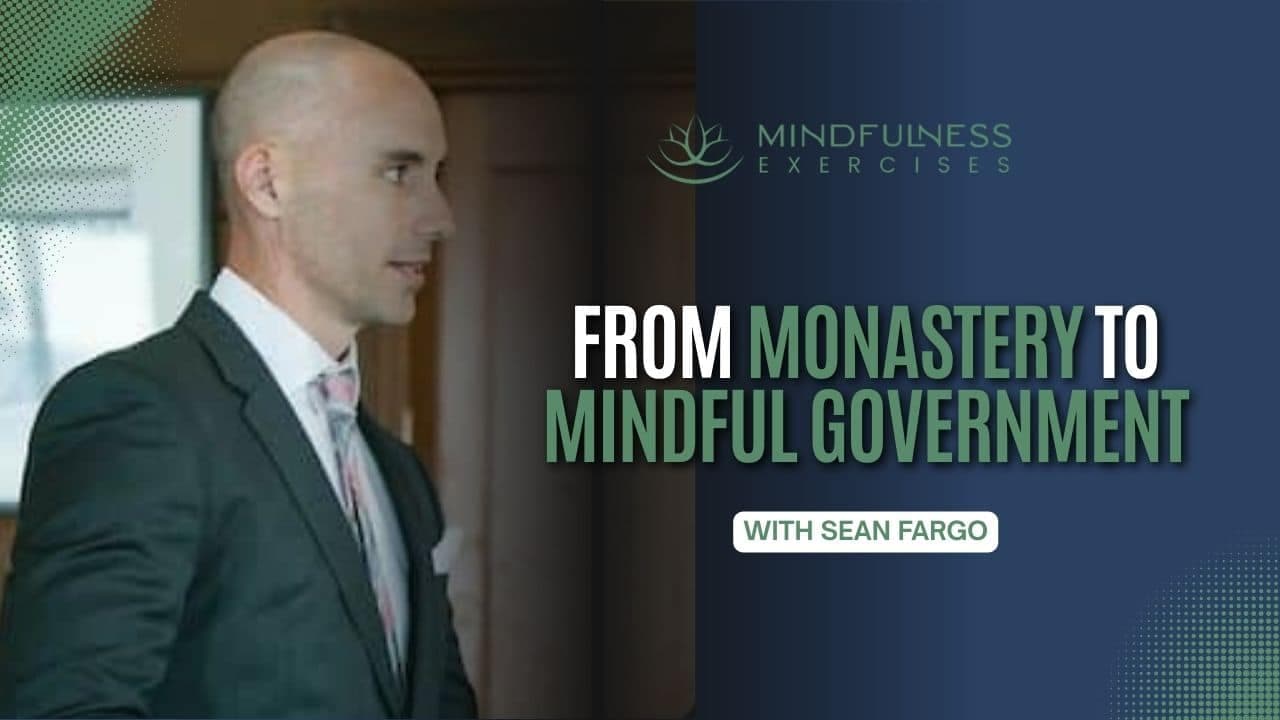
    From Monastery To Mindful Government

    SF
    Sean FargoPublished January 9, 2026 · 5 min read
    From Monastery To Mindful Government

    Listen to this episode

    Mindfulness Exercises Podcast

    Enjoying the episode?

    Follow the show in your podcast app. If this conversation supports your practice, a rating or review helps more listeners find it.

    From Monastery To Mindful Government — Tunein Logo

    TuneIn

    What does a monastery, a couch, a non-alcoholic hazy IPA, and the Environmental Protection Agency have in common?

    At first glance, not much. But when you listen closely—when you slow down enough to hear the deeper story—they form a powerful arc about attention, compassion, and what it means to serve a world under pressure.

    In this episode of the Mindfulness Exercises Podcast, From Monastery to Mindful Government, we explore a journey that begins with leaving monastic life and unfolds into something unexpectedly impactful: helping seed mindfulness inside some of the most complex institutions in modern society, including federal government agencies.

    This is not a story about mindfulness as a wellness perk or productivity hack. It’s a grounded, honest look at mindfulness as a skills-based response to stress, climate anxiety, and high-stakes decision-making—and why it may be one of the most practical tools we have for creating more humane systems of leadership and public service.

    Sponsored by our Mindfulness Meditation Teacher Certification Program MindfulnessExercises.com/Certify

    Episode Overview:

    • Leaving monastic life and returning to family and service
    • Why mindfulness is a skills-based response—not a workplace perk
    • Bringing mindfulness into healthcare and government institutions
    • EPA leaders enrolling in mindfulness certification
    • Mindfulness and climate anxiety in high-stakes decision-making
    • Attention as a shared and trainable resource
    • Training trainers to scale impact with integrity
    • How workplace mindfulness shifts habits at home
    • A more compassionate model for leadership and public service

    Key Takeaway: Mindfulness belongs wherever people face complexity, pressure, and responsibility—especially inside institutions shaping our collective future.

    Show Notes:

    Leaving the Monastery: When Practice Meets Real Life

    The decision to leave a monastery is rarely about a single reason. In this story, it wasn’t just about tacos or rules—though both made an appearance. It was about something far more human: the longing to hug family again, to sit on a couch, to re-enter the messy, beautiful complexity of everyday life.

    Monastic practice offers depth, structure, and profound stillness. But there comes a moment for many practitioners when the call shifts—from stepping away from the world to stepping fully back into it.

    That call, in this case, was to serve a world increasingly on edge.

    What followed was not a rejection of contemplative life, but an evolution of it—bringing the clarity and discipline of mindfulness into spaces where it’s needed most: healthcare systems, leadership training, and eventually, government agencies navigating enormous responsibility under constant pressure.

    Why Mindfulness Belongs Inside Complex Institutions

    Mindfulness in the workplace is often misunderstood. It’s sometimes framed as a perk—something nice to offer employees alongside yoga mats and wellness newsletters.

    But as this conversation makes clear, mindfulness works best when it’s treated not as a luxury, but as a trainable skill—especially inside high-stakes environments.

    In institutions like the Environmental Protection Agency, decisions are not abstract. They affect ecosystems, communities, public health, and future generations. Stress levels are high. Climate anxiety is real. Communication breakdowns can have lasting consequences.

    Mindfulness, in this context, becomes a form of operational resilience.

    Leaders who participated in the mindfulness certification discussed in this episode didn’t come looking for stress relief alone. They came because they needed tools to:

    • Stay present during complex policy discussions
    • Regulate nervous systems under pressure
    • Communicate more clearly across departments
    • Make values-aligned decisions in uncertain conditions

    The science supports this approach. Mindfulness training has been shown to reduce stress and anxiety, improve emotional regulation, and strengthen focus—benefits that translate directly into better leadership and collaboration.

    From One Leader to Many: How Mindfulness Spreads Inside Agencies

    One of the most compelling themes in this episode is how mindfulness naturally spreads when it’s practiced with integrity.

    EPA leaders who enrolled in the certification didn’t keep it to themselves. They invited colleagues. They shared practices. They noticed subtle but meaningful shifts in meetings—short pauses before reacting, clearer listening, more grounded conversations.

    This is how cultural change actually happens inside institutions: not through mandates, but through lived experience.

    The conversation explores what a mindful federal initiative could look like across agencies such as:

    • The Forest Service
    • Housing and Urban Development
    • Healthcare systems
    • Even the military

    Rather than imposing a single model, mindfulness becomes adaptable—meeting each context with respect for its mission and constraints.

    Attention as a Shared Resource

    One powerful idea that emerges in this discussion is the concept of attention as a shared resource.

    In meetings, policies, and public service work, attention shapes outcomes. When attention is scattered or reactive, decisions suffer. When attention is steady and embodied, something else becomes possible: nuance, empathy, and wiser action.

    Short mindfulness practices—sometimes just a few minutes—can change the tone of a meeting. They can shift a policy conversation from adversarial to collaborative. They can help someone transition from a difficult workday to a more present homecoming.

    These small moments add up.

    Training the Trainers: Scaling Without Losing Integrity

    Scaling mindfulness often raises a critical concern: how do you expand reach without diluting depth?

    The approach described in this episode centers on training trainers—equipping leaders not just to practice mindfulness themselves, but to teach it skillfully and ethically within their own organizations.

    This multiplier effect allows mindfulness to grow organically while maintaining its core values: compassion, non-judgment, and grounded presence.

    It’s not about branding mindfulness or forcing it into every space. It’s about offering tools that people can adapt, embody, and share in ways that feel authentic to their roles.

    When Workplace Mindfulness Comes Home

    One of the quieter, but most meaningful insights from this conversation is how mindfulness at work inevitably spills into life at home.

    Participants noticed changes in:

    • How they spoke to loved ones
    • What they consumed—food, media, habits
    • How they showed up after work, especially during stress

    Mindfulness doesn’t stay contained within an office or agency. When practiced sincerely, it reshapes relationships, consumption patterns, and the way we engage with the world.

    This is where mindfulness becomes more than a professional tool—it becomes a way of living with greater care and awareness.

    A More Humane Vision of Public Service

    At its heart, From Monastery to Mindful Government is a story of hope—grounded, realistic hope.

    It doesn’t promise that mindfulness will solve every institutional challenge. But it does show what becomes possible when people inside systems are given the skills to pause, listen, and respond rather than react.

    For anyone who cares about mental health, leadership, climate resilience, or the future of public service, this conversation offers both practical insight and reassurance: meaningful change doesn’t always start at the top. Sometimes, it starts with a breath before a meeting—or a moment of presence at the end of a long day.

    Additional Resources:

    Transcript

    Show transcript· 7 min read

    Casual Check-In And Setup

    Hey everybody, hope you're doing well. I'm Sean from Mindfulness Exercises. I just got out of a long shower and crashed out here on the couch. Opened up my favorite beer that I like. It's a hazy IPA from Athletic Brewing Company, but it doesn't have any alcohol in it. I like the experience of beer, but I don't like getting buzzed or drunk anymore. I used to before I didn't. So anyway, I just wanted to share some news with you that I still can't quite wrap my head around fully. You know, a lot of people ask me why I left the monastery.

    Life As A Monk And Its Limits

    So I was a Buddhist monk for a couple years, and I left the monastery for a couple reasons. One was to be able to hug my mom and my sister again, because as a monk I wasn't allowed to like touch women, and I just felt like I wanted to be able to hug my mom and my sister and you know spend holidays with family. And I also wanted to be able to eat hard-shelled tacos. I know that sounds funny, but as a monk, in the tradition I was in, which was in the same tradition as Jack Cornfield and a lot of other teachers, you can't eat things by taking a bite out of something while you're holding it with your hands. So you can't like hold a taco or a burger or something and take a bite out of it while you're using your hands. You have to like cut it first, and then whatever can fit on your fork or spoon or in your fingers, you have to be able to fit in your mouth in kind of a neat, tidy, elegant way, but you can't like bite something and and then put the rest of it down. Anyway, I digress. I like tacos.

    Choosing Climate Action And Mindful Work

    But but the the I guess the bigger reason why I left the monastery is because I felt like with the state of our planet, we needed help with climate change, really. I mean, there's a lot of growing anxiety and depression and stress and stuff around, you know, addiction, and there's so many challenges in the world, obviously. You know, politics, nuclear war. There's no shortage of challenges, but climate change just felt so important to me to be able to support in some way. And I kind of felt like teaching mindfulness was a way to help people to live with more consciousness, kindness, empathy for animals and wildlife. Maybe we could tailor what we consume that's a little bit kinder for the planet.

    Training Teachers To Multiply Impact

    And so, you know, I worked at Spirit Rock for five years, learning how to integrate and apply mindfulness to daily life. I worked in healthcare for a couple years, and you know, now I lead this mindfulness teacher training program that certifies people to teach mindfulness, hoping that by teaching people how to teach, that'll make big waves around the world. And

    EPA Embraces Mindfulness

    so I got this email a couple weeks ago from a senior leader at the Environmental Protection Agency, and she and a few of her colleagues are actually in my mindfulness meditation teacher training program where we certify people to teach mindfulness, and they're liking it and loving it, and they are sharing mindfulness trainings throughout the EPA, which has thousands of people across the country in it, and and they want to sign up like 15 or 20 more people in the next round in hopes to further spread it around the EPA and also to plant seeds for a mindful Fed, like a federal nationwide mindfulness program for like every federal agency of the US. And just on a personal level, it's I mean, it's surprising that the the federal government would be open to something like this because you know, twenty years ago, not many companies were even exploring this or schools. But in the last twenty years we've seen this sea change, pun not intended, where now it's much more mainstream.

    Mindfulness Goes Mainstream

    The science is clear that mindfulness helps reduce stress and anxiety, fosters more empathic and compassionate communication, and just restores our well-being and our mental health and our physical health, and is really helpful for senior leaders, for management, for people sort of on the front lines. And so I guess it's surprising to me, you know, if you had told me that 20 years ago, but but it's just a an indication that this is the real deal, that mindfulness actually makes a big difference in organizations and companies and nonprofits

    Gratitude And Federal Momentum

    and institutions. Like you see it in the military, you know, we've had several Navy SEALs in our certification program. You know, the places you might least expect it. And it's beautiful and inspiring to me. You know, and I I just feel really grateful to be involved in this in a very small way, but it feels really good because you know, again, when I left the monastery, I could never have dreamed that I would be helping people to help others in the federal government like this, with the Forest Service and the Navy, Housing Department. No, there's so many agencies interested now in these trainings that are kind of tied in with the this EPA, this mindful EPA program. And so it's kind of come full circle in a way, and I feel like it's sweet to like celebrate that, you know, and just continue my pledge to helping as many people as I can practice mindfulness and integrate it into more aspects of their life, you know, whether it's in the workplace or not. And obviously, when people learn mindfulness in the workplace, you don't leave it at the workplace. It's not like you put your mindfulness in your top cubby in your desk or put it under a paperweight or something. You bring it home because it's

    Mindfulness Beyond Work

    it's in you. You know, it's in your body and your heart. And the more mindful we are at work, the more we can practice being mindful at home, with our spouse, with our kids, with our loved ones, with how we make decisions around what we buy, what we eat, how we talk to people. So, so yeah, so I just wanted to share that news. I feel really happy about

    Hope, Thanks, And Community Invitation

    it. I think it's a sign of like hope and optimism for our future as a country, as a planet, as a species. There's so many people doing so many good things in the world. You know, mindfulness, meditation teachers, and beyond. So, you know, whatever role you're playing in the world, whether you're a mindfulness teacher or not, you know, if you're making a positive difference in some way, thank you. We need more people doing good things, and and there are many, many people already doing good things. But I think there's a lot of signs of hope and optimism. Yeah, and let's continue planting these seeds for goodness. So, so yeah, those are my thoughts. I hope you're having a good day. Thanks for sticking with me here. I know this is a long video, but I guess I had a lot to share. Feel free to leave a comment below on what you think about this. You know, what good are you doing in the world? I think it'd be inspiring for other people to see what you're up to. You know, whether it's making people smile in some way, or if you're a therapist or a teacher, maybe you're doing business, doing something that feels worthwhile and fulfilling,

    Farewell And Ways To Engage

    let me know. Let us know. Also, if you're interested in teaching mindfulness or getting certified to teach meditation, I'll put a link down below for that as well. If you have any questions, feel free to let me know. All right, well, cheers everybody. Take good care, and I'll see you again later. Bye.

    Share

    Continue reading

    • Grounding Through Anxiety With Senses

      Grounding Through Anxiety With Senses

      Read
    • Shamatha Vipassana Explained For Modern Minds

      Shamatha Vipassana Explained For Modern Minds

      Read
    • How To Stop Believing You Are Not Enough

      How To Stop Believing You Are Not Enough

      Read

    Professional training

    Accredited mindfulness teacher certification

    Trusted by teachers in 100+ countries

    Structured training, CE credits for eligible pay-in-full registrants, and support for teaching without self-doubt — after you have explored this episode.