🎉 $1,000 off Mindfulness Teacher Certification — annual sale ending soon

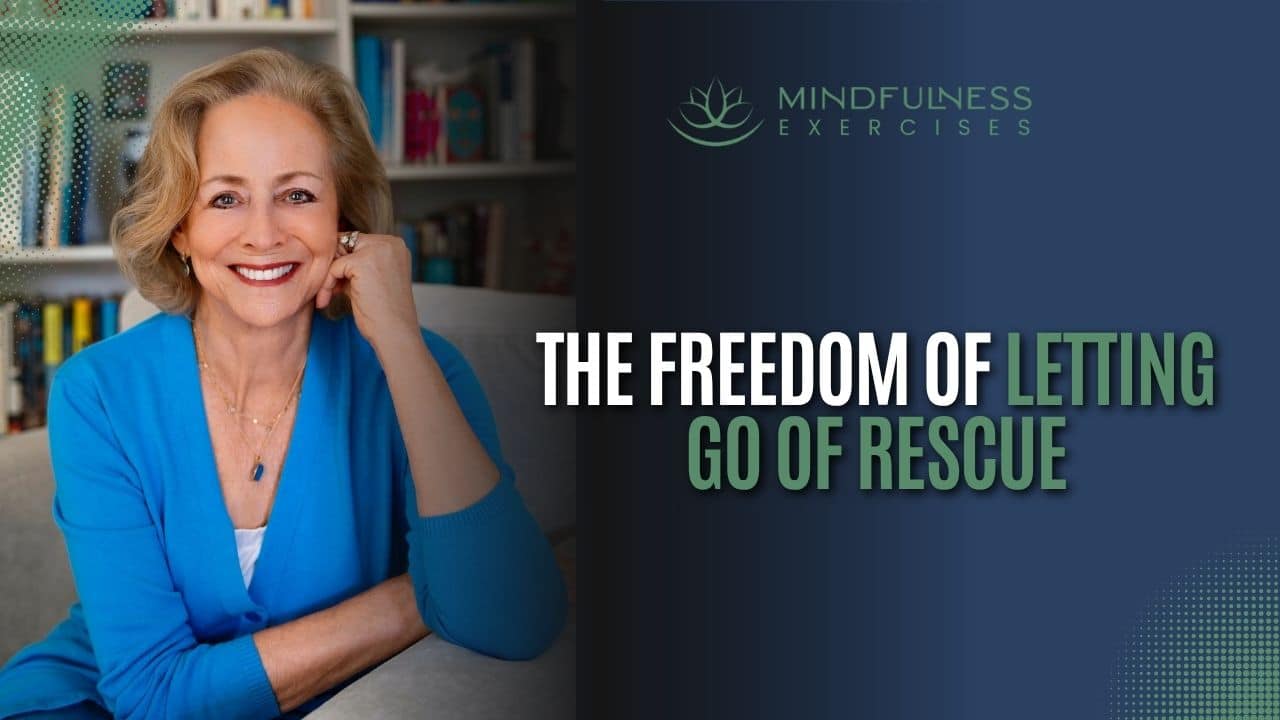
    The Freedom Of Letting Go Of Rescue

    SF
    Sean FargoPublished April 9, 2026 · 5 min read
    The Freedom Of Letting Go Of Rescue

    Listen to this episode

    Mindfulness Exercises Podcast

    Enjoying the episode?

    Follow the show in your podcast app. If this conversation supports your practice, a rating or review helps more listeners find it.

    There’s a quiet pressure many of us carry—especially as parents, caregivers, or helpers—the belief that we must fix, solve, or rescue the people we love.

    We step in quickly. We absorb their stress. We try to make everything okay.

    And yet, over time, this constant rescuing doesn’t just exhaust us—it can unintentionally take away something essential from others: their own agency, growth, and path.

    What if love didn’t have to look like control?

    What if it could feel more like an open hand?

    This is where the practice of equanimity begins.

    Sponsored by our Mindfulness Meditation Teacher Certification Program
     certify.mindfulnessexercises.com

    Episode Overview:

    Key Themes:

    • Reframing parenting through open-handed love
    • Practicing equanimity in caregiving and high-stress environments
    • Using “not my emergency” as a healthy boundary
    • Exploring vulnerability and identity in letting go of control
    • Understanding feeling tones as anchors for awareness
    • Supporting others without taking ownership of their path
    • Cultivating equanimity as a natural, trainable skill

    Key Takeaways:

    • You can be compassionate without overextending yourself
    • Boundaries are not barriers—they are acts of care
    • Letting go creates space for growth (for both you and others)
    • Equanimity helps prevent emotional exhaustion and burnout

    Show Notes:

    What Is Equanimity?

    Equanimity is often described as a balanced, steady state of mind—but in practice, it’s much more intimate than that.

    It’s the ability to stay present with what is, without clinging or resisting.

    It’s love without gripping.

    It’s care without control.

    When we cultivate equanimity, we shift from reacting impulsively to responding wisely. We remain compassionate—but grounded. Available—but not overwhelmed.

    And perhaps most importantly, we begin to trust that others can walk their own path.

    The Open Hand of Love

    Imagine holding something tightly in your fist.

    There’s tension. Effort. Fear of losing it.

    Now imagine opening your hand.

    Nothing is forced. Nothing is trapped. There is space—for movement, for change, for truth.

    This is the essence of equanimity in relationships: an open-handed love.

    It doesn’t mean we stop caring. It means we stop trying to control outcomes.

    Especially in parenting or caregiving, this shift can feel vulnerable. We may ask ourselves:

    • If I don’t step in, will things fall apart?
    • Am I being neglectful?
    • What if they make the wrong choice?

    But equanimity gently reminds us:

    Each person is the owner of their actions, their choices, and their path.

    Our role is not to rescue—but to support with clarity and presence.

    “Not My Emergency”: A Compassionate Boundary

    One of the most powerful (and misunderstood) phrases in this practice is:

    “Not my emergency.”

    At first, it can sound cold or dismissive—but when used with awareness, it becomes a deeply compassionate boundary.

    It doesn’t mean we don’t care.

    It means we recognize what belongs to us—and what doesn’t.

    For example:

    • A child forgetting their homework
    • A loved one facing the consequences of their choices
    • A client in emotional distress that we cannot fix for them

    Instead of immediately jumping in, we pause.

    We breathe.

    We remind ourselves: I can be present without taking over.

    This creates space for others to learn, grow, and develop resilience—while protecting our own well-being.

    The Role of Vulnerability

    Letting go of rescue isn’t just a practical shift—it’s an emotional one.

    It asks us to release identities we may have carried for years:

    • The fixer
    • The helper
    • The one who holds everything together

    Without these roles, we may feel exposed.

    Uncertain.

    Even guilty.

    This is where vulnerability becomes part of the practice.

    To let go of control is to trust:

    • That we are still worthy, even when we are not “saving” others
    • That love doesn’t require constant intervention
    • That presence is enough

    And over time, this vulnerability transforms into quiet strength.

    Anchoring in Balance Through Feeling

    In mindfulness practice, there is a concept called feeling tone—the subtle sense of whether an experience feels pleasant, unpleasant, or neutral.

    By tuning into these moment-to-moment sensations, we gain insight into our reactions.

    When we feel the urge to rescue, we can pause and ask:

    • What am I feeling right now?
    • Is this discomfort mine, or am I absorbing someone else’s?

    This awareness helps us respond with intention rather than habit.

    Instead of reacting from anxiety, we act from clarity.

    Equanimity Phrases for Daily Practice

    Simple phrases can anchor us in equanimity, especially during challenging moments.

    Try repeating these silently:

    For Yourself:
    • I care, and I can let go.
    • This is not mine to carry.
    • May I remain steady and open.
    For Others:
    • You are the owner of your actions.
    • I care about you, and I trust your path.
    • May you find your way through this.

    These phrases aren’t about detachment—they’re about loving without losing yourself.

    Avoiding Burnout as a Caregiver

    For those in helping roles—parents, therapists, healthcare providers, or support professionals—burnout is often rooted in over-identification.

    We take on too much.

    We give without replenishing.

    We feel responsible for outcomes we cannot control.

    Equanimity offers a different way:

    • Care deeply, but don’t carry everything
    • Show up fully, but don’t lose your center
    • Support others, but allow them their autonomy

    This balance is what sustains compassion over time.

    Equanimity Is a Trainable Skill

    The most encouraging truth is this:

    Equanimity is not something you either have or don’t have.

    It’s a skill you can develop.

    Each moment you pause instead of react
    Each time you choose presence over control
    Each breath you take before stepping in

    You are strengthening this capacity.

    Slowly, gently, consistently—you begin to experience more space, more ease, and more freedom.

    A New Way of Loving

    Letting go of rescue doesn’t mean stepping away from love.

    It means stepping into a deeper, wiser form of it.

    One that says:

    • I am here with you.
    • I care deeply.
    • And I trust your journey.

    This is the freedom of equanimity.

    An open hand.
    A steady heart.
    A love that doesn’t cling—but allows.

    Final Reflection

    Where in your life are you holding too tightly?

    And what might shift—within you and around you—if you gently opened your hand?

    Recommended Reading & Resources

    If you’d like to go deeper into the themes explored in this episode, here are some powerful resources from Margaret Cullen:

    📘 Book:Quiet Strength: Find Peace, Feel Alive, And Love Boundlessly With The Power Of Equanimity

    🌐 Website: Margaret Cullen
    https://margaretcullen.com

    These resources expand on the practice of equanimity and offer practical ways to integrate mindfulness into everyday emotional experience.

    Additional Resources:

    Transcript

    Show transcript· 11 min read

    The Open Hand Of Love

    Speaker 1 · 0:00I remember being on retreat with Joseph Goldstein and Bhiku Analio. There was a mom who raised her hand and said, You know, it's really hard for me to practice equanimity when I have a two-year-old at home and I love my daughter more than anything in the world, and it's really hard for me to relate to my daughter with equanimity. And I remember Joseph had a beautiful metaphor saying, Well, when you think of your daughter, does your love feel like a tight grasp around your daughter where you just lock on them so much with your love? Or is it more of like an open hand holding your daughter where you're still allowing your daughter to be her, but you're kind of loving her a little more gently? And it really helped the mother kind of reframe and understand the felt sense of equanimity a little bit more, of like allowing the world to do its thing without getting too locked in to the hyperbole and the control. And remember like how we are as a mother. Can we feel into equanimity and relate to the world with a little bit more ease? So many people in our community are mindfulness teachers, caregivers, therapists, counselors, coaches, wellness professionals who are helping other people. And it's their job to provide care for people, many of whom are severely depressed, suicidal, addicted to things, suffering from chronic pain. They're kind of in dire straits. Do you have, say, any equanimity phrases or words for caregivers who are burned

    Equanimity With Children

    Speaker 1 · 1:50out these days, especially after COVID?

    Speaker 2 · 1:53Yes. And also I really appreciate the story that Joseph, of course, not having children, has so much wisdom about her mother. And I just want to share that I think one of many reasons why I pursued this idea of equanimity, or it pursued me, was that in many ways, with my own daughter, I failed to be equanimous raising her. I became a mother late. She's my only child. I really had trouble bearing her pain. And I was very attached to making sure she didn't suffer. And of course, I failed at that. And I also think, in some ways, handicapped her because of my lack of equanimity in raising her. Fortunately, you know, she's an adult now and we talk about it and sometimes we even joke about it. And over the years, I have used that practice. I think as parents, it's one of the stickiest places where we get the most confused about how much control we have over the well-being of others, but it applies to all the providers you talked about in your last question as well. Just reminding myself, especially with my daughter, that she has her own trajectory and doing the equanimity phrases with her in my own heart was incredibly helpful and continues to be. I continue to work that edge, even with my adult child, who's very much in her own life now. So I just want to acknowledge how challenging it is with our kids. And in terms of providers, I wrote about in my

    Caregivers On The Edge

    Speaker 2 · 3:42book, I hope it doesn't sound too simplistic to people, but there's a catchphrase my husband and I heard someone say at a party long, long time ago, that has been so helpful to us. We were talking to an emergency room doctor who had been doing that work for a long time and loved it. And we said, How do you manage all that intensity every single day with life and death and time pressure and so much at stake? And she said, I remember it's not my emergency. That just became this catch phrase for us. It was so clear that in her case, if it was her emergency, she couldn't do her job well. But I think that's actually true for a lot of us, and certainly for providers, to really be present. We can fully show up with our skills and love and presence in whatever way we do

    Not My Emergency

    Speaker 2 · 4:46that for people who are in crisis.

    Speaker 1 · 4:48And to be able to understand what is our emergency and what is not takes a great deal of wisdom too. I just pulled up some equanimity phrases for listeners to get a sense for what we're referring to as what an equanimity phrase is. I'll just share a few, some of which speak to the fact that it's some of the things that we think is an emergency for us actually isn't. This feeling is here, and I am still okay. I don't have to fix this right now. Even this is part of the path. Balanced in praise and blame, balanced in gain and loss. You're speaking about the eight vicissitudes.

    Equanimity Phrases That Ground

    Speaker 1 · 5:32And then in terms of equanimity phrases for others, like say our kids, phrases that can remind us that they have their own karma, their own trajectory, their own life. Some phrases include, you are the owner of your actions, not me. Your happiness and suffering are not mine to control. I care about you deeply, and I release the need to manage you. May I respect your path even when I don't understand it. And these phrases are so powerful. And again, I feel like some of them relate to say uh an understanding of karma or belief in karma.

    Speaker 2 · 6:17We're getting a little Buddhist geeky here, but I have to find this quote because it's come up before, but I don't know that Khalil Gibron believed in karma. He probably didn't, that wasn't his tradition. I don't know what his version might have been, but he wrote that beautiful poem about our children are not our children. And I can't remember all the words right now, but Betsy Rose put it to music so beautifully. I can think of her singing this gorgeous poem about how they have their own destiny. So I think we can believe that even if we don't believe in karma.

    Speaker 1 · 6:58Yeah, absolutely. And a woman who held a babe against her bosom said, speak to us of children. And he said, Your children are not your children, they are the sons and daughters of life's longing for itself. They come through you, but not from you. And though they are with you,

    Children As Their Own Path

    Speaker 1 · 7:20yet they belong not to you. I can imagine Betsy singing this. I see her every once in a while here in Berkeley. Where are you located, by the way? I'm in Berkeley. Oh, you are? We're neighbors.

    Speaker 2 · 7:36We're neighbors.

    Speaker 1 · 7:38Yeah, I'm on uh Josephine

    Neighbors And Real-Life Parenting

    Speaker 1 · 7:40and Cedar for whatever it's worth.

    Speaker 2 · 7:42You are I'm on just off Cedar on Buena Vista and Euclid.

    Speaker 1 · 7:48Oh, that's funny. Maybe you'll take you to tea or lunch one day. We can talk shop sometime. I'm a dad of a seven-year-old now, and I think this is the hardest to practice

    Vulnerability And The Self

    Speaker 1 · 8:02with. I can understand why the Buddha's parents wanted to protect their son from suffering, and I want to do everything I can to protect my daughter, but I also know that I can't control things and I need to let her fight more and more of her battles, even though I cry thinking of that. You mentioned earlier that when loving kindness meets suffering, it's compassion. When loving kindness meets, you know, the well-being of others or success of others, it's mudita, sort of a form of joy. With equanimity, I don't know if you're playing with these phrasing a little bit, but you said when loving-kindness meets vulnerability, it can be equanimity. I think that's true. I wonder if loving kindness meets I'm wanting to say identity, but I don't feel like that fits right. I've never heard a teacher say that it meets something to create equanimity before. So I'm just curious if you can kind of speak to the vulnerability piece and if there's something else there too that I'm not quite getting yet.

    Speaker 2 · 9:12I'm not sure if you're driving at this, but what occurred to me when you asked that was the poignancy of loving-kindness, seeing the futility of defending

    Feeling Tones And Surrender

    Speaker 2 · 9:26the self and those efforts. There's something very poignant about that, about seeing that through the eyes of love, of seeing all that flapping around we do, all that rumination, all that energy, all of that treading water in place and not getting anywhere as we attempt to defend and curate our experience. So, in that sense, yeah, I'm not sure I would have a simple way of phrasing that, but that's part of the vulnerability that we're talking about. It's the vulnerability of how useless, in a sense, our attempts are to defend the self, as well as how little control we have over the happiness of our loved ones and a lot of outcomes that we can be very invested in. There's vulnerability in just kind of accepting, I would say, in an ultimate sense, we're talking about the fact that we are a part of the world and that there's tremendous freedom and relief in being connected to everything. There's a lot of pain and suffering in our ideas of being separate from everything. But as we well know, there's a giving up of a lot of illusions in that surrender. And that's the poignancy and the vulnerability of equanimity is the poignancy of giving up those illusions of control and that I have a self and that this self can do these things in the world, that I have more agency in some sense than I think that I do. And that I can protect myself from pain and suffering, that I can protect my loved ones from pain and suffering. It's a very poignant kind of Don Quixote windmill quest in a sense, human and poignant.

    Speaker 1 · 11:42Beautiful. For me, when I hear you talk about that, it rings true. And I come back to Vedana in the sense that like, how can I feel all of life? It's pleasantness and unpleasantness, and neither pleasantness or unpleasantness, and surrender my need to make it into something, or react, or identify, or crave for, you know, sense pleasure or becoming or creating an identity around it. Just as a side note, for those who would like to deepen their awareness of what we're talking about with the second foundation, I highly recommend a book on the four foundations of mindfulness by Biko Analio.

    Simple, Innate Equanimity

    Speaker 1 · 12:34And he really breaks down these links between you know mindfulness of the body, mindfulness of feeling tones, largely that can be quite physical, and then mindfulness of mental volition or thoughts and things that come up in the mind, the thought world, and just how powerful it is sensing into the power of surrendering the flailing and the, as you talked about, of just being human and how poignant that is. Margaret, thank you so much for talking about this. I feel like we're scratching the tip of the iceberg here. I hope this is helpful for our listeners, and this is going to be something that I dig into a lot more over the coming months. But I'm wondering if there's anything else that you'd like to share with our audience that hasn't been said, or if you have a message for people interested in this, maybe plug your book. What would you like people to know?

    Speaker 2 · 13:34Thank you. This has really been a very rich conversation and such a pleasure to speak with someone who's deeply familiar with Buddhist philosophy, which is really at the heart of the book, although it is a kind of big think approach to equanimity, but that's been my path. And I also think that Buddhist philosophy has done a better job of articulating equanimity than any other tradition. But I think the only other thing I want to say is that like the other Brahma Viharas, we all have equanimity. It's foundational, it's fundamental to being human. It's not anything anybody has to manufacture that like mindfulness, like the four immeasurables, we're uncovering, we're creating the conditions to experience more of what is fundamental to our nature and not to make it something lofty and unattainable and something we have to strive for. It can be very simple. It can be in a moment of clear seeing. It's like every step you take, you lose balance and you regain balance. So I think that's what I'd like to close with. Just very down-to-earth equanimity is within everyone's grasp. It's part of who you are. Our world and social media do a pretty good job of distracting us from it, but everybody has it.

    Share

    Continue reading

    • Grounding Through Anxiety With Senses

      Grounding Through Anxiety With Senses

      Read
    • Shamatha Vipassana Explained For Modern Minds

      Shamatha Vipassana Explained For Modern Minds

      Read
    • How To Stop Believing You Are Not Enough

      How To Stop Believing You Are Not Enough

      Read

    Professional training

    Accredited mindfulness teacher certification

    Trusted by teachers in 100+ countries

    Structured training, CE credits for eligible pay-in-full registrants, and support for teaching without self-doubt — after you have explored this episode.