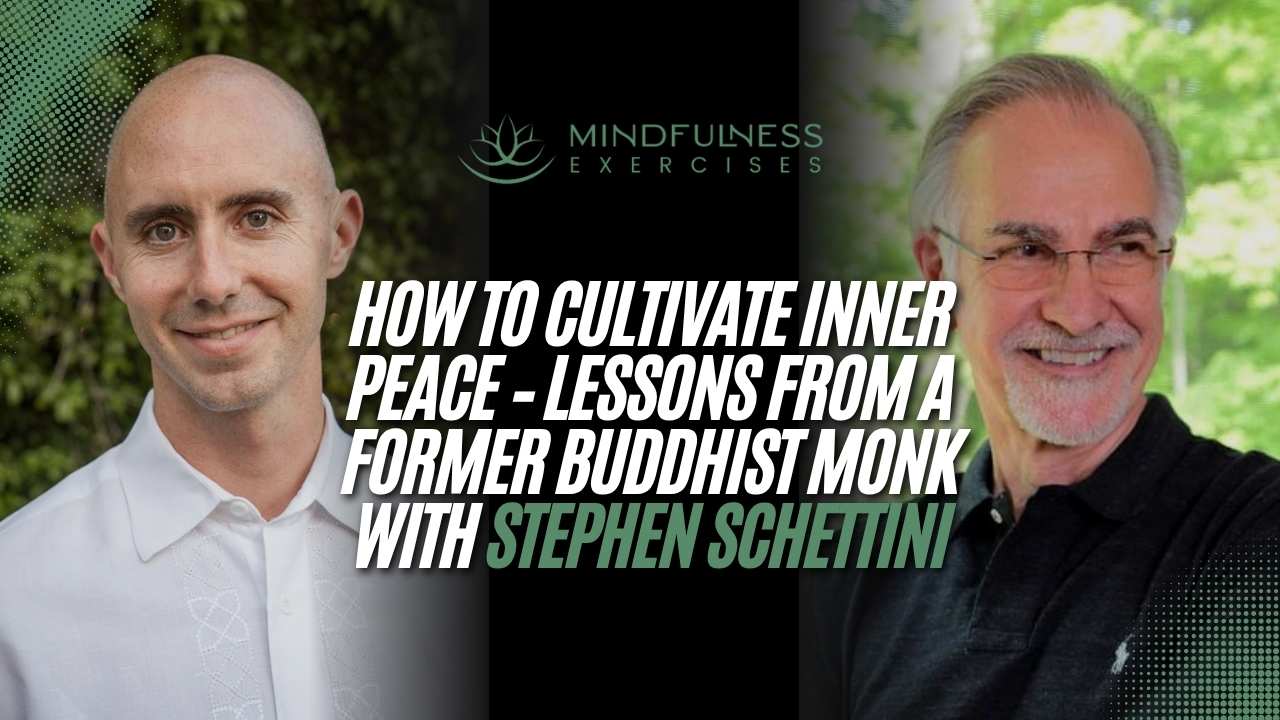
Speaker 1 · 0:00Alright, welcome everyone to the Mindfulness Exercises podcast. My name is Sean Fargo. Today I have the honor of speaking with Stephen Scatini, known as the Inner Monk. As you may have guessed, he was a former Buddhist monk like myself, and he turned into a mindfulness coach and author. After spending eight years studying Buddhist philosophy and psychology and debate in Asia and in Europe, Scatini transitioned to secular life, becoming a husband and a father like myself, and he's also a professional in writing, design, and typographic design. In 2003, Stephen founded Quiet Mind Seminars with his wife Caroline. And in the pandemic, in about 2020, he morphed that into what is now his ongoing service called Mindfulness Live. He successfully detaches meditative practices from their religious trappings using scientific language to address today's fast paced secular lifestyle. Stephen's books include The Novice, which is a memoir of his monastic years. And also it begins with silence, a secular guide to Buddhist teachings. He hosts regular online mindfulness sessions, he offers personal guided meditation services, and conducts regular mindfulness workshops and seminars. Through his brand, The Inner Monk, Stephen Scottini empowers individuals to reduce stress, improve focus, enhance their relationships, and cultivate emotional intelligence. Stephen, welcome to the podcast.
Speaker 2 · 1:57Thanks for having me, Sean. It's a pleasure to be.
Speaker 1 · 2:00Yeah, it's an honor to meet you. It sounds like we have some overlap in terms of our background. We were both monks for a while. Now we're mindfulness coaches and teachers wanting to help people in kind of a secular way in this modern world. Not too many of us out there, so it's nice to connect with you. I love your brand, the inner monk. That's really cool. Stephen, I'd love to start just kind of learning a little bit about your story and your journey. And can you talk about your first encounters with mindfulness or meditation and uh what inspired you to begin practicing?
Speaker 2 · 2:42I wanted to control my mind. It's driving me crazy. I didn't know I had attention deficit when I was a kid. People didn't use that phrase, but I did, and I had all sorts of problems, and and people looked at me as a problematic kid. And so I was angry and uh frustrated and distracted all the time. And I I was a teenager when I realized I had to do something about this. And it was the 60s, it was um it was the time of uh you know the Beatles and meditation and all that. And I used to put on a Ravi Shankar album and I'd lie on the bed with my eyes closed and imagine it was floating through the universe, you know. So that that was the beginning. Over the years I kept reading and learning, and uh it was a long process. Eventually um it became a really powerful drive. After four years of university, I dropped out because I just couldn't face that sort of continual life that I was I was on track to become just something I I didn't want to be and I didn't understand, and I and I felt compelled to really uh find myself. I uh I had one advantage, which was my parents were both from the circus, and they had both done what they really loved to do when they were young. So I grew up with this idea that uh I could do whatever I wanted with my life. So it wasn't hard for me to give everything up and uh went out to India and uh joined the Tibetans. Very different from the Thai tradition that you were in. This is much more colourful, it's it's much more Catholic tradition, in many ways much more challenging. I stayed with them for eight years, and in the last year or two I started uh exploring Theravada Buddhism, Southern Buddhism. That was part of the reason that I left. I I felt much more at home with that uh very human Buddha, as opposed to the Tibetan Buddha is you know, sort of a well, what would you call him? Supernatural, uh superhero, certainly not human, not someone I could relate to.
Speaker 1 · 4:47Yeah, maybe more of like a religious yeah, much more so. You had parents in the circus. You're in were you would you say that you're inspired by the Beatles in terms of their uh foray into meditation and being inspired by what's what's in the mind and how to cultivate the mind?
Speaker 2 · 5:07Yeah, I I don't think they caused that fascination. I was raised as a Catholic in a very old-fashioned and very dogmatic way. And I I did reject the beliefs, and I I had to walk away from the whole church. But one thing remained in my life, in my mind, which is that I I did need something. That's what kept me going.
Speaker 1 · 5:28Why did you actually go to Asia? Like, did you hear about the the monks in India? Or um, did you know you were going to Asia to to learn from monastics?
Speaker 2 · 5:43I was traveling. I just put out my thumb and I started traveling, and my uh whole my hope was to find, I suppose, a mentor. That's what I was looking for. I was looking for some guidance in my life. And as I was, I I'd already read quite a lot about Buddhism, and I was certainly inclined towards it, but I wasn't looking specifically for that. That just happened to play out that way. I came out of a period of intense uh uh drug use uh in Pakistan, and I landed in India uh in Dharamsala, and the Tibetans were very welcoming. I was at a very low point in my life, I was in need of comfort and belonging, and that's exactly what they offered. And they took me incredibly generous with their time and their teaching, and it was a wonderful experience. But in the end, I had to admit it wasn't for me. I wasn't made I was trained to be a teacher, but it was made clear that I should be teaching Tibetan Buddhism, Tibetan style. I realized that that would not go down with a very wide audience in the West, and that these were the people I wanted to I want to teach my peers. So I left and I found my own way. All my friends found teaching careers within different Buddhist institutions and groups and so on, and uh and I didn't do that. I walked right away from that, so it was a long and hard road, but uh it certainly left me in a very independent place.
Speaker 1 · 7:08It uh sounds similar to my story in the sense that my first year as a monk, the monastery where I lived was training me to be a teacher for their own specific style that was quite well, it it kind of raised a lot of eyebrows in the West, and I did not want to come back to the United States to see my family and friends teaching something that was quite bizarre, very belief-based, dogmatic. Um, I felt like I would uh be disconnected from from my loved ones and maybe a sense of reality, and uh knew that I had to find something a little bit more say secular, grounded in common sense, something that could make sense to the average person. So I think we share similar stories. I then found the Thai forest tradition, which I think much better fit the bill for me in the sense that their teachings are um more inquisitive, just be curious about your own awareness, your own experience, find your own insights, and that I could uh practice and share with others much more easily. So anyway, resonate with that part of your story very much. Can you share what were some of the first practices that you found that um resonated with you that you felt separate from the dogma or theology? What practices did you find most useful in the early years of your practice?
Speaker 2 · 8:48Uh death meditation. Over the years, all the I've studied a lot of philosophy, some of it's very complicated and language and all this stuff. But I over the years I've just I've realized that the difficult thing about mindfulness is doing, just doing it on a regular basis, really committing to it, you know, doing it whether it's a good day or a bad day. And uh that that's the hard part. There is no better motive, and there is I mean, it is the real motive. I mean, the reason we're doing all of this is to is to face our own mortality, face our our life. So when you realize, or then let's put it this way, the more you realize how close death really is and how easy it is and how uncertain it is, the more your life comes into focus. It really does. So in the Tibetan tradition, that they make it very clear at the beginning, at the outset, that you know there are two types of meditation, there's concentrated meditation and there's contemplative. So the contemplative was from the very beginning made and into a big deal, which I'd always thought was no, meditation is all about going in and inner peace and being completely shut off from the world around you and perfectly blissful. So I'm glad that that I was soon abused or disabused of that idea. But the death meditation that really works, still does.
Speaker 1 · 10:06Yeah, and and can you break that down in in terms of a practice? Do you is it just a mere reminder that death is could be here at any moment, or is there a step-by-step practice that you do?
Speaker 2 · 10:20Well, both. I mean, when it comes into your mind, that you know, to not dismiss it is already a big deal. So to realize, yes, you know, it is gonna happen. But then you can go through it methodically. Imagine you're lying on your bed, you're dying, you're breathing your last breath, the air's coming out and it's not gonna go back in. It's you can make it very vivid, it's not difficult. The funny thing is that it's not scary. And that's that's the greatest lesson, perhaps of all, is that uh because we avoid facing our fears and our our anxieties because God, I don't want to face it. And yet when you do, when you actually turn to face it, it becomes manageable in a way that you didn't expect. Yeah, doing it in that experiential way, as an idea, yes, has a certain effect, but when you really imagine it and you put yourself in that and you and you're bringing not just your your frontal cortex, but your whole body and emotional being into that experience, then yeah, it it changes the way you think, changes the way you feel, changes your priorities. Yeah, priorities are a big deal when you're when you're living in a consumer society. It's a constant effort. We're always trying to be more or be something else.
Speaker 1 · 11:33Yeah, you said for you it it put your life into greater uh say focus. How has it changed your priorities? And do you share uh say death meditation or or death awareness or marana sati with other people? And how do you see it affect them?
Speaker 2 · 11:53Some people are scared of it. Most people do get into it. They're very, you know, they're a bit nervous because they thought they didn't think they were coming for that sometimes. But on the whole, people appreciate it and and they start, it takes time to realize how it can affect you. But it is a big part of what we're doing. I mean, the very first step of the Eightfold Path is uh outlook, is your mindset. And that's exactly what this works on. It it points you in the direction of I want to bring purpose to my life, I want to make this life meaningful. It's short, it's brief. I'm gonna do it now. I'm gonna engage. What do I do? And of course, then that's the hard part. What do I do? But you find out for yourself, that's the important part too. A big part of what I teach and and what I write about is the whole concept of belief. And many people, for most people, religion is that's what it's all about. If you believe, you're okay. What I learned from the Buddha is that believing isn't enough. You have to do. So whatever helps you get away from the theory and actually enact what you're talking about, really get to know yourself, accept yourself. It's not easy, it's hard, it's it's it's an emotional challenge, but it's possible. And that's that's the goal.
Speaker 1 · 13:15And so you talk a lot about the inner monk. Do you believe that we all have an inner monk? And what is the inner monk?
Speaker 2 · 13:24Well, we can have it. It's a place where we feel safe with ourselves, where we respect ourselves, you know, instead of, oh, Stephen, you're so stupid. Why did you do that? It's it's a you know, it's it's a recognition that we treat ourselves badly sometimes, but um ultimately we're we potentially we can be our own best friends. And that's where the inner monk is. That's what the inner monk is. It's that place you can go to inside yourself, which is home, where there's no judgment, where you can really let go of your expectations, and you can see what's actually going on in your body, in your feelings, and in your thoughts, and in the world around you. There's no inner peace without outer peace as well. So it's it's you know, it's there's a big picture here. Meditation is not just private, individualized, but it does start by making friends with yourself, and that's a biggie. People have difficulty with that. I had difficulty with that. And now with social media these days, there's a there's a it's it's an epidemic of low self-esteem because everyone's comparing themselves more than ever with not even with people, with imaginary profiles, you know, made up ideas of what a successful human life is like. So um overcoming that is really hard because that's the world we live in. So you have to develop that inner monk. You have to develop some integrity in yourself. I don't mean just moral integrity, but I mean functional integrity, where you really know who you are, how you're being, how you react, what to watch out for, all of that stuff.
Speaker 1 · 15:00Yeah, you uh said something perked up my ears that I've been playing a with a lot lately, which is a sense of safety and how to feel safe with ourselves, how to find refuge with ourselves, and how to be friends with ourselves. What are some of the first few steps or recommendations that you have for people for cultivating a sense of safety with themselves?
Speaker 2 · 15:29Well, the first thing is to like yourself, which is harder than it sounds, or more unusual than it sounds at any rate. And there's a practice that that I do, uh and it's good for journaling, called I Like Being Me. Do something and look at it and say, well, that was good. I like that. I'm glad I did that. I'm I like being me. We're wired to give more attention to danger for obvious reasons, because you know, danger is it's gonna cut our life off, then everything else is irrelevant. So we tend to look more towards negativity. We see ourselves in negative ways much more easily than we do positive ways. And so it goes against the grain. It takes a special effort. And effort, you see, there's another aspect of the Eightfold Path, which which you need to cultivate. It doesn't just happen by itself. People ask me sometimes, so um, when does mindfulness get to that point where it's automatic? Of course, the whole point is that it's not automatic. That's what mindfulness is about. So we keep falling back into that, you know, and we keep falling back into the oh, I I I messed up, I'm so stupid. So it's very, very important to make a formal practice each day. If you're doing breath awareness, if you're doing uh mantra meditation, whatever, you should also do I like being me meditation. At least find something in the course of the day which makes you think, I like that, that's good. I'm not such a bad guy after all.
Speaker 1 · 16:58Yeah, when we think about, you know, why we're friends with other people, it's because we like different things about them. And so it makes sense that, you know, it would be important for us to find, you know, as many things as possible about ourselves that we like and to actually cultivate that likeness for ourselves. Uh yeah, and I think journaling is a wonderful way to do that, keeps us kind of focused on it, and we can find creative ways of bringing awareness to ourselves and putting it down on paper. That's a that's a great recommendation. And for those of you listening, you know, what do you like about yourself? How much do you like about yourself? And how would it feel if you liked 10% more of yourself? You know, can you cultivate this ability just to be with yourself in a way that's safe or comfortable? I think it's really, really powerful and can encourage us just to be more, just to be with ourselves and just kind of sitting and sensing.
Speaker 2 · 18:06One of the things that really um crystallized my practice after I left monastic life was because I studied with the Tibetans who very rarely actually study the Buddha. Well, look, there's 20, 2600 years of study and scholarship, and they focus mostly on that, the interpretations of the Buddha. But when I went back to the to the uh the Pali Canon, to the original of the earliest texts, I realized something, I I found something which really made a lot of sense to me. That the entry to the path, you enter the path when you become independent of teachers and doctrine. And that was a big eye opener. Because that means, well, does that mean I I should not be a Buddhist? Is that what the Buddha's telling me? Yeah, it's belief, again, belief is just not enough. You've got to, it's it's got to be in your own mental continuum, it's got to be part of your own experience if it's gonna transform you in any way at all. And that depends on believing in yourself, on trusting your own ability to know and move forward. Doesn't mean you're always right. You trust in your ability to learn as you move forward. It's a path of trial and error. And of course, when you first start, when you first encounter the Buddhist teachings, my God, they're so well organized, and you've got lists and numbers and hundreds, and it looks like a pristine, you know, and then you go and sit and meditate, and all you find is chaos. So it's there's a big contrast here. So it takes it it's that sense of befriending yourself, being comfortable in your skin as you're doing this, and relying on yourself. That's really what we're looking for. Once you can do that, then then you start to have a solid practice.
Speaker 1 · 19:51Yeah, there's nothing, say, external that's gonna save you. Yeah, and um, especially in the Theravada tradition, there's a lot of emphasis on say stream entry or this first part of awakening. One of the milestones, if you will, is uh that you've given up, you're clinging to what they call rites and rituals, which is basically what you said, that it's not about, you know, all these say beliefs or about how many times you you bow to a statue or say ceremonies. It's not about any of those things, these trappings, if you will, which when I became a monk, I got really excited about all these new rituals and chants and you know, wearing my robes a certain way. And, you know, I felt like if I did all these things, I'm gonna be a better monk and a better person, and it's gonna put me on a fast track to enlightenment. And, you know, there's nothing wrong with any of those things, but really what's more important is our heart. You know, are we grounded? Are we paying attention, adhering to our priorities? Are we treating ourselves and others well? There's elements of the Eightfold Path just around right livelihood and right effort and ethics that are so foundational. And it's about the practice of presence rather than you know succumbing to the trappings of, say, religious procedures.
Speaker 2 · 21:35To go back to your your idea of safety, it's about where we're looking for our safety. Are we looking for it outside or inside? In Buddhism, we talk very plainly about refuge. You take refuge in the Buddha and the Dhamma and the Sangha, which all sound like they're out there, but they're really not, especially Dharma. At the end of his life, they said, What are we gonna do? And he said, You rely on your practice, you rely on your Dharma. Who's gonna lead us?
Speaker 1 · 22:00Yeah, be a lamp unto yourself. And you know, we all have an inner monk, we all have an inner Buddha, you know, the practice is within, and that sense of connection with others is so important, but you know, we can be around others physically and still feel alone. And we can be alone and feel super connected with anyone, everyone, all beings, everywhere. So it really does start within. I'm wondering, you know, how how does your past identity as a Buddhist monk shape the way that you teach and connect to people now?
Speaker 2 · 22:41Gosh, what a big question. I gave back my robes, as they say, but my teacher just looked at me and he said, he said, you know what? Once a monk, always a monk. And it sort of stuck with me. I don't really I know you work a lot in business with business people and and uh corporate settings. And uh I never did that. I I worked for one year in a corporate job and that's all I could do. I've always been uh independent, I've always been, I've never really worried very much about money. Uh some people say I should have worried more, but I've been okay, I've survived. So I yeah, so in that way, being not really uh on the same page as most working people, uh I feel a little bit different, you know, and I feel maybe I'm too different that that my life made me sometimes I feel, oh, it's just too weird. And that's certainly the way people have treated me in the past. When I first came out of the monastery in 1982, the first thing I learned was to not talk about it, because people just thought it was too weird. And then in the 90s, that whole attitude began to change, and people used to say, Oh, really? You were a monk? That's so interesting. So there was a social change, there is a social change going on, and I began to see that then. So then it left me a little more free to uh expose myself as a monk. In fact, I called my first blog was The Naked Monk, which was about trying to pursue that ambition, that monkish ambition, um, but without the trappings, without the robes and the llamas and the you know the bells and the drums and all of that stuff. Um how do you actually do this? So that's what I was exploring in the blog and in my teachings back then. I'm very conscious of it. In a sense, it's an identity. I mean, in these days when we have to create an online identity, yeah, a former Buddhist monk keeps coming up again and again and again. And that's my that's my moniker. You use it too, it's on your website.
Speaker 1 · 24:38Yeah, I don't really think of it. Um but yes, people tend to yeah, I mean, some people like it, some people don't, but it's different. Exactly. That's the point. By no means does being a Buddhist monk mean that you're necessarily wise, but it does point to some degree of say intentionality, some degree of sincerity, and uh some degree of uh of practice. You know, nowadays some people ordain for like a day in certain monasteries, and so you know, there's a lot of people now saying they were a monk, but you know, maybe they didn't they didn't last 24 hours, which is fine. But there are degrees to these things um in the sense that some people were a monk for weeks, months, years, decades, and you can usually sense the difference in in them just in their quality of being or their quality of presence.
Speaker 2 · 25:40Yeah, I mean, even in the Buddha's time though there were householders who who did very well, who became arhats. You know, the Buddha was quite happy to proclaim their achievements. And the same today. You don't have to be a monk. But if for me, I was very damaged. I was emotionally uh needy, I was lonely, there was lots of stuff going on. But the point is it it was a healing mechanism for me, very powerful one, to be in the tradition, to be protected uh materially as well as spiritually and emotionally by this community. So it was it was a terrific experience for me, and I loved it. And I still look back upon it with a sense of longing, actually, but at the same time uh knowing that no, I d and I wouldn't fit there anymore. I don't want to fit there anymore. That's done. I mean I'm I'm I'm longing for that innocence, I suppose.
Speaker 1 · 26:30Yeah, is it innocence? Is it simplicity? Is it that connection with with other monks?
Speaker 2 · 26:37Being able to speak to people of like mind is a big deal. As I say, when I left the monastery, that was in Switzerland, and that's when I moved to North America, uh, and I literally had no support system here at all. And uh I soon discovered that no one was interested in what I had to talk about. Everything I'd been learning for the last eight years was completely irrelevant to the immediacy of my predicament. I had no money, I had no job skills, and I had to get to work, and that was really hard, leaving the community behind in that sense. But then eventually I did build up a community, starting with my wife, my present wife, uh, of people that I could talk to about this stuff. And I realized what friendship really meant to me, what friends what friendships I really valued, what I needed to continue my practice. Um you do need a Sangha. They don't have to be monks, they don't have to be Buddhists, they don't have to be anything, but they need to be people you can speak to on your own terms, who reflect your own values and who are honest to themselves.
Speaker 1 · 27:44Yeah, I think at the monastery the community was so invaluable to me. I grew up without any brothers, and I'd always wanted brothers. I had a few friends, but and they had brothers, and I was always jealous of them. And at the monasteries where I was I became incredibly close with a new collection of brothers. They varied in age and race and backgrounds, but uh we were incredibly close, and I remember laughing with them and you know, sitting close with them for countless hours on end and you know, meditating and practicing and talking. That sense of brotherhood was so uh precious to me. And you know, after I disrobed, I then worked at Spirit Rock Meditation Center for five years and found, you know, a wonderful, beautiful Sangha there, where I was there at least forty hours a week, but I ended up, you know, spending quite a few nights there practicing in the meditation hall, you know, going early to meet with others for a hike and really connecting with the sangha there. And now with mindfulness exercises, we have a nice, wonderful sangha of new mindfulness teacher trainees and co-teachers, and it's it's a a beautiful connection that we have.
Speaker 2 · 29:13It's necessary.
Speaker 1 · 29:15Yeah.
Speaker 2 · 29:17Mindfulness needs support. Yeah.
Speaker 1 · 29:19Yeah. Is it Ananda who asked the Buddha, like, like how much does Sangha or community or spiritual friendships, how much of an impact does that have on our own practice? Is it a part of the path? And the Buddha said, no, it's not a part of the path, it's the whole path, meaning Sangha and community and you know, spiritual friends are what help us to grow, sustain our practice, inspire us. And if we didn't have a community, then and if we're left to our own devices, it's much drier. It's less sustainable, probably a lot less meaningful. And so that segues into what you're doing now with Mindfulness Live, where it sounds like you have a growing community where you meet with people on a regular basis and uh sharing um time with each other. Can you talk about how you bring this sense of community into your teachings now and um how that's impacted your life?
Speaker 2 · 30:34Yeah, well, it's it's wonderful. I started teaching in Montreal in uh 2003, a series called Quiet Mind Seminars. And that went on every year. I did three or four 10-week sessions each year, and we'd have lots of people coming, and um a lot of them liked it. And at the end of each course, they'd they'd say, So what's next? And I'd say, Well, uh, you know, in six weeks we're starting the next course. But I realized I felt bad about it. I felt like I was dropping them. It was it wasn't right. And then, as I said earlier, I realized that, you know, what is the big difficulty with mindfulness is doing it. You need support. And I realized, well, most of these people who come to my classes are completely isolated. They don't know anyone like this. Very few people who meditate actually live with another meditator. The vast majority, their spouse or you know, the better half is simply not into it. And so they don't get that. Some of us do, we're fortunate, but but many don't. Putting together a consistent I wanted to provide support, and I discussed it with my wife, Caroline. She's she's a life coach, and we're very much on the same page. We have a lot of, she's been extremely helpful in what I've built. So the idea of continual support, three times a week, it's only half an hour, but it's it's it's the regularity which we're looking at. And so we meet, I've got 41 people right now. Um about 10 people show up regularly, uh, in person. At least half of those people never show up. They simply go to the recording, so they're on their own. But I'm constantly trying to bring them in. And the ones up front, the ones who do show, they arrive early, they stay late, they chat, it's it's and they get to know each other. It's it's really wonderful. People ask their questions, and sometimes I give an answer, sometimes they answer each other. And it's um it's really lovely. And and it's empowering.
Speaker 1 · 32:40What uh days of the week and times of day do you meet?
Speaker 2 · 32:43Uh Monday, Wednesday, Friday, 12 noon to 12:30, Eastern time. Uh not everyone can make it because people are all over the world, but um, I mean, whatever time you choose, there's gonna be some people who can't make it. So it's uh and I find that I've got a lot of working people who who come in their lunch hour. Uh local from Montreal, my my old in-person students. So um so it's good for them.
Speaker 1 · 33:10And do you lead different kinds of meditations each time? Do you incorporate heart-based practices or mindfulness of death, or what do you what do you guide people through?
Speaker 2 · 33:24Yeah, we we we we do a different theme each week. This week uh the theme was empathy. There's a little meditation, sometimes it's just very plain breath awareness, um, and sometimes we go into more reflective meditation, and then uh we have 10-minute discourse where I actually talk about the whole concept of empathy, how it relates to compassion, what's the difference, what's the connection, or what are the obstacles. I I I focus on obstacles a lot because you know people like to be mindful, you know, they they want to be mindful of the sunshine and the green grass and the flowing water, and and you know, this is what they think mindfulness is. But when I say, well, you know, you can also be mindful of your own reactivity, and they go, ooh, yeah. Yeah, but look, you face it, you can actually change it. You know, there's there's a big payoff here. And so I I try to ease them into that, and that that's really, I mean, that's that's the focus, that's the point, isn't it? You can actually transform ourselves, but not unconsciously. You've got to see what's happening. So it there's always this focus on what are the obstacles? Why, why, you know, why do I not want to sit? Why do I why do I try and sit my minds everywhere else? Why why can I not resist Uncle Jack, who's such a jerk, and he always makes me explode? That's the purpose. That's what we're working on. We're trying to transform our behavior, not just our way of thinking.
Speaker 1 · 34:49Yeah, mindfulness is not just about you know being calm all the time. It's about being more aware of, as you said, our obstacles, our reactivity, our fears. Uh, so I'm really glad that you touch on all those things. Um, sounds really dynamic and holistic.
Speaker 2 · 35:08It's the big difficulty is accepting, accepting that, you know, you know, it happened yesterday. I I was a jerk. I feel terrible. I don't want to say that. I'd rather say, oh no, it was his fault, it wasn't my fault. Well, you know, it's much easier to say, and it's much easier to think. And it's it's it's it's not being evil or anything like that. It's simply laziness. Blaming, putting the blame out there. It's the it looks like the easy way out. And so what we have to learn is that actually it's not, it actually is the hard way because it just piles up the emotional baggage, and you just carry it, you're carrying it more and more every year. So that that's the realization, like death meditate, or combined with death meditation, that's the realization which really can propel your practice.
Speaker 1 · 35:53How do I want to live? How do I want to interact with Uncle Jack? What feels like a say a warmer way to interact with Uncle Jack that really aligns with my values and what I aspire to? Yeah, I think, you know, for me, mindfulness of death was what got me on the this path to begin with in a very serious way, just reflecting on the contrast between how I was living versus how my mindfulness teachers were living, in the sense that they seemed to embody these values that I admired of care, patience, humility, forgiveness, focus, wisdom. And um, I thought, you know, I want to embody those values to the fullest extent that that I can. How do I do that? I might die tomorrow, so I might as well practice that right now. I might die next year, so how can I fill this year with practice to be able to be on my deathbed or almost get hit by a truck and realize that um, yeah, I've dedicated a large chunk of my life to embodying what I value the most in this world, which are these these values. And then so that's what got me to basically ordain there's a longer story behind that, but mindfulness of death is so clarifying, and you know, the Buddha himself said that it was the most powerful mindfulness practice there is, sensing into each inhale as if it's potentially your last inhale. And you know, we're not being morbid, we're just being aware of that reality. Um, we don't know how long we have. Um, yeah, so we don't have to be a monk in the sense that we have to ordain at a monastery and shave our heads and wear robes and you know, carry an alms bowl with us. You know, we can cultivate our inner monk. You know, I think that these communities of practitioners practicing together in a safe way are so invaluable, whether they're 30-minute sessions three times a week or on a long retreat together or at your local library. You know, I encourage everyone listening to find a group that resonates with you. And Stephen uh Scottini is a wonderful teacher with a very uh deep background of practice that's weave who's weaving in practices of the heart and body and mind and spirit. And so if you feel called to practice with him, I encourage you to check out Mindfulness Live at his website at um scatini.com. That's s-h e-t-tin-i.com. We'll put a link in the show notes to scatini.com and or mindfulnesslive.ca.
Speaker 2 · 39:16That works too. Same same website.
Speaker 1 · 39:19Wonderful. Thank you. And the CA is for Canada, correct? That's right, yeah. Yeah. So mindfulnesslive.ca will lead you to the same place where you can learn more about Stephen, read his blog, learn more about his um ongoing offerings with the Mindfulness Live. So that would be 12 noon Eastern, 9 Pacific for a half hour of meditation and reflection, uh, which again is so invaluable to our practice, our growth, our lives. Stephen, is there anything else you'd like to share that you think might be relevant for our audience or anything about yourself or your offerings that you'd like to share?
Speaker 2 · 40:06Uh yeah, I'd like to, because this all came up as we were talking several times and that we we never sort of addressed it directly, but I do like to underline that we we are social creatures, profoundly so. You know, we talk about inner peace, and we we talk about being solitude being a good thing, and it can be, you know, but only as a as a contrast to the reality of our lives, because we do depend on others. We gain a sense of identity through the eyes of others. We we learn uh all our good habits and all our bad habits in interaction with others, and um we we can't let it go. I mean, I tried to get I tried to become completely alone. That's that was the first thing I did when I started traveling. I wanted to get away from people, people with a problem. Um I was very much in that blame uh mindset at the time, and and I I was sure that if I got alone by myself that everything would be fine. I got there, I finally everything was perfect exactly the way I wanted, and I felt lonely. I couldn't believe it. I felt terrible. I was longing for company. I couldn't believe it. And since then, I mean it's been a long time, but I've begun to realize in so many ways how important it is, this aspect that I'm not just me, I'm a product of this society. You know, go back to the Buddhist concept of dependent arising. Um, but it it that it that really makes it tangible that what's going on is not just me. I'm learning to live with others, and other people trigger me, sometimes in good ways, sometimes in bad ways, sometimes I trigger myself. But it's always in connection with others. I uh mindfulness ideally is a social activity. Yeah, sure we work on ourselves, but not in isolation. We learn more about ourselves and how well we've done in our meditation when we go into a difficult situation where everyone's fighting and arguing, and we have to insert ourselves and do something constructive there. That's where the real practice happens. So it's not sitting cross-legged in a quiet room. The real work comes uh in the chaos of life.
Speaker 1 · 42:19Yeah, that's well said, and you know, just touching on that um important call to action to you know befriend ourselves more and more. Sometimes we can learn what our strengths are by being in community and hearing from others. What do you like about me that I may not see in myself? And sometimes community can uh help us realize that you know we are good people, or there's so much to like about ourselves that we may not see, but that other people might see in us. And that can kind of be a mirror for us to acknowledge how special we are.
Speaker 2 · 43:07Yeah, that's a wonderful thing when it happens.
Speaker 1 · 43:10Yeah.
Speaker 2 · 43:11We need to be reminded.
Speaker 1 · 43:12Yeah. Yeah. You know, we are we are human, and it's easy for us to notice the things that we don't like or that are not ideal. Yeah, and we all need reminders of what's good in us. Well, Stephen, I think that you provide a very safe container for people to practice on an ongoing basis, and that you have so many tools that you offer to encourage people to bring mindfulness to more and more aspects of their life with uh focus and intentionality, sincerity. So um it's been an honor to to meet you today, Steven. And uh it's been a wonderful conversation that I hope that we can do another round sometime. And uh you said you're in Toronto or no Montreal.
Speaker 2 · 44:09Montreal, same time.
Speaker 1 · 44:11Yeah. Next time I'm in Montreal, I'll uh contact you and maybe we'll have lunch together or something.
Speaker 2 · 44:17That sounds great.
Speaker 1 · 44:18Yeah, cool.
Speaker 2 · 44:19Okay, well, thank you very much, Sean. It was a real pleasure.
Speaker 1 · 44:23Yeah, yeah. Thank you. And encourage people to go to mindfulnesslive.ca or scatini.com to learn more. Um, Stephen, thanks again for coming and um I wish you a wonderful rest of your day.
Speaker 2 · 44:38Thank you very much, Sean. It was a great honor.
Speaker 1 · 44:40All of us. Thank you. Thank you.