🎉 $1,000 off Mindfulness Teacher Certification — annual sale ending soon

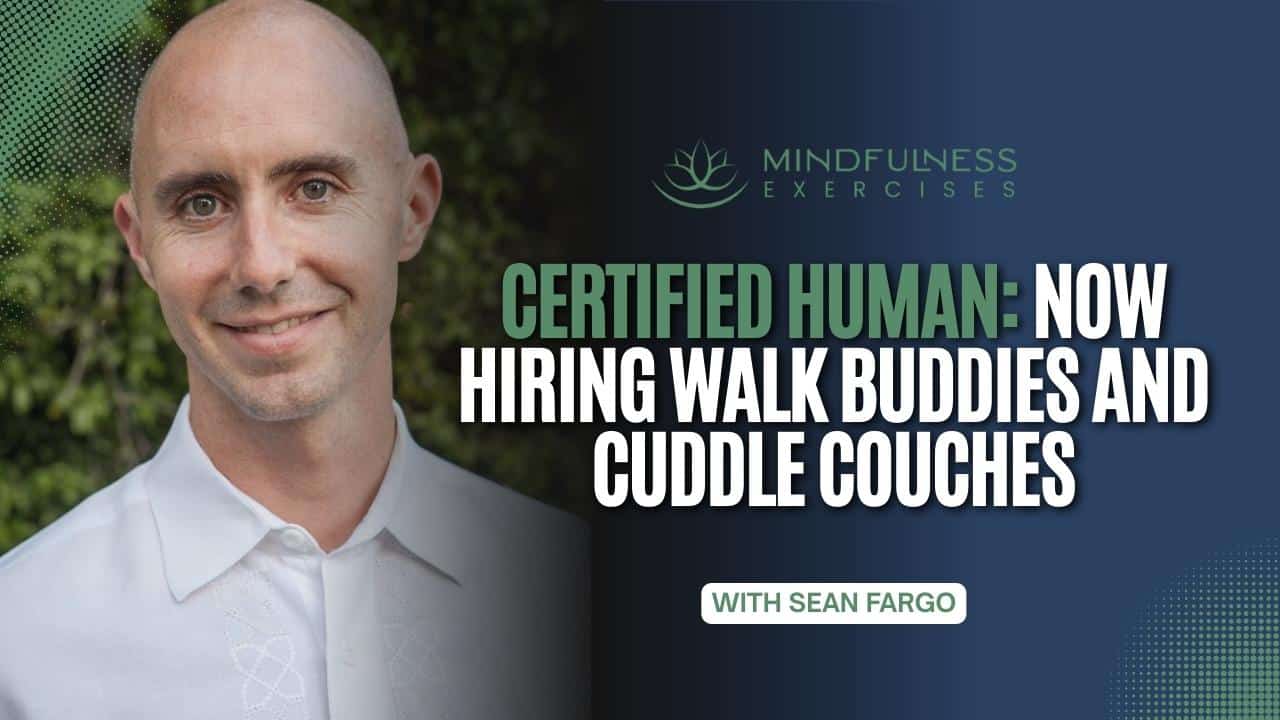
    Certified Human: Now Hiring Walk Buddies And Cuddle Couches

    SF
    Sean FargoPublished January 29, 2026 · Updated February 4, 2026 · 4 min read
    Certified Human: Now Hiring Walk Buddies And Cuddle Couches

    Listen to this episode

    Mindfulness Exercises Podcast

    Enjoying the episode?

    Follow the show in your podcast app. If this conversation supports your practice, a rating or review helps more listeners find it.

    There’s no shortage of mindfulness content in the world.Apps, tracks, timers, playlists, scripts.You can be guided through a body scan at any hour of the day or night.

    And yet—many people still feel disconnected.

    In this episode of Mindfulness Exercises, we ask a quietly radical question:What if what people are really craving isn’t another guided meditation—but another human?

    Not a guru.Not a therapist.Not a perfectly credentialed expert.

    Just a certified human.

    Someone who can walk beside them, sit with them, make eye contact, and share space without trying to fix anything. Someone who understands mindfulness not as a script, but as a lived, embodied experience.

    This conversation explores why real human presence is becoming one of the most valuable—and overlooked—resources in modern mindfulness practice.

    Sponsored by our Mindfulness Meditation Teacher Certification Program MindfulnessExercises.com/Certify

    Episode Overview:

    In This Episode:

    • Why human presence matters more than endless guided tracks
    • Embodiment as the missing link in mindfulness practice
    • Rising demand for relational mindfulness guides
    • Loneliness, paid companionship, and cultural signals
    • Teaching through stories, eye contact, and authenticity
    • Balancing head, heart, and whole-body awareness
    • Simple practices for integrated attention
    • Family intimacy, co-regulation, and the “cuddle couch”
    • Global mental health trends and mindfulness recognition
    • Encouragement for non-clinical mindfulness teachers

    Show Notes:

    When Mindfulness Becomes Disembodied

    Mindfulness was never meant to live only in our heads.

    Yet many modern approaches unintentionally pull us out of the body:

    • Listening instead of sensing
    • Following instructions instead of noticing
    • Performing calm instead of experiencing what’s actually here

    Guided practices can be helpful, especially when we’re learning. But when mindfulness becomes something we consume rather than inhabit, it loses its grounding power.

    Embodiment changes that.

    Embodied mindfulness invites us to feel:

    • Feet on the floor
    • Breath moving in the chest
    • Subtle shifts in posture, tension, temperature

    And often, it’s easier to stay embodied when we’re with someone else.

    Why Human Presence Matters More Than Ever

    Loneliness isn’t just a personal struggle—it’s a global one.

    Across cultures and age groups, people report feeling more isolated even while being more digitally connected. This has led to unexpected trends: paid walking companions, professional cuddlers, and community spaces designed simply for shared presence.

    These aren’t gimmicks.They’re signals.

    They point to a rising, unmet need for:

    • Co-regulation
    • Safe, attuned attention
    • Nervous systems settling together

    Mindfulness, at its core, has always been relational. Long before apps existed, awareness was practiced in community—through shared silence, shared movement, shared life.

    Teaching Mindfulness Through Presence, Not Performance

    One of the most powerful moments in the episode is a reminder that mindfulness doesn’t require polished language or perfect delivery.

    Sometimes, it’s taught through:

    • A personal story
    • A pause that isn’t rushed
    • Eye contact that says, I’m here with you

    When someone shares their lived experience—how mindfulness helped them through grief, overwhelm, or uncertainty—it lands differently. The listener isn’t just learning about mindfulness; they’re feeling what it’s like to be met with attention.

    This kind of teaching can’t be automated.

    Head, Heart, and Whole-Body Awareness

    Many people unknowingly practice mindfulness from the neck up.

    This episode invites a broader balance:

    • Head: noticing thoughts and patterns
    • Heart: sensing emotion, tenderness, resistance
    • Body: feeling weight, movement, and breath

    When these three work together, mindfulness becomes integrated rather than effortful. You don’t have to concentrate harder—you simply widen the field of attention.

    A simple practice shared in the conversation:

    1. Notice what you’re thinking
    2. Sense what you’re feeling emotionally
    3. Feel one physical sensation in the body
    4. Let all three exist at once, without hierarchy

    This is mindfulness as inhabiting yourself, not managing yourself.

    The Cuddle Couch and the Science of Co-Regulation

    The idea of a “cuddle couch” might sound playful—but it points to something deeply biological.

    Humans regulate through proximity:

    • Infants settle through touch
    • Families bond through shared rest
    • Adults soften when they feel safe nearby

    Co-regulation isn’t weakness. It’s how nervous systems evolved.

    Mindfulness that ignores this can unintentionally place the burden of regulation entirely on the individual. Mindfulness that includes relational safety—whether through family intimacy, community spaces, or simple togetherness—honors how humans actually work.

    A Growing Global Recognition

    This episode also touches on broader signals of change.

    Organizations like the World Health Organization and the United Nations have increasingly highlighted:

    • Rising mental health needs worldwide
    • The importance of preventive, community-based support
    • The role of mindfulness and awareness practices in public health

    While data and research matter, the lived experience on the ground often speaks first. Communities are already responding—creating walking groups, listening circles, and shared mindfulness spaces that don’t require clinical labels.

    You Don’t Need to Be a Therapist or Yogi

    One of the most encouraging messages in this conversation is for aspiring mindfulness teachers.

    You don’t need:

    • A therapy license
    • A yoga certification
    • A perfectly curated brand

    If you can:

    • Be present
    • Listen deeply
    • Share honestly
    • Hold space without fixing

    You are already practicing something essential.

    Mindfulness needs more humans, not more experts performing calm.

    Coming Back to What’s Human

    Mindfulness doesn’t have to be complicated.

    Sometimes it looks like:

    • Walking with someone
    • Sitting quietly together
    • Letting the body soften in shared space

    In a world overflowing with content, presence is becoming the rarest offering of all.

    And maybe the most meaningful qualification we can claim isn’t expert, certified, or enlightened—

    but simply, human.

    Additional Resources:

    Transcript

    Show transcript· 10 min read

    Human Teachers And Real Connection

    Speaker 1 · 0:00Welcome everyone. Thank you for being here. I'd like to welcome those of you who may be new to the program or to these sessions. I'm hearing more and more that the demand for human mindfulness teachers will skyrocket or continue increasing because people are starving for real human connection. For those of us who are engaged with teaching one-on-one groups, either in person or online, I think we will be finding more interest in people wanting to be with others to practice together, to learn from a real person who knows what it's like to be human and go through the challenges of being human in 2026. And we need people from all walks of life in these roles of inviting presence, mothers teaching mindfulness for mothering in stages of life, people with chronic pain talking about how they use mindfulness to find ease. Every single walk of life, we want examples of humans going through the challenges and the joys of navigating this vulnerable experience of life and not to teach in a cookie cutter way for everyone, but to be personal and to share authentically. It's hard. Then here's some things that help me. These personal stories, personal teachings and examples can really sink in faster and more deeply. And even just eye contact alone, just kind eyes or a soft touch is itself so healing. And it's these types of experiences that are very, very powerful. And communities like this are invaluable. Certified human, yes. Absolutely.

    Speaker 2 · 2:36I have a question.

    Personal Stories And Embodied Presence

    Speaker 2 · 2:38When you were just talking about the demand for human mindfulness teachers that it'll likely skyrocket. I can't remember exactly what you said, but it sounded like you've heard it at a lot of places or something like that. I'm wondering, maybe through an email later, because you probably don't know off the top of your head, but I'm wondering what are some of the sources. Like, is there market data out there to look at, or are there articles out there to look at?

    Speaker 1 · 3:04Great question. I have not seen any, but I'm just gonna do a quick Yeah.

    Speaker 2 · 3:10I definitely intuitively that makes so much sense. But I've actually been doing some work. I live in New York. So like I went to the business library within the New York Public Library system to kind of do an actual look at what the market data might be, and I couldn't find the data that would like support my intuition. And it seems so I don't know, it seems like such an obvious thing. But anyway, I didn't mean to put you on the spot, but I was just curious about that.

    Speaker 1 · 3:37Yeah, that's a great question. I want to look into that and find something that I could point to other than what I've heard. I know my wife, she really feels strongly about this, but I saw a talk from Gary Vaynerchuk, who's this kind of like a media icon influencer. He's made a name for himself over the last 10 years of sensing into what's next of market trends and where people's attention are going to go next. He's often correct. I don't believe everything he says, and I think that he likes hearing himself talk sometimes. But he said something recently that there's a big business opportunity like unfolding right now for people wanting other people to take them on walks. Almost like a dog walker. There's like a human walker. I don't think I'm phrasing it quite the way he phrased it, but he was making a point that there's so many humans, especially I think humans over 50, where maybe they've raised their family, they're empty nesters, maybe they're divorced, working online, their friends are text friends or social media friends. I kind of want an excuse to be around a person, and it's easier to hire someone to go for a walk with than it is to have the courage to make new friends at the farmer's market, for example.

    Speaker 2 · 5:16I guess the context

    Is There Market Data For Demand

    Speaker 2 · 5:18of my question was like for me, I'm not a therapist, I'm not a yoga teacher, and I'd like to work as a meditation teacher. So without having those other two foundations, having some sort of data or something to point to, it feels like it would help me be able to kind of gently promote the business better. Like it has implications for trying to do this as a living, potentially. So anyway, I just felt like I had to add that.

    Speaker 1 · 5:49I have seen market data, I think a few years ago, about the demand for mindfulness and meditation teachers, and it was a steep curve up, and you can do like a simple Google search or ironically AI search for demand for human mindfulness teachers, demand for human meditation teachers. Part of the rationale is that the internet and AI is just flooding everyone with a quantity of teachings, that it's easier to find teachings than it ever has been, which is a blessing in the sense that we can find methods and practices that would have been much harder to find 50 years ago, 20 years ago. And because there's an increasing isolation, there's uh increasing demand for antidotes to that, which is human connection and so And especially with mindfulness teachers in the sense that there's typically a higher quality of presence, typically a higher quality of connection. I don't mean to sound righteous or judgmental, but that's kind of the point is that we're present for each other rather than focused on something else. Not to say that being entertained in a crowd isn't worthy. I think there's value in that too, but we do want to be seen, to be heard. The short answer is that I don't have something specific to point to right now, but uh I think maybe in my next five mindful musings newsletter, I'll try to include some empirical data on that.

    Speaker 2 · 7:32That was you awesome. I really appreciate your thoughts on this stuff.

    Speaker 1 · 7:36Yeah. Thank you for your question. And thank you for your recent emails as well. Michelle shared embodiment is the new theme for 2026. This practice will help many people. Yeah. And it's beautiful to see mindfulness really integrating more and more with more yoga studios, Reiki centers,

    Loneliness, Human Walkers, And Opportunity

    Speaker 1 · 8:01massage therapy, a lot of even business coaching and all sorts of things.

    Speaker 3 · 8:07Mindfulness is like stuck in all areas. I see it now and lots.

    Speaker 1 · 8:12My six-year-old daughter has mindfulness in her classroom and after school. It's not me introducing it, it's already there. And they have like breathing tools and feeling their bodies and noticing emotions, and it's much more prevalent now. And that's why during the guided meditation today, there was an invitation for us to notice. Is our awareness feeling head-based right now? Heart-based? Fully embodied? There's not like a right or wrong, but sometimes our awareness or our mindfulness can feel like it's very head-based, like we're relating to everything from here. Sometimes it might feel like it's from the heart. Sometimes it feels embodied. And so there's an invitation for us to kind of notice is there a place from which we're being aware or does it feel integrated? And I didn't say it in the meditation, but there's this very gentle invitation to find a nice balance overall. So we can focus in on a certain part of the body, and maybe there's a ton of awareness in my right shoulder or the nostrils as I breathe, or here, or in my right baby toe before it goes to the market. And can I integrate this gentle awareness throughout my whole being, or find a balance in other areas so that we're not always sort of defaulting to the same location or radius. Some very senior mindfulness teachers will say that a very worthwhile goal for mindfulness is embodiment and not to be a sterile human or a copy of human or what you think we should be, but rather like embodying our own essence, our spirit, our life, our joy, our soul, you know, embodying Michelle Diston or whatever we call ourselves. Like what did our mom or dad or caregiver call us when we were five? One of the best investments we've ever made was a cuddle couch. We got this

    Building A Teaching Path Without Therapy Or Yoga

    Speaker 1 · 10:56like oversized couch that has no place in our like really small living room. No interior designer would ever recommend this big couch for our small home. This big couch where like all of us can just lay down on it together. It's like my favorite thing. I love just laying down or sitting down on the couch and inviting space for family or or people just to kind of sit there with me, maybe cuddle, maybe sit next to us, or just lay down on different parts of it and just kinda be together. Feeling heartbeats, skin temperature, hearing each other breathe, kind of sensing into the nervous system, hear whatever comes up, sensing into the language of bodies. Could be a good book idea, like the power of cuddle couches. If anyone would like to share any requests, questions, comments, wins, anything at all. Dominique?

    Speaker 4 · 12:13I just want to share some data with you, Dorothy. I was in another session, I forgot where I went to, but there's a huge data with the WHO World Health Organization that mental health is really rising globally. The number of people suffering from physical and mental health in general could be around about three billion people. So we have about 8 billion people in this world. So over 1 billion is already in soaring, needing mental support. It goes to show that our role to support that what Sean and everyone are saying, that we need to prepare to help and assist others coming up and what's going on. So I hope if you look into who it might help with some data. Also, Sean, thank you so much for supporting us weekly.

    AI Flood, Isolation, And Quality Presence

    Speaker 4 · 13:10Having this space for us is so needed. I really had a hard time focusing today at the beginning, as always. Lots of things going on, end of the year and beginning of the year. There's a need to like, oh, what's your resolution? What are you gonna do this year different from next year? And oh, I don't have one. And I feel like, oh my gosh, I'm behind, or I don't know what I'm doing. I'm lost for 2026. But today really helps me to bring alignment and just being is enough. Just breathing and just being in stoness and just listening to my breath really helps me calm down because it was like leaf blowing, someone's cleaning up, but the plane is zooming down as we're meditating. And you know, through it, I just really hear my breath, and I'm very grateful for that. It's just the air coming in through the nostril, and it really's calm me. It's so simple. So thank you for having space for us. Yeah, yeah.

    Speaker 1 · 14:12Thank you, Dominique. We all need these reminders. Oh, yeah, it's all just right here.

    Speaker 2 · 14:19Also, toward the end of last year, so only like within the past month or two, I think that Rhonda McGee and John Cabot Zinn, and maybe other people, talked in front of the United Nations about mindfulness. I think the UN adopted something related that was like an outgrowth of that. I just don't know the details. But that seems really apropos and kind of the big deal.

    Speaker 1 · 14:43Oh, I hadn't heard that. Thanks for sharing that.

    Speaker 2 · 14:46Yeah. I'll try to find more information on it forward to you.

    Speaker 1 · 14:51Great. I interviewed Rhonda for our podcast. I'll share a link for people not aware of Rhonda. That's exciting. Hopefully, the United Nations does something with that. Yeah. Hopefully, it's not uh window dressing or or anything. It's really cool.

    Speaker 2 · 15:12If I can't post it in this chat, then I'm Sean, I'll email you the information I can find.

    Speaker 1 · 15:18Thanks.

    Share

    Continue reading

    • Grounding Through Anxiety With Senses

      Grounding Through Anxiety With Senses

      Read
    • Shamatha Vipassana Explained For Modern Minds

      Shamatha Vipassana Explained For Modern Minds

      Read
    • How To Stop Believing You Are Not Enough

      How To Stop Believing You Are Not Enough

      Read

    Professional training

    Accredited mindfulness teacher certification

    Trusted by teachers in 100+ countries

    Structured training, CE credits for eligible pay-in-full registrants, and support for teaching without self-doubt — after you have explored this episode.