🎧 New episode: Nothing's Missing: Dr. John Demartini on Mindfulness as WholenessListen →

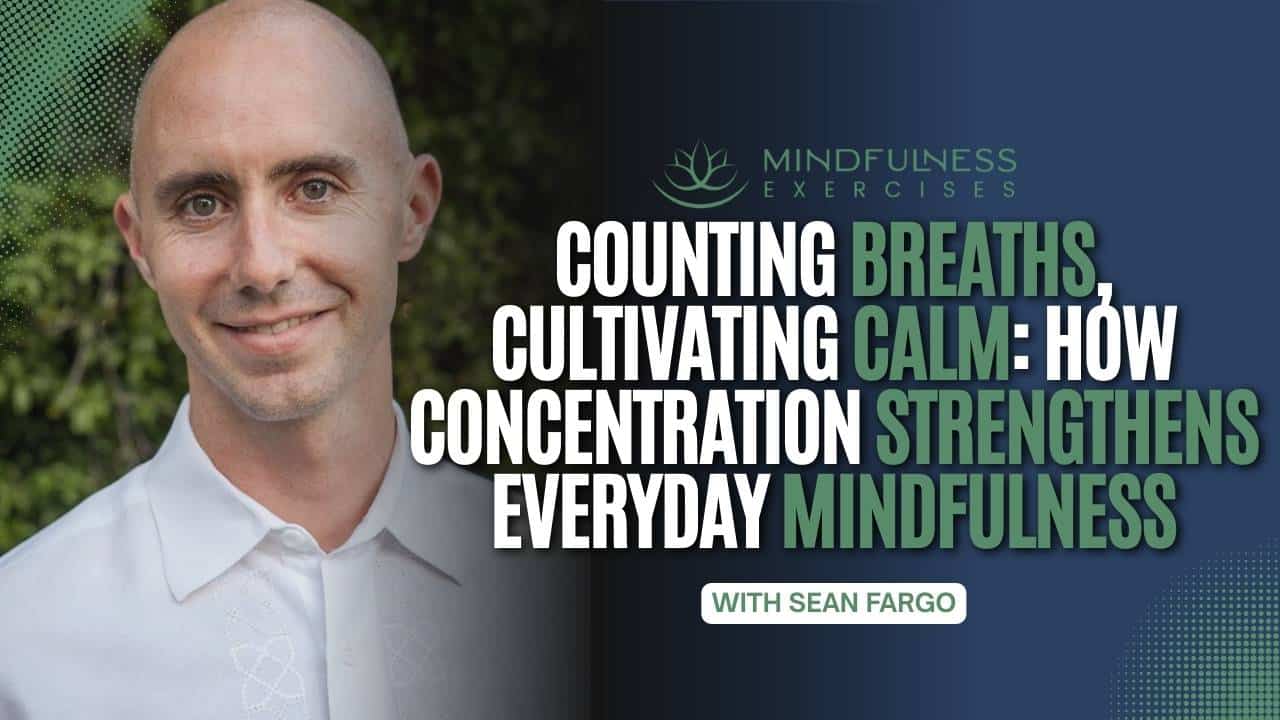
    Counting Breaths, Cultivating Calm: How Concentration Strengthens Everyday Mindfulness

    SF
    Sean FargoPublished December 9, 2025 · 5 min read
    Counting Breaths, Cultivating Calm: How Concentration Strengthens Everyday Mindfulness

    Listen to this episode

    Mindfulness Exercises Podcast

    Enjoying the episode?

    Follow the show in your podcast app. If this conversation supports your practice, a rating or review helps more listeners find it.

    Counting Breaths, Cultivating Calm: How Concentration Strengthens Everyday Mindfulness — Tunein Logo

    TuneIn

    There are moments when life feels too wide—too fast, too loud, too overwhelming. Yet, paradoxically, the path to feeling more open often begins by narrowing our focus. In this week’s episode of Mindfulness Exercises Podcast, we explore the gentle craft of concentration and how a single point of attention can soften the entire nervous system.

    “Counting Breaths & Cultivating Calm” reminds us that mindfulness isn’t built through force. It’s cultivated through friendliness, patience, and a willingness to rest our awareness someplace simple. In this article, we expand on those ideas and offer practical ways you can use counting breaths meditation—and other anchors—to stabilize your attention and reconnect with ease.

    Sponsored by our Mindfulness Meditation Teacher Certification Program MindfulnessExercises.com/Certify

    Episode Overview:

    This episode explores the essential role concentration plays in developing reliable mindfulness. Through breath counting, sensory anchors, and loving-kindness phrases, the discussion breaks down how steady attention allows the nervous system to settle and the heart to soften.

    Key Themes:

    • How narrowing attention widens your overall sense of calm
    • Why “gladdening the mind” creates a safe landing for attention
    • Practical concentration anchors for different temperaments
    • What relaxed steadiness feels like in the body
    • The purpose of silence while counting breaths
    • How to restart without self-judgment
    • When to choose concentration vs. broad awareness
    • Turning distraction into an invitation to return

    Anchors Covered:

    • Counting exhales in cycles
    • Feeling the breath at the nostrils or belly
    • Receiving sounds as they arise
    • Repeating short loving-kindness phrases

    Show Notes:

    Narrowing Attention to Widen Your Life

    It’s counterintuitive at first: by asking the mind to attend to one small movement—one inhale, one exhale—we end up experiencing life more vividly, not less.

    The podcast describes this beautifully through the metaphor of a flashlight:

    • Wide beam: open awareness, receiving anything that arises
    • Narrow beam: concentration, resting attention on a single anchor
    • Adjustable dial: your ability to shift intentionally between the two

    Concentration isn’t restriction. It’s an anchor. It’s how we create the stability that makes broader awareness sustainable and nourishing, rather than overwhelming.

    When attention steadies, space opens. Colors appear richer. Sounds soften. The body begins to trust that it can truly rest.

    Building a Friendly Runway: Why Effort Alone Isn’t Enough

    Instead of forcing focus, the episode offers a refreshing approach: gladden the mind first.

    Before you even start counting your breath, you might:

    • Feel gratitude for something simple
    • Notice a moment of warmth or safety
    • Bring to mind a person or memory that softens your chest
    • Offer a phrase like “May I be at ease”

    This isn’t fluff—it’s neuroscience. When the nervous system feels safe, the mind can settle without strain. Concentration becomes a natural consequence of emotional warmth.

    The Heart of the Practice: Counting Breaths

    Counting breaths meditation is one of the most accessible tools for developing concentration.

    How to Practice:
    1. Settle into a steady, comfortable posture.
    2. Bring your attention to your exhale.
    3. At the bottom of each exhale, mentally note:“One… two… three…”
    4. Count up to whatever number feels natural—often 5 or 10.
    5. When you reach the end of a cycle, return to one.
    6. If the mind wanders (and it will), simply restart. No judgment.

    The intentional silence between counts matters. It gives the mind room to breathe, offering tiny pockets of rest.

    When You’re Doing It Right: Relaxed Steadiness

    The episode describes a feeling people often overlook:Steady but soft. Focused but not tight. Present but not rigid.Like a hand resting gently on a warm stone.

    This is the sweet spot where concentration and ease meet.

    Alternative Anchors for Different Temperaments

    Everyone’s mind works differently. Counting the breath may feel grounding for some and agitating for others.

    The podcast offers a menu of anchors:

    1. The Belly or Nostrils

    Feeling the breath physically—expansion, cooling, warmth—can be especially helpful for sensory-oriented practitioners.

    2. Sounds

    If your thoughts feel too loud, letting sound become the anchor allows awareness to rest on something external and ever-changing.

    3. Loving-Kindness Phrases

    Short phrases like “May I be safe” or “May I be at ease” steady the heart and mind together.

    Each anchor has the same purpose: to stabilize attention with friendliness, not force.

    The Spectrum Between Concentration and Mindfulness

    A powerful distinction offered in the episode is this:

    Concentration steadies the mind. Mindfulness widens it.

    Both are essential.

    Use concentration when:

    • your mind is scattered
    • you feel overstimulated
    • you need a clear anchor

    Use wider mindfulness when:

    • strong emotions arise
    • your intuition wants more spaciousness
    • you’re processing complexity

    Think of concentration as the “home base” you return to whenever things get shaky.

    Posture, Self-Talk, and the Practice of Beginning Again

    Real practice is messy. Thoughts wander. Emotions pull. The body fidgets.

    Instead of seeing these as failures, the episode reframes them as invitations:

    “Each distraction is a cue to return.”

    Your posture can support this by being:

    • Upright but relaxed
    • Balanced, not stiff
    • Alert without strain

    And your self-talk can gently whisper:

    “It’s okay. Start again.”

    This is where compassion and concentration meet.

    Integrating Concentration into Daily Life

    The gifts of counting breaths meditation don’t stay on the cushion.They spill into your relationships, work, parenting, creativity, and rest.

    You may notice:

    • A longer pause between thought and reaction
    • A softening of the chest during stress
    • More vivid sensory detail
    • A clearer mind during decision-making
    • A sense of safety in your own presence

    When concentration becomes a familiar home inside you, life feels more manageable—and more alive.

    Try It Today

    If this practice resonates, listen to the full episode and try a short breath-counting session this week. Share it with a friend who’s building a mindfulness routine, and leave a quick review letting us know:

    Which anchor felt most grounding for you—and why?

    Your insights help others find their way to calm, clarity, and presence.

    Additional Resources:

    Transcript

    Show transcript· 8 min read

    Welcome And Today’s Focus

    Speaker 1 · 0:50Welcome everyone. Hope you're all doing well. So today for today's practice, I thought I would try a concentration practice. I emailed in a newsletter recently about concentration practice as being a support for our mindfulness. To be mindful, we do need some degree of focus to be able to sustain our awareness from one moment to the next, to the next, to the next. So concentration, our ability to focus, helps fuel our mindfulness and our ability to sustain our mindfulness in daily life. And so there are a number of different kinds of concentration practices that we can choose from. Some are say body-based or somatic in nature, in which we can focus on or narrow our attention to felt sensations such as the rise and fall of the belly or the sensations of air or breath in and out of the nostrils. We can receive sounds coming into the ears and focus on whatever sound is actually entering the ear at that moment. We can repeat a mantra or a phrase or a sound. Classically speaking, in a lot of mindfulness circles, phrases or words of care or loving kindness

    Why Concentration Fuels Mindfulness

    Speaker 1 · 2:30are very popular. So phrases like may we be safe, may we be healthy, may we be happy, may we live with ease, or simply safe, healthy, happy, or simply like care or love. Repeating these phrases as a tool for staying with one type of experience, or just kind of focusing our mind on one thing. Another method that's I think being used more and more these days is the method of counting our exhales, either going from one upward until we lose track, or going from one to ten, and then back down to one and then back up to ten and repeating that cycle. And if we lose track, we can start it back over at one. I think that's actually the very first meditation. Actually, no, the second meditation I've ever learned was just counting breaths, very simple practice. So these practices aren't exactly mindfulness practices where we're kind of noticing change, noticing whatever's arising and various aspects of our experience. Concentration practice is really just a narrowing of awareness onto one thing and staying with that as much as we can without grasping or striving too much, but just staying with and only staying with that for a sustained period of time. We can also visualize something and stay with the visual. There's more types and styles than I'm mentioning here, but these are just a few of the ones that are most common. Before we practice concentration practice, it's very helpful to invite a sense of say gladness or safety, warmth, or connection to help the mind settle and feel safe enough to focus on something rather than looking out for threats or trying to analyze something or

    Common Focus Objects And Methods

    Speaker 1 · 4:50you know, be vigilant per se of our surroundings or things we need to think about is very helpful before we focus the mind to invite the heart to the table to reflect on things we're grateful for, people we love, moments that help our hearts to soften perhaps wholesome moments in our life that feel rather karmically positive, or happy, joyous, maybe moments of our own meditation practice in which we really felt a deep sense of peace, or revelatory insight, or a paradigm shift in which the clouds parted. So for each of us, these different reflections will be different.

    Speaker 2 · 6:15We can all think of something personal that helps us to gladden the mind, as Rick Hansen would often say reflections that help soften the body to help us land moments of goodness gratitude. Noticing what happens with our breathing and with our body as we reflect on these moments of goodness.

    Guided Counting And Quiet Practice

    Speaker 2 · 13:02For each breath. And if you wish to count the exhales, feel free to do so from one to a hundred or from one to ten to one to ten, and starting back over to one if we get distracted. Just noticing what's true for us right now. How are we holding ourselves? What are the predominant sensations around the head and the heart and the belly? Our well being.

    Speaker 1 · 25:33I purposely kept it silent for the most part because some of you were probably counting. And in my experience, if I'm counting and someone inserts a reminder or invitation, then I may lose track. So just one point of note as a guide of certain concentration practices. But I'm open to hearing what some of you experienced or thought, any questions or comments about that practice, and also just opening it up to anything in general for anyone who has anything to share or ask about anything. So the floor is open.

    Speaker 3 · 26:13We have a question. Can you explain again how why a concentration practice is sort of different from a mindfulness practice?

    Speaker 1 · 26:22Yeah,

    Debrief And Teaching Note On Silence

    Speaker 1 · 26:23it's a great question. So there are a couple ways of thinking about it, or there are many ways of thinking about it, but some people will liken this to being like one of those flashlights where you can expand the scope of light or kind of narrow it down to like a laser. They're called mag light flashlights, and where you like twist the end and it can expand or narrow. And say on one extreme where the light is wide, that can be likened to mindfulness in the sense that it's this open awareness of kind of any part of our experience. Okay. Whereas concentration is kind of like a laser where it's just on one thing and one thing only, and locked in on that one thing. There's a lot of sort of gray area in between. Most of which is still considered mindfulness. Concentration is really sort of near the end of the spectrum that's narrow. Another say metaphor is that you have a stick or a log. One end is mindfulness,

    Q&A: Concentration vs Mindfulness

    Speaker 1 · 27:35the other end is concentration. They're like two sides of the same stick, or two sides of the same coin in a way, but you can't have one without the other. They're interconnected. It's kind of like the Taoist symbol where the small white part is within the big black part, and the small black part is within the big white part. They're integrated so that you need concentration in order to stay mindful, and you need mindfulness in order to know that you're concentrated and like to be aware of what you're focused on. Say with mindfulness, say the big part of the flashlight, or the you know, the wide part of the light, like that it would be considered like open awareness practice, in which we're mindful of bodily sensations and/or sounds, andor sights, and or emotions, any part of our experience as it arises. We can shift awareness to different parts of our experience, notice them changing in real time, and we're fluid with experience as it arises, you know, mindfulness of walking, talking, eating, stress, joy, like whatever's arising. We can stay mindful with it all or parts of our experience. Say a more narrow lens of that would be say like a body scan, in which we're sensing the toes and then the foot and then the ankle and then the calf. Like that's considered a mindfulness practice because we're we're shifting gears, we're inviting awareness to different parts of the body, noticing changing sensations, open to sensations that are pleasant or unpleasant, or neutral, sensing the bone, skin, flesh, etc. But it's it is more narrow because it's just bodily sensations usually. Mindfulness of breathing is uh kind of closer to a concentration practice. So we're kind of getting kind of into gray territory here where with mindfulness of breathing, we could be aware of breath at any part of the body or just the belly, but we're kind of noticing the changing rhythm of breathing, the different sensations around the belly as we breathe, how that's affecting mood. We're still kind of open to the changing landscape of our experience, but we're mostly just kind of sensing into breathing. We're open to being like with mindfulness of breathing, like if a strong emotion arises or a strong sound distracts us, like we can shift our awareness towards the predominant emotion, tend to it with gentleness, and then come back to breathing, where the breath is a preferred object of awareness, but we're not necessarily limiting our focus on just the breath per se. We're we're still open to whatever's predominant, but we're gonna come back to the breath once whatever's pre more predominant. Subsides. So depending on the mindfulness practice, it may be more of a wide flashlight or a more narrow light. But as soon as we really start getting into territory where we're really locked into just one small part of our experience only. And we're not really open to anything else, where we're really just coming back, coming back, coming back, coming back as kind of

    Metaphors, Spectrum, And Overlap

    Speaker 1 · 31:20quickly as we can back to the concentration object. We're not noticing all these other things. We're just glued into a more and more and more and more narrow part of our experience. That's more and more and more part of a concentration practice. So sometimes the line gets a little blurry, and usually it'll be referred to as a mindfulness practice. But sensing into just the breath at the tip of the nostrils, and especially with the counting, that would be considered more of a concentration practice.

    Share

    Continue reading

    • Grounding Through Anxiety With Senses

      Grounding Through Anxiety With Senses

      Read
    • Shamatha Vipassana Explained For Modern Minds

      Shamatha Vipassana Explained For Modern Minds

      Read
    • How To Stop Believing You Are Not Enough

      How To Stop Believing You Are Not Enough

      Read

    Professional training

    Accredited mindfulness teacher certification

    Trusted by teachers in 100+ countries

    Structured training, CE credits for eligible pay-in-full registrants, and support for teaching without self-doubt — after you have explored this episode.