🎉 $1,000 off Mindfulness Teacher Certification — annual sale ending soon

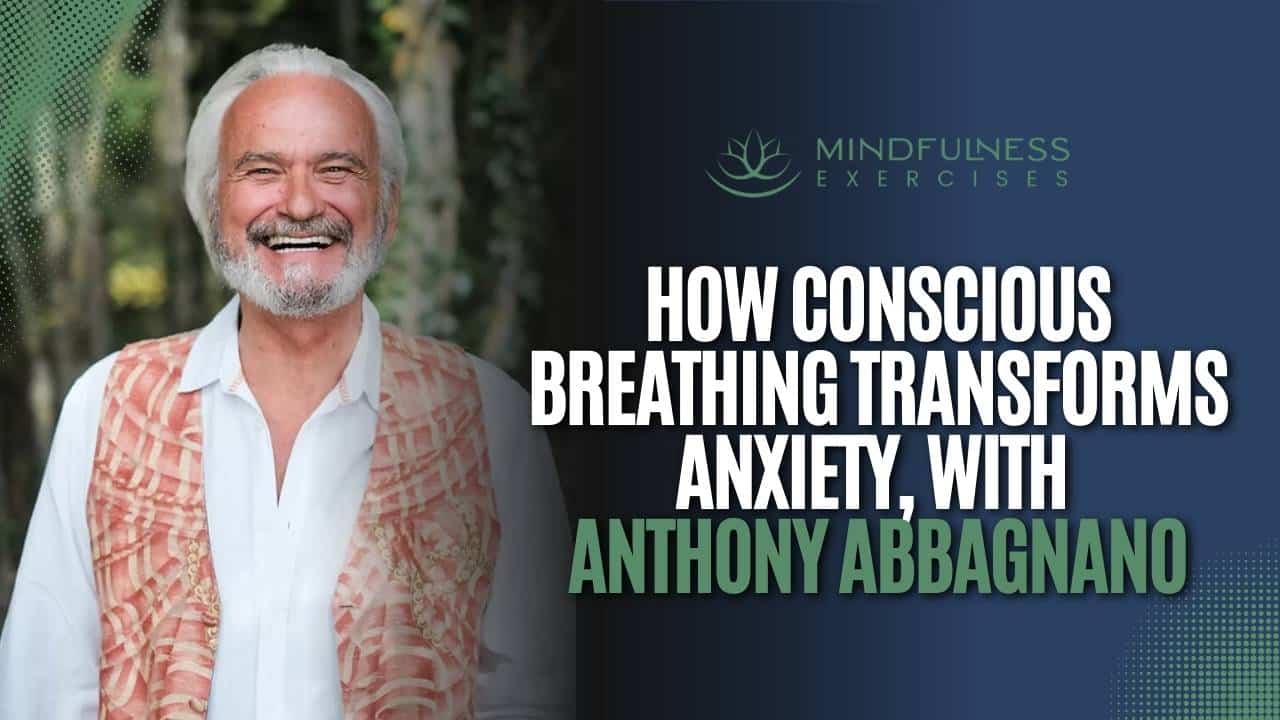
    How Conscious Breathing Transforms Anxiety, with Anthony Abbagnano

    SF
    Sean FargoPublished January 29, 2026 · Updated February 4, 2026 · 4 min read
    How Conscious Breathing Transforms Anxiety, with Anthony Abbagnano

    Listen to this episode

    Mindfulness Exercises Podcast

    Enjoying the episode?

    Follow the show in your podcast app. If this conversation supports your practice, a rating or review helps more listeners find it.

    How Conscious Breathing Transforms Anxiety, with Anthony Abbagnano — Tunein Logo

    TuneIn

    What if the safest place you could find wasn’t somewhere new—but something you’re already doing?

    For many people living with anxiety, safety can feel elusive. The mind scans for threats, the body braces, and the breath—often unnoticed—becomes shallow, fast, or held. In this episode of the Mindfulness Exercises Podcast, we sit down with Anthony Abbagnano, founder of Alchemy of Breath and author of Outer Chaos, Inner Calm, to explore a deceptively simple truth: the breath you’re already taking can become a refuge.

    This conversation is not about quick fixes or forcing calm. It’s about understanding how breathing patterns shape our nervous system, how conscious breathing can gently interrupt anxiety loops, and how reclaiming the breath restores a sense of choice when life feels overwhelming.

    Sponsored by our Mindfulness Meditation Teacher Certification Program MindfulnessExercises.com/Certify

    Episode Overview:

    In this episode, you’ll learn:

    • Why the breath can become a reliable place of safety
    • How anxiety shows up in breathing patterns
    • The difference between coping and true nervous system resolution
    • Why hyperventilation isn’t a solo practice
    • How Conscious Connected Breathing works
    • A simple four-count breathing technique to calm anxiety
    • How to build a personal “breath catalog” for everyday life

    Show Notes:

    The Breath as a Place of Safety

    Anthony’s relationship with breath began early, shaped by moments of intensity and stillness. From a startling awakening during his time at boarding school to months of forced rest during a life-threatening illness, his journey revealed something most of us aren’t taught: the breath reflects our inner state—but it can also reshape it.

    When anxiety takes hold, the body often behaves as if danger is imminent. Muscles tighten. Thoughts race. Breathing becomes rapid or restricted. What Anthony makes clear is that anxiety isn’t just “in the mind”—it’s a whole-body physiological response, and the breath sits right at the center of it.

    By consciously working with the breath, we’re not suppressing anxiety. We’re meeting it from the inside out.

    Understanding Conscious Breathing (And What It’s Not)

    One of the most valuable parts of this conversation is Anthony’s clarity around what conscious breathing actually means—and what it doesn’t.

    Not all breathwork is created equal.

    He explains why hyperventilation is not a DIY practice, especially for people with anxiety or trauma histories. While some breathing methods are powerful when facilitated properly, attempting them without guidance can intensify symptoms rather than relieve them.

    Instead, Anthony introduces Conscious Connected Breathing—a continuous, circular breathing pattern with no pauses between the inhale and exhale. Practiced intentionally and appropriately, this method allows emotions and stored stress responses to surface and resolve, rather than staying trapped in the body.

    The key takeaway? 

    Breathwork isn’t about pushing harder—it’s about listening more closely.

    The Nervous System Reset: Four In, Long Out

    For listeners looking for something practical and immediately accessible, Anthony offers a grounding technique that’s especially effective during anxious moments:

    Inhale for four counts.

    Exhale longer than the inhale.

    This extended exhale sends a clear signal to the nervous system: it’s safe to settle.

    Unlike complex techniques, this pattern can be used anywhere—before a difficult conversation, during a panic spiral, or in moments of quiet overwhelm. It gently shifts the body out of fight-or-flight and back toward regulation.

    Over time, these small resets add up. The breath becomes a familiar anchor rather than an afterthought.

    Coping vs. Resolution: The “Octave” Metaphor

    One of the most memorable insights from this episode is Anthony’s “octave” metaphor.

    Coping, he explains, helps us function—but it doesn’t always complete the emotional cycle. Resolution, on the other hand, allows the nervous system to finish what it started.

    An unresolved stress response is like a musical note left hanging, suspended without closure. Conscious breathing helps complete that octave, allowing the body to release what it’s been holding onto—sometimes for years.

    This reframing is powerful, especially for caregivers, teachers, and mindfulness practitioners who may be highly skilled at coping but still feel stuck in recurring patterns of tension or anxiety.

    Building a Personal Breath Catalog

    Rather than prescribing a single “right” way to breathe, Anthony encourages listeners to catalog their breath.

    Notice how your breath changes when you feel:

    • Anger
    • Fear
    • Love
    • Focus
    • Fatigue
    • Safety

    By becoming familiar with these patterns, you can begin to rehearse supportive breathing states—practicing them when things are calm so they’re available when things are not.

    This is how breath becomes a tool for agency. Not control—but choice.

    From Reactivity to Response

    At its core, this conversation is about shifting from survival mode to presence.

    When anxiety runs the show, we’re often on the back foot—reacting, bracing, enduring. Conscious breathing offers a way back to the front foot: meeting uncertainty with curiosity, steadiness, and self-trust.

    It doesn’t remove life’s challenges. But it changes how we meet them.

    And sometimes, that makes all the difference.

    A Final Invitation

    If anxiety has ever made you feel disconnected from your body or from yourself this episode is a gentle reminder that support may already be within reach.

    The breath doesn’t demand perfection.It doesn’t require belief.It only asks for attention.

    Press play. Breathe along. And begin again—right where you are.

    Additional Resources:

    Transcript

    Show transcript· 18 min read

    Meet Anthony Abagnano

    Speaker 1 · 0:00Welcome everyone to the Mindfulness Exercises podcast. I'm Sean Fargo. Today I have the honor of speaking with Anthony Abagnano, who guides people through breathwork and their inner journeys. He is the author of the new book Outer Chaos, Inner Calm. He's the founder of Alchemy of Breath, which facilitates breathwork facilitator trainings. We'll go into that shortly. Anthony is a visionary breathwork pioneer and a founder of Alchemy of Breath, and also Asha, whose life's work is dedicated to unlocking the profound healing potential of the breath. His journey with breathwork began in his late teens and has since grown into a global movement. Through the hashtag breathe the world, Anthony offers online breathwork sessions that reach communities across 40 plus countries, providing a unique avenue for self-discovery, healing, and transformation. With a background in philosophy, psychology, and conscious loving, he weaves diverse disciplines into his approach, encouraging people to see breath as a powerful tool for both spiritual and practical self-awareness. Anthony's teachings emphasize compassionate self-acceptance and connection with one's true essence. His unique ability to see the soul beyond the personality creates a transformative environment for healing trauma and reconnecting with self-love. Known for his gentle humor, empathy, and deep respect for human vulnerability, Anthony encourages us to explore breath not as a mechanical process, but as a doorway to a heart-centered existence. Whether working with seasoned practitioners or those new to breath work, Anthony guides with profound sensitivity, recognizing breath as a powerful ally for navigating life's challenges. Anthony Abagnano, welcome to the podcast.

    Speaker 2 · 2:19Thank you. Thank you so much, Sean.

    Speaker 1 · 2:21It's a delight to be with you. You discovered breathwork in your late teens, and it doesn't look like you're in your twenties right now. So you've been practicing this for a while. You know, breathwork came on my radar with people like Wim Hof maybe eight or ten years ago. That's been one of the ways that it's been

    First Awakening At Boarding School

    Speaker 1 · 2:45popularized recently. I'm wondering how you found breathwork in your late teens and how did that journey start for you?

    Speaker 2 · 2:53Actually, there's a little bit of a secret there. My first experience, my first conscious experience of using the breath was actually when I was much younger. I was eight years old, and I was at an old British boarding school, not a happy boy. I missed my family. Life was actually pretty grim. I didn't understand why I have been put in an institution like that. It seemed quite medieval. But to an eight year old it was more about being deprived of family and loved ones. So life it was troublesome for me. I I think my first year I cried myself to sleep every night at boarding school. I just didn't understand why I'd been deposited there. But one day a young boy, a couple of years older than me came up with a paper bag and he put it in front of my mouth and he said, Take twenty deep breaths into this bag, and then I'm going to let you down to the ground gently. And he did. I took the twenty breaths, and thankfully he came from behind. He took my chest and he squeezed as I made the last exhale, and he gently laid me on the ground. That I think was my first conscious spiritual experience. Words can't reach the possibility of describing what it was, but how it affected me was that it immediately became apparent that the parts of my life that felt unpleasant and the wounds that I had all of a sudden seemed tiny in comparison to the magnificence of what I discovered. Of course I was hyperventilating, that's actually what I was doing. And since then I understand more of the mechanics of what happened, of course, but at that point in time I was just absolutely speechless, and had everything put back into proportion again. The whole concept of suffering became like a micro dot on a very large page. And so the proportion of my sadness changed to one of more equanimity, really, but I think also joy, because there was something that nobody was connecting to that was just so much bigger and more important and more significant. So the human foibles after that experience, you know, the ways we love and the ways we get jealous and the ways we hurt each other, and they all had a different context to be looked at. And then in my late teens, I was a very young father. My first son was born when I was eighteen, and we were studying, his mother and I were studying breath work during the pregnancy, which I think most men do when they study the Lemon, the Le Boyer method of breath work, is they become the coach for their wife, and it's a great way for the man to be more involved and really engaged.

    Breath In Birth And Early Practices

    Speaker 2 · 5:30We'll talk about it a bit later, but when you breathe with someone, there's a sense of intimacy that you develop that is so easy and so inoffensive and so gentle. And so that's what we did every day. We did two breath practices a day, and of course then when it was time for Damien to come into the world, this would be back in nineteen seventy three, we did all the exercises that we'd been practicing, and the birth was just beautiful as a result. And then from that point on, whenever I had an opportunity I would practice, I made it my practice, and I explored pranayama and I explored Sufi breathing, and then I explored more of the post nineteen seventies Western methods of breathing, so things like holotropic breath work and transformational breath work and all of those, and wasn't what I did with my life, actually my life I was involved in architecture and restoring beautiful old buildings in Italy, in Tuscany and in Umbria. But I was never really satisfied with life, and so in my forties I decided I would change my life and I moved to India and then to Bali, and I spent about sixteen years. The first seven of those years I spent sitting and disengaging from my past, just letting the momentum come slow down and come to a stillness, and then I began to think about, well, how am I going to reintegrate myself into this material world? I think I probably need to. I have a family and they would like to see me, and so I kind of moved back into the world with breath work. What convinced me was a life-threatening illness. I picked up a parasite in the east and I didn't know that's what it was, and nor did anybody else never went. I went to many countries in Europe to get tested, and no one could diagnose what the problem was. But eventually a fine doctor in New York was able to diagnose that I had a parasite, but I came very, very close to death. There was a period of two and a half months where I was immobile, I couldn't move and in deep pain. Even breathing hurt. Coughing or laughing or anything like that wasn't possible. So I learnt to breathe with the minimum amount of disturbance in my body that I could, and that was another form of stillness, and I think that was really such a valuable period for me because I deeply inquired into where will and surrender meet. Of course, in simple terms, it takes will to breathe in and it takes surrender to breathe out. So this breath that is really the bridge between our life and our death is something so worthy of discovery and research, and I would advise anybody I'm a true believer, as you probably tell I'm a true believer, but for me it represents that which is

    Illness, Surrender, And Will

    Speaker 2 · 8:20most subtle, and in many religions it's referred to as a supernatural power, I think forty three times in the Bible and three times in the Quran. In the Quran, that's how Muhammad was born was because of the breath upon his mother's chest. And so the more I paid attention to the breath, the more I understood that there was to learn. There's one guided meditation I do which is to get people very slow down and to imagine one breath as a sip of the most delicious nectar that you could ever sip, because that's really what it is. It has life force, it has our life force, and it also has so much mystery, and so one breath is worthy of, I believe, years of contemplation. But we take one after another in such a hurry and we don't notice. So the more we slow down, I think, the more we can learn and the more present we become.

    Speaker 1 · 9:15Delicious nectar with a lot of mystery. There's a lot to unpack there. It's a fascinating journey you've been on. Going back to when you're at boarding school, you're breathing through the paper bag. You said that you were hyperventilating, and it sounded as if that was like a good thing. I've never heard that word hyperventilate be used in a positive context, but it sounds like through actively breathing quickly, that that was part of the methodology for what you felt in that experience. Can you talk about the mechanics of what happened to, say, your nervous system, what the method was in that first form of breath work that you did?

    Speaker 2 · 10:00It's not far off what is called a conscious connected breath today. And that is a breath that you give your awareness to, hence conscious, and it's a breath that's connected, which means that you don't pause between your inhale and your exhale. But the difference is when you use a paper bag, you are re-inhaling your exhale. So part of the carbon dioxide of your exhale is coming back into you. So you're not over-oxygenating because you're diminishing the amount you take in, because it's not fresh air, it's air from inside a bag. The concept of hyperventilating is also connected to conscious connected breath. And there's a context in which it can be useful. It's not what I would recommend anybody to do. Don't press the pause button and go try it. You need someone who's expert to be able to be with you. And I don't use hyperventilation in my breath practices or the ones that I teach. But the whim half breath is akin to that because you're breathing very deeply and you are connecting your breath. It's a longer breath than hyperventilation. Hyperventilation tends to shorten. I mean, what we're discussing right now is the tiniest slice of a very big pie. The way that we can use or the ways that we can use our breath are infinite to have effect on our nervous

    Breath As Spiritual And Practical Power

    Speaker 2 · 11:20system. And the more close we get to it, the more intimate we become with our breath, the more able we are to really manipulate our nervous system and create effects that we want to create. So if I was going to speak to an audience, which I'll be doing in Spain, and I want to be vigorous, there are a bunch of young entrepreneurs that I'm going to be speaking to, so I have to scale down my age a bit, get a bit more vigorous, I'll use a more vigorous breath. Before I go on stage, I'll be doing some pretty powerful breathing. On the other hand, if I felt a sense of nervousness where I was apprehensive, if you are a public speaker, I know many who are very good speakers who still have a real difficulty before they come on stage. There are breath practices that you can use that will help give you a sense of calm and equilibrium before you go out there. To make this useful and practical and applicable today, the advice that I would give would be to start noticing the ways you breathe under different conditions. So when is it that you hold your breath? When is it that you run out of breath? Why? How do you breathe when you are angry or emotional? How do you breathe when you feel a surge of love? How do you breathe when you make love? How do you breathe when you run? How do you breathe when you're panic stricken or anxious? How do you breathe when you're happy? All of the different conditions can be studied, and they all come with a breath, and breath is a symptom of the way that we feel. But the exceptional thing about the breath, even though it's something we can do without having to give it our attention, is that when we do give it our attention, we can take those symptoms and reverse manipulate the psychological or the emotional condition that we're in. So that would mean if I'm anxious, if I do what I call the transformer breath, which is an inhale of four and an exhale of eight, and then I keep extending the exhale up to maybe twenty-five or thirty, I can't be anxious anymore. It just doesn't stay there. The breath becomes more important. And honestly, half the game here is to be counting what you're doing and to be paying attention to your breath. That's really half the job. My strongest

    Mechanics Of Hyperventilation And CO2

    Speaker 2 · 13:40recommendation to anybody would be to discover your breath. It's right under your nose and it's been waiting a long time. It is worth it.

    Speaker 1 · 13:48Beautiful. I had no idea that there were unlimited ways to practice this. And speaking with entrepreneurs, you know, it's uh fascinating that you would employ a breathing methodology to increase power and change your breathing depending on the situation or the goal. I'd love to explore a little bit more about you mentioned breathing for relieving anxiety, maybe the four or eight breath, extending the exhale. So you're a board member for the Global Professional Breath Work Alliance, or GPBA, with a focus on trauma recovery, addiction treatment, and plant medicine integration. A lot of our community are feeling unsafe for a variety of reasons. And a lot of people in our community are mindfulness teachers or soon-to-be mindfulness teachers who support those who don't feel safe. Can you talk a little bit about how people who don't feel that safe can relate to their breathing in a way that's say non-triggering, in a way that's gentle, that can help them feel safer even in the midst of trauma?

    Speaker 2 · 15:04Yeah, thank you. There's coping and there's resolution, there's relief and there's resolution. One of the principles I teach is to learn to be with the unknown long enough to become a detective of the unknown in order that resolution can occur. So let me give an example. If you think I'm not a singer, but I'm going to give it a go, but if you think of the octave, it's eight notes, but two of them are the same. The first one and the last one are the same. The last one is a repeat, but one octave higher. So you would normally sing or play a whole octave if you were practicing piano or guitar or any instrument, you would play the whole octave. But what's been discovered is that last note brings resolution. That eighth note brings resolution. So if I go dore mi fa sola ti, you're left hanging for the last du then something relaxes inside. And this principle is being used in cancer research and all kinds of places. But I use it as an analogy because we are taught to comply as children. That's how we get fed, and that's how we can guarantee love and attention.

    Tailoring Breath To State And Goals

    Speaker 2 · 16:20And we're also taught to cope. And the commercial world is more than happy to give us systems we can cope with, whether they're medicines or habits or addictions or debilitating non-resolution orientated methods. So we feel better. So I get home at six and I've had a really tough day and I'm gonna have a couple of glasses of wine to loosen up, or I'm depressed, or I'm gonna go shopping, or whatever system we have them. And it's legitimized, it's considered to be normal. But it's not natural, and we've lost the distinction between normal and natural. We mistake normal for natural. So we think it's even natural. That's what life is, it's like course. But if one can learn to treat that gap between the seventh and the eighth note, which is called suspense, because that eighth note hasn't come yet. Once we learn to navigate suspense, then we become more adept at being with what is not known, accepting that there is something other than what I know. And the best way to find out what it is is to inhabit it. It's like how can you tell what color the room is unless you open the door and go and look. So we need to go into that space and to develop the strength to be able to go into that space. And as we develop the capability to do that, we become more resilient and more prepared. You might think of it as going to the gym because you're going to run a marathon. So you're going to do your practice and you're going to get in shape and you're going to do your training. Well, this is a training, a training to gently and carefully and delicately expose ourselves to this sense of what we're used to calling insecurity, but to treat it as something else. I think Dan Siegel said it quite beautifully. I think he said something like, where there's the least certainty, there's the most possibility. If we can learn to inhabit a space of less certainty, and I'll come to the breath in a minute because this all leads to the breath, we then become more agile, more causative in our lives. We become more on the front foot than on the back foot. And the unconscious tendency to become the victim of outer

    Anxiety Tools: The Long Exhale

    Speaker 2 · 18:40circumstances transforms into understanding that we can actually co-create life. So what does that look like? Well, in practical terms, if one is moved by this as a possibility, if it's an attractive or compelling possibility, we can start right now, today, with very simple cataloguing of the breaths that I've been using in different circumstances. And that catalogue then becomes my manual. And then if I want to feel more alive and too complacent or too lazy or exhausted or about jet lag, whatever it might be, a few powerful strong breaths that would perhaps imitate an anxious breath or a panic stricken breath will actually bring me out of a depression or a darker space and make me more alive, and vice versa. Once we've got our catalogue, we know what breath works for us, and we can all make them up for ourselves. You don't really need to be taught these kinds of breaths. The conscious connected breath, which we'll come to in a minute, is a different thing. But to speak directly to this issue of anxiety, and I know how it feels because each of these human emotions I purposely navigate in order to be able to be closer to people who experience them. That's my job is to feel depression so I can explore it and understand what the corners of the room look like, or anxiety or whatever it might be. The way we can deal with With this is twofold. One is to create practices that make me more robust, make me feel like I'm on my front foot, make me feel like I'm more of a co-creator with life. And then the other is to use the coping system when it happens. If I get caught out and I've just had a terrible piece of news, then I employ the same breath and it will be reconnecting with that state of mind that I've artfully created for myself before. So it's no longer coping, it's just remembering. It's going back to the preparation and the training I've got. So if we take that analogy of going in the gym, so you can run a marathon, where you go to the gym for a month and then you see your child running away into the high street where cars are traveling, you're going to be able to run and save your child because you're going to be quick, you're going to be fast. That's what I'm talking about. This works from both ends. It works firstly as a preventative. And then if the preventative is not created the state that you need, if there's something surprising that happens,

    Safety, Trauma, And Resolution

    Speaker 2 · 21:00then you go back to that breath pattern and it's already known. You're going back to a state of memory and capability rather than victimhood.

    Speaker 1 · 21:07Beautiful. It's wonderful to hear that we all have this capacity to catalogue our own breathing and to say reverse engineer how different types of breathing feel and that we can breathe differently by choice.

    Share

    Continue reading

    • Grounding Through Anxiety With Senses

      Grounding Through Anxiety With Senses

      Read
    • Shamatha Vipassana Explained For Modern Minds

      Shamatha Vipassana Explained For Modern Minds

      Read
    • How To Stop Believing You Are Not Enough

      How To Stop Believing You Are Not Enough

      Read

    Professional training

    Accredited mindfulness teacher certification

    Trusted by teachers in 100+ countries

    Structured training, CE credits for eligible pay-in-full registrants, and support for teaching without self-doubt — after you have explored this episode.