📖 Free guide: How to Teach Mindfulness & Meditation

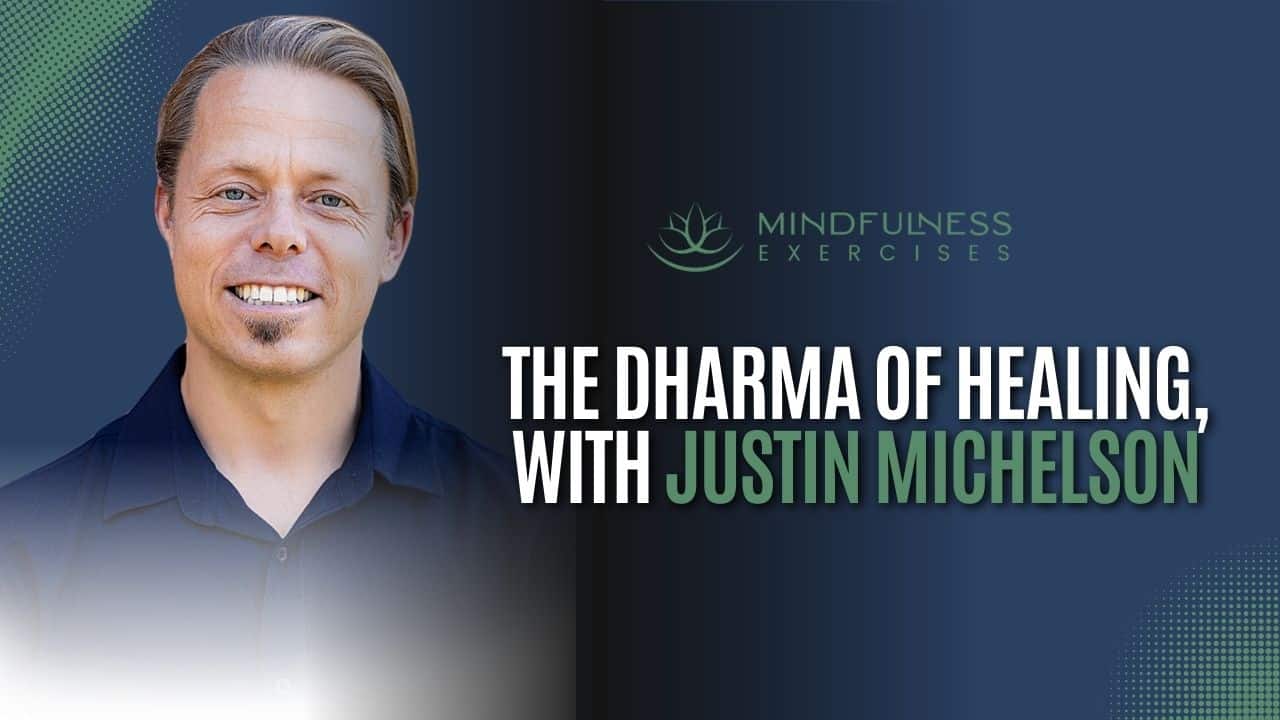
    The Dharma of Healing, with Justin Michelson

    SF
    Sean FargoPublished December 16, 2025 · 5 min read
    The Dharma of Healing, with Justin Michelson

    Listen to this episode

    Mindfulness Exercises Podcast

    Enjoying the episode?

    Follow the show in your podcast app. If this conversation supports your practice, a rating or review helps more listeners find it.

    The Dharma of Healing, with Justin Michelson — Tunein Logo

    TuneIn

    Healing is often framed as a destination—something we achieve, complete, or finally check off a list. But what if healing isn’t about fixing what’s broken at all? What if healing is about learning how to be in relationship with pain in a new way?

    In this episode of the Mindfulness Exercises Podcast, we sit down with Insight Meditation teacher and author Justin Michelson to explore what he calls The Dharma of Healing—a deeply humane, compassionate, and spacious approach to stress, emotional pain, and trauma. Rather than striving to overcome suffering, Justin invites us to bow toward it with curiosity, kindness, and care.

    This conversation is a gentle yet powerful reminder that healing doesn’t require force. It requires safety. It requires presence. And most of all, it requires compassion.

    Sponsored by our Mindfulness Meditation Teacher Certification Program MindfulnessExercises.com/Certify

    Episode Overview:

    • Why healing is a relationship, not a goal
    • How compassion creates safety for deep emotional healing
    • The Four Turnings of the Wheel of Healing
    • Why self-aversion functions like psychological autoimmunity
    • How nature can support healing, even in urban settings
    • The role of lineage, culture, and collective experience in personal pain
    • Why teaching and healing are shared practices

    Show Notes:

    From Striving to Surrender: A Different Relationship with Healing

    Justin’s journey into meditation began early, with his first class as a teenager. Like many sincere practitioners, he initially approached practice with effort and determination—a “warrior stance” aimed at conquering discomfort and mastering the mind.

    Over time, however, life offered different lessons.

    Through encounters with overwhelming energies, emotional pain, and the limits of striving, Justin discovered that force often deepens suffering rather than resolving it. Healing, he learned, comes not from pushing through pain, but from softening toward it.

    This shift—from effort to surrender—became foundational to his teaching. Rather than asking, How do I get rid of this? the practice becomes, How can I be with this safely and kindly?

    Healing as Relationship, Not Resolution

    One of the central insights Justin shares is that healing is not a checkbox. It’s an ongoing way of relating to what hurts—physically, emotionally, and psychologically.

    When we treat pain as an enemy, we often create a secondary layer of suffering: frustration, shame, or self-judgment. Mindfulness, when paired with compassion, allows us to stay present without turning against ourselves.

    Healing, in this sense, becomes less about outcomes and more about how we meet each moment.

    The Four Turnings of the Wheel of Healing

    Justin offers a clear and practical framework he calls the Four Turnings of the Wheel of Healing. These stages aren’t rigid steps, but living dimensions of compassion that deepen over time.

    1. Surface Compassion

    This is the compassion we bring to everyday difficulties—the minor stresses, irritations, and emotional frictions of daily life.

    Surface compassion might sound simple, but it’s profound. It includes:

    • Pausing when stressed
    • Noticing tension with kindness
    • Allowing small moments of care to interrupt reactivity

    These small acts build trust in the nervous system and lay the groundwork for deeper healing.

    2. Depth Compassion

    As safety grows, deeper layers naturally emerge—old grief, fear, or unresolved emotional pain.

    Depth compassion means:

    • Letting buried experiences surface at their own pace
    • Staying present without overwhelm
    • Offering kindness to parts of ourselves that learned to hide

    This stage reminds us that healing doesn’t mean reliving trauma—it means creating enough safety for the body and heart to release what they’ve been holding.

    3. Collective Compassion

    Here, healing expands beyond the personal.

    Collective compassion recognizes that much of what we carry was inherited—from family systems, culture, history, and society. Patterns of anxiety, shame, or disconnection often didn’t start with us.

    This perspective reduces self-blame and invites a wider tenderness. We begin to see our struggles not as personal failures, but as human experiences shaped by larger forces.

    4. Universal Compassion

    At the widest turning of the wheel, compassion becomes spacious and inclusive.

    Universal compassion allows us to rest in something larger than our individual stories—a benevolent field of awareness, connection, and belonging. Pain is still present, but it’s held within a larger context of meaning and care.

    This stage offers a deep sense of being supported by life itself.

    Self-Aversion as Psychological Autoimmunity

    One of the most striking metaphors Justin shares is the idea of self-aversion as psychological autoimmunity.

    Just as autoimmune conditions cause the body to attack itself, our minds often respond to pain by turning against ourselves. This instinct is ancient—it once helped us avoid danger—but when directed inward, it keeps wounds stuck.

    Self-criticism, avoidance, and suppression all arise from this reflex.

    The antidote isn’t analysis or control—it’s kind attention. When we meet pain with warmth rather than resistance, the autoimmune loop begins to unwind.

    Letting Nature Support the Healing Process

    Justin also speaks beautifully about nature as a teacher and ally in healing. While retreats in forests and mountains can be powerful, he emphasizes that nature is accessible everywhere.

    For those living far from wilderness, simple practices can reconnect us:

    • Feeling sunlight on the skin
    • Noticing a single tree on a city street
    • Listening to wind or rain
    • Touching soil, stone, or water

    These sensory moments remind us that we are part of something larger—and that support doesn’t only come from within the mind.

    Reciprocity, Belonging, and the Native Foods Nursery

    Beyond meditation teaching, Justin tends a Native Foods Nursery, growing edible native plants. This work is not separate from his spiritual practice—it is the practice.

    Tending plants becomes an expression of reciprocity: caring for the land that sustains us. It restores a sense of belonging that modern life often erodes.

    Healing, in this context, is not just personal—it’s relational, ecological, and communal.

    Teaching as Shared Practice

    Justin’s approach to teaching is refreshingly grounded. He doesn’t position himself as someone who has “arrived,” but as a fellow practitioner walking alongside others.

    The goal isn’t perfection. It’s resilience. It’s helping people remember their own inner wisdom and capacity for care—especially in a turbulent world.

    A Gentler Path Forward

    If you’ve been longing for practices that feel practical, humane, and spacious enough for real life, this conversation offers both a map and companionship.

    Healing doesn’t require us to be fearless. It asks us to be kind.It doesn’t demand certainty. It invites curiosity. And it doesn’t happen alone—it unfolds in relationship, presence, and compassion.

    Additional Resources:

    Transcript

    Show transcript· 37 min read

    Welcome And Episode Setup

    Speaker 1 · 0:12Welcome to the Mindfulness Exercises Podcast. A show to help you live more mindfully and inspire others to do the same. Go beyond listening. And dive deeper into mindfulness. With evidence-based meditations and ancient wisdom.

    Meet Justin Michelson

    Speaker 2 · 0:49Welcome everyone to the Mindfulness Exercises Podcast. My name is Sean Fargo. And today I have the honor of speaking with a very dedicated practitioner and author of the Dharma of Healing, which we'll be talking about today. Speaking with Justin Michelson, who is a teacher in the Insight Meditation tradition with over 20 years of training at Spirit Rock Meditation Center, Insight Meditation Society, and quite a few other centers. He's the founder and lead teacher for two meditation centers based in Eugene, Oregon, called Nature's Heart and the Eugene Insight Meditation Center. His root teacher is Rodney Smith, I believe Rodney's teacher, correct me if I'm wrong, Justin, but was Ajahn Buddha Dasa, one of the preeminent elders of the Thai forest tradition out of Thailand. One of the great masters of the 20th century, who I highly revere. So we share similar lineage, I'd say. So I'm really looking forward to diving into our conversation. But Justin is an author of

    The Dharma Of Healing Book Overview

    Speaker 2 · 2:11new book published out of Penguin Random House and Shambhala publications. The book is called The Dharma of Healing: The Path of Liberation from Stress, Pain, and Trauma. So I think a lot of ears are perking up right now. It's not every day we get a book like this where we connect the dots of Buddhism and insight practice with pain and trauma and stress. But the Dharma of Healing is a significant book, some people call a handbook for spiritual freedom in this age of global crisis that we're going through. The world is in turmoil because of its trauma, and our unhealed psychological wounds block our innate expressions of wisdom and compassion, setting the stage for ongoing conflict, division and stress. And our fate, both individual and collective, lies in our capacity to heal emotionally and spiritually, and for that we need to remember the power, resilience, and essential goodness in our own hearts. Justin Michelson walks readers through an ingeniously simple approach to healing and spiritual insight using a unique and powerful form of self-compassion rooted in Buddhist wisdom. The book includes thirty-nine different guided meditations that walk readers step by step through their inner journey, providing everything that's needed to confidently walk our path to healing ourselves. Justin Michelson, thank you so much for joining me today in conversation. It's a pleasure meeting you.

    Speaker 3 · 4:08Yeah, it's great to be here and nice to meet you as well.

    Justin’s First Steps Into Meditation

    Speaker 2 · 4:11So reading a little bit about you, it looks like your meditation and mindfulness practice started at a relatively early age. Can you talk about when you were introduced to meditation and what that was like for you?

    Speaker 3 · 4:26Yeah, sure. I was fortunate to be invited to a class for teenagers, specifically when I was 15 by my mother. And this class was led by Rodney Smith, who remains my teacher today. And this was up in Seattle, Washington. And so I by it was just perfect timing. I was raised Christian, but by that point excited to find alternatives. And it sounded very exotic and interesting, this meditation back in, I guess it was 2000. So I gathered up my high school friends and 10 minutes he did with the group of us. But I came out of that and I was hooked. Yeah, I was just something, wow, I'm gonna I'm gonna keep doing this. It was exactly what was happening at the time, but looking back, it makes a lot of sense. Being in high school and having to deal with all the fitting in and figuring out who you are and how you present yourself, just kind of complicated and burdensome. And to have someone just say, just sit down and just breathe and just be who you are felt like a great relief at that time. And I was a nature lover already at that time. And so I thought, oh, this is what the trees do. They just sit there and they just be who they are, whether they're sick or they're magnificent or they're just proud and emanating this sort of authenticity. So I thought, oh wow, this makes sense. I'm not sure if Rodney said any of those things exactly. Yeah, that's kind of one little story into the first times, but I kept going and kept going. And I was sure I would finish the path in just a few years, but uh to lip to enlightenment. Yeah, right. At least, you know, whatever enlightened enough to stop, you know, and be like, okay, I finished. Check that box. Right. But yeah, it turns out it was a different journey than I thought, sort of a a never-ending journey of sorts, ever-deepening journey. So here I am still on it and yeah, happy to share.

    Speaker 2 · 6:19Yeah, thanks for sharing that. Yeah, I think a lot

    From Breath To Spacious Awareness

    Speaker 2 · 6:24of us maybe go into some of these practices with a productivity mindset or an accomplishing mindset. And, you know, we're trying to get to 15 minutes or 60 minutes of sitting or lower my stress level, and then I'll be all good. We realize that, as you said, it's about sustained being, sustained awareness. I'm curious how the practices went for you over time, like what practices called to you? You mentioned breathing and just being. What were some of the practices either through Rodney or other teachers that you felt really resonant with? And I'm curious about maybe one or two of the first, say, bends in your journey that happened where you realized, oh, this is not gonna be quite as smooth as I thought it might be.

    Speaker 3 · 7:24Yeah, I mean, the first way that I was taught to practice was simply just to be mindful of the breath. And that has deep roots in the Buddhist tradition. And some people, that's their entire practice, and that's wonderful. And for me, it was generally just paying attention to the whole process of breathing in and out and the whole body as it breathes, as opposed to just focusing on, say, the tip of my nose or something like that. Well, I was naturally kind of instructed by Rodney, but also naturally inclined towards a more spacious type of attention. So my attention would tend to want to expand, and especially if I was out in nature, which I love to do at that time, and still just having a sense of the presence of nature around me, expanding my attention really naturally, or just hearing the birds, whatever might be expanding. So it was started with the breath, but it became pretty quickly a more spacious or expansive awareness and settling into just being. I don't know if other people have a similar experience, but at first that simple practice was just kind of everything, just being with the breath and just being, and it cut through so much. I'd say the first seven years of my practice were more in my like evangelical phase where I'm just like, meditation will solve everything. I think I had the power of now, and I was like giving it out to everybody. But it was, it was magic. And there's things so much I let go of that I didn't even know I was letting go of. So I had like a little more magical and simple version of it at first. And then yeah, there was some rude awakenings as I hit deeper layers of the mind and heart.

    Humbling Energies And Surrender

    Speaker 3 · 8:57I say the first big one of those was I was living out in Maui at retreat center out there in my early 20s. And for whatever reason, I just started getting a lot of tension, somatic tension in my body. And I was thinking to myself, well, I need to go to a yoga class and learn some yoga positions, and maybe that'll help. And I ended up at a kundalini yoga class, which I didn't know what it was. And I did one class, and I remember afterwards the teacher was like, Oh, wow, that really got you. I was like, I didn't know what she meant, but I ended up having this big deep terror fear experiences, whatever they call it, kundalini energy or whatever. For months after that, and it was like a big humbling experience. I was just like, oh my god. And you don't want to analyze that experience too much, but say, like, you know, I'm just hitting deeper layers of mind or the deeper existential terror or um grief.

    Speaker 2 · 9:50Was the terror like a physical manifestation or was there like a mental fear that arose too?

    Speaker 3 · 9:58It was both. Uh-huh. And they would feed off each other. So it was just kind of like a lot of constriction around letting things go out of my control at a much deeper level. It's like, okay, yeah, I have a relatively controlled meditation practice. I have these results I'm seeing. And it's like, whoa, actually, when it comes down to it, I am deeply attached to the way things are going in my life and my body. So I think it's just like deeper movement. But I mean, it was too much, it was overwhelming. So that's another big learning point. Because at that point, I was just had young man warrior energy and was like, I'm gonna do this thing. And life was sort of like, yeah, that's that energy will get you so far, but there's something much bigger than you happening here, and you sort of have to bow to it in a certain way, surrender to it. So that was just one of I'd say many similar points throughout my twenties that was like very humbling and kind of ended up rerouving my path towards more emotional healing and trying to merge that with the Dharma that I had known, which is a lot of where this book comes from.

    Speaker 2 · 11:00You mentioned feeling that young warrior energy when you started the practice, and then you learned for that type of say Kundalini energy experience that you felt that you really needed to bow to it.

    How To Bow To What Scares Us

    Speaker 2 · 11:17I'm wondering if you would be able to share with our listeners some tips or invitations for learning how to bow to something that may feel so scary. I think a lot of people step up in their warrior energy out of feeling of a need to control it or resist it or change it quickly. So I love that expression of bowing to it. Can you share maybe some ideas for how people can do that in a time when it could feel so terrorizing?

    Speaker 3 · 11:51Yeah, well, you know, I think it's so individual in a given moment. I want to say keep everything on the table. You know. I'm still recovering from a very intense health journey over the last 15, 16 months. And sometimes you do everything you can in your power to change your circumstances, whether that's a treatment or that's getting out of a relationship or changing a job, or sometimes you just do what you need to do, and it's not spiritual at all. It doesn't necessarily feel that way, right? And then other times it's like, oh, this is a time just to bow and to listen and to wait and to let it wash over me. Keep all your cards on your table, all your tools. There isn't any response that's inherently aspiritual, or sometimes we need lots of different things depending on our situation. To keep it in the context of my spiritual practice in my history, sometimes it is that if you resonate with bowing and putting those two hands together and putting your head down and letting it not just be about you in that moment. There's something a lot greater that I don't understand that's happening in this moment, in this world, in this universe, and just to withhold judgment for a moment, because there's an inherent arrogance in that, that we think we know what's happening, what should be happening. And say, okay, we'll withhold that for a moment and just wait and listen. And usually there's something else that comes in that informs us in a way that helps us relax and be at ease a little bit more. On a practical level, to answer your question is sort of what the book is is trying to provide. It's a whole series of self-compassion exercises of different types, including the type of self-compassion where you just allow yourself to be held. Allow yourself to be held by something greater than you. Maybe sort of a broad answer there, but we can drill a little deeper.

    Nature As Support And Teacher

    Speaker 2 · 13:35Yeah, I like this theme of how you're connecting with nature, connecting with something greater. It's not just about you. There's this connection with spaciousness and the natural world and spirit. A lot of our listeners live in maybe dense cities. And there aren't these continued reminders of our natural world in a lived experience with social media and screens and everything, it's so easy to get caught up in all these stories and reactivity. I'm wondering if you could talk a little bit about, say, your relationship with nature as a support for your mindfulness and dharma path and how you relate that to healing.

    Speaker 3 · 14:27I mean, firstly, for those folks that are not surrounded by nature or don't have access, I think it can be really hard. A lot of what I write about is how relating to our own challenges with a real sincere type of compassion is a liberating experience in and of itself. So I do think that whatever it might be, whether it's our distance from nature, whatever challenging conditions we have, if we can be with them with a real wholeheartedness, real care, that can be a refuge for us as well. So I just want to note that distance from nature, I think, is a pretty big component as to why a lot of us struggle, or at least a lot of our normal habitual tendencies get overactive and exacerbated. So we don't have a lot of good role models. And when I say role models, like the trees. We don't have a lot of good role models. I'm looking outside my window, you know, fortunately, and able to see a lot of these beans. And I mean it very literally. Immediately, I'm like, oh, okay, yeah, that's a way to live, right? Is just to stand tall and to reach to the sky and just sort of almost a prayerfulness in a way that I see the plants and trees live. And so I'm reminded, right? I'm gonna remind them of that part of me. If we say everything's interconnected, which I think we would all agree, then very much is a part of me, that version of me that's like a tree. It's inside me as well. So, anyway, good to have good role models. Um in terms of how that relates to healing, I'd say the most obvious way to me is the support that we feel or the support that one can feel. I take people out into nature and we meditate together, and not everyone's comfortable out there. But as you do develop ease in a natural setting and relax, most people do feel quite readily the support of the natural world. And that's maybe enigmatic sort of thing. It might be the elements, maybe the wind as it moves through your hair, the sun on your face, or it might actually be some other creature, some other animal that you see that sees you, and you sort of remember something about yourself. Regardless, this feeling of we're a part of something larger than ourselves and we're being held by that, that tends to create a feeling of safety and connection within ourselves. That to me is sort of the basis of emotional healing, but also of spiritual insight.

    Restoring Safety And Connection

    Speaker 3 · 16:42So that safety and connection is a real touchstone.

    Speaker 2 · 16:46You wrote this book to help a lot of people to heal. I'm wondering about what you're finding in terms of how people are unhealed. That's a great way of putting it. But like you talk about safety and connection as something we can say learn from nature, but they're integral into Dharma practice and insight practice and meditation. I'm wondering if you could talk about the ways that people are not feeling safe or connected these days. What practices, some of the guided meditations that you share that can help people to heal their sense of not being safe or not feeling safe, or not feeling connected. How are you seeing that manifested these days? The people who are really struggling?

    Speaker 3 · 17:43It's an incredibly tough time in the world for a lot of people. There's a lot of reason that people don't feel safe and don't feel connected. So I want to first start by just validating that that's understandable. Everyone can validate that by themselves. Like, I don't feel safe and connected. You don't want to blame yourself. I should be able to if I was just spiritual enough or just had the right practice, then I would. No, and maybe Justin's practice. Start with actually connecting to whatever that pain is, that lack is, that lack of safety and connection, the lack of having what you need or want in your life. And that's the touch point to begin the healing. So just noticing that first before we get off on our healing journey to turn the attention back around and say, okay, what's my motivation for even joining this? Because a lot of our unconscious motivation is just aversion to pain. We don't want to be in pain anymore. We don't want to be uncomfortable anymore. I am right there with you. And if that is our primary driving force, it's an ancient force in our psyches. And if that is the leading force, well, it's going to prolong our suffering. It's going to get us into trouble. A premise of how I frame my practices is that we need to lead with the opposite of aversion to what's unpleasant. We need to lead with compassion for what's unpleasant. And that we can work from there, we're going to slowly restore safety and connection. So zooming out a little bit, my take is that we each receive a lot of blows from life. You know, we get hurt. And we get hurt before we're even able to talk about what it means to be hurt. And we hold these wounds in our body because we didn't feel safe enough to process them, because we whatever we didn't have the right conditions in our family life or in the culture. And so we just hold a lot in our bodies, a lot more than we often realize, and we pack it all away. Then we get introduced to the spiritual path, and we

    Is There Love In Nature

    Speaker 3 · 19:30say, oh, this is the way out of all of that. And we think that we can get around it somehow instead of having to go back down through it all. But we can't go back down through it all by trying to put on some spiritual image of ourselves or some fancy technique and practice. And it has to often just be a real humble willingness to approach our own messiness and our own uncertainty of what even lives inside of us. There's so much we don't know about the world, so much we don't know about the what the bottoms of the oceans and the universe. But there's a whole lot we don't know about what's in our own hearts and minds. So this humble and caring approach to our own emotional lives is what I tend to prescribe. When we're young, we're reliant on the circumstances around us almost entirely to provide safety and connection for us. But as adults, we're tasked now with this responsibility to say, how do we create this for ourselves when the outer circumstances aren't safe and connected or aren't safe or threatening in some way? How do we start to create a refuge for ourselves inside of ourselves? You know, I'm offering a lot of basic compassion practices, although they're kind of fine-tuned, this particular type of compassion, I think, is most helpful, but really showing up for ourselves in ways that create internal safety and connection that make us resilient to the outward crises that surround us. Hopefully you could follow all that.

    Speaker 2 · 20:50Yeah, yeah. There's a lot of love there. Do you sense, say, love in nature? You know, it's easy to sense into being and restfulness and relaxation. I guess through what connection? But I'm curious if there's a sense of benevolence in the natural world that you connect with, or if that's a part of how you relate to your role models outside.

    Speaker 3 · 21:15That's one of my favorite questions, left uh kind of like a co-on or a riddle. Where do you find kindness in nature? Or where do you find love in nature? It's interesting to ask that to a group and to hear what's there, whatever reason coming to mind is one of the two things I said earlier, wind blowing through the hair or sunshine on your face, or these moments where it just it touches you and you feel held and you feel joy come up in the presence of being held. So is that inherent in nature, or it's in the relationships that are in nature, right? So I guess that would be more my general answers. The love is in the interrelatedness, the way that we all depend on each other, the mutual indebtedness we have to one another. I'm only breathing because the trees are breathing in the opposite chemicals, right? So that I can live. And there's so many other ways every spoon of food I put in my mouth, right, is a mutual indebtedness that I'm incurring, and I indeed will give my body back, and hopefully much more than my body I'm trying to give back. Yeah, so I think that's where for me the heart of the love is, but the individual experiences people have are so varied and they're just are like an old growth tree. Just I'm not sure what it is. For me, really, when you get down to the bottom of it, it's that anything exists at all that is why love is at the center of everything. Which is like a riddle of itself, but it's like, how else could this beautiful oak tree be standing here if it wasn't for love? I don't know what else it would be. And so there's sort of a some essential goodness in the creative essence of life itself that's expressed in all these forms. And I think that's what really kind of gets me most essentially.

    Speaker 2 · 22:58Beautiful.

    The Native Foods Nursery Story

    Speaker 2 · 22:59In addition to your teaching and writing, you also own and operate the native edible plant nursery outside of Eugene, Oregon. I've never heard of an edible plant nursery to begin with. What is that? And I'm guessing that this is connected with your spiritual practice, your dharma. And so I'm wondering if you could talk about that possible connection.

    Speaker 3 · 23:26Yeah, in 2017, I started a nursery called Native Foods Nursery. And it was a reflection of my love and ongoing curiosity around the native plants of most of the Northwest where I live, but also the western United States in general. And in particular, the plants that are native and edible. Sometimes they're not very edible. I mean, sometimes they're not delicious, and other times they're actually pretty darn good. But it's a sort of a tribute to the plants of this area that have really not got as much attention. Most of the plants that we eat and cultivate are old world plants. They're from Europe or Eurasia. And there's a lot of beautiful plants. Well, just a lot of people know the Huckleberry, maybe. There's a lot of wonderful huckleberry species out here. They're sort of like blueberries, but they haven't really been cultivated. Anyhow, so bringing attention in some of the beauty of this region and educating people about that online via our website. But yeah, for me, in a spiritual sense, it's like, how can I get 80 of my best friends to live with me? Why don't I start a nursery and propagate 80 different species of native plants?

    Speaker 2 · 24:33Your friends being the plants.

    Speaker 3 · 24:35Exactly, right? This is sort of like family. There's a sense of family and this inner relatedness or this mutual indebtedness that I'm speaking to. So, oh hi, I know you are. There's a plant called Salal. It's a low-growing evergreen shrub that I walk by a lot of different plants of Salal, for example, say, Oh, hi. There's this relatedness being together in this dance of life. And so, yeah, what an amazing thing to grow these plants and to take care of these plants and then to offer them to other people to get to know them so that they once again hopefully can feel more connected to the places that they live, even if it's in the city or the suburbs. We have people buying in those places, and it's a little piece of the environment that was back with them. It's sort of a little piece of themselves back there with them that they're caring for. And it's in that relationship that magic happens. And that might just be like stress relief. They're gardening. It feels good to be outside and be, you know, water my plant. And there's also something deeper, more spiritual there, I think, that's happening. For me, that's what it was. And is, I mean, unfortunately, running a business requires a lot of it's not just a fun spiritual time with the point. Requires much more time on the computer than I would have ever imagined. But nonetheless, that's sort of the spirit of it.

    Speaker 2 · 25:49A lot of people say they have spirit animals. I'm wondering if you have a spirit plant or animal. Right. I wouldn't say I have a single one. No. But you have a lot of friends. Yeah, I've gained a lot of friends. In your book, which I highly recommend, you talk about the four turnings of the wheel of healing.

    The Four Turnings Of Healing

    Speaker 2 · 26:10Four turnings, being like surface, depth, collective, and universal. Can you talk about the four turnings and how it relates to our healing and kind of give an overview for people on what that means?

    Speaker 3 · 26:25Yeah, the first part of the book is the theory of a lot of things I'm talking about, why healing's important on the spiritual path, emotional healing, and then what the process of that could look like. And then the second part of the book is all the practices, all the guided meditations that I divide up into four different sections, and those I'm calling turnings, turning of the wheel of healing, kind of a playoff of turning the wheel of the dharma. I basically put self-compassion practices into four different categories. And the first is sending ourselves compassion, sending the surface level part of our self-compassion. It's like the day-to-day ups and downs, like, oh, I don't feel that well today, or my stomach kind of hurts, or something didn't go well at work, or these sort of like ongoing, simple but challenging things. And the surface layer of our hearts, that's just like outer part of our personality, is kind of like, I like this, I don't want this. Kind of reacting to situations, learn how to soothe ourselves so that when these inevitable disappointments and challenges happen, that we're right there with a hand on our heart saying, I see you, I understand, I care about you, I'm here to support you. We're just speaking to ourselves and learning to be kind to ourselves. And so that's the first turning is kind of the surface level and getting the hang of the practice and a guide through that. And then the second is kind of a deeper plunge into our subconscious. I mentioned some of the experiences in my path, just the deeper fears that we have, or the deeper shame or the grief we might have in our own lives or about the world, and touching into those places, which can be really tender. And we often need a more safe and controlled environment to go there, or we need more confidence in our practice to go there. So building up to that and then with the first turning and then going into these second turning practices. And most of all, those types of wounds need a more wholehearted devotion. They need a more wholehearted compassion and gratitude than the simple day-to-day challenges. So that's the second turning is diving into that. And then the third is spiraling back out a little bit and having compassion for the ways in which our own wounds have been and are and will be co-created by family, by culture, by nature, even by our sort of evolutionary past. So it's using self-compassion in the more impersonal way, seeing how everything we hold in our bodies that constricts us has been co-created. It's actually not just ours. In fact, there's quite a bit of it we can set down because it's not ours. It's like, okay, well, I'm gonna give that back to my lineage, give that back to the culture that imprinted that on me, right? So that's the third turn, sort of this bigger sense of who we are and how we've been formed and offering compassion to that. And then the fourth is this more universal layer, being held by something benevolent that's much greater than us, and actually experiencing compassion from something greater than us and resting all of our efforting towards healing and spiritual growth and just entering more of a state of being, I guess you could say silence, stillness, spaciousness. So that's more what the fourth turning is about. And then starting back over again.

    Speaker 2 · 29:34The wheel keeps turning.

    Speaker 3 · 29:36Through that process, naturally coming to the center of the wheel. You could say coming to a place where those four different turnings or aspects of healing and spiritual growth are all one thing. They're all that's like a holograph. Each is the other, and have a more unified sense or a whole integral sense of who we are as both a human and a spiritual being, healing and spiritual insight as one. So that's kind of the culmination of the journey as it's framed.

    Self-Aversion As Autoimmunity

    Speaker 2 · 30:04Beautiful. Thank you for sharing that. A lot of people who are practicing self-compassion run into this self-aversion. There's many reasons for that, I think. There's a lot of shame that comes up. We feel like we may not be worthy or good enough, we haven't accomplished enough, we're not as good as someone else, or other people deserve it more. You know, I'll be okay. You frame self-aversion as a kind of psychological autoimmune response. And I thought that that phrase was quite interesting, that this self-aversion is a kind of psychological autoimmune response. Can you talk about what you meant by that and just kind of unpack that metaphor a little bit?

    Speaker 3 · 30:56The easiest way to figure out what emotional healing work we have to do is to start a self-compassion practice like this. And often we'll find right away what we're aversive to. We'll attempt to say some kind phrases to ourselves and then some other part of us will argue with it, or we'll shut down, or we'll kind of find where our edges are around it, or we'll find pieces that feel they they aren't worthy. So I just say that to say part of self-compassion practice is all of that other stuff. It's inevitable, it's expected, it's actually what you want to be coming up because then you know what to be with, what to focus on, what to help, what to support. So just to normalize that and validate that. But yeah, from that metaphor comes from a larger perspective that aversion is just an ancient and necessary impulse within our biological and psychological selves from millions and millions of years ago that we share with all other sentient beings, that when something hurts, you try to pull away from it and get some distance from it, or something doesn't serve you. You can see that from one cell organisms all the way to these complex creatures like ourselves. And so we hold a really ancient instinct, and it's helped us in a lot of ways that a lot of times it's just that for most, if not all, other creatures that I'm aware of, they never turn it on themselves. So it's like we want to move away from that which hurts us in the outside environment. But humans in the creation of our complex brains, at some point along the way, developed a capacity to have aversion towards our own inner experiences because those too were painful. And this is part of what makes us complex and what makes us store so much trauma compared to other animals is that we have a capacity to stow away this pain and then have a capacity to be aversive to that pain that we have stowed away within our own bodies. And that aversion might be a hatred, it might be a self-hatred, or it might be a fear. I don't know what that fear, that pain is in me, but I don't even want to go there. All understandable stuff, but just like an autoimmune disease is sort of the immune system overreacting to parts of the body that are actually your own, right? The immune system's supposed to only interact or attack foreign invaders, so to speak, but it's attacking our own cells. And in the same way, psychologically, we're attacking our own wounds. Our wounds are stuffed down in us, just needing attention, care. And instead of offering that, we unconsciously are beating ourselves up. That's what I meant by that autoimmune response. But it's a fascinating thing. And I think it's a key mechanism that explains why there is so much trauma still within each of us and in the world itself. It's just the way our minds and hearts became wired over our evolution.

    Speaker 2 · 33:45It reminds me of an old book. I think it's called Why Zebras Don't Get Ucers. Have you heard of this? Heard of it. I haven't read it though. Yeah. They return

    Growing As A Teacher And Guide

    Speaker 2 · 33:55to physical safety after a say a scary event of maybe a leopard chasing them or something like that. The zebras will shake it out, shake out the stress in their bodies and wiggle their tail. And I walk my puppy every morning, and after she chases a squirrel and then calms down, she shakes it off. A couple months ago, I won a raffle for my daughter, like a five-foot-tall stuffed giraffe that has like rainbow dots on it. And it's standing so regal right in front of me right now. Looking upwards. I imagine the even the stuffy shakes out its trauma sometimes. Thank you for sharing that really fascinating, unique way of what humans do of storing the trauma in their bodies for so long and then become averse to it. It's a little ironic. So a lot of people who are listening are people who help others. So there's a lot of counselors and coaches and yoga teachers and therapists who dedicate their lives to helping other people. And I think a lot of us who do that do so because we've been on our own healing journeys, dedicated a lot of our attention towards how we heal as people. And we find different modalities and things that we can share to help others to pay it forward and share what we've learned. I'm wondering if you could talk about your process of becoming a teacher. Say what you started teaching in the beginning, any lessons that you've learned or tips that you can share for others, and how you hold that concurrently with your own continued healing with this ever-turning wheel of healing. While still wearing the hat as a teacher at the same time.

    Speaker 3 · 35:58Yeah. That's a big topic. I tend to coach folks of all sorts to find something in their life that feeds them and feeds the world, you know, when they're trying to figure out what's my calling, what am I supposed to do? So I would hope that folks that are healers, teachers of different sorts, that are your listeners, you know, have come to that place in a way that feels good to them when they are helping others that it serves them or supports them and their practice in some way. So for me, moving into being a teacher in the insight meditation tradition became a big evolution in my own growth. In my journey as a student, it was just another step along that path. Because every time I have to try to articulate my own experience and share it with others, I see it in a new way. I see it in a deeper way. Every time someone asks me a question, I have to reassess. And everyone, all of us notice over time is that our answers will change over time. Which is kind of a funny thing about writing a book because what are we going to think of this book in 10 years? I don't know. We'll see. Even when it's been a year since I've finished the final draft, I still wouldn't have said things exactly the same way. So this paradoxical acknowledgement that we are always changing, always evolving, always learning, at least we are regardless. We may or may not admit it to ourselves or to others. And at the same time, all of us have something we can offer. Yeah, I mean, you see that in any group experience that I lead, and there's so much wisdom in the room. And at the same time, I'm guiding it and I'm offering my own perspective, but trying to do so in a way that acknowledges that, hey, I don't know everything. This is just one perspective. This is one tool for your toolkit. And you have a lot of wisdom in yourself. And in fact, all of these things I'm offering are really only there to try to have you remember and realize your own wisdom and compassion that is innate to you. That's not dependent on me. I think as a teacher, as a healer or whatever, the more we can empower the people we work with with tools, but really more than that, with that self-confidence in their own connection to everything they need to know. Then that helps all of us, right? Hey, I'm a teacher still learning. I want to offer this. And if people are showing up to listen, that's great. And I want to make sure you all know that you have what you need to continue on the path. And then we can learn together. And so that's where the magic really is for me in it, is that like, I don't think I'd rather be anywhere else but practicing self-compassion in a group of people together. It's sort of like I said with the plant nursery. It's like, I just wanted to get my friends together. Why don't we just

    Dharma, Nature, And How To Connect

    Speaker 3 · 38:34get together, go out in nature, and do the only thing worth doing, which is just to care for what is in front of us together, to do what is impossible together, right? I have such big visions. Oh, we're gonna heal the world, we're gonna turn this thing around, we're gonna awaken to our true nature. And then we get slammed with life and with deep wounds that we have. And so, in a way, it feels impossible at times. But you know, the only way we can do what's impossible is to do it together and to do it humbly and the amount of strength we get from that and the amount of inspiration we get from each other. So I want to get my friends together and go out in nature, you know. So it's more that spirit of companionship on the path that can be hard in certain contexts. If everyone's projecting on you that you're the guru, you're the teacher, you're the healer. Well, it is your responsibility to start to soften those projections. They have their value for certain people at certain times, but they need to be challenged often. You'll notice there's people who get a lot out of those projections. They really need a teacher, they need someone to look up to, they need someone to think is perfect. And it works for them until they get to a maturity level where they're ready to realize that nobody's perfect and nobody's finished. Even the big names out there. And at that point, then we're friends in practice together. Then we're doing the work together, evolving this way beyond ourselves, a time way beyond ourselves. It just becomes a bigger ritual, and we're turning these wheels endlessly with everyone around us, but with all the beings of the past, all the buildings. Of the past are with us. They're turning the wheel with us. The elements, the stars, the galaxies. It's part of something bigger we're doing that we can't and never will fully understand. But it's sort of like our duty doing what we can, which is to show up in this moment caring for what is in front of us. So if we can do it together, it's like, wow, my life feels more complete. That's more me as a teacher, you know.

    Speaker 2 · 40:22Yeah. It resonate with that. Your book is called The Dharma of Healing, and it's just kind of occurring to me that one of the translations or meanings of the word Dharma is nature. It's like the nature of healing. It's one possible interpretation. The way things are, truth, what the Buddha was pointing to with his teachings. I think we're all in this boat together, in this forest together. Why not practice this self-compassion together? And speaking of together, how can people find you? What do you offer? And how can people practice with you?

    Speaker 3 · 41:05Yeah. My website is JustinMichelsondharma.com. So you can look that up.

    Offerings, Links, And Closing Blessing

    Speaker 3 · 41:12I have a Facebook and an Instagram of the same name, Justin MichelsonDharma. And I'm outside of Eugene, Oregon. That's where I'm stationed. And there's some retreats I offer locally in Oregon here and also some online offerings. So people can check those out and join me. And I'd love to continue the dialogue.

    Speaker 2 · 41:31Beautiful. Looks like you offer group mentorship. So we'll post links to Justin's website in the show notes and on our website, JustinMichelsondharma.com. We'll also post a link to the book that you can find on Amazon, Shimbala Publications, Barnes and Noble, etc. Looks like you have some nice offerings on your website. So I highly encourage people to check out Justin's book, The Dharma of Healing. Tara Brock wrote a nice blurb for it. Justin, thank you so much for your warm-hearted presence today, your teachings and offerings today, and really just appreciate the approach and the perspective that you have on practice. I think this is going to be helpful for a lot of people out there. Thank you.

    Speaker 4 · 42:23Yeah, you're very welcome. It's great to meet you, and I love to talk about it. So I'm happy for all those questions you asked me.

    Speaker 1 · 42:31The Mindfulness Exercises Podcast. May this be a source of inspiration and motivation in your mindfulness practice and teachings. Remember to subscribe so you don't miss an episode.

    Share

    Continue reading

    • Grounding Through Anxiety With Senses

      Grounding Through Anxiety With Senses

      Read
    • Shamatha Vipassana Explained For Modern Minds

      Shamatha Vipassana Explained For Modern Minds

      Read
    • How To Stop Believing You Are Not Enough

      How To Stop Believing You Are Not Enough

      Read

    Professional training

    Accredited mindfulness teacher certification

    Trusted by teachers in 100+ countries

    Structured training, CE credits for eligible pay-in-full registrants, and support for teaching without self-doubt — after you have explored this episode.