It sounds like a joke until it doesn’t.
Your boss has an AI girlfriend.Your phone talks back with empathy.Your meditation app knows your mood before your closest friend does.
And still—your nervous system wants a hug.
As artificial intelligence weaves itself into more intimate corners of our lives, mindfulness offers a necessary pause. Not to reject technology outright, but to ask better questions about how we relate, connect, and care for ourselves and one another in a rapidly changing world.
This conversation isn’t about fear or hype. It’s about discernment. About understanding what AI can genuinely support—and what it cannot replace.
Sponsored by our Mindfulness Meditation Teacher Certification Program MindfulnessExercises.com/Certify
Episode Overview:
In This Episode:
- Clarifying lifetime access and open attendance
- Setting a welcoming, human-centered community tone
- Where AI excels: personalization and scalability
- Why simulation can’t replace lived presence
- The risks of outsourcing awareness and creativity
- Cultivating compassion, gratitude, and equanimity
- Loneliness as a public health concern
- Ethical considerations for AI in wellbeing spaces
- Preview of an upcoming workshop on mindfulness and AI tools
Show Notes:
What This Podcast Episode Explores
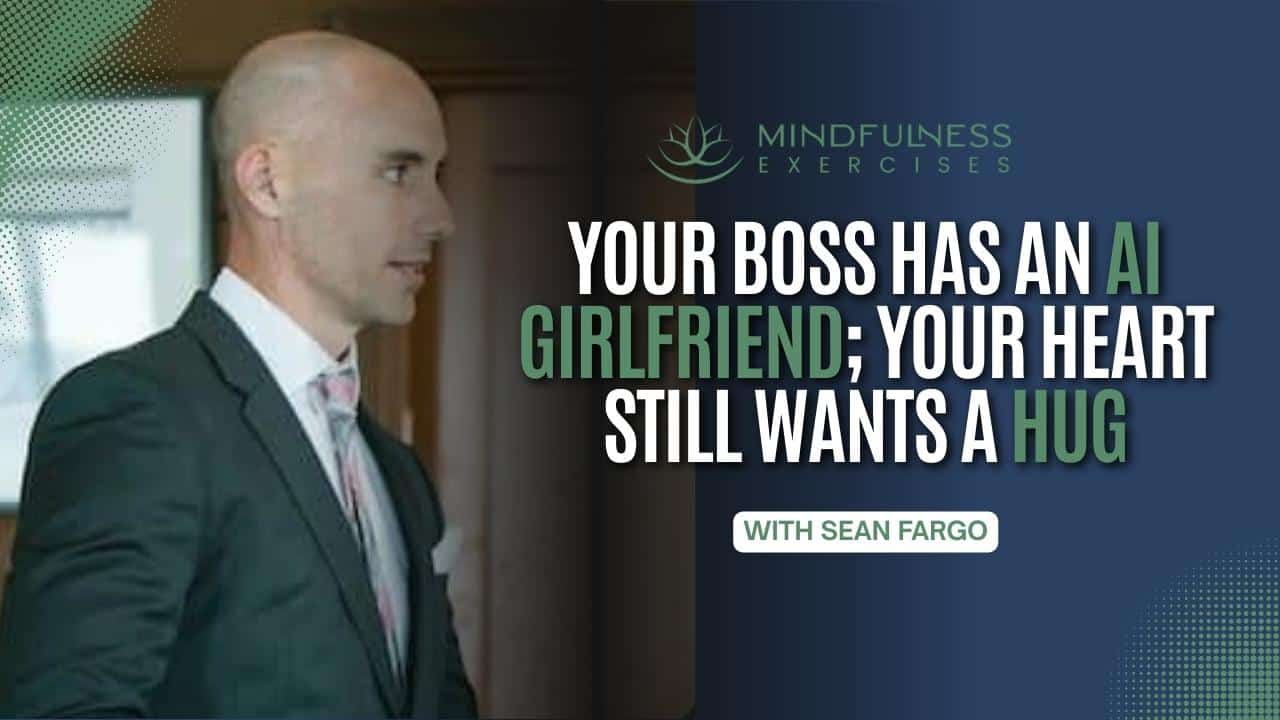
In “Your Boss Has An AI Girlfriend; Your Heart Still Wants A Hug,” we sit with the tension many of us are quietly feeling: gratitude for powerful new tools alongside a deep longing for human presence, shared reality, and emotional attunement.
The episode explores how mindfulness helps us hold that tension without collapsing into extremes—neither blind enthusiasm nor moral panic.
Below, we expand on those reflections and translate them into practical insights for daily life.
AI and Mindfulness: Where Technology Truly Helps
There’s no denying it—AI has real strengths when used intentionally.
1. Personalization at Scale
AI can adapt mindfulness practices to individual needs in ways that were once impossible. From personalized meditation prompts to adaptive pacing and reminders, these tools can meet people where they are—especially those who may not have access to live teachers or groups.
2. Accessibility and Consistency
For many, AI-powered tools offer a gentle entry point into mindfulness. They’re available 24/7, free from judgment, and able to provide structure when motivation is low.
3. Support Between Human Touchpoints
When used as a supplement—not a substitute—AI can help people practice between therapy sessions, classes, or community gatherings.
Mindfulness has always adapted to culture and context. In this sense, AI is simply the latest environment in which practice unfolds.
But support is not the same as replacement.
The Limits of Simulation: What AI Cannot Replace
No matter how advanced the interface, AI remains a simulation of relationship—not a lived one.
Human Presence Is Not a Feature
Presence isn’t just responsiveness. It’s co-regulation. It’s being seen by someone whose nervous system is also in the room with yours.
A voice generated by code cannot mirror your breath.A chatbot cannot sit in silence with you.An algorithm cannot feel the weight of shared grief or shared joy.
Shared Reality Matters
Mindfulness is rooted in this moment, with these beings, in this body. AI can describe compassion, but it cannot practice it. It can model language, but it cannot embody wisdom.
The Risk of Outsourcing Awareness
One subtle danger of over-relying on AI in wellbeing spaces is the quiet erosion of our inner authority.
When we ask a tool:
- How do I feel?
- What should I notice?
- What’s the right response?
…we may stop trusting our own capacity to sense, reflect, and respond.
Mindfulness invites the opposite:
- Turning toward experience
- Staying curious
- Letting awareness arise from within
Outsourcing these skills—even unintentionally—can weaken the very muscles mindfulness is meant to strengthen.
Loneliness, Technology, and the Body’s Wisdom
Loneliness is not a personal failure. It’s a public health issue.
And while AI can simulate companionship, it cannot meet the body’s need for relational safety. Research consistently shows that human connection eye contact, tone, touch, shared silence regulates the nervous system in ways no digital interaction can fully replicate.
You might enjoy a conversation with an AI. You might even feel comforted.
But your heart still knows the difference.
That knowing is not backward. It’s intelligent.
Ethics Matter in Mindfulness and AI
When AI enters wellbeing spaces, ethical questions follow:
- Who owns the data generated during vulnerable moments?
- How are emotional responses being trained, shaped, or monetized?
- Are tools designed to empower users—or keep them dependent?
Mindfulness teaches us to look not only at outcomes, but at intention, impact, and relationship. Ethical use of AI means transparency, consent, and clear boundaries—especially when emotional wellbeing is involved.
Cultivating What Technology Cannot Give
Mindfulness remains a practice of remembering what is already here:
- Compassion that arises from shared humanity
- Gratitude grounded in real connection
- Equanimity built through lived experience
These qualities are not downloadable. They’re cultivated slowly, imperfectly, together.
AI may support the practice. But it cannot walk the path for us.
A Both/And Future
This isn’t about choosing sides.
We can:
- Use AI thoughtfully and
- Protect what is irreplaceably human
Mindfulness helps us stay awake to that balance—curious, grounded, and connected to our values.
Because even in a world of infinite simulations, the body still knows when it’s being held.
Additional Resources:
- Free Training with Sean Fargo: How to Teach Mindfulness With Confidence & Credibility
- Certification: Mindfulness Meditation Teacher Certification Program
- Blog: 80 Resilience Quotes to Inspire and Motivate
- Blog: 60+ Self Care Quotes: Inspiration for a Balanced Life