🎉 $1,000 off Mindfulness Teacher Certification — annual sale ending soon

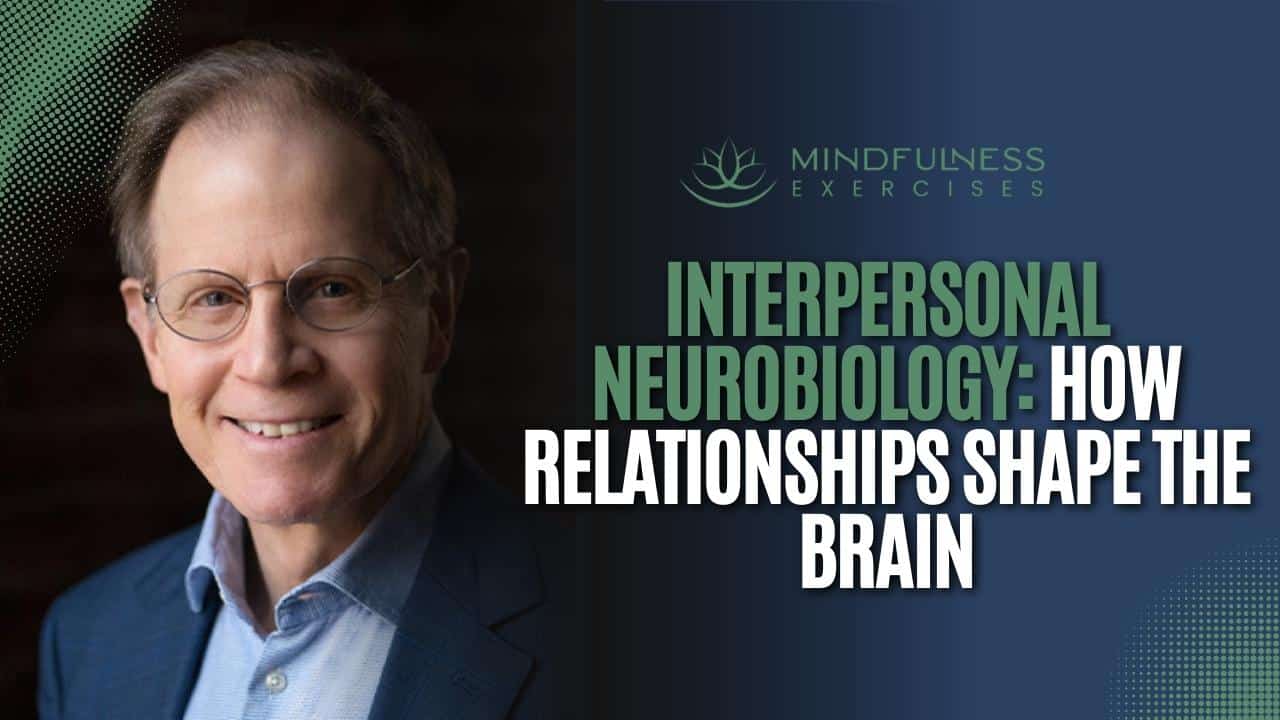
    Interpersonal Neurobiology: How Relationships Shape The Brain

    SF
    Sean FargoPublished January 16, 2026 · 4 min read
    Interpersonal Neurobiology: How Relationships Shape The Brain

    Listen to this episode

    Mindfulness Exercises Podcast

    Enjoying the episode?

    Follow the show in your podcast app. If this conversation supports your practice, a rating or review helps more listeners find it.

    Interpersonal Neurobiology: How Relationships Shape The Brain — Tunein Logo

    TuneIn

    What if your mind isn’t confined to your skull—but instead lives in the space between us?

    This question sits at the heart of interpersonal neurobiology, a field pioneered by psychiatrist and researcher Dr. Dan Siegel, which reframes how we understand mental health, resilience, trauma, and human connection. Rather than viewing the mind, brain, and relationships as separate entities, interpersonal neurobiology reveals them as parts of a single, living system—constantly shaping and reshaping one another.

    In this article, inspired by the podcast episode “Interpersonal Neurobiology: How Relationships Shape the Brain,” we explore how connection literally wires our nervous systems, why integration is the foundation of well‑being, and how awareness‑based practices can expand our capacity for clarity, flexibility, and connection.

    Sponsored by our Mindfulness Meditation Teacher Certification Program MindfulnessExercises.com/Certify

    Episode Overview:

    Key Themes:

    • Mind, brain, and relationships as one system
    • Epigenetics and neuroplasticity
    • Emotion as an integrator
    • Trauma, memory, and the body
    • Attunement and co‑regulation
    • The Wheel of Awareness

    Show Notes:

    What Is Interpersonal Neurobiology?

    Interpersonal neurobiology (IPNB) is an integrative framework that draws from neuroscience, psychology, attachment theory, systems theory, and contemplative science. At its core is a simple yet radical idea:

    The mind is a regulatory process that organizes the flow of energy and information—within us and between us.

    This means the mind is not just located in the brain. It emerges through:

    • Neural firing in the nervous system
    • Signals from the body
    • Emotional states
    • Relationships and social interaction

    In other words, who we are is shaped moment by moment through interaction—internally and interpersonally.

    Beyond Nature vs. Nurture: How Experience Shapes Biology

    For decades, debates about mental health centered on nature versus nurture. Interpersonal neurobiology dissolves this false divide.

    Epigenetics: When Experience Talks to Genes

    Epigenetics shows that life experiences—especially relational ones—can influence how genes are expressed. Stress, safety, trauma, and attunement don’t just affect mood; they alter biological pathways.

    This means:

    • Early attachment experiences matter deeply
    • Healing experiences later in life also matter
    • Biology is responsive, not destiny
    Neuroplasticity: The Brain That Keeps Learning

    Thanks to neuroplasticity, the brain remains open to change across the lifespan. New relationships, reflective practices, and intentional attention can literally reshape neural circuits.

    This is not self‑help optimism—it’s neuroscience.

    Emotion: The Primary Integrator

    Emotion takes center stage in interpersonal neurobiology.

    Rather than being disruptive or irrational, emotions are understood as integrative signals. They:

    • Assign value to experience
    • Direct attention
    • Motivate action
    • Link bodily states with meaning

    When emotions are felt, named, and shared within safe relationships, they help integrate the system. When emotions are ignored, suppressed, or overwhelming, integration falters.

    The Middle Prefrontal Cortex: A Hub of Integration

    A key player in this process is the middle prefrontal cortex (mPFC). This region acts as a convergence zone, linking:

    • Body awareness
    • Emotional regulation
    • Empathy and social understanding
    • Insight and moral reasoning
    • Flexible, adaptive responses

    When the mPFC is well integrated, we can pause, reflect, and choose how to respond rather than react.

    When integration weakens, the nervous system can swing toward extremes.

    When Integration Breaks Down: Chaos and Rigidity

    Interpersonal neurobiology describes two common states of dysregulation:

    • Chaos: overwhelm, anxiety, emotional flooding, hyperarousal
    • Rigidity: shutdown, numbness, depression, inflexibility

    Both narrow the window of tolerance—the range in which we can stay present, connected, and responsive.

    Trauma often pushes systems toward one of these extremes, making everyday life feel unpredictable or flat.

    Trauma, Memory, and the Body’s Alarm System

    Trauma doesn’t always erase events—it often fragments memory.

    • Implicit memory stores sensations, emotions, and bodily reactions
    • Explicit memory holds narrative, time‑bound stories

    Trauma may silence the story while preserving the alarm.

    This is why someone may know they are safe but still feel threatened. The body remembers, even when words are gone.

    Healing involves gently reconnecting these layers—without forcing recall—so meaning and sensation can be integrated.

    Attunement: The Power of Feeling Felt

    One of the most healing forces in interpersonal neurobiology is attunement—the experience of being seen, heard, and felt by another.

    Attunement enables:

    • Co‑regulation: nervous systems stabilizing together
    • Self‑regulation: internalizing safety over time

    This is why relationships heal what relationships wound.

    Research shows that adults with coherent personal narratives—stories that make sense of both pain and resilience—are more likely to raise securely attached children. Identity is not inherited; it is authored through reflection and relationship.

    The Wheel of Awareness: A Practical Tool for Integration

    To support integration, Dr. Dan Siegel offers a powerful practice called the Wheel of Awareness.

    The wheel helps differentiate and link key aspects of experience:

    • Sensory input (what you see, hear, touch)
    • Interoception (internal bodily signals)
    • Thoughts and emotions
    • Connection with others

    By intentionally moving attention through these domains, we strengthen integrative neural circuits and expand choice.

    Over time, awareness itself becomes a stabilizing force.

    Redefining the Self: From Noun to Verb

    Through the lens of interpersonal neurobiology, the self is not a fixed thing.

    It is a dynamic process—shaped by:

    • Relationships you choose
    • Attention you train
    • Stories you integrate

    The self becomes less of a noun and more of a plural verb.

    And that means change is always possible.

    Final Reflection

    If this conversation sparked something for you, consider how the relationships in your life shape not just your feelings—but your nervous system, your story, and your sense of self.

    Share this episode with someone who needs it. Follow the show. And if you leave a review, name one insight you’re carrying into your week.

    Awareness grows where attention goes.

    Additional Resources:

    Transcript

    Show transcript· 15 min read

    Defining Interpersonal Neurobiology

    Speaker 1 · 0:00Welcome to the deep dive. Today we are getting into something truly, I think, revolutionary in modern psychology. It's a field called interpersonal neurobiology or IPNB.

    Speaker 2 · 0:12Right. And it's not just theory, it really is the science of human connection.

    Speaker 1 · 0:15The science of connection. I like that.

    Speaker 2 · 0:17It's really the ultimate synthesizing field. Yeah. The core idea is that the mind, the brain, and our relationships, they aren't three separate things we can study in a vacuum. They're all interconnected aspects of a single reality, one system.

    Speaker 1 · 0:31Aaron Powell Okay, that sounds like a big philosophical leap. So what's the scientific grounding

    Challenging Reductionism In Mental Health

    Speaker 1 · 0:36for this? We're pulling from a foundational text in IPNB. And in its latest version, the author did something pretty extraordinary. He checked all the initial hypotheses against, what, over 2,000 new scientific papers? Using all the latest neuroimaging and data.

    Speaker 2 · 0:50Aaron Powell Yeah, he was essentially trying to prove his own framework wrong. And the result is, frankly, exhilarating. The overwhelming majority of the propositions, you know, how relationships shape the brain, how emotion works, how we store memory, they were all confirmed. Not just by old findings, but by all this emerging technology.

    Speaker 1 · 1:08So our mission for you today is to really distill this massive body of work and show how human connection quite literally shapes the physical architecture of our brains.

    Speaker 2 · 1:18Aaron Powell And by extension, our entire sense of self.

    Speaker 1 · 1:20Aaron Powell Let's start at the beginning then by tackling a pretty big historical assumption. For a lot of the 20th century, psychology and especially psychiatry was really tilted toward reductionism, a kind of biological determinism.

    Speaker 2 · 1:32Aaron Powell Absolutely. The idea was if you were suffering, the answer was just in your genetics or some fixed biochemical process in your brain. Experience was often seen as, well, secondary.

    Speaker 1 · 1:42Or even irrelevant in some camps.

    Speaker 2 · 1:44Right. And that perspective created a huge problem. It prioritized the brain over the mind, and it sort of demoralized the field by ignoring the power of human experience. The great irony, which the source material just drives home again and again, is that all the latest neuroscience points in the complete opposite direction.

    Speaker 1 · 2:03Aaron Powell So it's not just

    What Is The Mind’s “Energy And Information”?

    Speaker 1 · 2:04our biology.

    Speaker 2 · 2:04It's that our interactions with the world, especially our social and emotional relationships, directly shape the physical development and structure of the brain itself.

    Speaker 1 · 2:13Okay, so if the mind isn't just the brain, if it's not just contained inside our skulls, how does IPNB actually define it?

    Speaker 2 · 2:20Aaron Powell The definition they land on is that the mind is the regulatory process that creates patterns in the flow of energy and information.

    Speaker 1 · 2:27Right. That's a dense definition. And I can hear you at home wondering energy and information flow. What does that mean practically? This is getting too philosophical.

    Speaker 2 · 2:37It's a great question because it sounds esoteric, but it's actually grounded in physics and biology. Just think of information as energy flow. It could be electrical, chemical, whatever. Yeah. It gains value because it changes patterns based on what we've learned before. When we talk, we are literally sharing that flow. My voice creates kinetic energy, that energy hits your eardrum, and that converts to electrochemical flow in your acoustic nerve.

    Speaker 1 · 3:01So ions are flowing in and out of membranes.

    Speaker 2 · 3:03Exactly. That sequence of activity is the flow of energy. And it becomes information once your brain recognizes the pattern.

    Speaker 1 · 3:10So the mind isn't a thing, it's

    Integration As The Core Principle

    Speaker 1 · 3:12a process. And that process needs connection to work.

    Speaker 2 · 3:15Precisely. The single skull view is just too limited. Our mental life comes from both our internal brain functions and the shared communication, the relational connections between us. And this brings us to the core operating principle of all of IPNB. Which is integration.

    Speaker 1 · 3:30Integration. When I hear that, my first thought is, you know, blending everything together into one big soup.

    Speaker 2 · 3:35Yeah. And that's a common thought, but the differentiation is key. Integration is defined as the linkage of differentiated parts of a system. Think of a healthy ecosystem or a really well-rehearsed jazz band.

    Speaker 1 · 3:47Okay.

    Speaker 2 · 3:47The flute, the bass, the drums, they're all totally differentiated. They keep their unique qualities, but they're linked together harmoniously. And that creates a system that's complex, flexible, and adaptive.

    Speaker 1 · 4:00Aaron Powell So if I have this right, the mind regulates the flow, the brain is where the flow is shaped, and relationships are how the flow is shared.

    Speaker 2 · 4:08Aaron Powell That is the entire IP and B framework in a nutshell. When integration is working well in the brain, separate areas keep their unique functions, but they're also connected to each other.

    Speaker 1 · 4:16Aaron Powell And that's how the relational, the neural, and the mental all become one cohesive

    Nature Via Nurture And Epigenesis

    Speaker 1 · 4:22system. This moves us straight into that old nature versus nurture debate.

    Speaker 2 · 4:26Which IPNB rephrases, I think, beautifully as nature via nurture.

    Speaker 1 · 4:30Okay, so we all accept that our genes set the general blueprint for our brains. But how does something as abstract as, say, an emotional experience actually pull the trigger at the molecular level? How does it decide which parts of that blueprint get built?

    Speaker 2 · 4:45Aaron Powell The mechanism is called epigenesis. It's one of those exciting breakthroughs in the sources. Your genome sets the potential, but it's experience, the repetitive firing of certain neural pathways during interactions, that determines which genes get expressed and when.

    Speaker 1 · 5:00So experience is literally flipping molecular switches that turn genes on and off.

    Speaker 2 · 5:05You got it. So if a child grows up in, let's say, a highly anxious environment, that environment isn't just some external stressor. It is physically and chemically changing the structure of that child's brain by silencing some genes and activating others.

    Speaker 1 · 5:19The environment is the molecular programmer.

    Speaker 2 · 5:21It is. And the really exciting part is that this isn't just locked into childhood development.

    Speaker 1 · 5:25Right. This is the power of neuroplasticity, the idea that the brain stays open to change throughout our entire life.

    Speaker 2 · 5:32Absolutely. The research is so clear on this now. How we learn to focus our mind through intentional practice or new experiences can change the brain's activity and its structure, even late in adulthood.

    Speaker 1 · 5:44The brain is designed to change based on what it pays attention to.

    Speaker 2 · 5:47And the whole system is recursive. It's a loop. Our behavior shapes how the environment responds to us, which changes our gene expression, which changes our neural connections, which then changes our behavior again.

    Speaker 1 · 5:58It's transactional, a constant feedback loop. It's not heredity

    Neuroplasticity And Recursive Feedback Loops

    Speaker 1 · 6:02or experience.

    Speaker 2 · 6:03It's a constant dynamic dance between heredity, epigenesis, and experience. And we have to remember the brain is not some isolated computer, it's completely embodied. Our higher thinking depends on input from our heart, our gut, our whole body, and it's fundamentally relational, always being shaped by the social world around us.

    Speaker 1 · 6:20Okay, so when we talk about regulating this whole dynamic, embodied relational system, emotion has to be in the driver's seat, but what's its purpose in the IPNB model?

    Speaker 2 · 6:30Emotion is the primary integrating process. It's the glue, it's the mechanism that links our internal world, our body and brain, with our interpersonal world. It's like an evaluation center. It assigns value to things instantly, and most importantly, it directs our attention across the whole system. It tells us what to focus on right now.

    Speaker 1 · 6:49And where in the brain does this massive integration job actually happen?

    Speaker 2 · 6:54That responsibility falls largely to the middle prefrontal cortex of the PFC. It's the ultimate convergence zone. It integrates everything. Social cognition, body state, emotional arousal, flexible responses. It's essential for

    Emotion And The Middle Prefrontal Cortex

    Speaker 2 · 7:08self-regulation and for what the source calls mindsight.

    Speaker 1 · 7:11Mindsight. The ability to see our own minds and the minds of others.

    Speaker 2 · 7:15Exactly.

    Speaker 1 · 7:15So if our PFC, our central integrator, is working well, we have flexibility, coherence. What happens when that integration breaks down?

    Speaker 2 · 7:23When integration is impaired, when those differentiated parts aren't linked up effectively anymore, the system tends to swing toward one of two extremes. And these extremes really characterize most mental suffering. And those are chaos and rigidity.

    Speaker 1 · 7:36Can you give us a simple analogy for those two?

    Speaker 2 · 7:38Aaron Powell Sure. Think of it like driving a car. Chaos is when the accelerator is jammed to the floor and you've got no steering and no brakes. It's just unregulated, explosive arousal, like intense rage or panic.

    Speaker 1 · 7:52Okay, and rigidity.

    Speaker 2 · 7:53Rigidity is the opposite. The brake is slammed on, the steering wheel is locked, it's a fixed, inflexible state. You might avoid all emotional connection or just shut down completely.

    Speaker 1 · 8:02And this leads us to the concept of the window of tolerance. It's a pretty well-known idea.

    Speaker 2 · 8:07Right. That window is the optimal zone of arousal where your mind can process what's happening without the whole system breaking

    Chaos, Rigidity, And Window Of Tolerance

    Speaker 2 · 8:14down. If you get too aroused, you fly up into chaos. That's your sympathetic nervous system fight or flight. If your arousal drops too low, you hit rigidity or shutdown.

    Speaker 1 · 8:23The source mentions something called the dorsal dive. Can you give us a quick explanation of that? It sounds pretty intense.

    Speaker 2 · 8:30It is. So simply put, if chaos is hitting the gas, the dorsal dive is slamming on the emergency brake so hard the whole engine stalls. It's a really ancient primal survival response, a kind of flaccid freeze state where the body just shuts down communication to conserve resources. You might feel dissociated or totally numb.

    Speaker 1 · 8:50So chaos and rigidity are both just signs of a loss of integrated function.

    Speaker 2 · 8:54Exactly. And one last thing on emotion. The source is really stressed that most of this is non-conscious. We can be, for all intents and purposes, emotionally blind. Meaning. Meaning the bulk of our emotional life happens outside of our conscious awareness. We need consciousness to make an intentional choice to change our behavior. For someone with, say, an avoidant attachment history, there might be a lack of neural connection between their emotion and their consciousness. So they genuinely might not be aware of their own fear or sadness.

    Speaker 1 · 9:22Which would make it almost impossible to see it in other people, too. If our regulatory systems can collapse into chaos or rigidity, how does that state corrupt the way we actually store and recall our lives? Let's talk about memory.

    Speaker 2 · 9:34We have to

    Implicit Versus Explicit Memory

    Speaker 2 · 9:35understand the difference between implicit and explicit memory. It's a crucial distinction. Implicit memory is the early foundational kind. It's there even before we're born. It includes our mental models, our reflexes, emotional reactions, perceptual biases.

    Speaker 1 · 9:52And the key is you don't need to pay conscious attention to encode it.

    Speaker 2 · 9:55Exactly. And when you retrieve it, there's no feeling of remembering something.

    Speaker 1 · 9:59Yeah.

    Speaker 2 · 9:59It just happens.

    Speaker 1 · 10:00So an implicit memory isn't I remember that time I rode my bike, but the actual physical skill of how to ride the bike.

    Speaker 2 · 10:06That's it. Or the flash of fear you feel when you see a steep drop-off.

    Speaker 1 · 10:09And then there's explicit memory.

    Speaker 2 · 10:11Right, explicit or declarative memory. Right. This develops later, starting around age one. Right. It includes facts, semantic memory, and really importantly, autobiographical memory, the story of you across time. And explicit memory absolutely requires focused, conscious attention to encode. And it comes with that feeling of, oh, I'm remembering something from the past.

    Speaker 1 · 10:31Aaron Ross Powell The sources have this great term for those implicit mental models. They call the brain an anticipation machine.

    Speaker 2 · 10:37It's a fantastic phrase, isn't it? These models are vital for survival. They let the brain instantly classify new situations and bias our perception so we can predict what's likely to happen next based on what's happened before.

    Speaker 1 · 10:52They're the unconscious expectations we carry into every single interaction.

    Speaker 2 · 10:56And they're fundamentally shaped by our relationships. We actually rely on other people to build our own remembering self. How so?

    Culture, Attachment, And Autobiographical Self

    Speaker 2 · 11:04Well, think about a family talking about their day. Research shows that parents who have elaborative conversations who ask open-ended questions like, and how did that make you feel? instead of just did you like the zoo?

    Speaker 1 · 11:15Yes or no questions.

    Speaker 2 · 11:16Right. Their kids develop earlier and much, much richer autobiographical memories. Relationships literally teach us how to build the story of ourselves.

    Speaker 1 · 11:24That makes so much sense. And our culture shapes this too, doesn't it?

    Speaker 2 · 11:27Absolutely. The research on culture is powerful. For instance, people raised in certain East Asian cultures might focus more on the whole scene, the context, while Westerners might focus more on the individual objects. It reflects different cultural values about self and relatedness, and it shows how deep these relational patterns go. They shape our very perception.

    Speaker 1 · 11:46So connecting this back to what you said about chaos and rigidity, how does trauma specifically mess up this dual memory system?

    Speaker 2 · 11:55Trauma is a perfect, if terrible, example of impaired integration. When overwhelming stress hormones like cortisol flood your system, they can actually block the explicit memory system, the hippocampus, from encoding a clear story. But at the very same time, the high alarm signal from the amygdala is powerfully reinforcing the implicit system.

    Speaker 1 · 12:15So the narrative, the story of what happened, gets shut down, but the fear template gets stamped

    Trauma As Impaired Integration

    Speaker 1 · 12:20onto the body.

    Speaker 2 · 12:21Precisely. The result is you have impaired autobiographical memory. You can't tell a clear story of what happened. But the survival parts, the intrusive feelings, the smells, the body sensations, the emotional reactions, they're all still there as implicit memories.

    Speaker 1 · 12:34And they just intrude into your present life without you knowing where they came from. You feel terrified, but you have no idea why.

    Speaker 2 · 12:42Okay, so moving back to relationships. What's the ingredient that creates secure connection? How do we start to repair some of those early wounds? It seems to come down to one thing attunement.

    Speaker 1 · 12:53Attunement is everything. It's that process where one person allows their own state of mind to be influenced by another person's. It creates a resonance between you. The most powerful summary of this I've ever heard comes from the source material. It quotes a patient who said she finally felt helped because she feels felt.

    Speaker 2 · 13:11Wow. That's that is profound. It's not just about being understood with your intellect, it's about being sensed on an emotional level.

    Speaker 1 · 13:18Yes. And that feeling of being mirrored and sensed allows for co-regulation. A child and later an adult in

    Attunement, Co‑Regulation, And Coherence

    Speaker 1 · 13:25a healthy relationship learns to regulate their own intense internal states through that interaction with a calm, attuned caregiver or partner.

    Speaker 2 · 13:32Aaron Ross Powell So co-regulation is how we build the capacity for self-regulation. That's how it's built. And the integrity of this whole process actually shows up in how we tell our own life story. This is measured by the adult attachment interview, which looks for narrative coherence. Coherence. The AI doesn't really care what happened to you. It's measuring your state of mind about what happened. Secure, autonomous parents tell coherent, autobiographical stories. The stories are believable, they're consistent, they're reflective, they flow. The speaker can link their past to their present without getting lost in overwhelming emotion or disconnected logic.

    Speaker 1 · 14:08And that coherence in the parent is the single best predictor of secure attachment in their child.

    Speaker 2 · 14:13The most robust predictor we have.

    Speaker 1 · 14:15Coherence and integration, then, are tied directly

    Mindsight And Reflective Function

    Speaker 1 · 14:18to that idea of mindsight.

    Speaker 2 · 14:19They are. The development of that reflective function mindset seeing minds is catalyzed by all these early social interactions. It's what allows us to have complex social communication. Consciousness is what gives us the power to choose, to break out of that implicit anticipation machine and actually create change.

    Speaker 1 · 14:37So if integration is the key to mental health, and we're often working against years of these deeply embedded implicit patterns, what's the what's the actionable

    Mindful Awareness And The Wheel Practice

    Speaker 1 · 14:48takeaway? How can we cultivate this as adults?

    Speaker 2 · 14:50It all centers on cultivating mindful awareness. This just means paying attention on purpose to your present experience, but without judging it. It's been scientifically shown to enhance mental, physical, and social well-being because it strengthens those exact regulatory and integrative neural pathways. It gets us off the emotional automatic pilot.

    Speaker 1 · 15:10And the book offers a specific tool for this, right? A metaphor for integrating consciousness.

    Speaker 2 · 15:14Yes, is a practice called a wheel of awareness. You visualize a wheel where the center, the hub, represents pure awareness. And the rim is divided into four segments of all human experience.

    Speaker 1 · 15:24What are the four segments?

    Speaker 2 · 15:26Our external senses, our internal body sensations, our mental activities like thoughts and feelings, and finally our sense of connection to others. The practice is

    Rethinking Self As A Plural Verb

    Speaker 2 · 15:36to intentionally send a spoke of attention from the hub out to each segment on the rim one by one. By doing that, you are systematically differentiating each element and then linking it back to that center of awareness.

    Speaker 1 · 15:49You're strengthening the integration of consciousness itself.

    Speaker 2 · 15:52It is integration and action.

    Speaker 1 · 15:54This has been a really, really insightful journey. We started by defining the mind not as a thing, but as this regulatory process of energy and information flow. We've seen how our mental lives emerge from this dynamic dance between the interpersonal and the neural.

    Speaker 2 · 16:08And that integration, that flexible linked differentiation of parts, is the fundamental key to achieving a more adaptive, complex, and coherent life. And that synthesis leads to a truly radical way of rethinking identity. If the sources are correct, the idea of the self as this singular noun defined by our body is just too limited. A more accurate view might be that the self is a plural verb.

    Speaker 1 · 16:30A plural verb?

    Speaker 2 · 16:31A continuous dynamic process of shared energy and information flowing between us and others in a larger mind web.

    Speaker 1 · 16:38Wow. A plural verb. That forces you to reconsider every choice you make about who you connect with. Given that our relationships so profoundly influence who we will become by literally shaving our neural structures, the final thought this work leaves us with is this If the self is a plural verb, what steps can you intentionally take to choose the connections that promote your fullest, most integrated life?

    Share

    Continue reading

    • Grounding Through Anxiety With Senses

      Grounding Through Anxiety With Senses

      Read
    • Shamatha Vipassana Explained For Modern Minds

      Shamatha Vipassana Explained For Modern Minds

      Read
    • How To Stop Believing You Are Not Enough

      How To Stop Believing You Are Not Enough

      Read

    Professional training

    Accredited mindfulness teacher certification

    Trusted by teachers in 100+ countries

    Structured training, CE credits for eligible pay-in-full registrants, and support for teaching without self-doubt — after you have explored this episode.