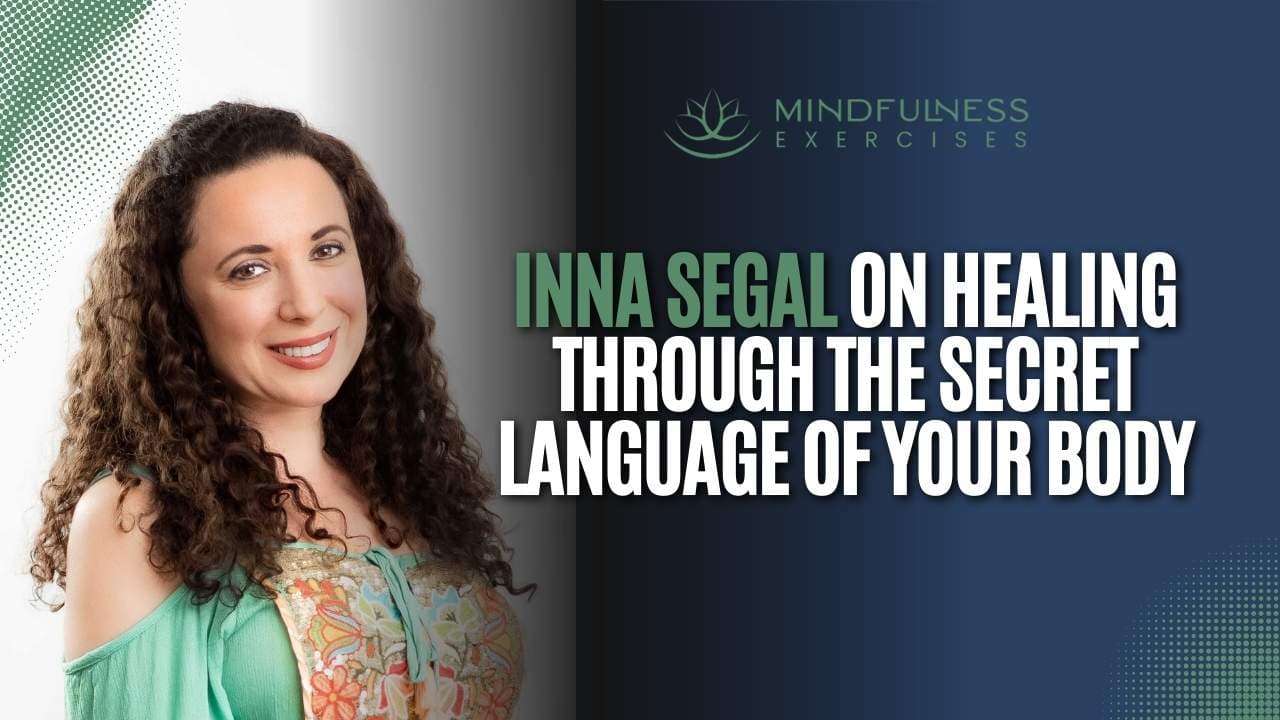
Speaker 1 · 0:00Hello everybody. Welcome to the Mindfulness Exercises Podcast. I'm Sean Fargo. Today I have the pleasure and honor of speaking with Ina Sagal, creator of Visionary Intuitive Healing and bestselling award-winning author of The Secret Language of Your Body and the Secret Language of Color Cards. And the secret like sorry, the secret of life wellness. The essential guide to life's big questions. The secret language of your body, the essential guide to health and wellness, has I think over 1700 five-star reviews. If you're on our mailing list, I emailed you asking for your thoughts on Ina, and I got a lot of responses saying Ina is amazing, Ina has changed my life, I've learned so much from her. And the more I uncovered through listening to some of her YouTube videos and researching her books, feels like there's a lot of overlap here and synchronicity and synergy with what we do here, mindfulness exercises. And Ina really goes into a lot of depth and emotional awareness, emotional healing, physical healing. And is very generous with sharing some free master classes on healing through her website, in atsigal.com. We'll post links to these masterclasses in our books in the podcast description. That's I-N-N-A-S-E-G-A-L.com, Ina Sagal. And she has quite the life journey where through her life when she was a teenager, she suffered from severe back pain, anxiety, skin conditions, and she visited lots of doctors and healthcare professionals, and her condition was deteriorating. But then her through an incredible twist of flip fight while meditating, discovered an unusual way of communicating with her body by turning into her back and releasing all the pain and negative emotions. She was able to heal herself, you know, dedicates herself to assisting others in their journeys of self-healing and empowerment now with her books, her healing techniques, her online master classes, her healing frequency and media appearances reaching millions of people around the world. So it's a pleasure to meet you today. You're in Australia. I'm here in California. It's a pleasure to meet you here today.
Speaker 2 · 3:10Pleasure to be here, Sean. Thank you so much.
Speaker 1 · 3:12Yeah, also looking at a lot of these endorsements of you and your work from people like Jack Canfield and Christian Northrop, people I respect a great deal. So I'm looking forward to learning from you today. And you know, I referenced your healing journey a little bit when you healed yourself through turning your awareness to your back and discovering this healing ability that you have. Can you share a little bit about that event or that practice that you did that you discovered to be so healing for yourself?
Speaker 2 · 3:49Yeah, absolutely. So as you mentioned, I had been suffering with back pain, I had digestive issues, I had psoriasis all over my skin, I had anxiety because all of this was culminating in not actually getting better. And I was seeing a lot of different practitioners for a while from medical, because that's where my family was very focused on just medicine. And then from about 18, I met my partner at the time, and he was very open to just a lot of alternative medicine. And so I was also seeing alternative practitioners, but I felt like I was going with the attitude that I was taught from, I guess, from childhood, which is I don't know anything about my body, I have no connection with it, but the expert does, and the expert can tell me how, well, not tell me actually what I need to take, maybe medicine, or you know, we'll adjust my back or do something, and I don't have to participate in it. That's that was my perspective that I was going with. And I ended up at this chiropractor's office where I had been seeing him for about a year by this stage. And I wake up one day, and there were many, many things that happened to cause this, including that I in my family history, there's a lot of loss of life. My grandmother has gone through the war, and all her brothers and sisters were killed, and her mother. And this sense of sadness and grief and loss has been there, but not really protest. And I, when I was 19, I got pregnant, and I wasn't really ready, to be honest, for that experience, but I worked on it in myself and decided that that's what I wanted to do. I wanted to have the baby. And unfortunately, at the term, the child died. And this was a pretty, pretty traumatic experience, which pushed the feeling of being a victim of this, of my health, of what happens to me, of not trusting, I guess, that there is a divine support for me into my experience because how could this happen at you know, such a young age? And so my back kept deteriorating and deteriorating. And by the time I saw this chiropractor on this particular day that changed my life, he had seen me just hold and be stuck in my own trauma. And he came out of his office being aware of how I was in agony, my back was twisted, I was he was very inflamed as well. And he said to me, you know, your body's stuck. And I said to him, yeah, I know that part. How can you help me? And he just thought about it for a while. And he said, I can't help you because your body wants to be stuck, go home. But I also think he, having seen me for a year, he was aware that I just wasn't taking responsibility for anything and moving forward myself. So it was kind of like a, you know, a shakeup, I think, from his perspective. And so I went when on the way home, I was pretty enraged. But in that rage as opposed to depression, which I came with, it occurred to me that I had always relied on all these other people, and that maybe in this stuckness that he was talking about, there was there was a language, and that my body was trying to communicate with me. It was trying to say to me, hey, there are things you need to let go of, there's things you need to transform, and you need to take responsibility essentially. And so I went home and I really didn't know what I was doing. But what I was aware of was that I was constantly holding my breath and trying not to feel because feeling was painful. And so I placed my hands on my back and I started breathing into the pain, which was intense. But at the same time, it occurred to me that even though I had little trust in the divine, so to speak, that I needed higher help if anything was going to happen and shift. And so I asked and I said, if there is something higher divine out there that can help me with this healing, please help me now. And I just felt this warmth flood my body and I saw a golden light. And so I thought to myself, something is happening. And then this thought came into my head. I just wondered what my back would look like if I saw it, if I could see it. And it was a very strange thought. I'd never had it before, but it was literally like the lights which went on, and I could see my back. Like I had x-ray vision, I got a fright because of what it looked like. And at the same time, at the same time, I thought to myself, you know what? Why do I have this at this very, very young age?
Speaker 1 · 9:09And this when I was this vision or the pain.
Speaker 2 · 9:12The the pain. The pain. Why do I have this and all these health conditions? And at that point, I started having visions that came to me of experiences that were connected to this. And so it started from me being aware that when I moved to Australia, I just felt so uncomfortable, so deeply, deeply uncomfortable in my own skin because I was bullied for not being able to speak the language for being so different from being from Eastern Europe, Europe instead of from, you know, some country like England or America where I could speak the language. And that, and I remembered that it was around the time that I first came to Australia and went to school that my skin exploded with psoriasis. And so I just kind of felt through it. And then I was aware, as I acknowledged this, of another visual image that came, and it was of me actually going to high school and coming home. And my parents actually decided that I needed to go to a private school because this particular private school allowed you to pay a lot less if you were from this Eastern European kind of countries. And what they didn't realize was that the families who did go there were like extremely, extremely rich and wealthy. And the children of those people did not like the fact that the school opened the doors to people like myself. And they treated me and anybody else who came from Eastern Europe with disdain and with as if we were something that they could, they didn't even want to look at. And it was very hard to express this to my parents because they had their own issues, you know, being in a different country. And I would just come home and not feel like I could, you know, that I was completely safe to talk about it because my mom just didn't understand this. Like she was amazing in everything else. But she was like, you know, we're paying for this, we're, you know, supporting you to have a better life. It it wasn't something she really understood, you know, what I was going through. So I recognized that. And then it was very interesting that the image changed again. I actually cried through some of this, and I saw my grandparents and the fact that they had gone through all these traumas in their life, but didn't talk about it, didn't assimilate it, didn't digest it. And I had pretty, you know, bad digestive issues as well. And so did everybody in the family, I should mention. And I started to, I guess, have compassion for their journey and also understanding that I was this sponge that I just pull everything into myself and trying to work things out, trying to help. And so at that point, in all of these insights and awarenesses, I fell asleep and I had the best sleep that I'd had in years because I felt like my body kind of let go. Because there was, again, with my grandparents' situation, I cried about my own loss, I cried about their loss. I felt like finally acknowledged the grief and start to let go and start to make a decision to move forward. And the next day when I wake up, about 70% of the pain was gone. My back wasn't twisted, it wasn't fully, you know, better. But it was huge, you know, for me to feel this, you know, this relief. And over the next few weeks, I just kept connecting to the body. I just kept moving through the different emotions, moving through the different timelines. And by the end of it, my skin just completely got cleared up, never had psoriasis since. I and it was very bad. Like it was all over. My arms and legs, my back was fine. I've never had back pain since. The digestive issues improved, but it's something that I'm still always aware of. And my anxiety went right down. So, and and then I realized that I could see into other people's bodies as well. So it was kind of a huge, huge month for me.
Speaker 1 · 14:08Yeah, that's amazing. Yeah, so that doctor who said, you know, maybe your body just wants to be stuck, I find it so such a bold thing to say that it sounds like it really, you know, struck something deep inside you. You're like, no, it doesn't want to be stuck. I, you know, I need to step up, and it's like you were you felt more empowered yourself to not take control, but to actually like, you know, do something yourself. And you know, I think asking for help is so powerful, like asking for spiritual help, spiritual support, ancestral help, divine help. I'm just curious, like, what led you to ask for that divine support? And how how did you even know to like put your hands on your back and breathe with the the pain and with the body?
Speaker 2 · 15:13And that's a bit I'll answer the body one first. I actually wanted to be an actor, and so I had gone to a lot of acting classes, and we when I was doing those classes, we would often connect to our breath and do meditation and visualization and and things like that. And so I had been aware of this, I had practiced it in the classes that I went to, and so I think it occurred to me if I was going to do something, then I and I was gonna go inside, I was gonna use the acting work that I'd done to try it on my body. Obviously, we weren't doing it on the body, but I felt like what came to me as I was in the car reflecting was that I just I wasn't breathing. I was trying to hold my breath all the time. But also in the acting classes, we were taught about breathing. And you, you know, when you when you use your voice and you're training to be an actor, they're always they're always talking about your breath. So that was a link that came from that place. And I think my back was just so sore that I thought if I place my hands there, I will create some kind of a connection and support, which later on I realized it's kind of like you're you're actually connecting into your nervous system, and you're by placing your hands on the part of your body, you're really allowing the focus and the energy flow to occur. I think in terms of the divine aspect, there were two parts to having my experience with this child that died. One one was that I totally wasn't prepared for it, and there was a part of me that felt like how would, you know, how would let's say the divine or God or source, you know, allowed this to happen to me when I was so young. I, you know, I had just turned 20 at the time. But but also there was an experience, I think it was one of my earliest ones. It was definitely the clearest experience I've ever had spiritually, where I saw an angelic being. And this being said to me when I was in trauma, in this place of trauma, and I really didn't know much about those types of beings at that time. And this angel said to me, Don't worry, you will have two children soon, and showed me a boy and a girl. And for the next, I think, three hours after that happened, I was really, really calm. And I remember thinking to myself, I'm gonna use this process to help other people. I I mean, this experience, I'm gonna, I will talk about it because I was so shocked. I had no idea it happened, especially in Australia. I thought maybe it happens, you know, somewhere like in in countries that are really poor, but I can't understand how this happens and there must be something wrong with me and all sorts of things. But this kind of angelic experience was very powerful. However, because I had not had children yet, I still didn't know if it was real or not. So it was so I was I asked that question because I'd had the experience with the angel, but I also was very skeptical because I hadn't had children, you know, yet. So it was like, well, is this real or is this just me trying to, you know, calm myself down, you know, as we doubt lots of things, you know, when we don't understand them.
Speaker 1 · 19:03Yeah. Did that come true?
Speaker 2 · 19:05Yes. Yeah.
Speaker 1 · 19:10Um so I have I have so many questions about your your journey and your teachings, but I'm wonder so part of this sort of origin story of your healing, right? And maybe you might call it an awakening of sorts, you you you talk about the breath, talked about light, talk about the divine. I worked with a lot of patients struggling with chronic pain in medical settings, sharing mindfulness and meditation with them, and uh helping doctors prescribe mindfulness to their chronic pain patients. And these elements of breath, light, and say the divine or spirit or god, or however you want to language that were common elements to people's healing, people really breathing through all the parts of their body and their hearts and the pain, inviting different colors of light through their being, through their aura, and you know, inviting the sacred to um help them. And also, you know, I think there's a presence with the divine that helps us to feel safe and soft and fluid, open. So I just want to I think share with our community that you know it's not uh you know this headfulness or brainfulness or just you know head-based awareness that we're talking about. It's this embodied being this embodied breath and light and spirit that can really help us to heal whether we have pain or not. And you know, I'm I'm curious with your journey and with your teachings now. Say how much the breath and light and divine are incorporated into your current understanding of healing and listening to the body.
Speaker 2 · 21:11Hugely incorporated. So I obviously have grown a lot since then, but I feel like while different color, different light, divinity is something that I'm constantly working with in terms of my students and encouraging them to clarify also, like you you were saying, you know, using different whatever languaging we want to use, whatever it means to us. At the end of the day, language is about meaning. And so I I often start especially my awaken the healer within programs, where I'll say to somebody, okay, we're going to work, we're gonna start with with a process for divine connection and protection. So we're going to strengthen our own aura. And this is something I encourage them to do daily, where as they wake up, they really support their day and we strengthen, strengthen the whole auric field. But as we're doing that, I usually say to them, okay, I want you to reflect on if there is a being that you connect with, or what does divine actually mean to you? Because saying those words and feeling that and really understanding what that is is so different and it creates a completely new experience for you. And so I'll say to them, like, for me personally, I have developed a very, very strong connection with Christ. But that hasn't happened just through, you know, going to church or anything like that. It's happened through me studying different beings and what they did and how they acted, and then working with trying to bring those qualities into my life, like, you know, how do I become more compassionate? How do I become more understanding? How do I step into somebody else's shoes? All of these things. And so I say to them, it's if you're saying and connecting to a being like that, or it could be Buddha or Moses or whoever you connect with, I would like you to be aware of the qualities, you know, that they did have. What is it that you want to develop within your own self? How do you want to live? You know, and so when we, you know, and we also talk about how do we start to awaken the higher I am within you, the higher self through how you are behaving, how you are feeling, how you are thinking, what you are reading, you know, how do you how you are living your whole day, how you are with other people. And so I really believe in this thinking, feeling, and willing part of ourselves that aligns and we start to live a life, like you said, in this super aligned way. It's not always going to be perfect and it's not always going to be aligned, but what it is is that as you recognize what alignment means, whenever you're out of it, you want to come back to it. And so you start to, you know, look at what are the processes, what are the ways that I can bring myself back to this sense of centeredness in myself where I can be the best version of myself. But essentially, when we think about all these different aspects, we have an opportunity to then work with it in a much, much deeper way. Much deeper way. So again, what I would say divine meant to me 25 years ago to what it means now is so different and how I, you know, work with it and receive it and embody it. And I think it it constantly evolves if you study spirituality and and you kind of study and understand so many different aspects of it. And obviously, for me, or maybe not obviously, but for me, having a very early experience of losing, you know, a child, which I don't wish on to anyone, to be honest, that opened the door to wanting to understand spirituality, wanting to understand the spiritual world, wanting to what happens when we pass over, how does it work? What does it look like?
Speaker 1 · 25:55Beautiful. Thank you for sharing all that. There's so much there to unpack. I like how you said that you like studied and study people who you admire, people who irradiate or embody these qualities of compassion and care and wisdom. And you know, I think that's so missing from a lot of our lives these days is looking for the people who we admire, these spiritual qualities, these ways of being. And really sensing into and studying what do they do to cultivate these qualities of being? What are they practicing? What are they reading? How do they talk? What words are they using? You know, how are they aligned with their message? And so I I think it's just a wonderful practice for all of us to look for those people and collect those people in our minds. And some of us can you know create shrines with photos of these people, or we can journal about them or read their biographies or autobiographies. I think that's such an underlooked practice these days because a lot of us are going through self-help, which is great. And you know, we need support, we need inspiration. We need to, you know, collect these people in our mind's eye to be inspired by because it does take community whether we you know are physically connected with them or not. And uh so I am curious a little bit about who some of those people are for you. You know, you mentioned Christ, and forgive me for this sort of double-ended question here, but you you mentioned how a lot of the times when you start the day, you you ask for protection and you know, like a protection around your or your being, your spirit. So I'd love to hear more about asking for protection and say who you have in mind for that or what you have in mind in terms of asking for protection. Because I also feel like that's so underlooked and quite powerful for us.
Speaker 2 · 28:04Okay, I hope this. So the person that has inspired me the most, I would say, and it's a big statement because I've had a lot of people who've inspired me at different timelines in my journey, but the one that I have had the most admiration for, I would say, the most kind of like I have 200 plus of his books, um, is Rudolf Steiner. So I had originally heard of his work through the Rudolph schools through the Steiner schools and took my son for a little while to one, but I really didn't know much about his work until I was in my early 30s. And I ended up, and this kind of sort of connects into this protection experience. I ended up being married to somebody who was an actor and at the time, and he was essentially doing things using acting techniques that were very dangerous, I thought. And you know, when we talk about protecting ourselves, this is about creating a boundary. This is about, you know, it is not about fear, I want to say. It's never about fear, but it it is about making sure that we're not taking on everybody's energy because naturally most of us are sponges and we just we take on other people's pain or trauma or you know, whatever's going on. And especially in, you know, the acting industry, this is what people do. And so we don't have our own kind of healthy boundaries, but you don't have to be in an acting industry to have that. It's it's it's like many of us haven't been taught boundaries from childhood. And so we we end up as we get older as well, having more issues. Where we get exhausted. Let's say exhaustion is one of the biggest issues because we go to places and we we take on other people's energy. We give a lot of our own out and we don't really know how to work with it. And you know, over time we we become, we start having diseases also because we don't have our own natural etheric, let's call it, energy to work with whatever's going on. It just, it's too much. People are constantly in overwhelm and overload. And this overload is what I want to help people prevent by this morning connection and strengthening themselves. And so just coming back to the Rudolph Seiner idea experience for me, I ended up reading this acting book that was from Michael Chehov, who was this incredible, incredible Russian actor. And because I come from Belarus, which is the Eastern European, you know, part, it's very close to, you know, to Russia. And I was fascinated by learning from you know of what he was talking about. And and Michael Chehov was this, you know, he was a student of Rudolf Seiner's, and he talked about something called you read me practice.
Speaker 1 · 31:23You read me.
Speaker 2 · 31:24You read me, yes. Um, which is about it's a practice that Rudolf Siner brought, which is kind of like communicating with the divine, but through movement on earth, you know, through gesture and through movement. And in in that type of communication, you also you, you know, some of it is very simple, like grounding, and some of it is about kind of connecting to the heart and opening the heart and connecting to your creativity, but also your, you know, materialism, but making sure that you know you're kind of holding materialism down so it doesn't take over your life, but you're living through your heart and from your heart and balancing life through your heart. And so I ended up finding this lady. I was living in Melbourne at the time, and I ended up finding this lady who taught this Eurythme course. And when I got to her house, I had never experienced anything so pure in my life in terms of this energy because I was very sensitive. I am sensitive, I'm very aware of the energy of the space when I get into the place. And I was just fascinated. And I said to her, what is it that you, you know, can you tell me how you do it and what you do? And she said, Well, I've been doing your Rhythmia for over, I think at the time for 36 years, and you know, and I've also been studying Rudolph Seiner's work. Um, if you're open to it, I will, I'm happy to guide you. So I I have to say I wasn't really open to it at the beginning because I kind of felt like I had my own path that I was treading, and but I was fascinated. I was fascinated by what she was sharing and by her own kind of auric field and energy that I was feeling that just felt so expanded. And so I want to say that the way I started, I read Rudolf Seiner's book called Theosophy, which is not an easy one. Nothing that he wrote was easy. But then I kind of went, I I'm gonna read about him. I'm gonna read and study him as a person and his autobiographies, like you said, and what other people wrote about him before I decide, because I was already in my 30s, you know, and I had already been teaching for years and years and studying, you know, different types of work. And so I thought to myself, if I'm going to really connect and open myself up to another person and their teachings, I want to know who they were. I want to know what they stood for. I want to know what they believed, I want to know where they got their information from and how and in what way. And I did that for I think it was probably 18 months or something like that before I started going deeper into his work because I went, okay, now I'm really, really interested and curious about how this works. And Rudolf Sider was where I truly learned about higher beings from a new perspective, including the Christ being, and changed my whole perspective and everything that I thought I knew before or didn't know, and kind of just became very inspired and became very detailed. I feel like my level, I was very generalized in my understandings of things before that, and I became incredibly detailed, and I started doing very specific practices of mindfulness, let's call them. So, for instance, one of the practices that Rudolph Seinhooks talks about is concentration, and that unless we learn how to concentrate properly, a mind is going everywhere and we cannot be fully present. And so those concentration practices were my least favorite because they were kind of you know difficult and not and they weren't about making everything interesting. They were more about something like I would hold a pencil and I would spend five minutes just fully concentrating on the pencil and in my mind creating thoughts only about the pencil, nothing else. And so I found it very difficult at the beginning to do, but over time I did it again and again every day for years and years. And what I found was that I could then think very clearly and logically and specifically in the moment and be extremely present with whoever I was with or whatever I was doing. And then I could meditate properly because I knew how to, you know, it's it's like a muscle to be able to concentrate, as you probably would know, and you know, that I could bring concentration and then meditation became this incredible experience, and then every process that I would do for myself or teach others, including the protection process, but I teach many, many others, I could learn so much from the processes. I felt they that they came to life and they would teach me about what else is possible in healing or in spiritual expansion that I didn't know just because I could concentrate and be detailed and fully kind of discover from the process.
Speaker 1 · 37:30Every time you talk, I just am filled with so many more questions. That's really yeah, really amazing how you found Rudolf Steiner. We'll put his say Wikipedia page in the podcast description so that people can check him and his works. Yeah, you know, I think for say a lot of quote unquote mindfulness teachers will say that mindfulness and concentration are two ends of the same stick where you need concentration to fuel your ability to be present, as you said, and you need some element of mindfulness to be able to concentrate as well. And I never quite heard of a concentration practice like the one you shared around you know, looking at a pencil, thinking about the pencil. It sounded like you incorporated different types of experience of the pencil as an example, really limiting your focus towards these different aspects of the pencil. And this practice of concentration is really foundational for our mindfulness practice and our ability to be present, as you said. I'm wondering if you see concentration practices as being foundational for say connecting with the body. And I noticed that Rudolf Steiner was uh clairvoyant in some ways, and it sounds like with your ability to see things and connect with the divine in different ways. I'm wondering if you would call yourself clairvoyant, but kind of wondering if concentration practices fuel that ability to see deeply feel, deeply connect more deeply with these different kinds of energies.
Speaker 2 · 39:28Well, absolutely. I mean, Rudolf Seiner was one of the most incredible scientists and clairvoyants that I'm aware of in terms of that has lived. He the you know, he he taught doctors, there's there's medicine connected to his work, there's it's called anthroposophical medicine, there is homeopathy connected to his work. So he was also an architect. He he built the he he created you know drawings for different buildings that were built, and the a lot of the schools are built based on that. He created schools, he in the industry that I found him in the acting, he he gave instructions on that and movement and voice. He gave us an understanding essentially of what happened historically and broke down some of the most incredible, you know, like I mean, books, holy scriptures, and you know, and talked about them, you know, in people like Buddha and Moses and so many, and as they're so strange, so many that have come before us that we are absolutely, you know, incredible and what they brought to us. So he gave us so much to understand, and he also gave us the understanding of what happens in the spiritual world. At the same time, your question around, you know, mindfulness and and and concentration to open clairvoyance. I would not compare myself clairvoyantly to Rudolph Seina in any way or form because you know, I feel like not even gonna talk about being a baby compared to what he was capable of. But I I feel like my abilities have started with more of seeing the person as opposed to clairvoyantly into either the future or into the spiritual world. So for me, my concentration in this life so far has been much more about what's going on, you know, physically with somebody, emotionally, mentally, as opposed to, yeah, what Rudolph Sina was able to do. But I do very deeply believe, Sean. What he did is he he spoke about several exercises to refine your intuitive abilities wherever they were at. And concentration was the number one exercise. It was the first one you would do. And he talked about how, you know, the heart is the area of intuition, which to me was so fascinating because that's what I always saw and felt in my courses in terms of people opening up. When they opened their heart, they could feel and sense things that they could not while their heart was shut down. And so the exercises that Rodasina talks about in the heart are exercises that we'd want to do anyway. So it's things like concentration, positivity, constantly finding the blessing in the challenge. You know, what happened to you that was difficult, and how can you turn that around? How can you do that daily, right? How can you move that energy and that opens your heart? You know, he talked about open-mindedness. So I can have a completely different perspective to you, but be open-minded and kind and listen to you and then discern for myself, is this right for me or is it not? He talked about a practice of equinomity where, you know, so many of us, including myself, before I, you know, learn to, you know, love these big emotions and only think that when we're really high and happy or when we're really sad and down, we can kind of feel things, or you know, a lot of people are numb. But what Rhoda Sarah talks about is how do you become sensitized? How do you become sensitized by actually allowing yourself to be aware of the subtleties, the subtle feelings, you know, the spaces between different feelings and what what are they and how do they, you know, what can you discover if you are not just you know going through the bigger feelings, you know, what are the layers? So yeah, it's just really beautiful the practice. And then he also talks about the practice of your will, that we are constantly, constantly doing things for others. And we don't, if we say that I'm gonna do something for ourselves, we are less likely to keep that word than if we say I'm gonna do something for somebody else. So we're very likely to break, you know, our own agreements with ourselves. And he also talks about how if you're going to open this heart chakra in this way and the you know, intuition, you must learn to keep agreements with yourself and in that use the will, you know, the will energy by saying to yourself, for example, I'm gonna do something every day, but it's not useful. So he says that, you know, because we're like everything has to be useful in our lives, otherwise we don't do it. And so he asks you to do an exercise that is not useful, but but that is connected to will that you agreed to do daily. So it might be like anything, clap your hands 10 times, you know, touch this, you know, each finger and count to 30. It, you know, it can't be useful, it has to be something it can take 30 seconds to do, but something that you do where you learn to keep agreements with yourself and trust yourself. So people say often say, I don't trust myself because we break agreements. That's why we don't trust ourselves. We constantly say, I'm gonna complete something and we don't do it, you know. And so his whole idea is how do you strengthen yourself? And also, one other thing that is very, very important in Rudolph Seiner's work is that in most Eastern ways of thinking, we're we've been taught, and I was a proponent of this for a long time as well, that the ego is bad and we have to get rid of it, we have to dissolve it. Whereas Rudolph Siner talks about redeeming the lower part of the ego, the lower self, and awakening the higher sense of your ego, the higher I am. And that also totally changed my understanding of everything from healing and how you live your life, that you're you're meant to strengthen your sense of self. And by strengthening, you get to know who you are, and when you know who you are, you can start to refine the parts of yourself that you know are stuck in the shadow or in, you know, are operating from places of you know subconscious or unconscious awarenesses that are creating self-sabotage, that are creating harm to you and others.
Speaker 1 · 47:05Yeah, so powerful. Yeah, and so many things to concentrate on. You mentioned, you know, several great examples of what we can concentrate on to say, you know, redeem the lower part of our self and awaken the higher self. I'm just out of curiosity, were there concentration practices that either he taught or that you teach that are in the body? Um you mentioned how the heart was you know a centerpiece of you know his his focus. I'm wondering if there's any concentration style practice in which you focus on the physical heart inside the body, just out of curiosity.
Speaker 2 · 47:55Absolutely. I think most of the practices that I teach are, if not all, are connected to concentration, and majority are definitely connected to the body. I'm always saying to people the same as I connected to my back to find the place inside the body that feels uncomfortable. And that could be pain, but it doesn't have to be pain. It could be numbness, it could be emptiness, it could be just some kind of tension. And placing your hands on that part of your body and actually concentrating, starting with the breath. We always have to connect the breath. I'm not the biggest fan of forcing breath, you know, breathing just because I really like gentle, really gentle ways of healing. So really intensive breathing is not for me, you know, not what I teach, but I teach people to find their own breath in terms of what is one natural, and then we have little practices where we might breathe through the nose and out through the mouth with slightly pursed sleeps because we know that that relaxes the nervous system and that it calms it down. And you were saying that earlier, Sean, that we need to concentrate, we need a little bit of relaxation in the nervous system, you know, because if you're chaotic, you cannot concentrate. So we do need a bit of both of that, you know, and so I teach people to ground. I usually don't do many processes when I'm teaching without grounding first. And, you know, so I usually start with grounding and then connecting to the heart, and then we we will go to which part of the body, you know, and and where what's going on there. And so we'll look at, and I'm I'm slowing down and saying this also because to rewind slightly back, I really believe that to sensitize the body is to allow the body to give you insight, right? And most of us, if we live in this chaotic world and we're, you know, we're kind of just trying to make things happen and we get up, we don't take the moment to connect and meditate, and we just we're straight, you know, for the coffee, the, you know, like doing, doing, doing type of way, we are going to numb ourselves. We're going to, you know, and if we spend a lot of time, you know, working on the computer or like most people do now, and a lot of time scrolling through social media and all of this stuff, and not enough time in nature, not enough time outside, not enough time moving the body, we are going to numb it and and and and really connecting with it. And so usually I my first practices with people is to move the body by waking it up. It's very simple and easy to do, just just shaking your arm for 30 seconds and then stopping and waiting 30 seconds, and then shaking the other arm and waiting and stopping, especially if you're in a place of overwhelm. And then connecting to the body, you know, and then breathing into it. And as you calm down and breathe into it, then we can start to ask questions from the body, which is another practice of concentration. Because as I ask a question, I need to slow down and concentrate to receive an answer from my body. And the kinds of questions that I, because the body is alive, you know, it's it's it's like it's embodied by a soul, and the soul is constantly trying to communicate to you through feelings, through giving you an understanding of things, through color, through sensations, through essentially symbolism and archetypes and memory. So when we start to connect to the soul in the body, we start to become much more aware of our inner life and why we have the issue that we have. And so we might start with saying, if there was a thought pattern that was connected to my discomfort, what would it be? And what I say to people, again, if we are looking at concentration, it's not you, it may not be the first answer. You might go, and what's underneath that? And what's underneath that to get to a little bit more of an awareness of what am I really believing and thinking? And is this helping me, or can I turn that around? You know, and I have a lot of processes that I teach people of how to turn it around, you know, and then you have, and then you might go deeper and you go, well, is this thought pattern fueling a feeling? And a feeling in my job. And I'll say to people, not feeling something is also a feeling. It's a feeling of saying, I'm too scared to feel the real feeling, so I'm gonna numb, you know, and put a protective barrier around what is going on because I don't want to feel the real feeling because it's scary, right? So numbness is always a feeling. And again, you might go, well, what am I protecting if I'm feeling numb? What's underneath this numbness? Am I ready to face that? And then you might go, is this connected to an experience that I've had? And when was this experience and what happened? And this is where it becomes very, very interesting, Sean, because what I've discovered over years and years and years of doing this work is that we have these archetypes. So Jung is another person that I've been very, very influenced by and inspired by. So his discovery that internally we are made up of a variety of archetypes and that essentially every experience that we have becomes archetypal. And what happens within our own psyche and within our own emotional being is that every every stage of development, every year that we go through becomes, you know, I guess brings out an archetype that either grows or becomes stunted. So there are parts of us that have grown tremendously and we can we feel like I can keep going and I keep can keep exploring and expanding. And there's parts of us that have become very stuck and stunted. And when we look at that, we start to see how disease occurs, right? And if we if we even look at that word disease, disease, right? It starts with that internal, I don't feel at ease, I feel stressed, I feel uncomfortable, I feel tense, stuck, disconnected, you know, cold, I feel hurt, I feel this, I feel that. And so I'm gonna hold myself back, I'm gonna hold my body in a particular way. And so when we start to understand archetypes, to me, archetype is like the architecture of us, right? It's it's our internal, it's going where what what happened to me? What happened to me that caused this particular issue? And how do I connect all the pieces? Well, you the easiest way to connect it is by becoming aware of the archetype that is related to that, those ways of thinking, that those ways of feeling and the experiences you've had, what caused it to become, you know, sick? What caused it to become tense? What caused it to become to stop expressing itself or you know, this part of yourself. And so when we really understand that, we can use this higher, wise sense of self to go, oh wow, I can I understand why anxiety is showing up right now. I understand why discomfort, where is it in the body? Oh, it's here. Which archetype is connected to this part? And what I've done over the last 25 years is by tuning in and connecting to tens of thousands of people, I've gone, right? I can see this archetype showing up in this area of the body, and here the connection to the ages where this becomes developed, and it is just fascinating because the body is truly a map. It's a map, you know, if we learn how to read it, how to work with it.
Speaker 1 · 57:05Yeah, and and understanding the what different kinds of archetypes there are, the elements of the body, you know, behind you for people able to watch the video of this, there's a art piece behind you of four colors. There's like kind of a red, yellow, green, blue. And to me, when I first saw that, I was, you know, could translate that into seasons or elements of fire, light, earth, air, or wind, or space, and even just being able to sense into those types of elements in the body and the energy of the universe. But yeah, like through your work being like studying the elements of ourselves and sensing into them, you're more adept at reading maps more quickly and seeing the patterns and discovering where parts of ourselves are are blocked or free. Like the one book right next to me as a book on archetypes of masculinity, king, warrior, magician, lover, and just kind of sensing into you know what areas of my own masculinity are stuck and sort of learning the vocabulary and the manifestations of these types of energies and you know beliefs and architect in many ways, I guess. I'm curious as you study these uh senses and the messages that our body has for us. You know, you mentioned that when we listen or sense into the body, there may be I think you said thought patterns, I think you reference colors, symbols. I'd love to review like what those different types of elements are for the lack of a better word. And also in your teachings, you emphasize that every body part, like the spine or the brain, holds messages about our lifestyle and emotions. And I'm wondering if you've seen patterns of certain body parts communicating certain kinds of messages, or are all kinds of messages sort of everywhere in the body? If that makes sense.
Speaker 2 · 59:28It does make sense. All right, let's start with the question. So we can explore the body in different ways, you know, by asking questions, whether it's the elements that are always involved is the thinking, the feeling, and what happened, right? What was the experience? But sometimes we might do it in a slightly different way, where I like to do this particular process where I'll get people to place their hands on any part of their body that is. You know, has discomfort, or I'll do a general one and I'll say, okay, place your hands around your eyes, and this is going to be all about your whole vision of yourself. And I'll ask questions such as if there was a color, you know, in you know, in this part of your body, or if you're doing your eyes in general, but could come to you to show you a general sense of where you're at in your life, what would it be? And people will say, okay, you know, they'll get a color, but they often don't know what colours mean. So this is why it's so fascinating. And then I'll say, okay, is this a healthy colour or an unhealthy colour? And usually it will be unhealthy. And then I'll say, What would be a healthy colour? And a completely different colour will show up for them, which to me it tells me a lot about where they're at. And then my next question will be, okay, if there was a thought, what thought would it be? If there was a symbol, what would it be? If there was a feeling, what would it be? And if there were three words, any three words, one to three words that you can tell me at the end, what would it be? And so I then doesn't matter which part of the body, by them telling me that, I can tell you everything that's going on in that part of your body, you know, and why. Because that that gives me, you know, the symbolic understanding of what's going on, the feeling, the colors will tell me where you're at and where you need to be and what the differences are. And the last kind of like the symbol, as I said, gives me a real awareness of what the story is likely to be around there. So I may ask for a symbol, or you know, because symbol or archetype is metaphoric, right? It gives you the metaphor of what's actually happened and why the person is in that state. And then the last few words is like, okay, that's where you're stuck, or that's where you're you're going, where this is where you're gonna move to, which is going to be positive. So people get really amazed at it. And it's, I mean, I continue without it, it just takes longer to concentrate. But if I want somebody one to understand it themselves and to show them how it works, or to give them within two minutes pretty much what's going on in their body by them showing me, telling me that. And it, you know, it it becomes really, you know, profound for them because they go, Oh my god, you've just told me exactly what's going on. And this is pretty much 100% of the time that people say that because, you know, because I'm like, well, that's actually the language of the soul about the body, right? About what's going on in the body. And so this is really fascinating. But if we start looking at the body as itself, your second question, we start to go, okay, every part of the body has its own function. And based on that function, it tells us what's actually going on inside. So if we just take a few parts of the body, let's say we take the eyes. The eyes are about seeing, right? What am I seeing in my life? And if I'm seeing things that I don't want to see, that are difficult to see, that are painful to see, like my family members getting sick or dying, like, you know, losses, like traumas, I'm gonna start to blur the vision, or I'm gonna start to create hardness in my eyes and develop issues, you know, around that. And so what I say to people, it's like the eyes tell you the story of what is it that you don't want to see, what is it painful for you to see and difficult. And if you want to improve your vision, you actually, besides doing eye exercises that are very powerful, and I wrote about them in my book, The Secret Language of Your Body, you know, you you need to one let go of what caused you not to want to see, so you have to release the trauma. But then you also, this is the will, right? You have to consciously focus on what it is that you do want to see. You know, where is the beauty? So going into nature, finding places and people that you want to spend time with that gives beauty, you know, and this is why you even mentioned my pictures, like having, you know, color and pictures around you that make you feel like, oh my God, this is beauty, you know, like this makes me feel good. I was mentioning that I have over 200 Rudolph Sinov books. I have them because I like to look at, I like to know that in, you know, that if I need to find a topic, right, I can go to my bookshelf or if I'm inspired, or I just intuitively want to discover something, I can look and something will pop out, and I'll be like, okay, I want to read this, I want to open this, I want to learn this. So, you know, so how and and and and in general, having that, what makes you feel strengthened, what makes you feel strong, what makes you feel healthier. And this is, you know, so this is connected to the eyes. But if we look at the throat, and I remember I went on tour to the US several years ago, and I decided, which I don't do very often, but I was like, okay, on this tour, I'm just gonna tune into people because I I like knowing what's going on with majority of people, you know. So it's like, what are the issues that are coming up in this particular country at this time over and over and over again? And the time that I went, it was thyroid, just like every second person had a thyroid issue. And I just kept seeing it over and I was like, I I I actually do know how to tune in. I'm saying this because you guys, what's going on? Like, what are you not saying? What are you not living? How are you not expressing yourself? What are you pushing down? How are you, you know, because that's an area of communication, that's an area of expressing yourself, that's an area of, you know, I guess the thyroid also helps with your metabolism, with your hormonal levels. So it's like, what emotions are you pushing down? What's going on with your intimate relationships where you're hiding things and not really communicating with your partner about what's going on, which was coming up a lot. And so, you know, and so each part of the body has its wisdom in a sense of it. I want to emphasize this, it may have similar aspects, some of them. So, for example, we might have fear that shows up in the liver, and we may have fear that shows up in the kidneys, but it's not the same fear. This is the biggest thing that that that is confusing and that is very easy to get lost in and generalize because in the liver, the fear that I'm gonna have is going to potentially be it's so we have the feminine and masculine sides of the body. So the right side where the liver is is always masculine. And so we the liver is going to be about my fear of moving forward, of achieving something, of fully showing up, of having the confidence to do what I say I'm gonna do, maybe fear failure around a project in the kidneys. The fear is ancestral. The fear is about what your ancestors had not processed in themselves. So you could have like I had this fear around being homeless when I was 20. And it was ridiculous because I had a, you know, I had a home that was, you know, already had a house that my partner and I had bought. I, you know, like we didn't even have to pay it off. Like it was we already we bought it outright. So the fact that I was in this massive fear that I and then I remember talking to my cousins and they said the same thing. And it was like my grandparents didn't have a home, you know, for a long period of time. They would have had that intense fear, and that, you know, because it wasn't processed, it then got passed down. And so that's the fear in the kidneys. It's like you don't really know why you're so afraid, and this can activate the victim archetype where it's like, I just, you know, I'm just afraid of things, but I don't know why. So even though there could be similar types of feelings or thought patterns that are showing up, they are essentially giving you a different story if they're in a different part of the body. It's like, what is the fear about? What is the quality of it? You know, what is that feeling really showing you? And if we can ideally understand a little bit about the function of the body. So, like the liver is about detoxing, cleansing, you know, and you know, digest helping us to digest. So then we we're looking at what what is that doing? What is it doing, you know, and how is it giving me insights? What I found so fascinating that Rudolph Steiner said also in terms of intuition, just for a minute, is that so we have the heart as the organ of intuition, but we also have the liver as the organ where we can actually connect to divine beings, which I thought was so fascinating that that was the place that we could have these types of connections.
Speaker 1 · 1:10:31Interesting. I'm just kind of thinking through that a little bit and how with a sobriety and cleansing the litter, the liver and detoxing the liver can help us to kind of stay connected with the divine. I don't know. You know, for a lot of our community, we really focus on you know mindfulness practice, these gentle awareness practices. And what often gets lost in translation is what to do with that mindfulness. And classically speaking, in the Buddhist tradition, the Buddha talked a lot about sati sampajanya. Sati is mindfulness, sampajanya is clear comprehension, essentially sensing it as the context and responding appropriately with this clarity of mind. You know, so the Buddha would talk about mindfulness, but he usually connected it with clear comprehension. And I think as I hear you talk about all this nuance, and I think we're just scratching the surface of what you cover in your books and your master classes and your courses, that you combine both. You combine the mindfulness, the uh concentration, this ability to sense deeply, sensitize our bodies and listen and intuitively sense into the meaning, the languaging, you know, the story, the the journey of what can unfold and how we can take ownership or agency of how to heal proceed. So I'm just appreciating the combination of what you're sharing. There's this sati and sampajanya, there's this clarity of knowing and responding appropriately with a lot of nuance and you know combining so many different lineages of wisdom and and practices. So I really recommend that people check your website, inasigo.com. That's I-n-n-a-s-e-g-a-l dot com. Her best-selling books are on basically wherever you get your books, but there's literally thousands of five-star reviews. Many of you on my email list have already been impacted profoundly by Ina's teaching. You can sign up for her free master classes on our website on awakening your intuitive body, secret language of the body, awakening the healer within, and sign up to get notified about Ina's events and get on our email list. I'm certainly going to dig into your work more, Ina Rudolf Steiner, maybe listen to this podcast again, even though I was a part of it, and and and share this with our community more. So, you know, I'm really grateful for your generosity of teachings and spirit. I've learned a lot today. Before we say goodbye, I'm just curious if there's anything else that you'd like to share with our community, any messages or invitations, or anything else that you'd like to share?
Speaker 2 · 1:14:08I think I just wanted to share. I also have this book that I write called Understanding Modern Spirituality. And I would encourage people maybe to check this out first before reading Rodolf Seiner's books, just because it will give you a lot of insight and preparation, so to speak, for his work. So again, it's called Understanding Modern Spirituality.
Speaker 1 · 1:14:33That's your book.
Speaker 2 · 1:14:34Yeah, this is my book.
Speaker 1 · 1:14:35One of your books.
Speaker 2 · 1:14:36I wrote it one of my books, yeah. I wrote it because I was so inspired by Rudolf Seiner, but I also felt like it's it's very challenging to kind of it's challenging work for a lot of people to step into without having some foundation behind them and some kind of connections and understandings. And so this was kind of my it's not just about Redol Sign, it's not just about his work, but this is kind of this book has come from me being really inspired by looking at various different topics from destiny to karma to, you know, even topics like happiness, what's you know, you know, we're always pushed to be happy, but is it that we're looking for happiness or is it that we're actually looking for deep fulfillment inside ourselves? And you know, and so I kind of I I I talk about the angelic realm a little bit here and opening the doors to it. I talk about why I believe we're even here on this planet and how it's all got connected. I talk about ancestry, I talk about karma, I talk about soul family and how that works and so and give a lot of different practices at the end of the book as well. All my books have practices in them. So I think, yeah, if people are interested in deeper look at spirituality and kind of connection, that would be a good way in and also discovering more in themselves. But at the end of the day, I feel like what I hope to do is to inspire people to take a step forward towards themselves, towards their body, towards, you know, their their own heart, towards really listening, really listening to the messages within. And by listening, discovering who are you on this planet? And I guess the most important question for me has been: what am I doing here? Where am I going? And what do I need to do to get there and to become, you know, to continue to become the best version that I can be through every trauma, every challenge, every difficulty, as well as every amazing, pleasurable, beautiful experience that I have.
Speaker 1 · 1:17:10Amen to that. May we all experience that. You know, thank you so much for everything you've shared and how you've shared it today. Thank you for the work that you're doing for the world and for so many beings out there. We'll put a lot of this information and links in the description below. So I really encourage people to connect with you and your your work. Because again, I think we're just scratching the surface here. Uh, thanks again for for coming and I hope this isn't the only time that we're able to connect.
Speaker 2 · 1:17:45I love that. Thank you so much.
Speaker 1 · 1:17:46Yeah, thank you.