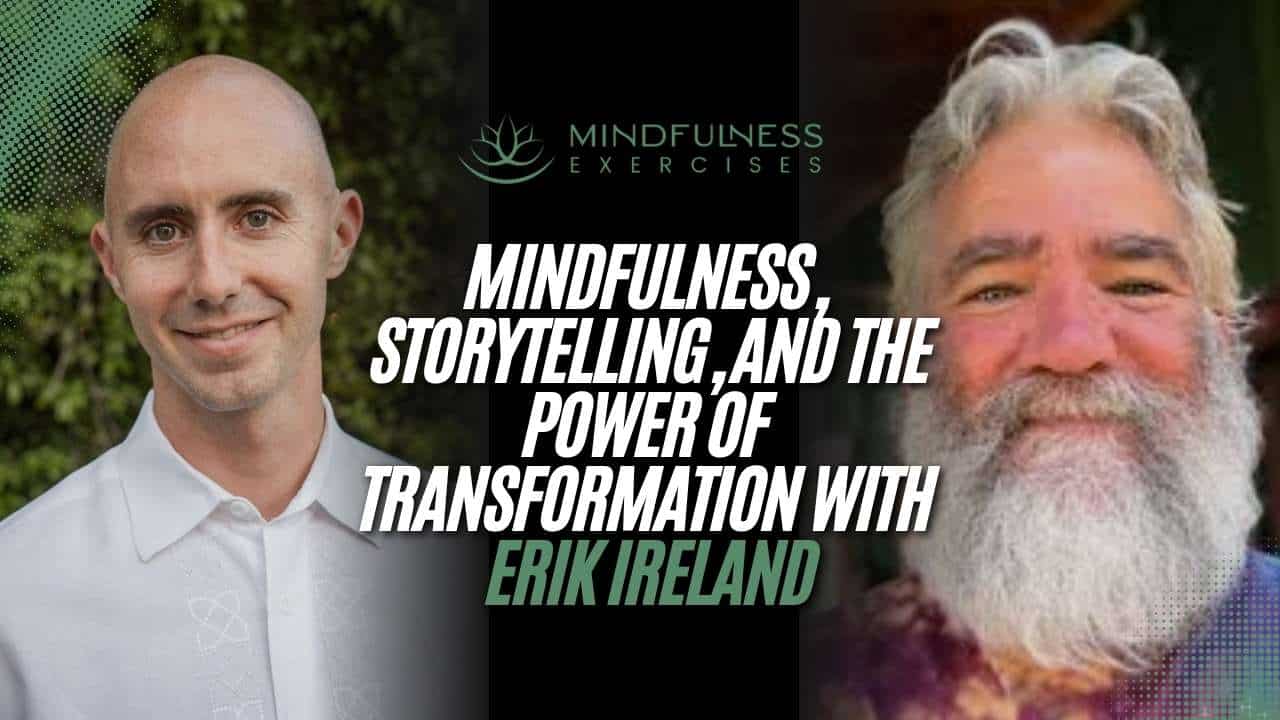
Speaker 1 · 0:06I am very excited to welcome Eric Ireland to not to the program, but as a as a guest teacher. He's been in the program for some time and uh is one of our vocal contributors and someone who is quite sincere in the practice and with his teaching. He's been integrating uh mindfulness with helping people fall asleep through his storytelling abilities. Um, he's the creator of Listen to Sleep, which is one of the most popular podcasts in the world. And I highly recommend it, but he's incorporating mindfulness into his podcast. He's also creator of Awaken Your Myth, awakenyourmyth.com. Unlock your true potential and ignite your hero's journey. And that's what he's going to be talking about today. Um, and how mindfulness can be a part of this for each of us.
Speaker 2 · 1:17Thank you so much, Sean. It's uh so wonderful to be here in this Zoom room where I experienced so much personal transformation. It's a privilege. I am an actor by training, but being myself in front of people is always a completely different thing than acting. For those of you that don't know me, uh, Sean gave a wonderful uh introduction. I really appreciated that. Um, I'll tell you a little bit about my story since today is going to be about storytelling in many ways. My hero's journey really started when I met my great aunt at 18. I grew up in a family that might had, like many of ours do, had drama about things we couldn't talk about and people who were in our family that we didn't talk to. And one of these people was Kim Stanley, who was an Oscar-nominated actress. And in the 50s, she was actually considered to be one of America's greatest actresses. And she was my dad's great aunt. And when I was 18 and I went away to college and I didn't know what I was going to do with my life, I got involved with the theater department. And I thought, well, I have this aunt who's an actress. I should get in touch with her and just see. Maybe this is for me. And so she uh very kindly invited me down to Los Angeles and I spent a weekend with her and decided, yeah, I want to be an actor. This isn't practical, this doesn't make sense career-wise, but she got me started on the journey of wanting to be an artist and follow my heart instead of my financial considerations. And I went through college, and when I was graduating, she was leading classes in Los Angeles, and I wanted to come down to LA and audition for her class. She told me that I could, she wouldn't guarantee that I'd get in, but she said, sure, you can come down and audition, uh, but I don't recommend it. I got into acting early, and I know what it's like to be a young actor in this business. And I think you could better grow as a person going out into the world and living life like a hero's journey, seeing what life has for you, seeing what gifts it wants to give you, what you can learn about yourself, and then bring that back to the theater someday if you want to. That made a lot of sense. But I told her, yeah, no, I'm coming to LA. And then I one thing led to another, I fell in love, I flipped a coin, I changed my mind. And that was where my hero's journey really started. And for let's see, that was 1988, 89. For almost 30 years, my hero's journey was strictly a journey through the outside world. Because I had gotten into some spirituality when I was younger, and I finally just decided that it just seemed like it wasn't gonna happen for me. I didn't understand it. Meditation made me squirrely. I just thought I'm going to look for happiness in the outside world. That's what the hero's journey is. I'm gonna go through the world and find my happiness and my treasure and bring it home, and then I'll be happy. Well, I did that for 30 years, and I spent 20 of those years working on getting to here in this cabin in the woods that was my dream of what I thought would be everything I needed to be happy. Only to find out when I got here that I was not happy. Well, it didn't just make me happy to get my dream I had been working toward for 20 years. And that was when I started my podcast. I thought, well, if I do more for others, that should make me happy. And it did. It definitely was a great thing to add to my life, but I still didn't have that inner peace I was looking for. And that was when I decided that I would add mindfulness to my podcast, that I would wanted to do meditations for my podcast. So I and I saw an ad for Sean's program, like probably many of you did. And I clicked on it and I called him on Skype and I talked with him, and I thought, wow, this is a really, really nice person. I'm going to do this. And I had no idea how this would change my life and finally lead me toward understanding the true meaning of the hero's journey, which is a journey through the outside world to our inside world. It's a journey that takes you to who you are. And I was avoiding that part at all costs. So I spent all my time on the road and none of my time finishing my journey. And once I've added the mindfulness component to it, I was able to get to a place where I could see what was going on inside of me. I could have that non-judgmental awareness of the present moment, which had always eluded me because I thought happiness and pleasure and security were kind of all the same thing. And sometimes they are, but none of them last. There was a joy, a peace that came with mindfulness that brought the whole thing together. So that was when I first started to see: oh, okay, this is the combination of things I've been looking for. Right about that same time, I got on TikTok to start promoting my listen to sleep podcast. One of my friends was like, hey, you should try TikTok. People, you'd probably love it. And you could do these little voice things that people would reuse in their videos, and it might get you some new listeners. And I thought, okay, it's going to be me and all of Gen Z, you know. Fine, let's try it. And I met the most wonderful kids. I met so many people from Gen Z who I had never met before. You know, I don't have kids of my own, and I obviously don't have a lot of friends that are that young. I'm in my 50s, and Gen Z is in their teens and early 20s. So this was a place where we could meet. And they adopted me as kind of their big gay mountain grandpa, and would ask me all the time, what did you do to get where you are? And I saw that there was this burning desire in so many of these people for a way to live their dreams and a way to move through the world that wasn't all these old, outdated ways of doing things that their grandparents had done, like me. And so I told them, I said, I, you know, I can't tell you what to do because the situation was so different when I started out in the 90s before you were born. Uh, and I really don't know what your situation is like, but I can tell you my how and my why, and I can help you find yours because I did that. And I have that personal experience that I can share with you and sort of point you to those places in yourself, and you can use that own inner wisdom, your own inner wisdom, to chart your own course and make your own dreams happen. That was when I started to develop Awaken Your Myth. I thought, okay, it really was this hero's journey that was missing this very critical piece. What if I bring them together? And I started that for those kids. And I realized, oh, okay, it's not just kids who need that. There's lots of us more mature folks who could use it too. Uh so let's talk a little bit about the hero's journey. We'll do sort of a brief overview of it. It is one of the oldest stories we tell as people. It is literally the oldest story we tell. The Epic of Gilgamesh is the oldest recorded story. And it's from Mesopotamia, around 1500 years they dated at before Christ. So this story model is about the basics of it, are three things. It's separation, initiation, and return. So the hero becomes separated from their normal world. They move into another world of trials and challenges, where they are put through an initiation that transforms them. Then they come back from that world and they are back in the ordinary world again, but they're forever changed, and they have brought a gift of their inner wisdom, and sometimes it's a supernatural gift, like a god gave them. But this story has been told all over the world for as long as there have been people. And if you go back, I think like 70,000 years ago, when there were maybe 10,000 people on the planet, some people think there were less because there was a huge volcano that blew up then that might have gotten us down to like a hundred humans on the planet. What were we like? What were we talking about? What were we doing with our day? Well, you know, we were hunting, we were loving, we were doing the things people would do. But what about the stories? What stories were we telling? To me, the hero's journey seems like the story that gets us back to what those original ancestors of ours had that we probably don't and maybe never will, is a life before all of the social conditioning that has come with being raised in uh in the modern era. You think about it, we're we're born almost like marsupials, you know, we need care for the first 12 years of our lives that requires us to be latched to our parents and to get all this conditioning that that makes our mind, makes our ego, starts to separate us from our instinct. And then for the most part, in our modern society, we don't get reconnected to that instinct again in adulthood. There are many societies that have initiations for manhood and womanhood that are meant to do that, to connect us back to our instincts as a human. It's our non-conceptual knowing. It's the part of us that doesn't have to think, that just knows the way when a baby turtle crawls out of the sand and heads for the ocean through the gauntlet of seagulls and fish that are all trying to kill it. It doesn't think about it and go, oh, that's very dangerous. Maybe I should do something else. Maybe I should go to the forest. It just goes. It just knows. And we have that same thing in us. We are a part of nature. And those people, when there were, say, a hundred or ten thousand of them 70,000 years ago, knew that. They wouldn't have even considered that they weren't a part of everything else. Whereas we draw lines there now. The hero's journey helps us to see that we are a part of everything else. And it is the gift that the people who remembered that have passed on. This is how I experience it anyway. There are other people who would probably argue that it's not that. But it does work this way, and it has worked this way for me in my own life, and it can work this way for others. So that journey starts with ordinary people in the ordinary world. Think Luke Skywalker on his home planet. It's about being with what is. Now that is where mindfulness is perfect because being there in the present moment allows us to know who we are right now and have a sense of what's happening around us that isn't clouded with too much thinking and identity. Then that space allows the next part of the hero's journey to happen, which is the call to action. That's when, oh, there's a problem, Princess Leia is needs help. So when that happens in our lives, sometimes it's an opportunity. It's a something that presents itself as like, oh, I want that. Other times it's grief or sadness or loss. And we're like, oh, I don't want that. But when we observe our lives through the lens of mindfulness, it doesn't matter so much whether it's the thing we want or the thing we don't want. We see that it's happening and we know, okay, this is life asking something of me now. What am I going to do? And we've got two options. We can resist, and that's the next step of the of many heroes' journey stories is the refusal of the call. And resistance was the name of my game. We were talking about it uh earlier, Sean and Sara May and I, about how I got called out so badly in this very Zoom room for my resistance. And it absolutely helped me transform my life. And it was with a session that we were doing with Dr. Gabor Mate a couple of years ago, where I was asking him about what about the trauma that you don't even remember? And he's like, Yeah, it doesn't really matter if you don't remember it because it's in your life now as whatever you're resisting. And I was like, Oh my God, I resist everything. And it was this light bulb moment that, oh, okay. And at first I was, you know, kind of like sad and embarrassed, and I'm like, oh, I'm just a resistor. I'm never gonna get this stuff because I'm a resistor. I realized that that resistance was a protector, was a part of me that was just saying, hey, we got hurt before when we did this, and we don't do that anymore. We we do this other stuff now. All that other stuff wasn't getting me where I wanted. And I was gonna have to follow some of these paths that I had complete resistance against to get to where I needed to go. So moving through that and crossing that threshold is a way for us to take that mindfulness and use the acceptance part of it to really lean into life, to yield to life, to yield to life, to our inner wisdom, not to our fear, not to our resistance. So once you've crossed that threshold, there's no going back. You can you could turn around and try to go back, but life will never be the same. And we all know what that feels like, where we've made a change and then, or I mean, maybe you all know, I definitely do, and then tried to go, oh no, no, no, no, no. I didn't, that's not what I wanted. Um and the hero's journey model of looking at life, you go, okay, I committed, I made that change, I'm going forward. I don't know exactly where this is going, but let's see what's next. And what's next is normally the the mentor, Obi-Wan Kenobi, shows up. So when we can look at our lives like a hero's journey, we can see that, okay, I have started on a new journey here. Who is out there that can help me? Who's been on this journey before? Who has who has knowledge from their own experience about this journey that can help me move through what I'm going through right now? And more often than not, the universe puts that person in front of us in one way, shape, or form. Whether or not we're gonna reach out and ask for the help we need is up to us. But when we can see that that is available and we start to look at life through a hero's journey model, we go, okay, this is about the time I should be looking for some help. I'm I'm coming up against these trials and challenges. I'm about to head into a dragon's cave, and I need somebody who's been there before. That person, those people, community, whatever it is, are there to support us. And then we move through that challenge. And more often than not, I've found that it's not about slaying dragons, it's about embracing them. And that so many of those dragons are like my resistance was. That was my dragon. That was what had been keeping me from making the transition I had been looking for, from having the transformation in my life I had been looking for. And I didn't even see it. So Gabor Monte was my Obi-Wan Kenobi in that moment on that journey. And then I moved through that challenge. I started to embrace that transformation. And that wasn't like an aha light bulb moment. Oh, okay, good. I'm not resistant anymore. Boy, that was nice. It was a slog through a lot of shadow work. And that's what happens in the dragon's cave, in the abyss, in this time on the hero's journey where we're going through transformation. We've started a journey, it's difficult, it's challenging, we're staying with it. Again, mindfulness is so valuable here. Acceptance, yielding, so valuable. So as we start to look through the shadow, as we start to see what we're afraid of about ourselves, but also our shadow can hold some of our greatest possibility. I didn't realize that the part of me that wanted to do awaken your myth was also in there, that this person who could get on a Zoom, not as a character, but as myself, to talk about my own personal experience, which would have scared the heck out of me before, was there in my shadow. That there was this element of me that I had put away. So I'm like, I don't do that. Okay, now I do. You know, and that comes through the transformation. That comes through being willing to look at our shadow. And then taking the time once we've done that kind of work to go into looking at our shadow and changing ourselves in these deep ways to integrate that. That's a part of the hero's journey that's called atonement. And this triggered me for the longest time because of my Christian upbringing and the whole idea of being a basically sinful person that needed to atone for things that I didn't do, but that I was. And then it's time to head back to the ordinary world. Because so many of these journeys don't involve actually going anywhere. It's an inner journey that happened all in the physical space of the uh the ordinary world. I mean, most of us don't go off to the Death Star to have our transformation. We do it in our jobs, in our lives, our ordinary lives. And when we've made these transformations, the last part of the hero's journey is bringing what we learned back and sharing it with the community and making the lives of others better through our own journey. And the part that I added to that was storytelling, that we when we tell our story and we learn how to tell our story in a way that gets to the heart of what our transformation was and who we are as people, again, in a non-conceptual way. We're not only inspiring others, we're inspiring ourselves for our next hero's journey. And so that is how I came up with this thing I call the myths method. And this is a way of taking five pillars, which are basically scales and attitudes, and using them to approach life as a hero's journey. Think of them as the support for your hero's journey. Now, the reason I call it the myths method is because um I wanted an acronym. And it actually, I was like, it'd be fun to have an acronym. And then I started messing around and I was like, oh, myths would be nice. And then I went through a few iterations before I realized, wait a minute, this works perfectly. So I'll tell you what it is. The M is mindfulness, it's our awareness of the present moment, the ordinary world. The why is, and these all coordinate with different stages of the hero's journey, is yielding. Because I realized that the skill that is taught least, probably, especially to these Gen Z kids who I was kind of creating this with them in mind, is letting things be, acceptance of what is. Especially here in the West, we have such a I want this, I can have this, I can change this, I can do this, you know, grasping, grasping, pushing, pulling attitude. And there's a time for that. But there's also many times where yielding and acceptance are what's called for. And I my own experience has shown me that to really get a non-conceptual sense of who we are as people, we have to learn to surrender. And surrender isn't something we can do. Surrender is something we're offered. And if we're willing and the intention is there, it can happen in life. But yielding is something we can do. Yielding is something where we can say, okay, I could struggle and push here, or I could stop and I could say, What is happening right now? What options do I have? What is life asking of me? And that's yielding. And that really is about the call to adventure and the refusal of the call. And the way to start the journey is to yield to the call to adventure, which is yielding to life instead of yielding to our fears and our doubts, which I don't know about you, but for me, most of my life, what I yielded to was my fears and my doubts. The next part of the journey is transformation, like I've just spent quite a bit of time talking about. It's that time in the dragon's cave. It's that time where we are looking at our shadow for what it has to teach us and what we can bring to this journey from the depths of who we are. What knowledge are we already carrying that might be appropriate here? What hidden part of us might see some light because of this unique challenge? So that's transformation and being willing to embrace transformation and not saying that it's don't change. You know, I mean, what I don't know about you, but everybody in my high school yearbook wrote, don't change. Like, oh my goodness, I'm changing all the time. I think the best thing we can do in life is be open to change. Um and then the next step is that atonement. It's healing. And there's nothing better for healing than the power of community. A place like this is an amazing resource for healing. But anything we can create in our life that gives us a space where we can just be who we are and have the the peace and um or it's like in a retreat. I was just in a retreat a couple weeks ago where you can spend a a week with people in silence and have this intense connection that is completely non conceptual, doesn't involve ideas or talking or anything I could say about who I am. So Healing. So it's really about how do we find ways to incorporate that into our lives. And it can be as simple as like almost every day, I have something I call unstructured time in my schedule. And that's my time for healing, where I know that I'm busier than I've ever been right now launching Awaken Your Myth and doing my podcast. And you know, it's been a lot. And for someone like me, that a couple of years ago, I would be burning out right now. But I'm not because I'm taking time to heal. And that's, I think, very important, especially when the transformation is coming hot and heavy. And lastly, we've gone through M Y T H S is storytelling. That's learning just a little bit about storytelling, about what does it mean to tell a good story? What are the elements of a good story? What is my true unique story that comes from my own personal experience? And that's not very hard to do. In one session. And then it's practice. What the myths method is, kind of what awaken your myth is. It's combining those two things basically and supporting people in implementing that in their own lives. We could stop and take a little time for questions right now if you want. And then I was thinking, I'd like to do a little guided meditation with you, sort of a visualization, and we could talk a little bit about our personal myth after that, and then maybe some ways to use this myth's mind reset to actually move through any challenge in life. Like I can't sleep because I'm nervous because I've got a presentation to give tomorrow.
Speaker 1 · 32:37His insights into the hero's journey and the power of mindfulness remind us that our greatest transformations often come from within. I hope his story inspired you to reflect on your own path and how mindfulness can guide you through life's challenges. If you feel called to deepen your practice and share mindfulness with others, I invite you to explore our mindfulness meditation teacher certification. Whether you're just starting out or looking to refine your skills, this program offers you the tools, resources, and the community to support you in sharing mindfulness with others with a sense of confidence and credibility. Visit mindfulness exercises.com slash certify to learn more and take the next step towards becoming a certified mindfulness teacher. Thank you again for listening and take care.