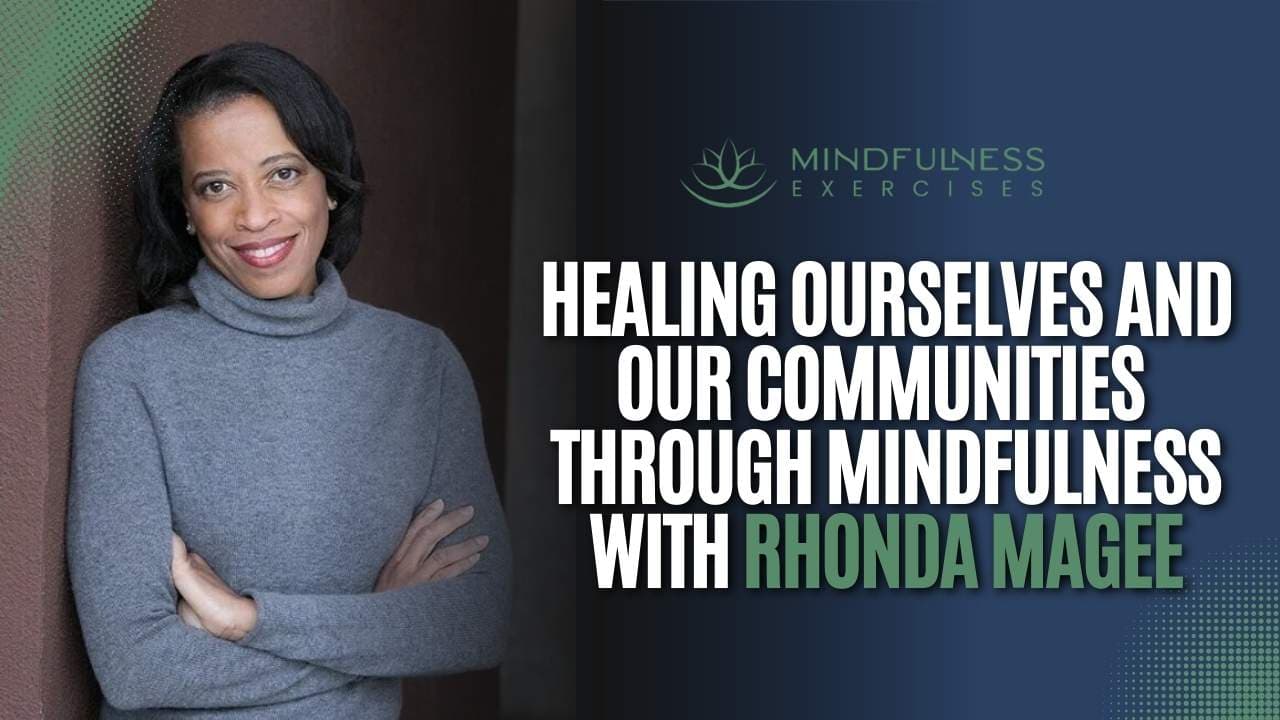
Speaker 1 · 0:00All right, welcome everyone to the Mindfulness Exercises podcast. Today I have the pleasure of welcoming Rhonda V. McGee in conversation to explore her experience with mindfulness and meditation and her teaching. Rhonda is a professor emeritus and founding director of the Center for Contemplative Law and Ethics at the University of San Francisco, just across the Bay from where I am now. Professor McGee is a leading mindfulness teacher and practice innovator with a focus on applying mindfulness to the hardest challenges of our times. She's an internationally recognized teacher, someone who I've been aware of for a few years now in a lot of mindfulness circles. She's a guide and mentor, and she's focused on integrating mindfulness into higher education, law, and social change work. And she's also a prolific author. She draws on law and legal history to weave storytelling, poetry, analysis, and practices into inspiration for changing how we think and act and live better together in a rapidly changing world. She's the author of a very popular and highly rated book called The Inner Work of Racial Justice: Healing Ourselves and Transforming Our Communities Through Mindfulness. You can find on Amazon or anywhere you buy your books. For more than 20 years, Professor McGee has studied mindfulness, its underlying origins in Buddhism, and its benefits and applications in our world. As both a law professor and a mindfulness teacher, Rhonda has been exploring the integration of mindfulness into teaching and learning, social engagement, and in support of personal and collective healing and activism and leadership. She's written extensively on how mindfulness and other contemplative practices support engagement in the world in the face of all the challenges that we're living through right now, including climate distress, migration, political polarization, which seems to be really hot right now here in the US, migration, war, and all of their effects on us all. Along the way, she's become a sought-after keynote speaker and thought leader, inspiring people to explore this integration of socially engaged mindfulness in research and applications all across society, including schools and workplaces and our communities. Professor McGee's current research and practice focus on the intersection of mindfulness and the African American aesthetic and practice approach that emerges from the Black social gospel tradition, which she calls soulfulness. And she's also creating community as well, which we'll talk about later. But Rhonda McGee, it's a pleasure to meet you today. And welcome to this conversation.
Speaker 2 · 3:16Well, thank you so very much. Uh, it's a it's a pleasure and an honor to meet you too. And it's a little embarrassing always to sit through one's own bio. But uh thank you so much for the graciousness of sharing a bit about my background to your audience.
Speaker 1 · 3:33Absolutely. For everyone listening, I highly encourage you to check out Rhonda's work at our website, rhonda vmagee.com. Put links in the podcast show notes. But Rhonda, I'd like to start just by learning a little bit about how you quote unquote discovered mindfulness or meditation in your personal life. And what were those early moments in practice like for you?
Speaker 2 · 3:59Thank you. Well, when I hear that question, I think of two things. I think as a kind of a backdrop to the actual discovery of meditation and mindfulness, there was the fact that I grew up in the southern part of the United States, often spending time with my grandmother, Nanny Suggs, Nan Suggs, who had been called to a kind of Christian ministry and certainly a very disciplined practice of getting up every day before dawn and centering herself to prepare her for the particular way she was taking that calling into the world. And so, you know, as a little girl, I would see my grandmother get up every day and just, you know, we knew she would spend 30, 45 minutes on her own, centering herself, getting herself ready for whatever the day might present to her. And, you know, she wasn't as fortunate as I have been to be well educated and to create the career of her dreams. You know, she, having been born in the early part of the 20th century in the southern part of the United States, was relegated to, you know, some pretty hard work. She cleaned houses for other people. And so to see her figure out a way to have a sense of the dignity and value of her own life, the sense that she that she had a message to give, and that all of that could be brought forth on a regular daily basis by beginning the day with a kind of centering practice. I think that created a background for me so that fast forward to the point where I became an adult, had had the benefit of education from the University of Virginia, three degrees there, and training as a military officer and a lawyer and all these things I was ready to do upon arriving by that time in San Francisco, about to start my first law professor or law job. I was a lawyer before I became a professor. I kind of realized I had been so busy studying all the time that it was very hard for me to kind of pause to shut off that energy of like do and learn and be engaged, even when uh I had time and permission to relax. I had trouble relaxing. So I looked for some support, I, you know, and I happened to find a book on the shelf of my partner in life then and now, who he had a he had a book that he actually hadn't read, but it was called the Bhagavad Gita for Daily Living. And that book, because some of you may have a sense based on the title, is from a Hindu perspective, and it's by the author and meditation teacher, meditation community builder, Eknath Estoran. So he was an immigrant to the United States who had come generation or so before me and created this Blue Mountain Meditation Center and practice set of commitments and invitations. And had written this beautiful book as a way of conveying the essence of how one might practice meditation for clearing one's mind, centering one, centering one's mind. So I remember reading just enough of that and really getting the sense of like one-pointed meditation as a way of really becoming more intimate with my own mental habits and patterns and conditionings, and developing a way of kind of choosing how to be in response to all the dynamics around me. And that so that book really was the first window into meditation in the kind of more Eastern sense, uh, as opposed to the kind of prayerful centering prayer. Well, as I meditation practice, my grandmother wouldn't have called that meditation, but so um this uh invitation I got through reading uh the book, The Bhagavad Gita for Daily Living, gave me this more mind-focused practice, this practice of like getting to know my own mind. And I really sort of was drawn to that. And that opened the door for me to study and explore more of these kind of Eastern-inspired meditation practices that are a lot of what I practice and offer today. I do blend those practices with a lot of the, I would say, heritage-based learning and teaching that I learned from my grandmother. So now they're actually coming together in a beautiful way.
Speaker 1 · 8:30Beautiful. Would you be able to give an example of one of those practices from that book, the Bhagavad Gita for daily living that helped you to center? Or do you have any insight into your grandmother's like practice and like what she did and how she centered herself?
Speaker 2 · 8:51Yeah. So I'll say from the Bhagavad Gita, again, this idea of one-pointed meditation. So simply to pause, feel the body in a dignified posture, almost resting like this idea of the resting like a mountain in the body, and then just allowing a focusing on the breath to support centering, uh, resting the busy mind on the in-breath and the out breath, and allowing in that moment of choosing to place attention on the anchor of breathing in and breathing out, just allowing that to center and concentrate the mind. So that is an example of the kind of practice I received from reading that book. And from my grandmother, you know, there are many different ways that she drew on the, I think her interpretation of the religion of Jesus, the teachings of Jesus, you know, from the Sermon on the Mount, um, and the way that so much of the teachings that were close to her heart and that formed the basis for her centering prayer practices and teachings, so much of them were about really, frankly, bringing love into the world. You know, it was, you know, recognizing the good news of the gospel, that we really didn't have anything to fear, that, you know, we could be protected. And so there are many different ways that I think the particular orientation that she had toward, again, prayer, but also kind of chant and reflection on the teachings of Jesus, Jesus and teachings from the Old Testament that she was inspired by, particularly Psalms, right? So my grandmother's was again a very Christian-based centering prayer and meditation practice. And I'll tell you one psalm that we were taught as a as children to remember, like the first thing, like first last and always, I think, was for her, was uh the 23rd Psalm, right? Which for those who may be familiar, it begins, the Lord is my shepherd, I shall not want, right? And it is just a beautiful, in a way, calming and sort of a meditation on the protectiveness that that that you know, basically somebody has that in those moments when we feel kind of a little lost, afraid, or um in need of a sense that we are not alone. The Lord is my shepherd, I shall not want that 23rd Psalm, you know, and I can recite it by heart because I learned it, you know, as a little girl all the way through. That is really kind of, I think, the foundational practice of my grandmother's that inspires my efforts to interweave her energy into my work as well.
Speaker 1 · 11:43Yeah, speaking of like weaving that energy, there's just so many parallels between those teachings and Buddhism and the Bhagavad Gita and what we're learning from neuroscience and studying the brain. So it's beautiful um to hear all that. When you were talking about that, it just felt so comforting. It's in my own nervous system. Yeah. Not wanting, feeling protected.
Speaker 2 · 12:11Yeah, exactly. Um, you know, I love the part of the 23rd song where it goes, you know, Lord's my shepherd, I shall not want. He he maketh me to lie down in green pastures, he leadeth me beside the still waters. There's a way that those words invite a remembering that we're all already surrounded by the kind of miracle and you know, miraculous gift of being a part of the natural world. So there's a ready way for me that so much of these practices from the different traditions invites us to kind of feel our already, always inherent interconnectedness with not only one another and the more than human world, but literally, you know, all that is, and certainly beautiful gives me these beautiful touchstones into, you know, just appreciating this, what we call the natural world, the environment, the climate that we're a part of.
Speaker 1 · 13:12Yeah. When you mentioned the Sermon on the Mount, I it brought me back to um my time in Jerusalem at Mount of Olives, and I touching the olive trees that may have been alive back in the time of Jesus and just feeling the roots and the natural world that um that connects us. And you mentioned green pastures. I mentioned to you earlier, I'm flying to Ireland today.
Speaker 2 · 13:39Yes.
Speaker 1 · 13:41Probably be gulfing on green pastures shortly. But but yeah, I think when we really connect with our breath, connect with our hearts, it helps us to open to the beauty of the natural world around us, and and vice versa. You know, they can support this practice of presence and sense of awe for this naturally unfolding life that's all around us. Um, thank you for sharing that. I was gonna ask you to kind of recite part of the psalm, but I didn't want to put you on the spot. I appreciate you sharing that. I understand that you did some work with um, I believe John Cabotson and University of Massachusetts. And can you share a little bit about your journey into say like Western mindfulness, as we may call it, with some of these teachers in America and how foray into this world? Yeah, for sure.
Speaker 2 · 14:41I it started to uh connect with mindfulness through frankly realizing that as a you know, a law professor, whatever insights, whatever this kind of calling was for me to kind of deepen, let's call it like this interior gaze, this sort of um commitment to some kind of inner work that might support the outer work. Uh, I was aware that, you know, to to whatever degree I might be inspired to try and bring that into the legal academy, I would need to do some, maybe some translating and be, you know, mindful of language and way in which, of course, if we're gonna teach in a public educational space, we have to do so in ways that are fully inclusive and embracing of all different perspectives and certainly don't seem to partake of any particular religious approach. So, you know, the idea, I it started to occur to me that there might be a way to integrate some of what I was learning into my work as a law professor. I found some other lawyers and other law professors who were interested in these kinds of, at the time, what I found was folks who were interested in like a spiritual kind of analysis or critique of law. And so there were some law professors who were thinking about that. They weren't always meditating, you know, law professors or scholars, they're writing articles about the spiritual critique of law. But when I would meet with them, as I did in person uh for some period of time, I would often be the one saying, but we should also maybe pause and meditate and sit together and center ourselves. And so they were sort of like, I think you want to be, you know, connect with the sitting lawyers. There's a meditating group of lawyers. So it's like a whole path. And in this amongst the sitting lawyers, we were mostly, we were led actually by a Buddhist teacher, uh Norman Fisher. And together we were meditating, but we were beginning to think together then. It wasn't just my impulse. Together we were all thinking, right? Professors at Berkeley or at UC Hastings, you know, in Bay Area based folk about how to bring this forward. Somehow we started offering translations of Buddhist practices that were really focused on, you know, what we have in common, that we all have a breathing apparatus, right? So the kind of centering breathing practices presented in a way that did not require us to have a Hindu or Buddhist or Christian or any other kind of background to just be able to breathe together. So we started bringing those forth. And along the way, I got connected to John Cabot Zen. It was kind of a, to me, it's a sort of a funny story. I started creating courses to bring this to law students in around 2009, 10 or so. And um, I was invited as a result of having presented about this and shared about it. I was invited to present about it at a conference in New York. And I was put on stage with John Cabotzin. So I met John first when sitting on stage beside him. He being presented as the person who's helped bring meditation to medicine. And me with my little class and my little tiny experiment being presented as the person who's helping bring meditation to law. That was the attacking life. Yeah, I know. It was sort of like, okay, one of these things is not exactly like the other. It's like this world-renowned person. But we really did connect very deeply and beautifully, so much so that he ended up writing the forward to my book. What I kind of quickly realized was that I, in our group, didn't have to reinvent the wheel of how to bring mindfulness into law or into the world. We could partake of the work of people like Jemon Kevazin. So I took a training in uh the teacher training program of mindfulness-based stress reduction. And yeah, that was my it was my way of saying, you know, there's this beautiful way in which we can bring these practices into secular, institutional, academic, professional spaces through the language and lens of mindfulness. And so that really, in a way, from being inspired by Christianity and Buddhism originally, and a kind of interest in the sort of spiritual critique of the legal structures that run our world. Like I've I kind of had this big kind of almost funneling toward that led me in deeper to mindfulness. But of course, then I kind of bring it back out in this bigger way. I hope this makes some sense.
Speaker 1 · 19:14Yeah, it's fascinating. I love that story of you on stage being the person bringing mindfulness into law. Right. Right next to John. Right.
Speaker 2 · 19:24And there's John and Saki Santorelli, who was his partner at the University of Massachusetts for so long.
Speaker 1 · 19:31Yeah. That's interesting. When you started asking, you know, your colleagues or your peers in law to, you know, pause and meditate, bring awareness to the breath, that it felt like maybe some people gave a little bit of pushback, like, no, you need to be with the other right. We're writing about that and talking about it.
Speaker 2 · 19:52We're not practicing yet.
Speaker 1 · 19:54Right. Can you share a little bit more about that journey of how you maybe brought some of the methods that you learned from MBSR teacher training, or like what you discovered to help not convince, but be gain permission to talk about mindfulness or to share certain practices in these very secular spaces. Like how is that changing?
Speaker 2 · 20:20Yeah, thank you. Yeah, you're you're hearing just a part of it in what I've alluded to, which is, you know, when you when you come together with people in academia, you know, we're just so often used to doing the research and analyzing and writing it up that even now it can still be challenging to bridge from, you know, the sort of more academic training and modalities, right, um, that tend to be much more kind of third person oriented. What do the other researchers have to say? What are the kinds of ways that we can know this using the traditional means and methods of science, right? The scientific method. We love all of that. We love all that. But the piece that's about first person knowledge that can only come through one's own experience, that can only come through one's own practice. You know, I've been drawn to bring those two together because it's just always been apparent to me that to fully know anything, you know, it might be important to expand the, you know, the epistemologies, the different ways we know, right? So to know in this third person sense is beautiful, but it's not the only way to know. To know in the first person sense that meditation, I think, opens up for us and other modalities can, modalities that help us sort of know from the inside, explore from the inside. That's beautiful. It's not the only way to know. And I should point to, um, as I'm speaking now, I'm really sharing how I came to see this as part of part and parcel of a kind of project called contemplative teaching and learning, right? Where we're opening up the aperture on how we know and how we teach, supported by a kind of a much more open embrace of various epistemologies, third person on the one hand, first person on the other, and even second person, how we can know together, right? By being together and the we, right, can know some things that I can't know by myself, and a third person researcher can't find out alone, et cetera. So basically, what I came to was this um deep interest in expanding how we know and how we apply what we know using these first-person uh practices, meditation and other practices for contemplation. You know, so then I had to sort of find folks who were who could help me get permission to do that. And so, yes, I found first, of course, folks who would help me deepen my own ability to engage in this sort of first-person exploration, my deepen my own meditation practice. And that was the sitting meditation, meditating lures. And they were supported, by the way, by this organization that's no longer in existence, but it was called the Center for Contemplative Mind and Society, a wonderful organization that existed for some 30 years, was a casualty in a way of the pandemic. Um, but it helped in this in the United States and actually beyond create a network of thousands. I think it at the highest, there were some 6,000 members of higher education who were drawn to this network of contemplative mind and higher ed. And so we were all through our different disciplines. Me over here in law, but folks in, you know, the whole range from architecture to physics to dance, we would come together and explore different ways of bringing the first, second, and third person ways of knowing into higher education. For me, it was finding others who were interested in similar things. And when you find other people, whether they were in-law, they weren't so much in law so much. I had to, you know, we didn't have a lot of people in law, we had just enough that I didn't seem crazy and alone. And then I was able to kind of find other people in higher ed. And we together made each other feel like though we might be the only one in our particular, you know, department or institution, we were when we got, when we saw what we had in common across the disciplines, across higher education, what we had in common was this commitment to expanding how we know what we know and how to apply it using contemplative practices like mindfulness, like movement practices, yoga, journaling, right? Kind of a whole range of practices. And so um what I started to do was like network and connect with that, with those in law and outside of law, in higher education generally, in research generally. And that led me to organizations like Mind and Life, right? I became a board member and then the chair of the board of the Center for Contemplative Mind and Society. And then I connected with uh the organization Mind and Life, which even today still supports the research into these um practices and the greater application through the science of mindfulness. And so it was it was through, you know, kind of really the fits and starts of connecting with other people in higher education who were kind of similarly drawn to broadening the way we learn and how we can teach and how we can benefit from this sort of first person exploration of our experience and what we know and that we can only know again through meditation and other kinds of practices. Yeah, that's sort of, you know, at the high level, how I got permission. It was actually connecting with and then helping to strengthen organizations, because we can never do anything alone, right? But to help connect with and strengthen organizations who were already who were doing this, and we started to understand that we weren't alone and that together we can make an impact. And so I kind of am still on that journey. I'm still connected with the mind and life. I am the advisor to many different organizations, including the University of Virginia Contemplative Sciences Center, University of Virginia UBA is my alma mater, uh, of course. And so um I've been fortunate to have been connected up with this beautiful group of folks who brought forth a contemplative sciences center on the campus there. And it and other institutions, Harvard and other institutions where I've connected, presented, we continue to bring forth this energy of a contemplative approach to teaching and learning. And I just feel very proud to and humble to have been a part of that journey for a while now.
Speaker 1 · 26:40Yeah, really impressive resume and uh list of experiences that you have. I think you're also forgive me if I'm mistaking you, but I think you're like the you were the president of the board for Search Inside Yourself and Yes, yes, I was. Yeah.
Speaker 2 · 26:57So yeah, I've done that. And but to be more concrete, so that's like a little bit at the high level, like I connected with all these organizations, right? And the funny thing is, I don't even think of myself as a networker or a connector. But in following my passion, I did all those things. And more concretely, I just started bringing these meditation practices into my law school and finding a few other similar souls, like other professors who similarly felt like something was missing in legal education and who were willing to roll up their sleeves with me, create, you know, places where our students at our law school could practice meditation together. So I didn't have to do it by myself, a couple other law professors. And we just were like committed. We're like, we don't care if just one student shows up, a teacher shows up, we're just gonna every week at this time, well, the rest of them for our law as long as we're there. And we did it for 10 years straight when we were together doing this, collaborating. I'm now professor of meritus, so I'm not on campus regularly now, but we offered meditations on a drop-in weekly basis. We we experimented, we created courses. We created one of the first courses for credit in an American law school where we integrated into the curriculum something called contemplative lawyering. So our law students could regularly count on a place in their three years of studying law where they could spend the semester exploring how who they were and their habits and patterns and their personalities and their own challenges, right, could be better known, better mastered, if you will, transformed into effective ways of bringing the knowledge, skills, and values of a legal education into the world and with compassion and with love. So we we were doing that for many, many years. And I still may teach from time to time at the University of San Francisco. There's an invitation there for me. But so that is just to say, and also I started bringing it into classes around race and racism, and that fueled the work, the inner work of racial justice, because I was teaching these classes with these young law students from all different walks and backgrounds in San Francisco, many who were recent immigrants. It just became clear to me that we needed more than simply just studying the cases and the policies. People's hearts were broken to talk about, to look at, you know, race, racism, other forms of bias and oppression, how the legal system had sometimes been a source of liberation and and and you know, some sort of redress, but sometimes was the the you know the harming factor, right? The the law had sometimes caused the problems and the policies were sometimes part of the problem. So to look at that and to study it, we traditionally, and when I was in law student, we just looked at it, you know, in the way that we studied anything. But I started to see that it was a missed opportunity for us to do healing personally and to heal across our lines of real and perceived difference. So we started bringing meditation, but also food and storytelling. Telling into those classes and going on retreat so that we kind of study and read, but then take a break and go out into nature and really sort of help ourselves integrate what we were learning. So those are some of the places where I experimented, you know, the creating the contemplative Laurian class, having created a class on race and American legal history, and then bringing it into that class. But then I was also teaching personal injury law, tort law, you know, traditional insurance law classes. And in my personal injury law class, this was all first-year students, or, you know, I'd have a big swath, a big large class of first-year law students. And not infrequently, they would start to just get stressed and freaked out about being first-year law students. And so they knew I was bringing these practices into my seminars for contemplative luring and race and law. And so they started to meet me in the hallway around midterm and say, Professor McGee, we know you're doing this drop-in meditation session. Can you please bring a meditation into our tort law class? We just had midterms and we're all freaking out. And so I would find ways to just start the class with a kind of a pause, a way for all the students to just rest, remember where we were last class, remember their notes and questions about today before we just launched right into it. So in these ways, I just started to change how we were teaching law. And then that spilled over into like faculty meetings, where I had my faculty members sometimes come up to me and say, you know how you sometimes will start, help us start the meeting by pausing. Can you please do that today? Maybe even bring your bell. We're gonna have a hard conversation about hiring today. We're gonna need some of that energy. So really, I was in a certain way starting to change kind of the culture at the law school to bring to make space for this inner dimension of our work.
Speaker 1 · 31:50There's so much in that. You went in and you, it sounds like you found co-champions, people who are already interested and or practicing, and found a way together to um make something work that felt aligned with schedules, intentions, goals.
Speaker 2 · 32:30Yes, learning objectives, et cetera.
Speaker 1 · 32:33Yeah. And you know, a lot of people have questions around well, what do I call this thing? You know, this mindfulness in the workplace project that I have or this initiative. And we don't have to use the word mindfulness, you know, you're using the word contemplative, contemplative or awareness.
Speaker 2 · 32:54Now, of course, well-being. I often don't use the M word, certainly the meditation word, sometimes mindfulness, but not even all the time. You know, it's a question of you know, skillful means. What's called for here? How do we align what we've learned and what we know might be of benefit with the, you know, the objectives, the core objectives of the organization or the place that we're, you know, wanting to meet.
Speaker 1 · 33:22Exactly. Yeah. Yeah. Use the languaging that's going to uh feel welcoming for the leadership, the you know, the people on the ground. There's so many great takeaways there. And thank you for getting into some of the nitty-gritty too, and how you created just spaces for people to be, pauses before classes or meetings, yeah, you know, trying courses, yeah, drop-in spaces.
Speaker 2 · 33:49We did brown bag for a while before we did any of what I just described. At the very beginning, we were just like, let's just create a brown bag lunch series where we just invite anybody to talk about how some sort of mindfulness opportunities might be a benefit here. And that helped create buy-in too, right? So it didn't just seem like we were coming with an idea. We're just like, what do y'all think about the possibilities? And it so it was a very kind of slow and very intentional effort to kind of work with the culture to create mutual shared buy-in and what would be a benefit to those around us.
Speaker 1 · 34:26Yeah, I helped consult the formation of the mindful EPA. And the first things that were done were mindful snacks, like little 15-minute breaks for people to come together to talk about this. And, you know, bring a snack and just explore it kind of loosely. Beautiful. And, you know, you noted that these spaces are not just spaces for pausing, but for raw emotions to surface. And rediscover what kind of healing needs to be done internally, interpersonally. Yes. And so creating space for us to be able to start that process of meeting ourselves and each other's in ways that are caring and that um offer that opportunity to heal. Yeah. Not just stress reduction.
Speaker 2 · 35:20Right.
Speaker 1 · 35:21And, you know, that can get sticky. Search inside yourself just as another example. You know, they talk about emotional intelligence as kind of the framework, but you know, and they start with emotional awareness, emotional regulation, but they they move into heart work and they move into spaces of noting suffering and pain and offering ourselves and others care in the midst of hardship. And that can get sticky. So I'm just wondering if you'd be able to talk about any either challenges you've seen with that andor practices or ways that you found effective for meeting the healing part of this.
Speaker 2 · 36:07Thank you. You know, that dovetails a lot with what I'm inspired to bring forth right in this moment right now. Um, I shared with you before we were recording that I've somehow felt called to help create a community, kind of a community of practice that I call Mount Iris. And that's a place which I think exemplifies some of what you're describing, which is bringing the heartfulness into mindfulness and really exploring the capacities that we have to deepen our um mindful relatedness with each other, how we are in relationship with each other. I mean, I think that part of this part of the work is in a way, I almost want to say healing how we tend to think of mindfulness, because I think that we tend to think of mindfulness as hyper-individualized training of the mind, right? For reducing stress, focus, and maximizing our productivity. Now, all of those things seem like reasonable things to seek to do, especially in the world that we live and work in. However, I think that when you really look at the underlying teachings that we draw on for mindfulness, that we started our conversation, looking at the Hindu teachings, Buddhist teachings, there is an underlying, let's just call it ethical dimension, right? This dimension that is at the foundation of these practices, really, really calling us to consciousness about who we are in the world, how we think of ourselves, how we are with each other can be harmful or healing, right? Any moment, any action, any way that we are with each other. So I really think that um when we point to how we we often receive mindfulness in these kind of hyper-individual focused ways, bring in emotional intelligence, open up the heart qualities of compassion and empathy. It can feel a little like a stretch because it seems like it's not necessarily what we thought we were getting into when we were at a workplace event and we were just, or in a classroom, right? When we were thinking we were just developing some knowledge or some professional skills, we start to realize that we're we're human. Underneath anything we do, we are still just these sort of soft-bellied, carbon-based beings that have landed on this Goldilocks planet that we did not create. In other words, there is this, to me, a way that mindfulness just unmasks the miraculous and the mystical about what it means to be alive. And from that place, yes, we have these heart qualities and you know, all of the different ways that being these, you know, hyper vulnerable beings. The fact is, we know that we have these opportunities to live, but we can't live forever. And so a life well lived is going to have loss and pain and what we call in Buddhism the eight worldly winds, right? We're feeling good one day, we're feeling, you know, beaten down the next. All lives, right? The core Buddhist teaching, right? There is suffering. There are causes of it, and there are ways to release, release ourselves from it. So there's a way that, you know, loving kindness and compassion as supports for just being human in the time of change and challenge, like the time we're in right now, seems like really the foundation of these practices for me, and the foundation that we don't always see integrated into our introduction into mindfulness. So I almost feel like this is healing mindfulness. But yes, I'm really, really inspired right now, give everything that's happening in the world to reinforce the idea in the way that for me, love, the love that my grandmother saw in the teachings of Jesus, the Sermon Jesus, the Sermon on the Mount, the love that I see as really foundational to whatever inspires us to bring these practices for our own healing, uh, to support others in the workplace. We might not call it by the L word, but there is that dimension of care. So I'm really feeling like bringing in that dimension of care, but also reinforcing our connectedness, practicing together and letting the community dimension take center stage in a way not to disregard that we have agency and separate identities, but that we're always in it together. That we're, we know nobody's really alone. We think we're alone all the time. Nothing we accomplish is by ourselves. For me, right now, that kind of interweaving of practice in community with love is where it's at. And uh I want for this time in my life to really help create spaces where we can learn and grow together with those touchstones of love and practice in community at the fore.
Speaker 1 · 41:00Amen. Well, may it be, Rhonda McGee. I feel like I just feel very uh aligned with everything that you're saying and count me as a big fan.
Speaker 2 · 41:11Wonderful. Join us on Mount Iris from time to time.
Speaker 1 · 41:14I would love that. Yeah, can you share a little bit more about like when that's gonna happen and how people so it's happening, right?
Speaker 2 · 41:21We've got mountiris.com. You can find it right now. And on Sundays, we have a couple of opportunities. Uh every Sunday for the next eight weeks. I usually, after eight weeks, we'll pause a week or so and then we'll restart. But we'll maybe we'll keep it going now, right? Now that we've got some momentum. But so it's really uh uh happening now. And everyone within this hearing, you're invited to just sort of check us out online. It's gonna be a hybrid space. So online opportunities to meditate live, right? Not just recordings, but live meditation spaces and then some in-person opportunities as well. We we have we have a big vision, but it all starts right here in the small spaces of our hearts and our commitments to practice together. So thank you very much for asking.
Speaker 1 · 42:09Absolutely. Yeah, people can find that at mountiris.com. That's o-n-t-i-r-i-s.com, building a just world together through soulful mindfulness.
Speaker 2 · 42:24Yeah, we didn't have a chance to really talk very much about soulfulness or, but this soul heartedness really is at the heart of it for me, too. This, which is this kind of again, well, James Brown, Godfather of Soul, was quoted as saying, when asked what he meant by soul, he basically said it's like how you meet the energy of I can't with a quality of creative, you know, kind of I can't, right? And that creative I can can be musical, can be heartful, can be storytelling, but remembering where we come from and allowing that, you know, the the teachers from our own traditions to kind of live through us as part of our journeys is kind of how I think of soul-heartedness.
Speaker 1 · 43:06Beautiful, yeah, and that heartfelt courage to break out of your bubble and meet other people, yeah. To you know, tune into the emotions within to meet the needs of our time, all that takes soulfulness, all that takes.
Speaker 2 · 43:26It's a creative, powerful energy. Yeah.
Speaker 1 · 43:29Absolutely. Yeah, and I love that it touches on this depth of mindfulness, that it's not just this head-based navel gazing thing that a lot of us may think it is, but as we as practitioners discover, it's so much more than that. And there's so much depth and layering and connection that is cultivated, you know, moment to moment. And it takes community. Uh, as Buddha said, you know, community is not zero percent, it's not 50% of the path, it's all of the path. And so we need community. And that's right. Everyone who's listening to this, nodding their heads, please check out my mountiris.com, uh, Rhonda McGee's website that we'll post a link to in the uh show notes. Rhonda, thank you so much. Is there anything else you'd like to share before we uh bid farewell today?
Speaker 2 · 44:25Oh, thank you. First of all, just thank you so much for all that you are doing and for this wonderful conversation today. I really, really appreciate it. It's kind of really felt full in my heart to be with you. And just to um say, I know it's a hard time for a lot of people out there right now. One of the ways that we respond to hard times like this is to feel sometimes really isolated and that, you know, there's nothing we can do. But I think that these practices that we're talking about are really meant to sort of, they're meant for times like this. They're meant to remind us that we are much more than what other people say about us or what the dominant discourses and politics are doing. You know, it they're meant to be a lifelong lifeline and a touchstone to something that is eternal, I think, that is um more powerful than we can really ever know. So I just want to for anybody that's feeling the, you know, that it's a hard, hard time, you're not alone. And these practices, everything we've been describing, it's meant in a way, I got my hand up like it's like a hand at your back, right? To remind you that you already matter, you already belong, and you can make a difference right where you are. And um, we're here to um hold hands with you in a way from afar, uh, in a big practice community, a worldwide practice community. So thank you. Thank you for being here.
Speaker 1 · 45:48It's a pleasure speaking with you. Thank you.
Speaker 2 · 45:50Thank you. Be well.