There’s a quiet, persistent voice many of us carry—the one that says we’re not doing enough, not achieving enough, not being enough. It shows up in subtle ways: comparison, self-doubt, perfectionism, or that lingering sense that something is fundamentally off.
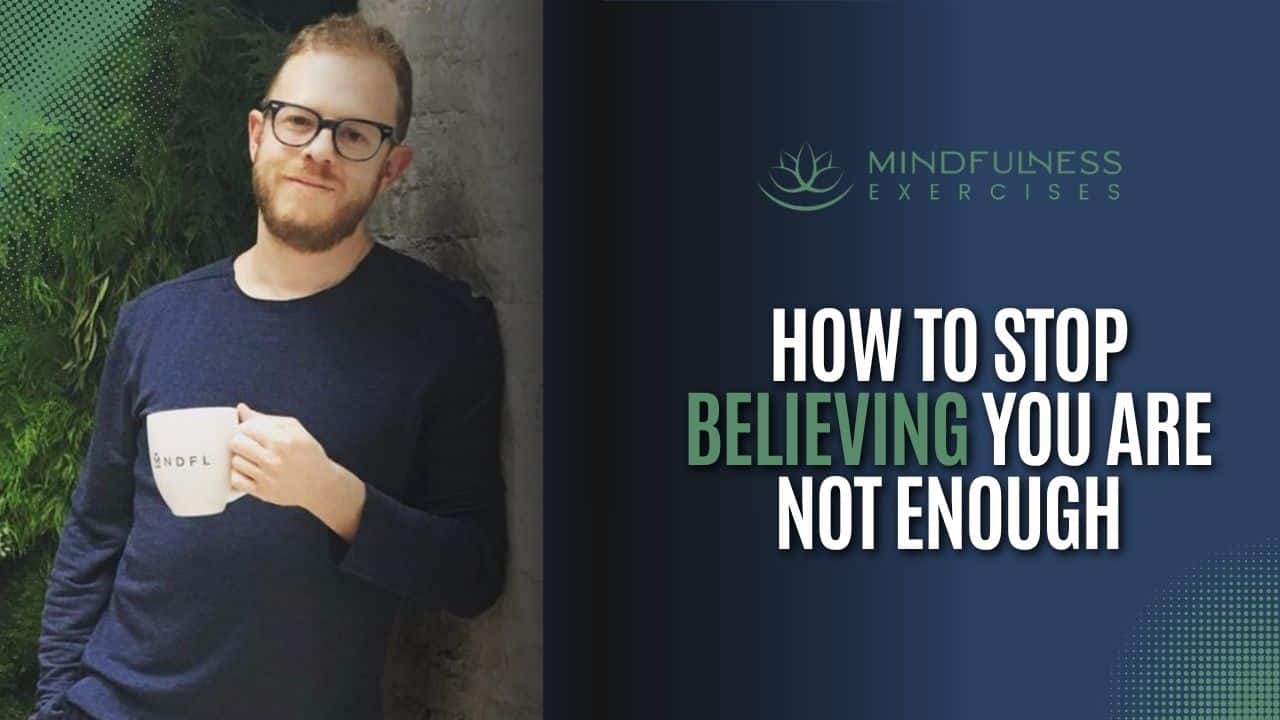
Sean Fargo talks with Lodro Rinzler, a Buddhist meditation teacher and author of eight books, including The Buddha Walks Into a Bar and You Are Good, You Are Enough, about the Buddhist teaching of basic goodness: in his words, “recognizing that you’re already whole, complete, and good as is.”
The conversation covers where “not enough” comes from, the stories we tell ourselves, acceptance and growth, shame and self-doubt, and a loving-kindness practice for someone difficult.
Rinzler also points listeners to the free guided meditations on his website.
Sponsored by our Mindfulness Meditation Teacher Certification Program
mindfulnessexercises.com/certification/
Episode Overview:
Key Topics Covered:
- Why we feel fundamentally flawed—and how to shift that belief
- The Buddhist teaching of basic goodness
- Letting go of limiting self-stories
- Working skillfully with shame and self-doubt
- Cultural conditioning and the myth of “not enough”
- The role of meditation retreats and longer sits
- Aligning work and life with intention
- The Four Immeasurables (loving-kindness, compassion, joy, equanimity)
- A practical loving-kindness exercise for difficult relationships
- Imposter syndrome in mindfulness teaching
- Healthy regret vs. harmful shame
- A compassionate view of harmful behavior
Resources Mentioned:
- You Are Good. You Are Enough. by Lodro Rinzler
- Guided meditations and teachings available on his official website
Show Notes:
Why Do So Many of Us Feel “Not Enough”?
Rinzler says advertising and consumer culture are “the water that we swim in,” and that they rely on people doubting they are okay as they are, so that we will try to buy something to fix ourselves.
Rinzler uses the image of a cocoon for the stories we tell ourselves about ourselves, which he says can wrap around us until we cannot interact with the world around us.
His example is the distinction between:
“I’m currently feeling anxiety” and “I’m an anxious person.”
He says meditation helps us acknowledge those stories and come back to the present, which slowly opens the cocoon.
What Is Basic Goodness?
In the Buddhist tradition Rinzler was raised in, basic goodness is the view that our basic state is good, whole, and complete, and that everyone is capable of love and compassion.
Rinzler says we have all had small moments of it. His examples:
- A moment in breath meditation of being present instead of spiraling in anxiety
- Warm shower water on his back and his shoulders dropping
- Hugging his daughter
He calls it ordinary, not something you need to work toward.
From Self-Judgment to Self-Acceptance
Rinzler says layers of shame, mistakes, and guilt can cover over basic goodness, and that letting go of unhelpful stories about ourselves makes it easier to remember.
He suggests a small shift in wording, from “this is who I am” to “this is one of the things happening right now.” In his telling, that moves us from feeling the cocoon is happening to us to seeing that we are reinforcing it moment by moment.
Replaying the same story all day is exhausting, he says, like holding a hot coal.
Acceptance Is Not Passive
Sean raises a common worry: that accepting ourselves means giving up on growth.
Rinzler says the two go hand in hand. When we are fully present we learn to be skillful, and the more we accept ourselves and the moment, the more we see the change that needs to happen.
In his view, acceptance can help us:
- Acknowledge mistakes without collapsing into shame
- Learn from the past without being defined by it
- Take action aligned with our values
It’s not about settling—it’s about starting from truth instead of self-rejection.
Working with Shame, Regret, and Self-Doubt
Not all difficult emotions are the same.
Healthy Regret vs. Harmful Shame
Sean asks how to hold the Buddhist ideas of hiri and ottappa, a healthy sense of shame and fear of wrongdoing, alongside the trap of doubt. Rinzler cites Pema Chödrön: negative shame, with its guilt and self-denigration, does not help, while “positive shame” is feeling sorry for harm done, which lets us grow wiser. His own phrase is “I too am human.”
He also shares a saying from a teenager: “100 different mistakes are progressive. 100 of the same mistake is regressive.”
A Simple Practice: The Loving-Kindness Photo
Rinzler describes the loving-kindness photo, one of the on-the-spot practices in his book, for someone we have a hard time with.
Here is the practice:
- Take a photo of someone you have a hard time with
- Put it where you will regularly see it, such as a bookshelf or your wallet
- When you see it, stop and make an aspiration for their well-being
- Use simple phrases such as “May you feel happy, may you feel healthy,” in a way that feels genuine, not forced
He describes a student who tried this for a couple of weeks with a difficult person and found herself friendly the next time she saw her. He adds that conflict can still happen.
The Role of Stillness in a Distracted World
Rinzler says that people who go beyond ten minutes a day, to longer sits or retreats, find that the balance between distraction and presence starts to shift.
Sean adds that after a retreat we see more clearly the water we were swimming in.
Rinzler adds, “No shame to anyone who is doing 10 minutes a day. That’s really wonderful.”
You don’t need a retreat to begin. You just need a willingness to pause.
Navigating Imposter Syndrome on the Path
Sean asks how to talk with helpers who want to share mindfulness but are held back by self-doubt.
Rinzler says he listens for trainees who value the practice and are a little nervous about it, and wants them to see what they offer from their own experience.
He does not expect doubt to go away: “the doubt’s going to come along for the ride, but I don’t get to let it drive.”
Meditation, he says, helps us put that voice down long enough to do what we want to do.
Rethinking “Evil” Through a Mindfulness Lens
Sean asks about the presence of evil in the world.
Rinzler says he does not think evil is a thing. He describes harmful behavior as:
A disconnection from basic goodness.
He is not excusing harmful acts. His view is that people do harm out of confusion or because they feel threatened, and that everyone is capable of love and compassion.
Choosing Space Over Busy
Rinzler describes spending his thirties building things he hoped would help people, with no rest, and then moving upstate “from the mind state of busy to a mind state of space.” He narrowed his work to one intention: making meditation accessible to people in modern language.
The intention stayed the same; the level of care he allows himself changed.
Bringing It Into Your Daily Life
You don’t need to overhaul your life to begin experiencing basic goodness.
Start small:
- Take one conscious breath before responding
- Notice when self-criticism arises—and soften it
- Offer yourself the same kindness you’d give a friend
- Pause during your day and simply be
These are small steps, and they can be repeated through the day.
Final Reflection
The idea that you are already good—and already enough—can feel unfamiliar, even uncomfortable.
But it’s not something you need to believe right away.
It’s something you can practice noticing.
And over time, that practice becomes a lived experience.
Rinzler describes the aim this way: “it’s not about self-improvement, it’s about self-recognition.”
Additional Resources:
- Free Training with Sean Fargo: How to Teach Mindfulness With Confidence & Credibility
- Certification: Mindfulness Meditation Teacher Certification Program
- Blog: 200+ Heart Chakra Affirmations: A Path to Emotional Healing and Love
- Blog: How to Teach Meditation for Restorative Sleep and Deep Rest