Listen now

For many people, meditation begins with frustration.

You sit down, close your eyes, take a breath… and immediately your mind races toward grocery lists, old conversations, deadlines, regrets, and imaginary futures. Within seconds, it can feel like you’ve failed.

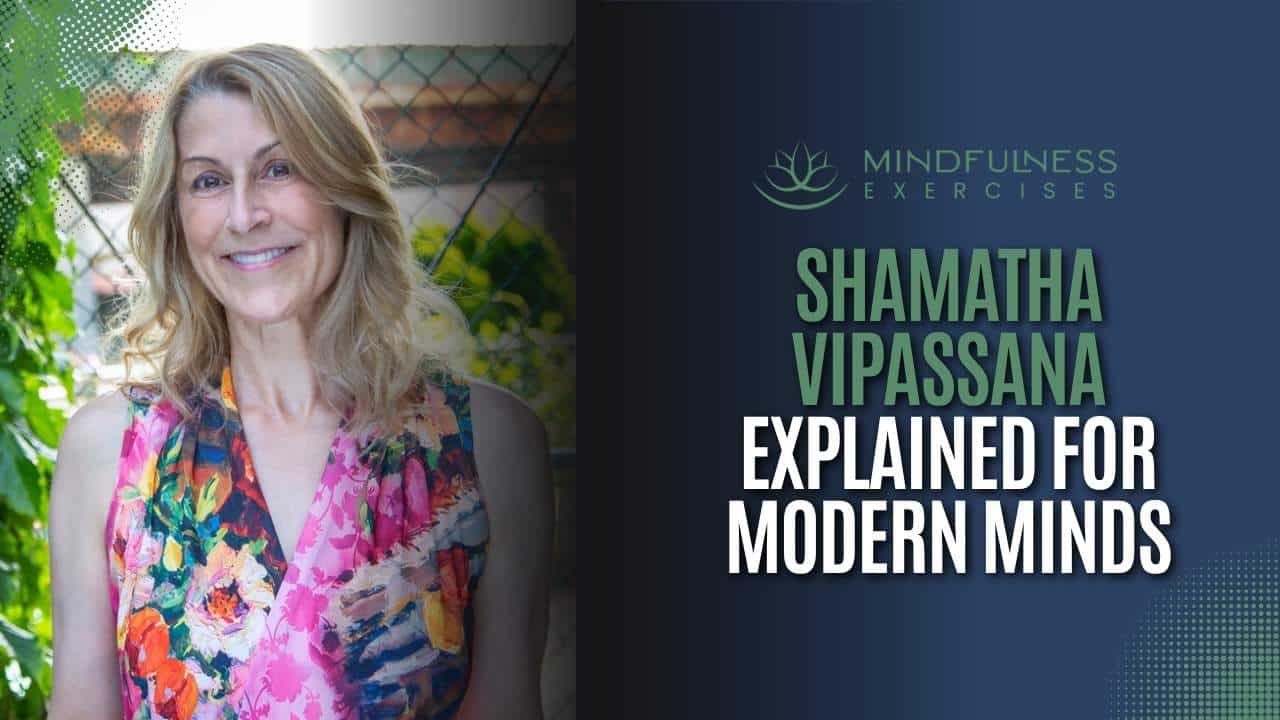
But according to meditation teacher and author Susan Piver, that experience is not failure at all. In fact, it is the practice.

In this thoughtful and grounded conversation, Susan explains the essence of Shamatha Vipassana meditation, a mindfulness-awareness approach rooted in Buddhist contemplative traditions yet deeply relevant for modern life. Rather than demanding perfect concentration or a blank mind, this practice teaches something far more compassionate and realistic:

Notice where your attention has gone, and gently return.

Again and again.

Not perfectly. Not forcefully. Just honestly.

For anyone who has struggled with meditation, doubted themselves, or wondered whether mindfulness “works” for busy minds, this perspective can feel like a breath of fresh air.
Sponsored by our Mindfulness Meditation Teacher Certification Program
 certify.mindfulnessexercises.com

In This Episode, We Explore:
  • What Shamatha Vipassana meditation actually means
  • Why thinking during meditation is normal
  • The difference between mindfulness and awareness
  • How insight emerges through awareness
  • Why meditation can increase emotional sensitivity
  • The science behind mindfulness and stress reduction
  • Misconceptions about being “good” or “bad” at meditation
  • How to build a kinder relationship with your mind
  • Why meditation is about returning, not perfection
Key Takeaways
  • Mindfulness is trainable attention
  • Awareness is the larger field of experience
  • Wandering thoughts are part of meditation practice
  • Returning attention gently is the core skill
  • Meditation is not about suppressing emotions
  • Self-compassion matters more than perfect focus
Memorable Insight

“You can’t breathe in the past or the future.”

Show Notes:

What Is Shamatha Vipassana?

At its core, Shamatha Vipassana combines two complementary aspects of meditation practice:

  • Shamatha refers to calm abiding or mindfulness
  • Vipassana refers to insight or clear seeing

Together, they create a practice that develops both focused attention and spacious awareness.

Unlike approaches that emphasize “clearing the mind,” Shamatha Vipassana recognizes something deeply human: thoughts happen. Minds wander. Emotions arise. Attention drifts.

The goal is not to stop being human.

The practice is learning how to relate to experience differently.

Susan describes mindfulness as the trainable skill of placing your attention somewhere intentionally — often on the breath — and returning when you notice the mind has wandered.

That returning is the meditation.

Noticing distraction is not evidence you’re doing it wrong. It is evidence that awareness is beginning to wake up.

You Cannot Breathe in the Past or Future

One of the simplest yet most powerful insights shared in the conversation is this:

You can only breathe now.

The breath always happens in the present moment. That’s why it has become such a universal anchor in mindfulness practice.

Our thoughts, however, often live elsewhere:

  • replaying the past
  • predicting the future
  • rehearsing conversations
  • revisiting mistakes
  • imagining worst-case scenarios

Meditation gently interrupts this habitual time travel.

Not by forcing silence, but by helping us notice when we’ve left the present moment and offering a way back.

For modern minds constantly stimulated by notifications, multitasking, and information overload, this simple act of returning can become profoundly stabilizing.

Mindfulness vs. Awareness: Understanding the Difference

One of the clearest distinctions Susan offers is the difference between mindfulness and awareness.

These words are often used interchangeably, but they point to different experiences.

Mindfulness Is Trainable

Mindfulness involves intentionally directing attention.

Examples include:

  • focusing on the breath
  • noticing bodily sensations
  • listening carefully
  • returning attention after distraction

This is the active part of practice — the mental “muscle” we strengthen over time.

Much like physical exercise builds strength gradually, mindfulness develops through repetition.

Every time you notice your attention wandering and come back, you are strengthening mindfulness.

Awareness Is Spacious

Awareness is different.

Awareness is the larger field in which thoughts, sensations, emotions, and experiences appear.

Unlike mindfulness, awareness often unfolds naturally rather than through effort. It can feel open, expansive, and less controlled.

Insight tends to emerge here.

You may begin noticing:

  • habitual emotional patterns
  • unconscious fears
  • deeper compassion
  • subtle tension
  • moments of clarity
  • interconnectedness

This is one reason meditation can feel both healing and surprising.

The practice doesn’t simply relax us. Sometimes it reveals what we’ve been avoiding.

Why Meditation Can Make You Feel More

Many people begin meditating hoping to feel calmer, happier, or less stressed.

And often, mindfulness practice does support:

  • emotional regulation
  • improved sleep
  • reduced stress
  • greater resilience
  • better focus

But deeper practice can also increase sensitivity.

Susan emphasizes that meditation may bring us into more direct contact with our emotions, including grief, sadness, anxiety, or uncertainty.

This can feel confusing at first.

People sometimes assume:
“I’m meditating more, so why do I suddenly feel everything more intensely?”

Because awareness is growing.

Meditation is not emotional suppression. It is intimacy with experience.

Rather than numbing discomfort, mindfulness teaches us how to stay present with life as it actually is.

For teachers, therapists, and mindfulness practitioners, this distinction matters deeply. Inner experiences do not always unfold in tidy, predictable ways.

Healing is rarely linear.

The Science of Mindfulness — and Its Limits

The conversation also touches on the growing body of research surrounding mindfulness practice.

Modern science has explored how meditation may support:

  • stress reduction
  • lower cortisol levels
  • improved sleep and insomnia support
  • emotional regulation
  • attention and focus
  • reduced relapse rates for depression when paired with appropriate care

Research into mindfulness-based interventions continues to expand in healthcare, education, psychology, and workplace wellness.

At the same time, Susan reminds us that not every meaningful aspect of contemplative practice fits neatly into measurable data.

Some dimensions of meditation are experiential, relational, and deeply personal.

Science can measure physiological outcomes, but it may not fully capture:

  • insight
  • compassion
  • inner spaciousness
  • existential clarity
  • spiritual connection
  • self-understanding

Both perspectives can coexist.

The measurable benefits matter. The mystery matters too.

Why So Many People Think They’re “Bad” at Meditation

Perhaps the most compassionate takeaway from this conversation is the dismantling of a common myth:

There is no such thing as a perfect meditator.

People often assume meditation success means:

  • never thinking
  • feeling peaceful all the time
  • staying focused continuously
  • transcending difficult emotions

But real practice looks much more ordinary.

You sit.
You breathe.
You drift.
You notice.
You return.

Over and over.

The wandering mind is not a problem to eliminate. It is part of being alive.

And every return to the present moment is an act of awareness.

For many people, this realization alone softens years of self-judgment.

A Gentle Meditation Practice You Can Try Today

If you want to experience the essence of Shamatha Vipassana, try this simple practice:

1. Sit Comfortably

You do not need a perfect posture or special cushion. Simply sit in a way that feels alert yet relaxed.

2. Bring Attention to the Breath

Notice the feeling of breathing naturally.

You do not need to control it.

Just feel:

  • the inhale
  • the exhale
  • the rise and fall
  • the sensation of air moving
3. Let Thoughts Come and Go

Your mind will wander.

That is expected.

4. Notice and Return

The moment you realize you’ve drifted into thought, gently return attention to the breath.

No criticism.
No starting over.
No failure.

Just return.

This small act repeated consistently becomes the foundation of mindfulness practice.

Meditation Is a Relationship, Not a Performance

Modern culture often turns everything into achievement:

  • optimize
  • improve
  • master
  • perform

Meditation asks something radically different.

It invites relationship instead of perfection.

Relationship with:

  • your thoughts
  • your emotions
  • your body
  • your fears
  • your humanity
  • the present moment

Shamatha Vipassana offers a path that feels especially relevant today because it does not demand that we become someone else before we begin.

We do not need to eliminate thinking.
We do not need to become calm people overnight.
We do not need spiritual perfection.

We only need the willingness to notice and return.

Again and again.

Final Thoughts

If you’ve spent years believing your busy mind disqualifies you from meditation, this teaching offers another possibility.

Perhaps the goal was never to stop thinking.

Perhaps the practice is learning how to meet your thoughts, emotions, distractions, and inner world with greater gentleness and awareness.

Shamatha Vipassana reminds us that mindfulness is not reserved for naturally calm people. It is a human practice for human minds.

Messy minds included.

And maybe that is exactly why it matters.

Additional Resources:

Related Episodes

Page 1 of 85
1 2 3 85
>