đź“– Free guide: How to Teach Mindfulness & Meditation

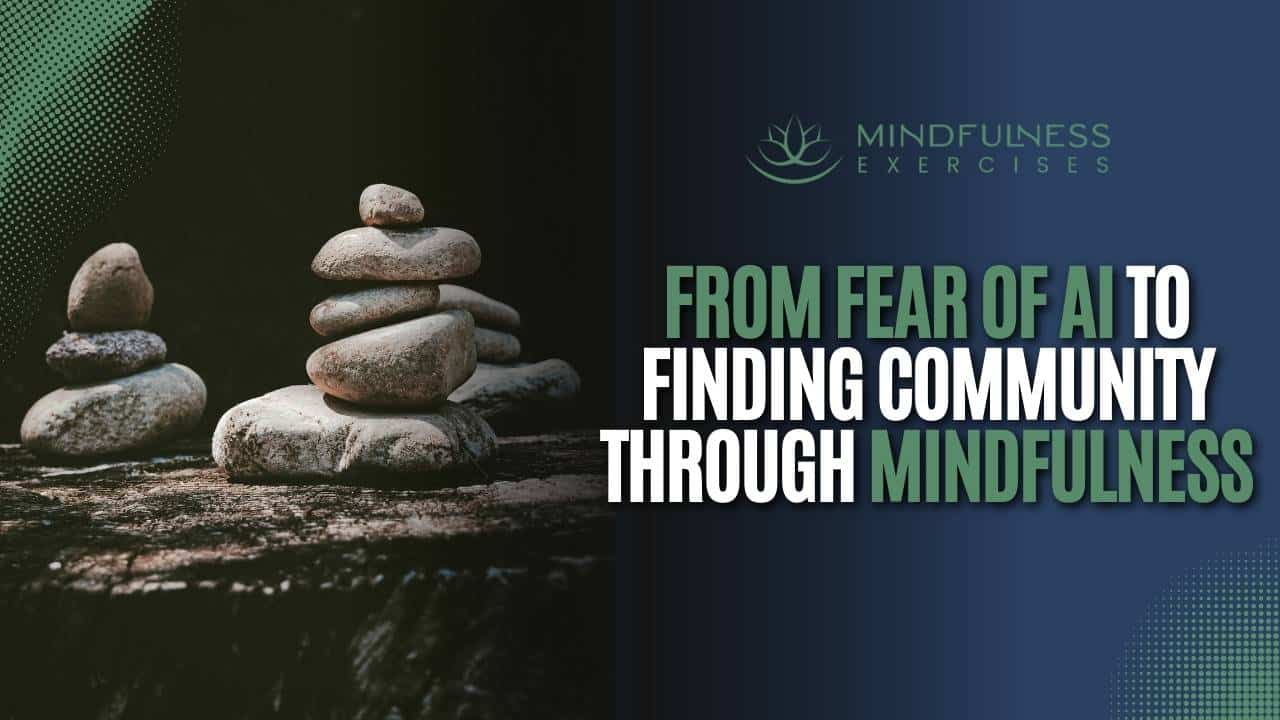
    From Fear Of AI To Finding Community Through Mindfulness

    SF
    Sean FargoPublished February 11, 2026 · 5 min read
    From Fear Of AI To Finding Community Through Mindfulness

    Listen to this episode

    Mindfulness Exercises Podcast

    Enjoying the episode?

    Follow the show in your podcast app. If this conversation supports your practice, a rating or review helps more listeners find it.

    Technology is evolving at a pace that can feel dizzying. Artificial intelligence is writing, speaking, composing, analyzing, predicting. For some, it’s exciting. For others, it’s unsettling. And for many of us, it’s both.

    In this deeply human conversation, we explore what it means to stay grounded and connected during rapid technological change — through the voice of a 75-year-old mindfulness practitioner who transforms doubt into devotion to practice and community.

    Rather than resisting change or blindly embracing it, we’re invited into something steadier: presence.

    This episode gently reminds us that mindfulness isn’t about escaping modern life — it’s about staying human within it.

    Sponsored by our Mindfulness Meditation Teacher Certification Program MindfulnessExercises.com/Certify

    Episode Overview:

    In This Episode We Explore:

    • Analog wisdom meeting digital anxiety
    • Community as the cure for isolation
    • Humility and lineage informing practice
    • ADHD-friendly mindfulness techniques
    • Sensory anchors and open awareness
    • Resources and teachings from Mark Coleman and Loch Kelly
    • Podcasting as a bridge for connection
    • Closing with tenderness and intention

    Key Takeaways:

    • Fear of AI often reflects deeper fears about connection and meaning.
    • Mindfulness helps us stay grounded during rapid change.
    • Community practice reduces isolation.
    • ADHD-friendly techniques make meditation more accessible.
    • Awareness itself remains unchanged — even when technology evolves.

    Show Notes:

    Analog Wisdom Meets Digital Anxiety

    There’s something powerful about hearing reflections on AI and technology from someone who has lived through decades of cultural transformation.

    A 75-year-old practitioner carries analog wisdom — handwritten letters, face-to-face conversation, slow reading, long silences. That embodied experience offers perspective when digital change feels overwhelming.

    Fear of AI often masks something deeper:

    • Fear of becoming obsolete
    • Fear of losing creativity
    • Fear of isolation
    • Fear of losing our humanity

    Mindfulness doesn’t dismiss these fears. It allows us to sit with them.

    When we pause and breathe, we discover that what we truly long for isn’t technological certainty — it’s connection.

    Community as the Cure for Isolation

    One of the most moving themes in this conversation is the reminder that community dissolves isolation.

    Technology can connect us globally — yet many people feel more alone than ever. Ironically, even conversations about AI often happen in isolation, behind screens.

    Mindfulness shifts that dynamic.

    Practice becomes relational.

    Whether through group meditation, shared podcasts, online sanghas, or local circles, presence deepens when practiced together.

    Community:

    • Normalizes our anxieties
    • Softens our self-judgment
    • Reminds us we are not alone
    • Grounds abstract fears in shared humanity

    Even podcasting itself becomes a bridge — a way to create meaningful connection across distance.

    The real antidote to fear of AI may not be more information about AI. It may be more embodied connection with each other.

    Humility, Lineage, and Staying Rooted

    Another thread woven through this episode is humility.

    In times of rapid innovation, it can feel like everything is new. But contemplative traditions have navigated massive social upheavals for centuries.

    Lineage matters.

    Teachers like Mark Coleman and Loch Kelly remind us that awareness itself is timeless. Practices of open awareness, embodied presence, and natural mindfulness existed long before modern technology.

    Humility helps us remember:

    We are not the first generation to face massive change.And we are not alone in navigating it.

    Practice doesn’t require reinventing wisdom — it requires returning to it.

    ADHD-Friendly Mindfulness Techniques That Actually Work

    For many listeners, especially those with ADHD or restless minds, traditional meditation instructions can feel inaccessible.

    “Just sit still and watch your breath” doesn’t always land.

    This conversation highlights ADHD-friendly mindfulness approaches that make presence feel doable:

    1. Sensory Anchors

    Instead of narrowing attention only to the breath, expand into the senses.

    • Notice sounds in the room
    • Feel your feet on the floor
    • Observe light and shadow
    • Sense temperature on your skin

    Sensory anchoring gives the mind something tangible to engage with, reducing frustration.

    2. Open Awareness Practice

    Loch Kelly’s teachings on effortless mindfulness emphasize recognizing awareness itself — rather than forcing concentration.

    Instead of focusing harder, gently ask:

    • What is already aware?
    • Can I rest as the space that notices?

    This shift reduces performance pressure and allows spaciousness.

    3. Micro-Practices

    ADHD brains often benefit from shorter intervals.

    Try:

    • Three conscious breaths before opening a new tab
    • Feeling your hands while waiting for a page to load
    • Pausing before responding to a message

    Mindfulness doesn’t need to be 30 minutes on a cushion. It can be 30 seconds of remembering.

    Staying Human in the Age of AI

    Fear of AI and mindfulness may seem like unrelated topics. But they meet in one essential question:

    What does it mean to be human?

    Human experience includes:

    • Uncertainty
    • Creativity
    • Emotional nuance
    • Relationship
    • Embodied presence

    AI can simulate language. It cannot replicate lived awareness.

    Mindfulness helps us inhabit what cannot be automated — compassion, tenderness, shared silence.

    Rather than competing with technology, we deepen into qualities uniquely human.

    Podcasting as a Bridge

    Interestingly, the medium itself — podcasting — becomes part of the solution.

    Hearing someone’s voice.Pausing together.Reflecting collectively.

    Audio creates intimacy.

    In a world dominated by fast visuals and scrolling feeds, listening slows us down. It invites receptivity.

    And in that slowing, fear softens.

    Practical Reflection Questions

    If fear of AI or rapid change resonates with you, consider journaling on:

    • What specifically worries me about technology right now?
    • What human qualities do I most want to protect or cultivate?
    • Where can I find community in my mindfulness practice?
    • What small, doable practice could support me this week?

    Often, clarity emerges not from solving the future — but from meeting the present.

    Closing With Tenderness and Intention

    This conversation ends not with answers about AI — but with intention.

    To practice.To stay connected.To remain curious instead of reactive.To meet fear with presence.

    The invitation is simple:

    Stay human.Stay together.Stay aware.

    Even in a rapidly changing world, awareness remains steady.

    And from that steadiness, community grows.

    Additional Resources:

    Transcript

    Show transcript· 14 min read

    Analog Fears And Changing Tech

    Speaker 1 · 0:00Welcome everyone.

    Speaker 2 · 0:01Hi, everyone. Good afternoon. This is uh quite an in-depth conversation for my very first time being here. Welcome. Thank you. And it's really good to be here. We work at all levels. Our environment is so interesting. I'm of an age where I'm still living in analog. I'm old. I am in my last chapter of my life. I've meditated all my life, but just starting this as working toward being a teacher at a very late stage in my life. And I realize how much of value the old guard is. I'm 75 years old. So we're the age of Aquarius, if you will. We've lived these lives that have seen so much change. And I remember my mother just absolute having an existential crisis over cell phones. Just an existential crisis. Like we are all going to die. That kind of what is happening here? You know, I need to have my phone in my house on the wall. This won't work. Then the crisis I had in the 90s of computers at all. How I thought we were really going to become disconnected in a world. And yes, science and statistics will say that we have. Yeah. But yet, everything you're saying, Sean, I also think so deeply of empathy. And, you know, will AI understand empathy? Will we really be able to feel those cuddle couches and touch? So I deeply believe that AI will not replace humanity. I want to believe that. It scares me otherwise. The point is, I'm here, I'm listening, I'm diving deep into what's happening at this moment with this group, but getting online, I registered for this course to think about studying and training in something online is absolutely penetratingly frightening. I mean, in my core of my loins, fear, how on earth am I going to feel connected to actually being a teacher of mindfulness by practicing online with a computer? That was all the doubt. And

    Will AI Replace Human Empathy

    Speaker 2 · 2:20I've been working with the doubt because I have had a practice for many, many years, my own practice. I went to Naropa Institute in the 80s. I did Shambhala. I practice. I have been practicing a lot. And it's practice. So when I hear all of you speaking about this, I really feel deeply that I just have to step outside and start with my community. And then if we all just stepped outside and started with our communities, I created a mindfulness group for our neighborhood women. We get together. This is all community service. Let's get together and sit quietly for 20 minutes. I'm not going to teach anything because I don't think I have anything to teach, but I know what it is to be human. Wonder if we all did that in our communities, just the next door neighbor. What's happening with the guy down the hall? Just this continued consciousness of willing ourselves, whether extroverted or introverted or wanting to sit and have a relationship with Lucy online, just to teach ourselves to continue to be human, first of all. Always. I think I'm talking six degrees of separation. I'm talking about that power of one, because I really feel like the humanity of the people here and what we're learning and trying to learn and embody and connect with is so powerful. We just need to connect with someone new once every day and connect and connect and connect and connect. I don't know if I'm making any sense at all.

    Speaker 1 · 3:48Yeah, beautiful. Love it.

    Speaker 2 · 3:50I'm an analog old lady. And I just feel so positive that we are not going to go down the tubes. I've seen so much. And these elder teachers, you know, Jack Cornfield, Goldstein, I mean Sharon Salzburg, we're all in our, I'm not at all comparing myself with, I'm just saying age-wise, these beautiful teachers have so much to give still. And I actually kind of kicked myself that I wouldn't go into this practice. Jack Cornfield spoke at Naropa in 1984. I

    Doubt About Online Mindfulness Training

    Speaker 2 · 4:20missed the lecture. I was a dancer movement therapist. I like forgot to go. You know, so these people were at Naropa Institute back in the 80s when I was just performing and doing this dance stuff and like, whoa, what? Trying to grab my ADD mind to start practicing. I just feel like a lot of grace and positive feelings that if we all keep doing what we're doing and keep focused on the learning and the humility, knowing that we are human and we have been born through humans, there's going to be conflict. It's going to be big, and it is already frightening for a lot of people. And oftentimes I feel that fear that AI will take over. But I still feel deeply that it cannot replace humanity, human beings. I hope anyway. I pray for that. That's why I'm here.

    Speaker 1 · 5:09Me too. Thank you, Deborah. Yeah, I love your intention and whether you teach online or in person. I think you have a lot of wisdom to share and a lot of presence and heart to share. I hope you don't sell yourself too short. We're actually not really teaching anything. We're kind of reminding each other to come back. There's this like invitation, a shared invitation to practice it together. Myself included, yourself included, we're all here, not like here, but rather just here, practicing together. That includes Jack Cornfield, Joseph Goldstein, Sharon Salzburg, etc. And we need the wisdom of people older than us with a perspective. Millennials and kids now grew up with screens all around them. Just even remember like a time without all these devices can be so grounding to know that the vast majority of human history didn't even have electricity, much less internet or TV or whatever. Some of the things that maybe make us a little bit unique or a little bit different can be our greatest asset. What do I have to share? Way you spoke was passionate. Yeah, I can feel it. Rooting for you, Deborah. You go, girl. Let us know how it goes. I will say one thing I'm really excited about. I've been reaching out to more and more people just to see if they want to have a conversation for my podcast. And it's

    Starting Local Community Practice

    Speaker 1 · 7:00just so nice to like meet new people without an agenda, but just to get to know them. I don't make money off the podcast. It's kind of like a personal interest thing. It's like, oh, who can I meet now and what can I learn? It's so fun. My point is that having a podcast is kind of an excuse to get to know people. And by the end of an hour-long conversation, it's like, are we friends now? Like it sounds like we're friends. Like, let's stay in touch for whatever it's worth. Heather?

    Speaker 3 · 7:32Just quickly again off the battery, Deborah was saying he's outdoor. Um, really Deborah, just feeling inspired because my mind I've been wanting to run just a really low key Upanishad meditation group locally up quite new to the area and haven't done it, and it's just fear stopping me because you know I'm not expert enough. So, from what you both said, I really like that idea of just a group where we just practice together. Thank you to both of you for that. And also, Debbie, you mentioned about an ADD brain. And Sean, I'm wondering if you or anybody else here has any resources or any information or ideas or thoughts around mindfulness specifically for people with ADHD.

    Speaker 1 · 8:15Yeah, yeah. Thanks, Heather. So there's more and more research on mindfulness for ADHD, and there are competing views. I'll just share a few bullet points. I have heard some people finding benefit from the book I just inserted in the chat section. It's mindfulness for ADHD. And my friend Mark Coleman is writing a book right now on mindfulness for ADHD. He is a senior mindfulness teacher, and he recently came out of the closet saying he has ADHD. He kind of hid it for a long time, but he recently shared it. But he's writing a book right now about it. It's funny, I went to go see him at Spirit Ruck Meditation Center, and he was teaching on this topic. Have you heard of Locke Kelly? He has a meditation technique. I'm putting his website in the chat section. Loc Kelly is a kind of a senior mindfulness teacher who has a mindfulness style that's particularly useful for people with ADHD. He's actually going to be a guest teacher for our certification program in March. I think we actually just confirmed the date yesterday, actually, and we're gonna announce it soon. I'm very excited. He's a special teacher March 18th from 1 to 3 Pacific. And I highly encourage coming to that live if you can and asking him about ADHD. We actually spoke about it on my podcast about mindfulness in ADHD. So if you go to our podcast and search Loc L O C H, you should be able to find it. He has his own podcast that actually might just be a lot better. I don't have a lot of wisdom on this myself, if you couldn't tell. The best thing I can do is point you to Locke Kelly. So this last link I'm sharing

    Honoring Elders And Lifelong Practice

    Speaker 1 · 10:45specifically talks about the ADHD part. Or trying to figure out what specific topic he should focus on for the workshop. And so maybe I'll email him today and say maybe really concentrating on ADHD would be helpful, since there is, generally speaking, a lack of great teachings around this. I'll just share a few bullet points of things that I've taught around this that could be helpful, which is that for meditation practice, it can be very helpful for people with ADHD to really make a point of noticing safety, to breathe, make take some deep breaths, think about a few things that we're grateful for, or parts of ourselves that we feel really good about that are wholesome. Aspects of our personality, experiences or moments in our past that feel like there's a wholesome sense of pride or joy, moments of transformation or peace. To notice aspects of our experience that are easier for us to notice. So if it's difficult to stay with breathing, then find something else that's happening right now that's easier. Maybe it's a sensation in a different part of the body, maybe it's being curious about how a particular emotion is feeling. Maybe it's the gratitude or the joy, or maybe there's a sadness or stress. What's being curious about the sensations of the emotion? Like where is it in the body? Is it predominantly in the belly or on the heart or the chest, the head? Is it dry or moist? Is it moving or still? Is it dense or hollow? Is it pleasant? Is it unpleasant? What's the shape of the sensations? Does it feel like a piece of flat paper? Does it feel like a bunch of little pennies or dots? Does it feel expansive or contracted? So being curious about sensations, um, including whether they're tied to an emotion. Hearing, like what sounds am I hearing? What are the layers of sounds? The durations, the frequencies, the pitches, the tones, the timbre, the qualities of sound as they're happening. Maybe I play something on Spotify or computer

    Podcasting As A Bridge For Connection

    Speaker 1 · 13:45of bird song or something in a language where I don't know what they're saying, I don't know what they're meaning, but I can notice the layers of sound. Sometimes I'll sit with a rock in front of me and I'll just sense rock. Or I'll sit in front of a bowl of water and I'll sense water or liquid or fluidity. Or maybe I'll sit in front of a candle or a fire and I'll sense into fire or temperature. Sometimes I'll sit in front of an empty bowl and sense into emptiness. Or maybe I'll sit outside or next to a air conditioner vent and sense into wind or movement. A couple days ago we taught my daughter a meditation, she's six, where we lay down on the cuddle couch and we get one of her stuffies or stuffed toys or animals, and we'll put it on our bellies. And as we breathe, we just look at the stuffy rise and fall, rise and fall, and notice the sensations of the stuffy on our belly, the weight, texture, posture. So anyway, these are just a few kind of fun things to notice and to be curious about. And remember that, you know, mindfulness and meditation is not meant to exclude experience per se. It's not meant to distract us or be a certain way, but rather mindfulness is about being present with

    Resources For Mindfulness And ADHD

    Speaker 1 · 15:50whatever's here. And there's so many fun or interesting things that we can sense into as it happens, whether we like it or not, but we can kind of cultivate this interest and ability to kind of stay with certain things in the present moment that feel easier to be with, without feeling like we should be mindful of certain things that might feel unsustainable. And there's nothing wrong with moving from noticing certain things to other things. The practice is just being present with life as it happens. And that's a part of life, is that life is always changing. So can we be present with the changingness of life? What's happening now? What's going on now? What can I feel? What can I sense? What can I notice now? And now. Rather than feeling like we have to stay tied to something. So hopefully that helps. That's great seeing those kids. I don't know if they're yours or not, but great seeing them. So what do you think? Is that helpful? Okay. Cool. Thanks, Heather.

    Speaker 2 · 17:06I would love to add one more thing, Sean, if possible. Um, speaking of ADD and my own, and all this has been incredibly helpful. But I live in Minneapolis. So most days are very cloudy. And today is a very unusual 40-degree sunny day. And I'm sitting here a couple of times, I wanted to sign off and just like literally run outside and start running through the neighborhoods yelling in ecstasy. When the sun comes out in the high north, it is a gift. And I used to live in Colorado. So that was just six months ago. What I practiced while we've been speaking and while you've been speaking, is I'm always moving. I always can feel it, you know, and I notice the feet on the ground, you know, I notice whether I'm sitting back or whether I'm moving in my chair. And I practiced, I've been practicing this the whole time we've been on this call. Because there has been an internal energy, like a neurophysiological feeling, sort of like a twisting in my gut to just run outside and be outside. Now there's still sun. And after we're finished with the call, I could still do that. But it's so prescient with what's going on and what we've been talking about. Everything you just shared, you know, open focus and um focusing with breath and bellies. And I wish I had a stuffy right now. I may go grab one of my grandsons.

    Speaker 1 · 18:34Yeah. Anyway. Absolutely. Yeah. Beautiful. Thank you, Deborah. So happy for you. Did you say you're in Minneapolis?

    Speaker 2 · 18:46Yes.

    Speaker 1 · 18:48My aunt-in-law. My wife's family all live in Minneapolis.

    Speaker 2 · 18:56Actually, we did have that conversation. Yes.

    Speaker 1 · 18:59Yeah. I might go out there soon. My wife's aunt was just diagnosed with like a stage two cancer and praying for her. So I might go out there to support her. Thank you for sharing all that. And you can just imagine you running through the streets in ecstasy. I just invite us to notice our experience right now. Various sensations, various emotions. We've included a lot today. So in these moments after this session, I do invite a little bit of space or tenderness. A little bit of slowness before we transition into the next thing. To offer ourselves some grace, some intention. So that we can continue this practice of gentle awareness through our day. With ourselves and with others, and remembering what really matters. Thank you everyone for coming today. Wish you all well. Thank you for your practice. Thank you for coming, everybody.

    Speaker 3 · 20:14Thank you for letting me see you, all of you, the group.

    Speaker 1 · 20:20Thank you, everybody.

    Speaker 3 · 20:21Thank you.

    Share

    Continue reading

    • Grounding Through Anxiety With Senses

      Grounding Through Anxiety With Senses

      Read
    • Shamatha Vipassana Explained For Modern Minds

      Shamatha Vipassana Explained For Modern Minds

      Read
    • How To Stop Believing You Are Not Enough

      How To Stop Believing You Are Not Enough

      Read

    Professional training

    Accredited mindfulness teacher certification

    Trusted by teachers in 100+ countries

    Structured training, CE credits for eligible pay-in-full registrants, and support for teaching without self-doubt — after you have explored this episode.