I turned 48 recently, and something about that number made me pause.
Not in a dramatic, life-crisis kind of way—but in a quieter, more reflective way. The kind where you start noticing patterns. Where you begin to see how much energy you’ve spent trying to get things just right.
And one of the strangest realizations?
How much time I spent trying to meditate “the right way.”
The Myth of the “Perfect” Meditation
At 28, I believed meditation had rules.
I thought I needed:
- A perfectly quiet room
- A perfectly straight back
- A perfectly calm mind
- And the discipline of someone who had spent decades in silence
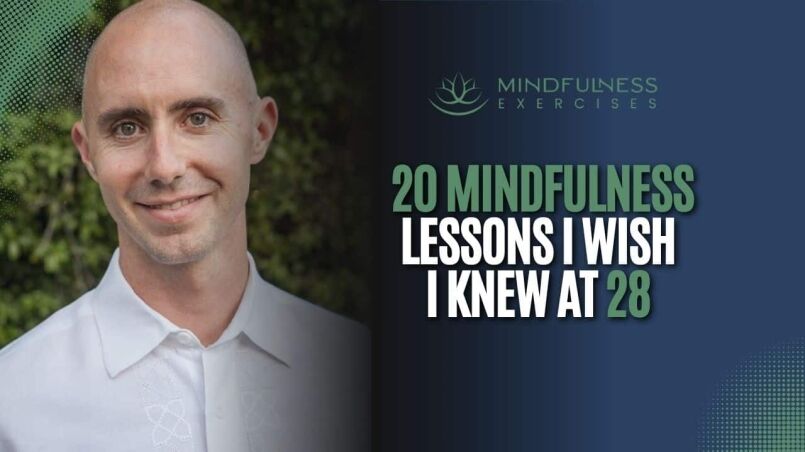
Back then, I had long curly hair, a slimmer belly, and a mind that refused to cooperate. And every time my thoughts wandered (which was always), I assumed I was failing.
But looking back now, I see something clearly:
I didn’t need more discipline. I needed a kinder relationship with myself.
Meditation wasn’t supposed to be something I mastered. It was something I was meant to meet myself inside of.
So if you’re somewhere on that path—whether you’re just starting or starting again—these are the mindfulness lessons I wish someone had gently handed me years ago.
20 Mindfulness Lessons That Actually Matter
1. Start smaller than your ego wants to
We tend to overestimate what we should do and underestimate what works.
Five minutes is enough. Even three conscious breaths count.
What matters most is not how long you practice—it’s that you return.
2. Stop trying to empty your mind
Your mind thinks. That’s its job.
Meditation isn’t about becoming thoughtless—it’s about noticing thoughts without chasing every single one.
3. Your posture doesn’t need to look “spiritual”
You don’t need to sit cross-legged on the floor unless that genuinely feels good.
Sit in a chair. Lean against a wall. Add a pillow.
Comfort is not cheating—it’s support.
4. Closed eyes are optional
Some days, closing your eyes feels grounding. Other days, it doesn’t.
An open gaze—soft, relaxed—can actually help you feel more present and safe.
5. The breath is not your only anchor
If focusing on your breath feels frustrating, you’re not doing anything wrong.
Try:
- The feeling of your feet on the floor
- The weight of your body in a chair
- The sound of a fan or distant traffic
- The warmth of a mug in your hands
Attention can rest anywhere.
6. Restlessness is not failure
That urge to move, to quit, to check your phone?
That’s not you failing meditation.
That’s you noticing restlessness.
And that noticing? That’s the practice.
7. Sleepiness is feedback
Sometimes meditation feels foggy or heavy.
It doesn’t always mean you’re doing it wrong.
Sometimes it simply means… you’re tired.
And your body is asking for rest.
8. Ten mindful breaths can shift your whole day
You don’t need a long session to feel a difference.
Ten slow, intentional breaths in the middle of a stressful moment can change the next hour entirely.
9. You don’t need a perfect morning routine
We often imagine an ideal version of ourselves—waking early, journaling, meditating, moving slowly.
But life is messy.
A short, real practice that happens is always better than a perfect routine that doesn’t.
10. Walking meditation counts
Not all mindfulness happens sitting still.
Some of the most grounding moments come from walking slowly, feeling each step, noticing your surroundings.
Movement can be meditation too.
11. Meditation isn’t separate from life
It’s easy to think mindfulness only “counts” when you’re sitting quietly.
But it also lives in:
- Waiting in line
- Washing dishes
- Listening fully to someone
- Feeling water on your skin in the shower
This is the practice.
12. The difficult sits matter most
Boredom. Irritation. Grief. Anxiety. Restlessness.
These aren’t interruptions to your practice.
They are the practice.
13. Name what’s happening
A gentle mental label can create space.
Try:
- “Thinking”
- “Planning”
- “Worrying”
- “Remembering”
It softens the grip of your thoughts without pushing them away.
14. Be careful with striving
The harder you chase calm, the more tension you create.
Peace tends to show up when you stop demanding it.
15. Mindfulness isn’t detachment
It’s not about becoming numb or distant.
It’s about becoming more honest, more connected, and more present with what’s actually here.
16. Self-compassion is part of the practice
You don’t become peaceful by criticizing yourself into it.
Kindness—especially toward yourself—isn’t extra.
It’s essential.
17. Some days, shorter is wiser
When you feel overwhelmed, pushing through a long session can backfire.
A softer, shorter practice can be more skillful—and more supportive.
18. You won’t always feel better right away
Sometimes meditation brings up what you’ve been avoiding.
That doesn’t mean it’s not working.
It means something real is being seen.
And that, in itself, can be healing.
19. Practice with others sometimes
You don’t have to figure this out alone.
A teacher, a group, or even one friend can:
- Offer clarity
- Reduce doubt
- Help you stay consistent
Community matters more than we think.
20. Begin again. Then begin again again
You’ll get distracted. You’ll forget. You’ll drift.
And then—you return.
Honestly, this might be the whole practice.
A Different Kind of Meditation
At 28, I thought meditation would help me control life.
At 48, I see something much simpler—and much more meaningful:
It helps me meet life.
Not perfectly. Not always calmly.
But more honestly. More compassionately. More real.
And over time, that changes everything.
A Gentle Invitation
You don’t need to take on all 20 of these lessons at once.
Pick two or three.
Try them this weekend.
Let them be simple. Let them be enough.
And when you forget?
Just begin again.