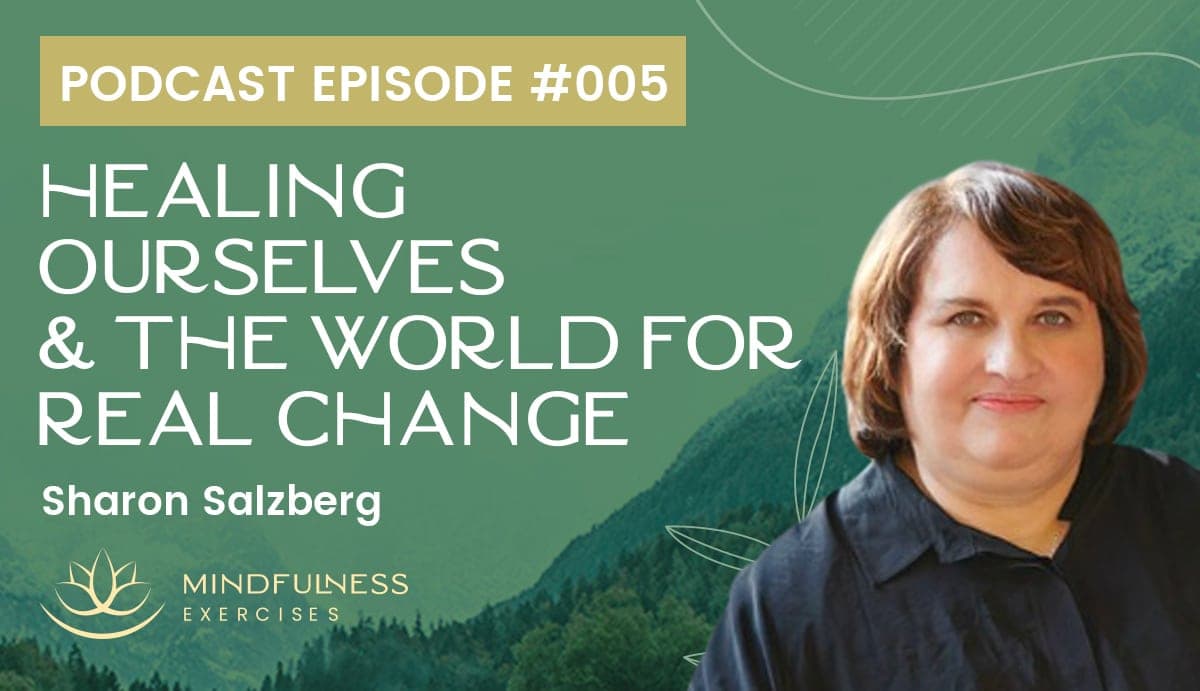
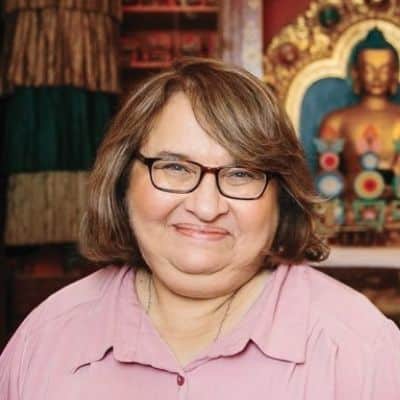
Speaker 1 · 0:00In today's volatile world, we're bombarded with breaking news that can stir up anger, grief, and depression. In the face of this fear and anxiety, we can quickly feel overwhelmed and burnt out, reactive to the smallest of situations. Mindfulness meditation can help us cope with the enormity of our own suffering. But is it ultimately self-serving? Or can it help us influence real change for the better of others too? Welcome to the Mindfulness Exercises podcast. May this be a source of inspiration and motivation in your mindfulness practice and teachings. In this episode, Sean Fargo interviews Sharon Salzberg about how we can enact real change from a state of caring perspective in the midst of today's most challenging experiences. Sharon Salzberg was instrumental in bringing mindfulness and meditation from Asia to the West. In 1976, she founded the Insight Meditation Society in Bar, Massachusetts, alongside Joseph Goldstein and Jack Cornfield. Sharon is the author of 11 books, including Loving Kindness, the New York Times bestseller, Real Happiness, and Real Love, the Art of Mindful Connection. Her newest book is titled Real Change, Mindfulness to Heal Ourselves and the World. In this interview, Sean Fargo and Sharon Salzberg discuss how mindfulness and equanimity are not replacements for action, but rather a means of summoning the courage to break through boundaries, reconnect to a movement bigger than ourselves, and sustain the energy to stay active in the fight for positive change in the world.
Speaker 2 · 2:15Thank you so much for being here, Sharon. Oh, it's a great delight to be here. It's a great delight to see you.
Speaker 3 · 2:21Yes, yeah. We're living in some wild times to say the least. We have COVID, we have a fight for racial justice on our hands and racial equity. Climate change is impacting us. So a lot of people are afraid, worried. There's also been an increase in a sense of loneliness and isolation, which you talk about extensively in your book. And in the midst of everything happening in our world and in our family life, and with the economy, and many people losing their jobs, there's this increased feeling of anger, and you make it clear that it's okay to actually be angry. And I was very struck by the section about anger. Like, anger can actually be a really good thing, it can be very useful for us. It's not this thing that we have to run away from or smother with love or get rid of. And you made it very clear it's okay to feel angry. You know, if we don't feel anger, we're not paying attention sometimes. And later on in the book, you mentioned that it's also okay not to feel forgiveness right away if we feel like we've been harmed or someone close to us has been harmed. Like it's okay not to feel the need to cross that bridge too soon. And so there's a lot of this maybe self-judgment around how we should feel versus how we actually are feeling.
Speaker 4 · 3:57First of all, with certain feelings, even in a very classical Buddhist sense, as you know, we don't have to call feelings of greed or jealousy or anger or fear bad or wrong. We can understand them as states of suffering, which they are, whether it's ours or someone else's. And feeling something is very different than being overcome by it, defined by it, led around by it. And that's where we have a lot of power and choice, just through being able to pay attention in a different way. I think it's kind of unjust to oneself and even cruel to say, I shouldn't feel this, I shouldn't be afraid anymore, I should have stopped grieving long ago, I should be beyond this, I've been meditating now for like 7,000 years, you know. Why do I still feel this? Which makes no sense because we feel what we feel. When conditions come together for something to arise, it will arise. We can affect those conditions for sure, but we can't absolutely control them or dominate them. And our real power lies in what do we do with something when it's come up? And anger would be a really good example of that. It's a complex feeling, it's not a simple thing. We feel what we feel, and we have to allow every feeling the dignity of its presence, you know, and recognize, okay, this is what's happening right now. Something like anger is usually very layered. And if we can be mindful of it and pay attention to it without either condemning it or ourselves, or just saying, yes, you know, I'm gonna do this vengeful thing, and then that. We learn a lot. You know, I've seen sitting with anger, the layers of sadness, the layers of fear. And almost always in there, there's like a kernel of helplessness. In Tibetan Buddhism, they say anger is what we pick up when we feel weak because we think it's gonna make us strong. And its strength is the energy. There's a kind of cutting through energy of anger, which is very needed, actually. And we know sometimes in a meeting, in a gathering, sometimes it's the angriest person in the room that is insisting that everybody looks at that problem and everyone else is kind of studiously looking the other way, not wanting to face it, and they're saying, no, look at that. You know, so we actually rely on that cutting through energy. But when a person is consumed by it or overcome by it, when it really becomes kind of a way of life, it's very destructive. And Buddhist psychology talks about anger as being like a forest fire, which burns up its own support, it can destroy the host. And like a fire, it can range very wild, and we might end up someplace we actually don't want to be. It's the difference between feeling something and being lost in it. Being lost in anger is like drinking poison and thinking it's gonna kill the other guy. I have no idea who said it. But it's very wise, you know. So it's not because what we're feeling is bad or injudicious, it's because out of compassion for ourselves, we decide do I want to get dedicated to this and just keep getting overcome by it, or do I want to find another way? The other way is not dismissing it, but utilizing the energy of it. So the big question for us becomes how do we harness the energy of it? That kind of cutting through possibility without getting consumed by it. Now, this is not easy, but it's actually almost like a characteristic of mindfulness that it helps us do that. And forgiveness is a whole other topic, you know, which is also very complex because we tend to use the word in so many different ways. One of our friends, Sylvie Horstein, used to say, forgiveness is not amnesia. It doesn't mean you're wiping the slate clean and that what happened didn't matter, or doesn't matter. Maybe it matters quite a lot. But again, it's a sense of being consumed, overcome, defined by, say, either our own actions in the past, if we feel we can't forgive ourselves or someone else's actions, which we actually cannot change.
Speaker 3 · 8:10Yeah, you know, you have a very wonderful quote in there about compassion. Some people have the misconception that compassion means that we're soft or that we don't fight or that we maybe are allowing of everything and we condone everything and are just kind of nice all the time. But you say that compassion doesn't mean we don't fight, it means we don't hate. And so we can continue being compassionate as we fight for change. It's how we relate to the fight that really is the difference. And compassion, as you share so often, is love in the midst of suffering. And you know, a lot of us struggle to hold a sense of love for ourselves during these times or for others, especially for people who we disagree with or feel like are harming us in some way.
Speaker 4 · 9:10You know, love can have different flavors, and none of the flavors are weak or saccharin or sentimental, which is easy to believe they are, but there's a flavor which has to do with just it's not even an emotion necessarily, it's a sense of inclusion, it's recognition that our lives are connected, that the construct of self and other and us and them that we live by is really just a construct. And it might be useful in certain circumstances, but it's just a construct. And the reality, going back to the word real, is that our lives are interconnected. So you might not like somebody at all, but there's a kind of bone-deep recognition that our lives have something to do with one another, and it's moving from self and other to more a sense of we. And that is actually an interesting place to be looking at problem solving. Not that you need to convert somebody to your view, which may be impossible, or think that all views are equal, which I actually don't believe is true. Some are very diluted, but in a sense of care for the person, there's much more of a recognition. I use the example in the book, which is I was riding in a car with a friend, and we were stuck in this incredible, terrible traffic and complained bitterly about it the whole time. And then my friend looked at me and said, Well, we're the traffic too, you know. And I thought, oh, that's so interesting. It's like that presumption. I mean, that it really is a state of privilege, that presumption of centrality. Like, it's my road. You are an interloper in the way, slowing me down, you know, get out of the way. But what about when that centrality, which is a mistaken notion, drops away and it's like, oh, we're all the traffic? That is actually realistic. That's the truth of life. And there's something that echoes in loving-kindness for somebody in that sense. You know, we're not saying we like them, we approve of them, we want to spend any time with them, we're not gonna fight their agenda. It's none of that, but we have that sense of linkage.
Speaker 3 · 11:19You know, in your book, Real Change, you make the distinction between empathy and compassion, and talk about maybe the misnomer that it's what we often call compassion fatigue is actually empathy fatigue. Empathy can kind of be like feeling with and taking on some of the energy of what's around us, whereas compassion is a bit more about feeling for. There's this offering or extension of care for the other, which includes ourselves as well, obviously, and we can form healthy boundaries out of a sense of compassion as well. You also share that the near enemy of compassion is a sense of burnout, feeling overcome by the amount of suffering there is in the world or for those who we care about. And so when we're burned out and we're overcome, we can't serve. Now, that near enemy of compassion is not compassion itself, it's something that we mistake for compassion, but that sense of compassion, that feeling for others, the genuine sense of care and love, it can feel a lot. You know, a lot of us who are in caring professions or who are caregivers, even if we have pure compassion, it's still a lot to be extending that care. And in your book, Real Change, you talk a lot about this intersection between compassion and equanimity. You share that equanimity helps to balance our care so that our compassionate action can be sustained in a way that we're not always burned out. This equanimity can help us to not drown under the weight of our own worry. And so I've always found equanimity and the intersection between equanimity and compassion to be very difficult to teach. And that said, in the last chapter of your book, Real Change, which I hope everyone buys 10 copies of, you do a great job of explaining that intersection between compassion and equanimity, and how equanimity can fuel us to care for others in a sustainable way where we're not feeling burdened. On page 221 of the hard copy, you share a few equanimity phrases with us. I care about your pain, yet I cannot control it. I will care for you and cannot keep you from suffering. May I offer love, knowing I can't control the course of life, suffering or death. I wish you happiness and peace, yet cannot make your choices for you. I will work to alleviate suffering in the world, and I know I'm not in control of the unfolding of the universe.
Speaker 4 · 14:22So equanimity is a really tough word to understand. It sounds to us like indifference and not caring and things flattening out or being oblivious, and it doesn't mean any of that. It does mean balance, and some of that balance comes, it's being able to hold many things at once, like the joy and the sorrow, and the devastation and the possibility, and being able to be in touch with acknowledge fully both. And I think that is the reality. We don't get over it, and we don't sort of only see the bright side, you know, of things is such tremendous suffering. And when you listed so many of the things between climate change and the economy and the pandemic and racial injustice, I mean, there's so many things, and we need to be able to acknowledge that. But if that's the only place we see no sense of possibility, no sense of beginnings, no sense of onward movement, then we will despair. And there's such a huge amount of depression and despair and exhaustion going on right now. But if we only look at, oh, you know, things can work out this way, and there's creativity and there's this, then we're so ungrounded that it's not realistic. So we need to learn to hold both, and we can learn to hold both. The example I'm using these days, I did this series of four events, which are now up on Wisdom 2.0's YouTube channel. So one of the events was me moderating a panel with people who had survived in some way and been strongly, strongly affected by the school shooting in Parkland, Florida, some years ago. And this young woman who I used as an example in my book was on this panel, and her mother is a teacher at Marjorie Stoneman Douglas. She was there that day, she wasn't hurt, but it had been like eight hours or something of not knowing if her mother was alive. And then this young woman, Samantha, is her name, who's an extraordinary young woman, became very active in helping organize the community, especially the community of students and the marches and so on. And so the first time I went down there to teach was not so very long after the shooting. And Samantha raised her hand at one point and she said, I feel really weird because I'm having this incredible experience being here. And I know the only reason this day is happening was because that horrible thing happened, and I don't know how to get over it in order to really appreciate this. And I said, I don't know that we ever get over it, but we learn to hold them both at once. So the other day on the panel, I said to her, Do you remember that exchange? And she said, Not only do I remember it, I think of it every single day. I think about equanimity, I think about the yin and the yang, you know, the dark and the light, and the light and the dark. And she said, It's like her North Star.
Speaker 3 · 17:34Yes, yeah. You talk about how equanimity is broadening a perspective, you know, rooted in care and wisdom, it's all about balance. And you talk about how with climate change, there's so many pieces to the puzzle, and it can feel very heavy. But if we bring a broader perspective to the forefront, that can help us to push for change in a sustainable way with more balance. Climate change is an enormous challenge. Personally, when I think about climate change, it can feel overwhelming very quickly, just through the enormity of it, and through equanimity, I try to broaden my perspective, and yet sometimes that perspective isn't even broad enough to kind of encapsulate climate change, because climate change can itself feel so big. When you reflect on climate change and the enormity of it, I'm just curious personally, like how you bring this sense of compassion and equanimity to be able to hold it within a wider perspective without getting overwhelmed by it, and what that means to you and how you relate to the enormity of it.
Speaker 4 · 19:12We can't take everything into our heart. We just can't, like the immensity, the enormity of climate change. But we can take in that which we feel passionate enough about to act on. Because the most corrosive feeling of all, I really do believe, is that sense of helplessness or hopelessness. So maybe within that enormity, there's one issue that you would really engage in. For me, the overarching issue I am passionately involved in more than anything, is voting right now. If you are a U.S. citizen and you are 18 years old and eligible to vote, I think it's imperative. So the work that I do, like writing letters and even in talks like this, is very much centered around that. And I know there are a million activities I'm not engaged in. And it's not that I don't care, but this is the one where I feel like a sense of focus and commitment, and I can actually do because remember the complaining on Twitter or you know, like feeling horrible because something is going on is kind of not the point. It's being able to metabolize that distress and move it into action. And so that's the arena where I really work. And for me, it's so consonant, you know, with a background in kind of Buddhist training in a very classical sense, although not monastic. It is so consonant that action of voting with the Buddhist teaching about the innate worth of everybody, that everybody has worth, everybody has innate dignity. And so that translates to me as everyone should have a voice and everyone should get to exercise that voice. And so I feel really happy. And so that's part of holding it all. You know, there's the devastation and the distress.
Speaker 3 · 21:04And in the context of real change and how we can heal ourselves and the world, I wanted to lead an online meditation for Black Lives Matter to dedicate a loving-kindness meditation for racial equity. And I announced it online. I said, you know, we're going to be doing a loving-kindness practice for this issue and for black lives. And I got a lot of pushback. And it was surprising to me, it was shocking to me how much pushback I received that people were saying that either all lives matter, or what good can you do with a meditation? What does it mean? Why don't you like put this into action or this is self-serving in some way? I got many different kinds of pushback, and I was very surprised. And in your book, you actually shared a story that you had a similar experience where you got a lot of pushback from people saying similar things, and you share a couple of tweets stating some of the context of what you mean or what your intentions are with the guided meditation and how it can impact our fight for real change. And so, just quoting you in the book, you say that, and I've modified it very slightly, but you say basically that I offer this meditation to remind myself not to disconnect from what is happening, it's so much less painful to look the other way. But this is vital. I would never suggest that meditation, prayer, or positive thoughts are a replacement for action, but I know I need to connect to something bigger repeatedly to have energy to keep acting. And so I feel like that clarification is useful for a lot of us who may not understand the link between our own mindfulness practice and doing this together as a collective community and linking that to real change. And so I have to be very helpful for my own sake, and I feel like that context may be helpful for others.
Speaker 4 · 23:32Sure. And the meditation I was proposing on Twitter actually was the suggestion of somebody else, and I thought, oh, this could be really powerful and helpful. So it was meta, M-E-T-T-A, meaning loving kindness, a meta minute for the kids who were in cages in detention centers at the border. And somebody put on Twitter the suggestion directed to me, and then I wrote back and said, Well, yeah, that's interesting. I'm on my way home. I'll see if I can get a script together and record something, and I did, and there was a fair amount of pushback. So it was just as you said, people saying you're as bad as the people who just do thoughts and prayers and never do anything, and why aren't you donating money? You know, why aren't you sitting in somewhere? And and I said exactly what you read, because it is hard to really bear witness to suffering and have enough energy to want to do something about it. And we see the most caring people who are on the front lines of suffering, whether as caregivers, you know, medical personnel, first responders, who are you know these days doing a fair amount of work with ambulance drivers, people like that, or activists who are really trying to create some kind of systemic change, is not easy. And we see people burning out left and right because it is not easy. And we need these people so tremendously, and so I've thought deeply about what helps us keep going, what allows us to sustain a kind of energy or effort. Well, you know, you don't get immediate results right away, or it's a long haul, you know, of effort. And for me to try to make a difference, and that might mean in your family, it might mean in your neighborhood, it might mean your community, it might mean in the country, it might mean on the planet. And the manifestation of the effort could be very different, and is something I really tried to emphasize in the book. That actually, that part was based on a conversation I had with Belle Hooks, who's a kind of iconic feminist writer, and I told her, because we're friends, that I'm used to Buddhist scholars who, as you know very well, will parse the exact word and be all fussy and like pick it all apart and change the vocabulary. And I told her she was even worse, which I think she is, which is probably why she's such a great writer. And I was in the process of writing the book. She said, I don't like the phrase social action, because I think it sounds like it's only limited to marches and protests and things like that. She said, What about art? You know, what about creativity that takes us beyond the conventional or the convenient and has us dare to imagine something different, dissolves boundaries, you know. So anyway, that's a bigger term than we normally give credence to. And if you are engaged in that way, then I think we really do need practices that will sustain us and will help us keep going. And when you say belonging, the way I am often talking about that precise thing these days is rest. It's some place of awareness where we're not trying to manipulate our experience and we're not trying to fabricate anything, and we can just rest. And there we find a sense of home. And it's a very powerful thing to do. It's also the kind of thing, amongst many things, that we can talk about that feels wrong. You know, it just feels selfish and weird. Like, I can't do that. You know, there's so much happening, it's so urgent, and there is so much happening, and nonetheless, we have to be able to hang in there. And then there's the sense of community and you know, the goodness that exists. There's some school in, I think it was Minneapolis, that was serving as a kind of distribution center for poor families and people who needed food, and they put out a call for something like seven bags of food, and they got 20,000. You know, and I think about that, I have to get the exact numbers right, but it's close to that, if not that. And I think about that, and I think, oh, that's true too. That also exists, even as this other, you know, the cruelty and everything that we see, even as that's going on. So I would take that section of what seems so wrong, see what we can act on and will act on, and also be buoyed up by the force of goodness.
Speaker 3 · 28:10Beautiful. Well said. Thank you, Sharon. Sharon, I'm just very grateful for your time today. I really think that Real Change is just a profound book. Nothing else quite like it that I've read. Very practical, very uplifting, very real. And I encourage people to check it out. I've been listening to it on Audible as well as reading the printed book. I think both are great. For those of you who have been impacted by Sharon in some way, who have benefited from today's teachings, I encourage you to share your generosity with Sharon. She's a full-time Dharma and meditation teacher. This is all she does. And her life is sustained by contributions from people like you. So I do encourage people to Sharon Salzberg.com forward slash contribute, where you can contribute. Sharon, it's been a pleasure. Thank you for offering this gift to the world. I can't thank you enough. Thank you so much for having me. Really thank you all.
Speaker 1 · 29:20Thank you to both Sean Fargo and Sharon Salzberg for this inspiring conversation on the intersection between mindfulness, meditation, and real change. This podcast is an excerpt of a longer interview with Sharon that you can find on the Mindfulness Exercises YouTube channel. For links to this and more, visit mindfulnessexercises.com.