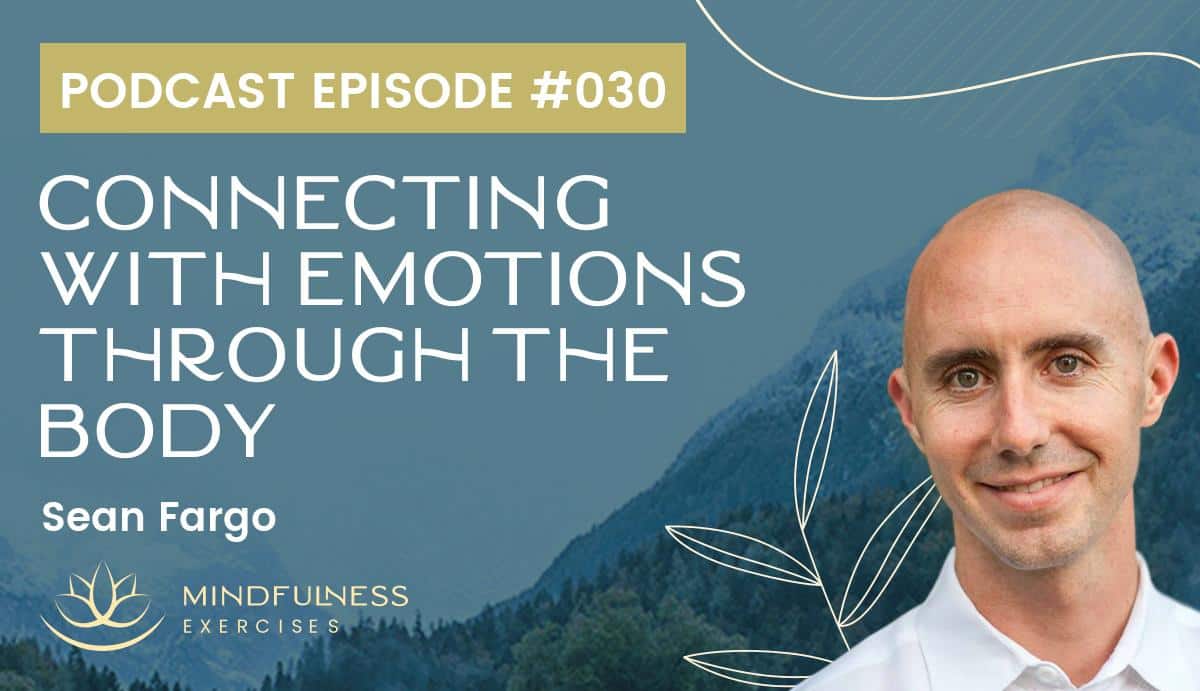
Speaker 1 · 0:04When was the last time you followed your body's intuition versus the thoughts in your head? Even experienced mindfulness practitioners can find it hard to tune in to the body's wisdom. Improving interoception, the awareness of the body's internal sensations, is a good place to start becoming truly present with our bodies, our emotions, and ourselves. As we deepen our awareness, there's no end to where the body scan can take us. In this episode, Mindfulness Exercises founder Sean Fargo teaches us how deepening mindfulness of the body offers a better understanding of our emotions and the opportunity to heal from past trauma.
Speaker 2 · 1:07It is usually part of like the first foundation. Sensing into breathing in and out, like belly rising and falling, air moving in and out of the nostrils. What does it feel like to breathe right now? Not trying to breathe a certain way, but just what does it feel like in the body to be breathing? Does it feel like to be walking? So that's usually the first foundation. And one of the things that's beautiful about that is that it sets us up to sense into emotions, because emotions live in the body, and oftentimes we can notice emotions faster in the body than in the head or through thoughts. Because emotions live in the body, and the more we sense into how different emotions feel in different parts of the body, the more we'll notice them rising, and we can tend to them faster and be fully with it.
Speaker 1 · 2:21Noticing emotions is the first step toward developing emotional intelligence, but we can go beyond simply noticing. Learning to tend to our emotions with gentleness and care begins with the practice of observing sensations without judgment.
Speaker 2 · 2:57And through these practices, we can sense into different parts of the body with more awareness, more nuance, more curiosity that we may not have been able to sense before, or may not have been curious to sense into before. So I really try to focus on the curiosity of what can I feel? What can I feel here? What can I feel here? And it helps to remember that each time I sense into you know my right hip, it's gonna be different, or it's probably going to be different. And so sometimes we can also get stuck into assuming that my right knee is going to feel like it did yesterday, or the last five times I did this body scan. And so making it a point to be curious rather than assumptive can also freshen our body scans a lot. I think that's important to emphasize too.
Speaker 1 · 4:11If we tend to be assumptive in our practice, we may be missing out on our present moment reality. By practicing being curious instead, our non-judgment can evolve into a state of welcoming and allowance. We become better able to remain present, no matter the sensations that arise.
Speaker 2 · 4:39And so by honing in on the geography and the types of sensations we can feel around these sensations, the more we can really up our curiosity of it, we stay present for what's here without trying to force the sensations to be a certain way, without trying to feel something different. We're not holding on to these sensations to make them stay. We're not trying to feel a certain way, we're allowing them to be however they are in this moment, in this moment, in this moment. So we're allowing them to be here, we're allowing them to change, we're allowing them to intensify, which takes a lot of courage sometimes. And we're also allowing them to go. But this full allowance is what helps these energies to fully process. And if we're staying with them without judging them, it's very, very healing in many ways. So we're allowing them to stay, to go, to change, to intensify. And we're staying curious. And oftentimes when we really bring curiosity to these sensations, we notice that there's actually something deeper that we maybe hadn't realized. So there's a lot of room for exploration, for even a sense of play with body scans. And so for a lot of your students or patients or clients who you share mindfulness with, whether they're kids or adults, it can be very helpful to encourage this curiosity for these different kinds of sensations in different parts of the body, and to offer them things that they can notice.
Speaker 1 · 6:54As a means of encouraging curiosity, we might ask our students to notice if there is a shape, a size, a color, or a temperature to the sensation. Some see this as an invitation to contemplate using the head, but we'd rather observe what's actually here. So it might also be useful to ask our students to notice where they are observing from.
Speaker 2 · 10:01A lot of us are, myself included, are in our heads a lot, speculating about all sorts of things. And so it can be very easy to get caught up into the thought world, which can be ethereal and empty, or at like not very substantive, very slippery. And so if we notice ourselves caught up into our heads with speculation or fear or worry, sometimes opening to the fullness of what's actually here in the body. It can be interesting to experiment, opening to the fullness of the feet. What is it like opening to the fullness of the shoulders? What is it like opening to the fullness of an area of the body that may be feeling tense? Sometimes opening the fullness of an area that's tense might intensify the unpleasantness. Sometimes it does the opposite.
Speaker 1 · 11:21Nor pushing away what is unpleasant. It's about being present with whatever we feel. That said, this capacity for presence doesn't need to happen overnight, especially when working with past trauma. When the sensation we notice is unpleasant or intensifying, it can help to have a plan and a safe space to which to turn our attention. As mindfulness teachers, it is our role to help those we guide navigate this discomfort.
Speaker 2 · 12:02People with disabilities, I will try to be very sensitive to that. People with chronic pain want to be sensitive to that. It helps if you know what those disabilities or challenges are in advance, especially if you're in person and you know that person, you can then navigate it appropriately in a wider group context. It's difficult to account for those things for each individual. And so that's where giving some caveat or invitation to say, you know, if things are a little uncomfortable, sometimes feel free to skip over it or do something else. You can say things like that.
Speaker 1 · 13:13Staying with the body in challenging but tolerable areas can help us build the confidence we need to remain present with unpleasantness.
Speaker 2 · 13:27Can we stay in the body, but maybe a different part of the body that's not so painful or unpleasant to stay grounded? And when we're sensing into the body, we are strengthening our, I think it's the insula, I-N-S-U-L-A, which is responsible for proprioception. And so the more we try sensing the body, the more we're building that muscle to be able to sense in the body more and more. And so it takes practice. Anyone can do this, it just takes practice, like going to the gym. And so if we find it difficult to sense into the body and to stay with the body, that's totally normal. That's to be expected. And that's why this is a practice. Can we keep coming back to the body, keep exploring the body from the body? Can we notice any judgments of the sensations and just kind of returning to the visceral nature of the body? And so when we have some pain or discomfort, sometimes it's helpful to kind of just sense into a different part of the body for a while, keep building the muscle of being able to sense in the body, keep building the insula. And then over time, as we strengthen that muscle, we can start to then move more slowly back towards the discomfort in baby steps, very slowly, like geographically, like kind of inching back towards the area of the pain with a sense of courage and softness and care, gentleness. And over time, as we're building the insula and our ability to sense into our actual sensations without judgment, we'll then be able to kind of start enveloping the discomfort with our awareness and really allowing that discomfort to be there, honoring it, validating it, if you will, allowing it to be here. We can then start to work with things like acceptance and true care. And science has shown that mindfulness of the pain itself can decrease the pain intensity levels by a considerable percentage, sometimes up to 93%. You know, and we had a discussion with David Trelevin, who wrote trauma-sensitive mindfulness, and trauma lives in the body, and a lot of us have trauma, and so it can be very scary to sense in the body, since a lot of mindfulness practices are body-centric, and if trauma lives in the body, then it gets a little tricky sometimes, and so finding safe areas of the body where we can explore, build that muscle of the insula, and if we have trauma, maybe working with a therapist or a really supportive guide, but kind of exploring parts of the body with this gentle curiosity more and more, and kind of gradually move towards what's uncomfortable bit by bit, like staying within our window of tolerance, but kind of inching towards what's more uncomfortable bit by bit. There are certain parts of my body that are much more difficult to sense into. I think that's just very common. That's why mindfulness of breathing is such a core practice for a lot of people, is because it tends to be easier for most of us to sense into the rise and fall of the belly. I mean, there are other reasons why it's a core practice too, but that's a big factor is our ability to sense into these core sensations. And if it's difficult to sense into sort of the subtle sensations of the body, or if something feels numb, I think it's worth exploring. Not beating yourself up if you can't sense into it, but maybe exploring the outer edge of the numb area. Like, okay, well, what's the nearest point that I can sense into? Like, what's the geography of the numbness? Like north, south, east, west, but also depth. Where can I sense into? And then, you know, can I sense in like an inch inward? Maybe not. Maybe I can't. Kind of gently exploring the outer edges and moving inward and seeing if that ability to sense into that area of the body changes. And again, I you know, want to be careful around trauma because sometimes areas of the body that are numb may be numb for a reason, and you want to be careful, but gently exploring. It doesn't mean you have to keep exploring it, but I do encourage people to try. And one thing I like doing is actually bouncing around my body, seeing if I can sense into different parts. Like, can I feel the sensations all around my left earlobe? My right eyelid, you know, some random part of my head or scalp, you know, my middle left toe. You know, like three inches into my side underneath my bottom rib.
Speaker 1 · 19:39Scanning the body in new or random areas can help enhance a sense of curiosity. We may observe pleasant sensations, pain, movement, numbness, or nothing at all. It's quite common, in fact, to experience an area that is void of sensation. This doesn't mean we cannot pay attention to it. It's simply another opportunity for exploration.
Speaker 2 · 20:16What is the void? Where does the void start and stop? Because a lot of us will have these black holes or like voids in the body. It's like it's really hard to sense into this area for whatever reason. Maybe just our brain goes offline, or we get stuck or paralyzed, or we're trying, but it's just really hard to sense into it. Maybe it just feels like a block of like a heavy brick, and it's just hard to kind of sense into it. There's different ways we can relate to it. And this kind of goes back to chronic pain in a way, because a lot of people with chronic pain will have these voids too. And so I think it's helpful to you know bring interest and curiosity, especially to the edges. So, you know, if there's a void in the middle right toe, for example, okay, well, where does that void start? Like, how close can I get before the void is a void? Like maybe I'll travel, you know, down the ankle, sensing into the top of the foot or the bottom of the foot. Maybe I'll sense into the like neighboring toes and you know, have tea over there for the afternoon, and then sense into maybe the edge of the middle toe for a little while. See, like how close to the edge can I feel into? Where does this void start and stop? What about the tip of the middle toe? Can I feel into the tip? Can I feel into the nail? What happens if I touch it with my fingers? What happens if I bend it? Like, what happens to that void? Does the void suddenly vanish and turn into sensation? Or is it still a void? Does the void get smaller? Does the void hide in a certain part of the toe? What happens if I warm the toe, cool the toe? Not to force anything, but just to maintain curiosity. But oftentimes sensing to the edges of the sensation and just hanging out there for a little while. There's no agenda, no judgment of the void, not trying to force anything, but just kind of hanging out on the edges and being there for a while. Sometimes that will I want to say soften the void, but it's like the sensations start to kind of come online a little bit more over time, you know, or maybe we may be able to sense into an emotion, you know. Maybe this void is actually fear or trauma or anger or maybe you stubbed it when you were three and you just lost sensation and the nerve endings are gone. Who knows? But like, what is it? Is there an emotional territory? Like, what happens when I hang out on the edges for a while without agenda, not trying to make it tell you everything, but just kind of listening or sensing and just kind of hanging out nearby, being curious. But a lot of us have these voids in different parts of the body, and a lot of our students will have them too. These places that are just difficult to tap into.
Speaker 1 · 23:49Observing physical sensation in the body or lack thereof has great healing potential. Thank you to Sean Fargo for this practical advice on how we might deepen our direct experience of sensation and more skillfully guide others as well. Listen to the previous episode, a deeper mindful body scan, for new and unique ways to expand your awareness using this technique.