🎧 New episode: Nothing's Missing: Dr. John Demartini on Mindfulness as WholenessListen →

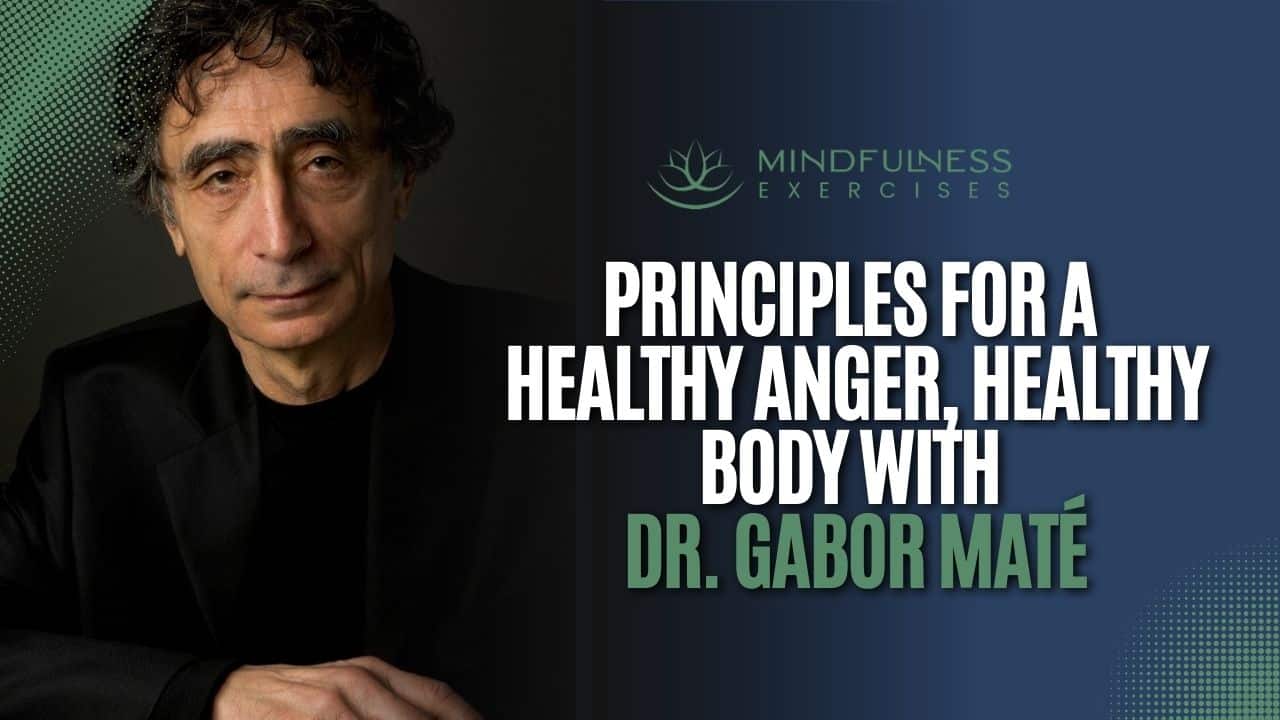
    Healthy Anger, Healthy Body – with Dr. Gabor Maté

    SF
    Sean FargoPublished December 12, 2025 · 5 min read
    Healthy Anger, Healthy Body – with Dr. Gabor Maté

    Listen to this episode

    Mindfulness Exercises Podcast

    Enjoying the episode?

    Follow the show in your podcast app. If this conversation supports your practice, a rating or review helps more listeners find it.

    Healthy Anger, Healthy Body – with Dr. Gabor Maté — Tunein Logo

    TuneIn

    Anger has long been misunderstood. Many of us grew up believing anger is something to avoid, suppress, or feel ashamed of. For some, “being nice” became a personality, not a preference—an identity rooted in survival rather than truth.

    But what if suppressing anger doesn’t make us kinder? What if it makes us sicker?

    In this powerful conversation inspired by Dr. Gabor Maté, we explore the deep connection between healthy anger, honest boundaries, emotional regulation, and physical wellness. Drawing from affective neuroscience, trauma research, and mindfulness practice, this article guides you through understanding why suppressed feelings can silently weaken the immune system and how learning to express natural emotions—skillfully, calmly, mindfully—can change the trajectory of your health.

    Sponsored by our Mindfulness Meditation Teacher Certification Program MindfulnessExercises.com/Certify

    Episode Overview:

    • Why chronic “niceness” can become harmful
    • The neuroscience of anger, grief, fear, and care
    • How the body mirrors emotional suppression
    • Healthy vs. unhealthy anger
    • How childhood conditioning shapes adult emotional habits
    • Boundaries as acts of self-respect
    • The link between suppression, inflammation, and disease
    • Simple mindful practices to honor your truth

    Show Notes:

    The Misunderstood Emotion: Why Anger Isn’t the Enemy

    In many cultures, anger is painted as destructive, unstable, or impolite. Children who show it are often labeled “difficult,” while adults who express it risk being seen as unprofessional or dramatic.

    But Dr. Maté reminds us that anger is one of the core mammalian emotional systems. Like fear or care, anger evolved for a very specific purpose:

    Healthy anger protects boundaries.

    It communicates:

    • “This crossed a line.”
    • “Something is not okay.”
    • “My well-being matters.”

    When expressed proportionately and mindfully, anger isn’t harmful—it’s protective. It helps us stay connected to our integrity and prevents resentment, exhaustion, and emotional self-abandonment.

    When “Being Nice” Hurts the Body

    Many people believe kindness means not causing trouble, not disagreeing, and not expressing discomfort. But this form of “niceness” often emerges from childhood environments where:

    • Love was conditional
    • Attachment depended on compliance
    • Emotional expression felt unsafe
    • Conflict meant instability

    In adulthood, these patterns turn into:

    • Chronic people-pleasing
    • Avoidance of conflict
    • Silence in the face of discomfort
    • Overworking to meet others’ expectations
    • Migraines, chronic pain, digestive issues
    • Burnout and emotional fatigue

    The body keeps the score—especially when emotions don’t have room to move.

    Research shared in the episode highlights:

    1. People with ALS who expressed anger survived longer.

    Not explosive rage—simply honest, straightforward emotional expression.

    2. Women in unhappy marriages had higher mortality when they kept their feelings unspoken.

    Silence becomes a stressor. Expression becomes a release.

    The takeaway is profound:

    Suppressing emotions forces the body to carry the weight the mind refuses to lift.

    When your voice is quiet, your immune system may learn to quiet itself, too.

    Healthy vs. Unhealthy Anger: A Mindful Distinction

    Not all anger is the same.

    Unhealthy Anger
    • explosive
    • punishing
    • reactive
    • fueled by fear or old wounds

    This form disconnects.

    Healthy Anger
    • calm
    • clear
    • proportionate
    • boundary-setting
    • rooted in present reality

    This form protects connection.

    Mindfulness helps us tell the difference by slowing the space between sensation and reaction. With awareness, we can feel anger arise without letting it take over—listening to its message instead of acting from its intensity.

    The Nervous System’s Role: Why Emotions Are Physiological, Not Just Psychological

    The conversation also breaks down six major emotional systems found in mammals:

    1. Rage — boundary protection
    2. Fear — threat detection
    3. Panic/Grief — attachment needs
    4. Care — nurturing connection
    5. Seeking — curiosity and engagement
    6. Play — social bonding and creativity

    None of these systems exist to cause chaos. They exist to keep us alive, connected, and attuned.

    When anger is suppressed, these systems become imbalanced. Fear takes the wheel. Grief becomes buried. The care system gets overused in the form of people-pleasing.

    Restoring emotional balance begins with allowing each system to do its job—including anger.

    How to Honor Anger in a Healthy, Mindful Way

    You don’t need to raise your voice to honor your boundaries. You don’t need to withdraw, explode, or create conflict.

    Instead, Dr. Maté suggests a simple mindful process:

    1. Name the feeling.

    “I feel angry.”Not: “You made me angry.”This keeps ownership and clarity.

    2. Identify the boundary that was crossed.

    What exactly happened that felt untrue, hurtful, or misaligned?

    3. Choose a proportionate, skillful action.

    This may mean:

    • stating a limit
    • asking for space
    • making a request
    • saying no
    • disengaging respectfully

    Healthy anger keeps the action aligned with the situation—not magnified by old wounds.

    How Childhood Survival Patterns Become Adult Burnout

    Many adults who struggle with boundaries have a childhood history of:

    • keeping quiet to feel safe
    • being responsible for others’ emotions
    • equating compliance with love
    • fearing disapproval
    • suppressing discomfort to maintain peace

    These patterns become automatic. We call them “personality,” but they’re actually adaptive survival strategies.

    When repeated over decades, they take a toll:

    • chronic inflammation
    • hormonal imbalances
    • immune suppression
    • emotional exhaustion

    Mindfulness allows us to gently examine these old patterns without judgment, offering new choices in the present moment.

    Why Listening to Your Body Is an Act of Self-Respect

    The body whispers before it screams.

    The early signs of emotional suppression often look like:

    • tight jaw
    • clenched stomach
    • headaches
    • fatigue
    • irritability
    • trouble sleeping

    If ignored, these whispers can harden into chronic conditions.

    Instead of pushing through, mindfulness invites us to pause:

    • Where is my body saying “no”?
    • What boundary is being crossed?
    • What truth am I not letting myself speak?

    This is not selfishness—it is self-attunement.

    A Mindful Question to Carry With You

    If there is one takeaway from this episode, it’s this:

    Goodness is not self-erasure.Goodness is self-respect.

    You are allowed to speak up. You are allowed to protect your inner peace. You are allowed to honor your needs without apology.

    Today, consider asking yourself:

    What boundary will I protect—gently, clearly, mindfully?

    Your body will thank you.

    If This Resonated With You…

    Share this article with someone who struggles with boundaries or emotional suppression.Follow the podcast for more science-backed mindfulness tools.Leave a review so more people can find these teachings.

    Your voice—and your truth—matter.

    Additional Resources:

    Transcript

    Show transcript· 5 min read

    Which Emotions Get Repressed?

    Speaker 1 · 0:00I I hear you talk about rage and anger a lot. Do you feel like the suppression is I mean, if you had to like have a pie chart or percentage of different emotions that people typically suppress, would you say most of the time it's say rage or sadness or fear? Or is it even possible to separate those?

    Speaker 2 · 0:23Well, it's interesting.

    The Brain’s Core Emotion Systems

    Speaker 2 · 0:24There's there was, sadly, he's not alive anymore, a neuroscientist, his name is Dr. Yak Panksap, who looked at the neuroscience of emotions. Affective neuroscience, he called it, affective neuroscience, not effective, affective neuroscience. And he distinguished some brain systems that we share with other mammals, some rudimentary but essential brain systems, and he capitalized them just for nomenclature's sake. And each of these brain systems were associated with certain brain chemicals and certain circuits in the brain. And they were not, you know, they were very much intermingled, but there was a circuitry for rage. He called it R-A-G-E, rage. There was also circuitry for panic and grief. He called it panic grief, capital panic slash grief. There's one for fear. There's one for lust. There's one for seeking. There's one for play. And one or two others. And each of these are necessary for human life. Mammalian life, actually. Now the rage system isn't an aberration, it's part of our apparatus. It shows up, it gets activated when we're threatened and our boundaries are threatened. You want to find out what rages? Try to mess with the bear cubs of a bear mother. You'll find out what rages. It's there for a good reason. We have a system for care, C-A-R-E, which makes us care for one another, especially for the young of the species. Without that, mammals don't survive. If the adults didn't have a care system in their brains, no infant would survive. We have a panic and grief system, panic grief, which is what the young feels when the care is absent. They feel panic, they feel sadness.

    Rage As A Boundary Protector

    Speaker 2 · 2:46Now, what I find is that the most commonly repressed are the rage and the panic and grief. And when you repress that, no, when you repress anger, healthy anger, you're actually suppressing your immune system. Why? I could go into the science of it, but in a nutshell, mind and body cannot be separated. And when you look at what is the role of healthy anger, is to protect your boundaries. That's emotionally or physically the case. Sean, if I were you are in the same room with you, if I were to attack you, you should mount a rage response. Oh, you can't do this to me. You know? And you might do the same thing if I was emotionally intrusive. That's to keep out what is unhealthy. In fact, the role of the emotional system in general is very simply let in what's healthy and nourishing and keep out what's not. That's basically the role of emotions.

    Emotions And Immunity Mirror Each Other

    Speaker 2 · 4:08Now, what is the role of the immune system? Trick question. It's to keep out what's unhealthy and let in what's healthy. It's the same as the emotions. In fact, the immune system and the emotional system are part and parcel of the same apparatus. When you're suppressing rage, your healthy rage, I'm talking about, there's such a thing as healthy anger, then there's unhealthy anger. When you're suppressing healthy anger, you're suppressing your immune system. Documentably so, physiologically so. But this is where therapy and inquiry comes into it. Because why would somebody repress healthy anger? Well, let me put it to you. Why would somebody repress healthy anger? What would you people say about that? Anybody want to answer that? Melissa.

    Speaker 3 · 5:02Because it's not safe to do so.

    Speaker 2 · 5:05Under what circumstances?

    Why Children Learn To Suppress Anger

    Speaker 3 · 5:08I agree with connection, relationship.

    Speaker 2 · 5:10Exactly. And exactly when? Particularly when, let me put it that way.

    Speaker 3 · 5:17A caregiver, somebody that is is needed for care, it would sever the relationship that would give you the care that is needed.

    Speaker 2 · 5:27I'm completely with you, and I totally agree with you. And but when most particularly in life?

    Speaker 3 · 5:33Oh, when you're a child.

    Speaker 2 · 5:34Exactly. You know, so that in that case, you would agree with me that the suppression of anger is actually a benefit because it allowed you to keep that relationship without which you can't survive. But that same benefit becomes a deficit later on. So most commonly it's what I see suppressed is anger. And of course, if you look at even the language, like we call depression this mental health disorder because of chemicals, nonsense. Look at the word depression. What does it mean to depress something? It means to push it down. What do we push down? We push down our emotions. Why do we push them down? Because

    Depression As Pushed-Down Emotion

    Speaker 2 · 6:15as Melissa points out, it's too dangerous to feel them when they would threaten the attachment relationship. So the the pushing down of healthy anger can lead you to autoimmune disease or cancer, neurological disease like ALS. And by the way, you know what something they've done studies. Even people with ALS who express anger, they live longer than people with ALS who don't express anger. I could talk at length about that. There was a study of 2,000 women in the states. Women who over 10 years, women who were unhappily married and didn't express their feelings of unhappiness were in those 10-year periods four times as likely to die as those women who were unhappily married, but they talked about their feelings. So the repression of healthy anger and unsadness and grief. They support you, it undermines your physiology.

    Health Costs Of Repressed Feelings

    Speaker 2 · 7:24I could go on about multiple sclerosis, fibromyalgia, in all of these conditions, what you've got migraines for God's sakes. Meet anybody with migraines, they got a lot of suppressed rage. That's what happens. And sadness, of course. If your parents need you to be happy, you'll put on a happy face. Yes, everything is okay. And then you go through life, and everybody thinks, What a nice guy you are, what a nice person you are. Always joyful, always cheerful. Then they come to your funeral and they wonder why is it that the good die young? The good die young because they suppress themselves.

    Speaker 1 · 8:02We provide you with the certification and the credentials you need to teach mindfulness in professional settings. I invite you to check out our uh webpage at teach.mindfulness exercises.com to learn more about the program, and uh look forward to seeing you on the inside.

    Share

    Continue reading

    • Grounding Through Anxiety With Senses

      Grounding Through Anxiety With Senses

      Read
    • Shamatha Vipassana Explained For Modern Minds

      Shamatha Vipassana Explained For Modern Minds

      Read
    • How To Stop Believing You Are Not Enough

      How To Stop Believing You Are Not Enough

      Read

    Professional training

    Accredited mindfulness teacher certification

    Trusted by teachers in 100+ countries

    Structured training, CE credits for eligible pay-in-full registrants, and support for teaching without self-doubt — after you have explored this episode.