Speaker 1 · 0:00Of course, in simple terms, it takes will to breathe in and it takes surrender to breathe out. If we're going to change this world that we live in from inside out, we need to do this work and we need to help each other. Each one of us exists, all the galaxies in the universe. It's all a hologram of the same thing.
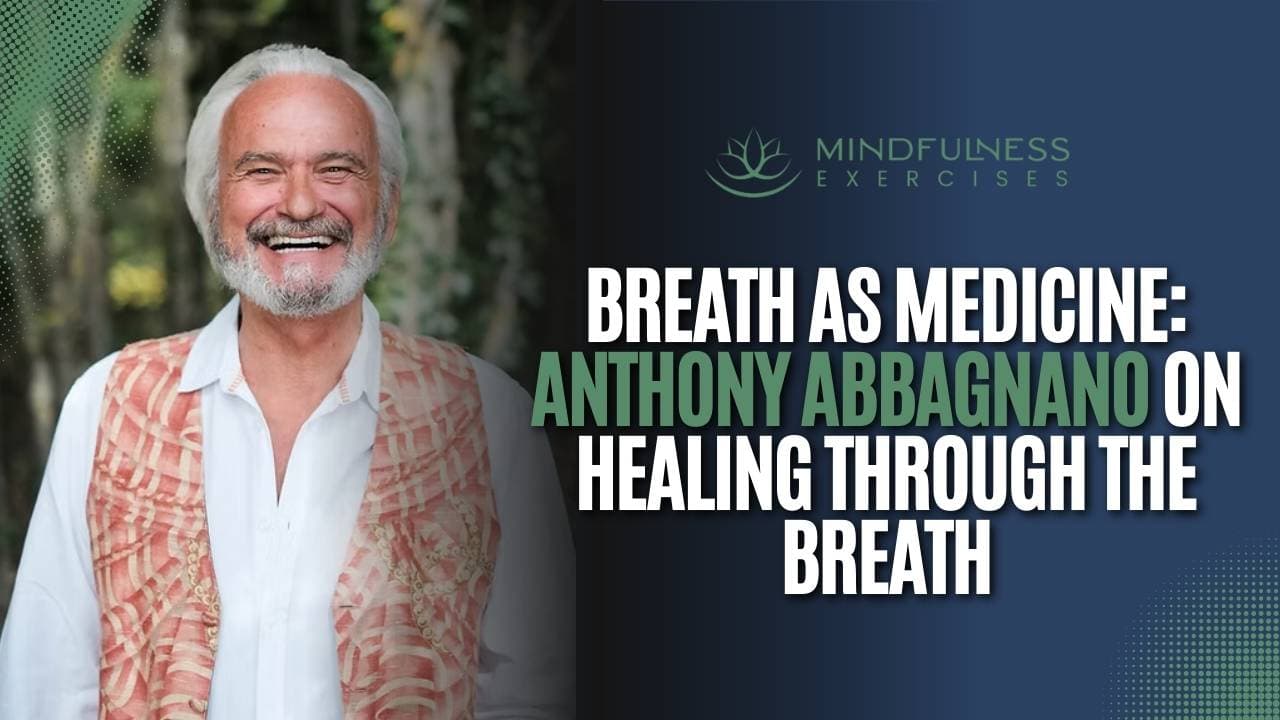
Speaker 2 · 0:20Welcome everyone to the Mindfulness Exercises Podcast. I'm Sean Fargo. Today I have the honor of speaking with Anthony Abagnano, who guides people through breath work and their inner journey. He is the author of the new book Outer Chaos, Inner Calm, which comes out in June of 2025. He's the founder of Alchemy of Breath, which facilitates uh breathwork facilitator trainings. We'll go into that shortly. Anthony is a visionary breathwork pioneer and a founder of Alchemy of Breath, and also Asha, whose life's work is dedicated to unlocking the profound healing potential of the breath. His journey with breathwork began in his late teens and has since grown into a global movement. Through the hashtag breathe the world, Anthony offers online breathwork sessions that reach communities across 40 plus countries, providing a unique avenue for self-discovery, healing, and transformation. With a background in philosophy, psychology, and conscious loving, he weaves diverse disciplines into his approach, encouraging people to see breath as a powerful tool for both spiritual and practical self-awareness. Anthony's teachings emphasize compassionate self-acceptance and connection with one's true essence. His unique ability to see the soul beyond the personality creates a transformative environment for healing trauma and reconnecting with self-love. Known for his gentle humor, empathy, and deep respect for human vulnerability, Anthony encourages us to explore breath not as a mechanical process, but as a doorway to a heart-centered existence. Whether working with seasoned practitioners or those new to breathwork, Anthony guides with profound sensitivity, recognizing breath as a powerful ally for navigating life's challenges. Anthony Abagnano, welcome to the podcast.
Speaker 1 · 2:52Thank you. Thank you so much, Sean. It's a delight to be with you.
Speaker 2 · 2:56Yeah. You discovered breathwork in your late teens, and it doesn't look like you're in your 20s right now. So you've been practicing this for a while. You know, breathwork came on my radar with uh people like Wim Hof, maybe eight or ten years ago. And you know, that's been one of the ways that it's been popularized recently. I'm wondering how you found breathwork in your late teens. And what was that? How did that journey start for you?
Speaker 1 · 3:33Actually, there's a little bit of a secret there. The my first experience, my first conscious experience of using the breath was actually when I was much younger, I was eight years old, and I was at an old British boarding school, not a happy boy. I missed my family, and uh life was actually pretty grim. I didn't understand why I've been put in an institution like that. It seemed quite medieval. But to an eight-year-old, it was more about being um deprived of family and loved ones. And uh so life wasn't it wasn't it was troublesome for me. I I think my first year I cried myself to sleep every night at boarding school. I just didn't understand why I'd been deposited there. But one day, a young boy, my a couple of years older than me, came up with a paper bag and he put it in front of my mouth and he said, Take 20 deep breaths into this bag, and then I'm going to let you down to the ground gently. And he did. He I took the 20 breaths, and thankfully he came from behind. He took my chest and he squeezed as I made the last exhale, and he gently laid me on the ground. And that I think was my first conscious spiritual experience. I there's no that you the the words can't reach the possibility of describing what it was, but how it affected me was that it immediately became apparent that the parts of my life that felt unpleasant and the wounds that I had all of a sudden seemed tiny in comparison to the magnificence of what I discovered. And I, of course, I was hyperventilating, that's actually what I was doing. And since then I understand more of the mechanics of what happened, of course. But at that point in time, I was just absolutely speechless and had everything put back into proportion again. The whole concept of suffering became like a micro dot on a very large page. And so the proportion of my sadness changed to one of more equanimity, really. But I think also joy because there was something that nobody was connecting to that was just so much bigger and more important and more significant. So the human foibles after that experience, you know, the ways we love and the ways we get jealous and the ways we hurt each other, and they all had a different context to be looked at. And then in my late teens, I was a very young father. My my first son was born when I was 18. And I was studying breath work then, we were studying. His mother and I were studying breathwork during the pregnancy. And I, which I think most men do when they study the Lamanze or the Le Boyer method of breath work, is they become the coach for their wife. And it's a great way for the man to be more involved and really engaged. Perhaps we'll talk about it a bit later. But when you breathe with someone, there's a sense of intimacy that you develop that is so easy and so inoffensive and so gentle. Um, and so that's what we did every day. We did uh two breath practices a day. And of course, then when it was time for Damien to come into the world, we uh this was this would be back in 1973, we um we did all the exercises we did uh that we'd been practicing, and uh and the birth was just of course beautiful as a result. And then from that point on, whenever I had an opportunity, I would I would practice, I made it my practice. I and I explored pranayama and and I explored Sufi breathing, and then I explored more of the post-1970s Western methods of breathing. So things like holotropic breath work and transformational breath work and all of those. And um, I still didn't really, it wasn't that I was uh it wasn't what I did with my life, actually, my life I was involved in architecture and restoring beautiful old buildings in in Italy, in Tuscany and in Umbria, but I was never really satisfied with life. And so in my 40s, I decided I would change my life and I moved to India and then to Bali, and I spent about 16 years. The first seven of those years I spent sitting and um disengaging from my past, just letting the momentum come slow down and come to a stillness. And then I began to think about well, how am I going to reintegrate myself into this material world? I think I probably need to. I have a family and they would like to see me. And um, so I kind of moved back into the world with breath work. And what convinced me was a life-threatening illness. I picked up a parasite in in the east, and I didn't know that's what it was, and nor did anybody else. Now when I went to many countries in Europe to get tested, and no one could diagnose what the problem was. But eventually the fine doctor in New York was able to diagnose that I had a parasite, but I I came very, very close to death, and there was a period of probably two and two to two and a half months where I was immobile, I couldn't move and in deep pain, and even breathing hurt. Coughing or laughing or anything like that wasn't possible. So I learned to breathe with the minimum amount of disturbance in my body that I could, that I could. And that was another form of stillness, and I think that was really such a valuable period for me because I deeply inquired into where will surrender meet. And of course, in simple terms, it takes will to breathe in and it takes surrender to breathe out. So this breath that is really the bridge between our life and our death is something so worthy of discovery and research. And I would advise anybody, I'm a true believer, as you can probably tell, I'm a true believer, but for me it represents that which is most subtle, and in many religions it's referred to as a supernatural power. In the Quran, that's how Muhammad was born, was because of the breath upon his mother's chest. And so the more I paid attention to the breath, the more I understood that there was to learn. There's one one guided meditation I do, which is to get people very slow, slow down, and to imagine one breath as a sip of the most delicious nectar that you could ever sip, because that's really what it is. It's it's it has life force, it has our life force, and it also has so much mystery. And and so one breath is is worthy of I I I believe years of contemplation. But we take one after another in such a hurry and we don't notice. So the more we slow down, I think, the more we can learn and the more present we become.
Speaker 2 · 11:16Delicious nectar with a lot of mystery. Yeah. There's a lot to unpack there. It's a fascinating journey you've been on. Going back to when you're at boarding school, you're breathing through the paper bag. You said that you were hyperventilating, and it sounded as if that was like a good thing. I've never heard that word hyperventilate be used in a positive context. But it sounds like through you know, actively breathing quickly, that that was, you know, part of the methodology for what you felt in that experience. Can you talk about the mechanics of what happened to, say, your nervous system, what the method was in that first form of breath work that you did?
Speaker 1 · 12:05Yeah, it's um it's not far off what is called a conscious connected breath today. And that is a breath that you give your awareness to, hence conscious, and it's a breath that's connected, which means that you don't pause between your inhale and your exhale. But the difference is when you use a paper bag, um, you re-inhaling your exhale. So part of the carbon dioxide of your exhale is coming back into you. So you're you're not over-oxygenating because you're diminishing your, you're you're diminishing the amount you take in because it's not fresh air, it's air from inside a bag. But the the concept of hyperventilating is is also connected to conscious connected breath. And there's a context in which it can be useful. It's not what I would recommend anybody to do. Don't press the pause button and go try it. You need someone who's expert to be able to be with you. And I don't use hyperventilation in my breath practices or the ones that I teach. But the whim half breath is akin to that because you're breathing very deeply, very and and you are connecting your breath. It's a longer breath than hyperventilation. Hyperventilation tends to shorten. And this is, I mean, what we're discussing right now is the tiniest slice of a very big pie. The way that we can use the ways that we can use our breath, infinite, to have effect on our nervous system. And the more close we get to it, the more intimate we become with our breath, the more able we are to really manipulate our nervous system and create effects that we want to create. So if I was going to speak to an audience, which I'll be doing this weekend in Spain, and I want to be vigorous, there are a bunch of young entrepreneurs that I'm going to be speaking to. So I have to scale down my age a bit and get a bit more get a bit more vigorous, I'll use a more vigorous breath. Before I go on stage, I'll be doing some pretty powerful breathing. On the other hand, if I felt a sense of nervousness or I was apprehensive, and if you are a public speaker, I know many who are very good speakers who still have a real difficulty before they come on stage. There are breath practices that you can use that will um help give you a sense of and equilibrium before you before you go out there. To make this useful and practical and applicable today, the advice that I would give would be to start noticing the ways you breathe under different conditions. So when is it that you hold your breath? When is it that you run out of breath? How do you breathe when you are angry or emotional? How do you breathe when you feel a surge of love? How do you breathe when you make love? How do you breathe when you run? How do you breathe when you're panic stricken or anxious? How do you breathe when you're happy? You know, all of the different conditions can be studied and they all come with a breath. But the exceptional thing about the breath, even though it's something we can do without having to give it our attention, is that when we do give it our attention, we can take those symptoms and reverse manipulate the psychological or the emotional condition that we're in. So that would mean if I'm anxious, if I do what I call the transformer breath, which is an inhale of four and an exhale of eight, and then I keep extending the exhale up to maybe 25 or 30, I can't be anxious anymore. It just doesn't stay there. The breath becomes more important. And and honestly, half the game here is to be counting what you're doing and to be paying attention to your breath. That's really half the job. So I my strongest recommendation to anybody would be to discover your breath. It's right under your nose, and it's been waiting a long time. Really is worth it.
Speaker 2 · 16:27Beautiful. I uh I had no idea that there were you know unlimited ways to practice this. And you know, like, you know, speaking with entrepreneurs, you know, it's uh fascinating that you would employ uh breathing methodology to increase power and you know, just change your breathing depending on the situation or the say the goal. I'd love to explore a little bit more about say you you mentioned uh breathing, you know, for relieving anxiety, you know, maybe the four or eight breath, you know, extending the exhale. So you're a a board member for the Global Professional Breath Work Alliance, or GPBA, with a focus on trauma recovery, addiction treatment, and plant medicine integration. You know, a lot of our community are feeling say unsafe for a variety of reasons. And a lot of people in our community are mindfulness teachers or soon-to-be mindfulness teachers who support those who don't feel safe. Can you talk a little bit about how people who don't feel that safe can relate to their breathing in a way that's say non-triggering, in a way that's gentle, that can help them feel safer even in the midst of trauma?
Speaker 1 · 17:56Yeah, thank you. There's coping and there's resolution, there's relief and there's resolution. And one of the principles I teach is to learn to be with the unknown long enough to become a detective of the unknown in order that resolution can occur. So let me give an example. Um if you think I'm not a singer, but I'm I'm gonna give it a go. But if you think of the octave, it's it's eight notes, but two of them are the same. The first one and the last one are the same. And uh the last one is a repeat, but one octave higher. So you would normally sing or play a whole octave if you're practicing piano or guitar or any instrument, you would you would play the whole octave. But what's been discovered is that last note brings resolution, that eighth note brings resolution. So if I go, you're left hanging for the last duh, and then then something relaxes inside. And this has been this principle is being used in cancer research and all kinds of places, but I use it as an analogy because we are taught to comply as children. That's how we get fed, and that's how we can guarantee love and attention, and we're also taught to cope. And the commercial world is is more than happy to give us systems we can cope with, whether they're medicines or habits or uh addictions or debilitating non-resolution orientated methods. So we feel better. So I get I get home at six and I've had a really tough day, and I'm gonna have a couple of glasses of wine to loosen up and uh or or I I'm depressed, so I'm gonna go shopping, or you know, what whatever, whatever system we have, we have them. And it's legitimized, it's considered to be normal, but it's not natural, and we've lost the distinction between normal and natural, we mistake normal for natural, so we think it's even natural, that's what life is. It's like of course. But if one can learn to treat that gap between the seventh and the eighth note, which is called suspense, because that eighth note hasn't come yet. Once we learn to navigate suspense, then we become more adept at being with what is not known, accepting that there is something other than what I know. And the best way to find out what it is is to inhabit it. It's like, how can you tell what color the room is unless you open the door and go and look? So we need to go into that space and to develop the strength to be able to go into that space. And as we develop the capability to do that, we become more resilient and more prepared. You might think of it as going to the gym because you're going to run a marathon. So you're going to do your practice and you're going to get in shape and you're going to do your training. Well, this is a training, a training to gently and carefully and delicately expose ourselves to this sense of what we're used to call, we're used to calling insecurity, but to treat it as something else. I think Dan Dan Siegel said it quite beautifully. I think he said something like, where there's the least certainty, there's the most possibility. So if we can learn to inhabit a space of less certainty, and I'll come to the breath in a minute because this all leads to the breath, we then become more agile, more causative in our lives. We become more on the front foot than on the back foot, and the unconscious tendency to become the victim of outer circumstances transforms into understanding that we can actually co-create life. And so what does that look like? Well, in practical terms, if if if one is moved by this as a possibility, if it's an attractive or compelling possibility, we can start right now, today, with very simple cataloguing of the breaths that I've been using in different circumstances, and that catalog then becomes my manual. And then if I want to feel more alive and too complacent or too lazy or exhausted, or I've got jet lag, whatever it might be, a few powerful strong breaths that would perhaps imitate an anxious breath or a panic-stricken breath will actually bring me out of a depression or a darker space and make me more alive, and vice versa. So once we've got our catalogue, we know what breath works for us, and we can all make them up for ourselves. You don't really need to be taught these kinds of breaths. The conscious connected breath, which we'll come to in a minute, is a different thing. But to speak directly to this issue of anxiety, and I know how it feels, I know how it feels because each of these human emotions I purposely navigate in order to be able to be closer to people who experience them. So that's my job is to you know to feel depression so I can explore it and understand what the corners of the room look like, or anxiety, or whatever it might be. So the way we can deal with this is twofold. One is to create practices that there you go, to create practices that make me more robust, make me feel like I'm on my front foot foot, make me feel like I'm more of a co-creator with life. And then the other is to use the coping system when it happens. If I get caught out and I've just had a terrible piece of news, then I employ the same breath and it will be reconnecting with that state of mind that I've artfully created for myself before. So it's no longer coping, it's just remembering, it's going back to the preparation and the training I've got. So if we take that analogy of going in the gym to so you can run a marathon, or you go in that you go to the gym for a month, and then you see your child running away in into the high street where cars are traveling, you're going to be able to run and save your child because you're going to be quick, you're going to be fast. So that's what I'm talking about. This works from both ends. It works, it works firstly as a preventative. And then if the preventative is not created the state you need, if there's something surprising that happens, then you go back to that breath pattern and it's already known. You're back into you're going back to a state of memory and capability rather than victimhood. Beautiful.
Speaker 2 · 25:10It's wonderful to hear that you know we all have this capacity to catalog our own breathing and to say reverse engineer uh how different types of breathing feel, and that we can, you know, breathe differently by choice. I think it's helpful for some of our listeners to say remember that um mindfulness of breathing was heavily emphasized um by the Buddha, many Buddhist traditions, as one of the more powerful practices, and that you know, the Buddha's path to enlightenment was fueled by mindfulness of breathing uh or anapanasati. And as I was hearing you talk about you know catalog cataloging our breath, it reminded me that the practice of mindfulness of breathing in its fullest sense incorporates awareness of our body, our feelings, our mind, and what are called the dhammas or say awakening factors. So with mindfulness of breathing, we can be aware of breathing long, breathing short, experiencing the whole body, and tranquilizing the uh bodily activities. So relating breath with the body, we can relate breath with our feelings by breathing and experiencing rapture, bliss, mental activities, and then tranquilizing mental activities, and then there's practices for uh relating mindfulness of breathing with uh the mind, and then the awakening factors, and we'll put a link to uh full Anapanasati practice in the show notes. Um, but I just thought that there was some relationship uh with say cataloging our breath with relating mindfulness to various aspects of our so in sort of a more traditional classic sense. Anthony, you have been training people with breath work for a long time, and at alchemyofbreath.com you offer a certified breathwork facilitator training. Uh, many people in our community are highly interested in uh certification programs that they can use for supporting their clients, whether they're a therapist or a counselor, coach, yoga teacher, etc. And your facilitator training program is very impressive. You have more than two million people who have attended your seminars or workshops. You've been endorsed by many, many, many people. Uh, you have over 2,000 certified students, two million breathers with Alchemy of Breath as the first online breathwork school, and the leaders who originally brought breathwork online, reaching uh millions of people. Can you talk a little bit about your breathwork training program, who you serve to become breathwork facilitators, and what that training looks like?
Speaker 1 · 28:36Yeah, I'd love to. That's my passion. First of all, this is driven by uh passion, and it's driven by uh a wish to contribute to a tipping point of human consciousness. So we have a little motto at alchemy called 10 to the power of nine, which adds up to one billion people, and we want to do our part to contribute to uh one billion people. I mean, if only if if one billion people could take 10 breaths at the same time, I think everything everything would change. But the the trainings that we do uh have been online uh for the last 10 years, and then just recently now we've brought them back onto land again. So we do both. We do trainings on land and at Asher, and we do trainings online as well. And um the facilitated training we do in many ways I prefer online, I have to say, because probably because of my own trauma being at school and the way that I was taught back in the um 50s and 60s, which was you know, do it or die, you know, get the blackboard dust thrown at you, sort of thing. I like the online training because it's a once a week class and it gives you time to absorb, um, to reflect and to practice. And it's an eight month period, and then that concludes with one month at What we call breathcamp, which is where all our graduates come together and it's where they kind of they come out really. They we have the public that are invited to these breath camps as well. So it's a very real life situation. It's not a laboratory uh examination, it's a real life situation. And we like to get people practicing within a month or two of the trainings beginning. We want people to start practicing for themselves and with any other victims they can find, you know, mum or dad or the wife or the dog or whatever you can do. But so so by the time they come to this graduation, they're really very professional. And um the I'd have to say, you know, I'm I'm really speaking more than anything now about the conscious connected breath. I'm not speaking about a breath of four in and eight out, which anybody can do and you can get anyone else to do. But the conscious connected breath is the most transportative, natural way of opening our consciousness that I've ever found, and the quickest. And I've had experience with a fairly long life of you know, psychedelic exploration and plant medicine exploration and different meditations, and and I found this to be the most effective and the quickest. But it's also it also calls us into a very deep inner journey if we breathe the conscious connected breath. So I've made it the backbone of my training to be an inner journey for the facilitators. So I require them to start by looking at their biography. They actually they actually write their own autobiography. We we kind of have a little teaser, we say write a minimum of 50 words for every seven years of your life, beginning with the seven years before you were born. So what were the conditions that your parents lived in, and so on. And so they articulate this, but nobody ever sticks at 50 words. People sometimes have a bit of resistance about doing it, but by the time they get into the flow, they just keep going. Most of them will write much, much more because it's a journey of such discovery. People didn't, people don't know until they start focusing, and then things come into awareness, and then they discover more. And the more that they discover, the more they can discover, the more strength they develop. So this might involve going and talking to mum and dad or to grandma or to peers that you grew up with, and you know, just gathering information. What was I like? I, you know, I was caesarean, for example, and I as a child found it very difficult to sustain interest in anything. I I couldn't, I didn't have a lot of stamina until my father somewhat shamed me into developing it. I wasn't able to continue doing things more than two or three times. I'd get bored and I'd need something else to stay stimulated. I think we might call that ADHD today, but in those days they didn't have letters like that. So you find that every condition at birth, for example, of which we have eight pages of different things that can happen during your pregnancy or your birth process will show up in habits that you have today. And they generally show up as one or the other, as sort of polar opposites. So someone who's a cesarean like I am might have very little willpower because it was all done for me. You know, my mum was just cut open and I came out. And what's more, she was under a very heavy anesthetic, so I was anesthetized as well. So it gave me very strong powers of dissociation, almost automatic. If I didn't like something, I could just detach. But it wasn't a healthy detachment, it was a trauma reaction. So now, as you know, having done the done my inner work and done this inner journey, then I've understood that these things can be transformed. If we can, if we can understand what happened to us as children, we can bring a sense of choice from our adult conscious awareness back to times that we really didn't have any choice at all. And that's really what that inner journey is about is taking stock of the challenges that we faced and the trauma that we suffered, and how we can bring not relief but resolution. And so that's a fundamental part of the training because when a facilitator sits with a breather, the breather can go into some very deep spaces. And it's imperative to me that the facilitator is able to be right alongside. You can't do it for them, but it means the world to them to know that you're there and that you can understand. And that includes even death. And one of our facilitators works with the maid program in Canada, so she'll be with the the individual that's chosen to die, plus the close family members, and give support and guidance and use the breath for them all to craft the most beautiful, gentle experience that is possible. But in order to do that, that's got to be someone who's ready to face their own death. And so it's it's it's a calling and it's um it's it's exacting, I would say, as a journey, but it is the most rewarding thing possible. And what I've found with the students that I've taken through this training is that almost invariably the biggest challenge that they uncover in their own life, which might be showing up now as uh addiction or any one of these habits that we mentioned earlier, dissociation, whatever it might be, once they've been through this inner journey with alchemy, and that's the whole point, is to use the alchemy in the breath to make this transformation possible and easy and graceful and kind, not violent and not damaging, not reactivating trauma, but resolving. And almost invariably the biggest challenge that a student has to face becomes the gift that they offer. So, in one of my, you know, we have it, we have a system after people graduate now that we help them find work because so many people are asking me, like, hey, I need a good facility facilitator in Tuscaloosa, Alabama, or I need one in New York, or I need one in, you know, um Spain, wherever it might be, and we have facilitators all over the world. So we want to support them after they've done the training, and we we refer them when we're asked for good people, we we refer them. And um, so I have one addict uh who used to be a porn addict, and he's now resolved, and he's now going to help a wonderful clinic in Switzerland that has a ratio of 15 therapists to one client, and he's going to be doing the breath work part. And what I've found with all of the doctors and nurses and psychotherapists and psychiatrists that have studied with me is uh consistent that using the breath can make things happen really quickly. In one hour, sometimes equates to 10 or 20 years of analysis or process work. That all of a sudden there's something that happens when we import this supernatural quality of breath that allows us to take a quantum leap of understanding. And we use the body a lot with alchemy. I find it, I feel it's a very, very powerful embodiment process. And we have something called alchemy meditation that's really quite similar to Vipassana. There are similarities, I would say, except that we actually speak from a deep state of meditation. We actually talk to each other and communicate, and so our facilitators are taught to do that, and that means we can achieve a deep state of presence at the same time as communicating. So we're not just withdrawn, we're actually actively engaged, and but also speaking from a very, very deep, slow, still space of awareness. And that really helps people feel safe. And I think some of the navigation that we need, if we're going to change this world that we live in from inside out, we need to do this work and we need to help each other. And that's that's why I'm passionate about it. If I can just get one more person to breathe, or one more student to go out there and get another 10 people to breathe, that we'll get to that 10 power, 10 to the power of nine. 10 to the power of nine, by the way, means if 10 people go get another 10 people, and each of those 10 people get another 10 people, and that happens nine times, that will reach one billion people. So it's it's not that honestly, I don't think it's that big an ask. I mean, I I've been asked to do an app, uh, to work on an app now which is which will be having a reach of about 50 million people. So that's already 5% of the way to a billion. So I I really feel hopeful that the more of us that come together and join this wave, this movement of awakening consciousness, that the the bigger the wave will get and the faster it will travel. So that's the online. And the and then the online or the um in real life training is a three-week coach breath coach training. And the same principles apply. They still do an inner journey and it's in presence, which has its advantages as well, because you're practicing, practicing, practicing, and you're getting feedback, feedback, feedback. One of the criteria that I feel is really important about a breathwork training is to be teaching each other. So I have uh sometimes a 25-year-old and an 80-year-old in the same class, and they've got so much medicine for each other. You know, the a life that's full of experience and and contemplation as we as we age, and one that's fresh and innocent and bright, and in so many ways cuts to the chase. It's not so heavily conditioned as a mind. It's beautiful to see people help each other. So I can I kind of feel even with our best trainers, you know, we have faculty, and I'm I'm the head of faculty obviously, but when I when I go into class, it feels for each student that there are 20 trainers because all the other students are their teachers as well. And it's a it's a beautiful atmosphere, great community.
Speaker 2 · 40:55Beautiful. Well, I hope to come visit in Italy here in about a month or so and uh get a taste for some of the training. Um while you were talking, you thank you for sharing your your story about being born via cesarean and the relationship with willpower, you know, and and having all the uh the drugs in your mother's system, you know, being absorbed by you. It reminded me of my wife and daughter and some of the trauma involved during my daughter's birth. And as you were talking, I noticed my breathing becoming very different. I was kind of reliving that a little bit as you were speaking, and I and so I noticed my breathing, and then just you know, I'm not trained yet in uh conscious connected breathing, but I just intuitively breathed with some investigation and care and consciousness and connection with the body as I kind of relived that to some degree and noticed a a quite a powerful change in my you know, some energy moved, it started to feel lighter. Um I don't think it was dissociative, but it it did feel like I was integrating some form of healing with that. And I'm sure I just scratched the tip of the iceberg there, but I can see why I can see how conscious connected breathing may be you know the most powerful breathing technique that you've come across. And you know, you've been skilled in lamas, pranayama, Sufi prayer, holotropic breath work, etc. And I'm not wanting to say rank them, but you have a lot of experience with a variety of breath work. And so I'll sign up for the um facilitator training to get more of a taste of it. And you know, I've been in um Vipassana for for quite a while, and you know, different practices, and they're all wonderful. And I notice sometimes that um some of us, including me, we can get stuck in story. Um some of it can feel a little heady sometimes, and that incorporating body-based practices are very powerful and very complimentary or supplementary. Would you, you know, it and when I hear you speak, I you know, you seem quite grounded, quite heartfelt. Um how do you find that balance, say, between cultivating body awareness, working with the breath and the body? And well, it sounds like with conscious connected breathing, you're incorporating a lot of heart work into this. Do you do you find much value or do you personally practice anything that's not quite body-based or heart-based? Do you do you practice, say, like mental awareness of things as well? How do you find that that balance of integration?
Speaker 1 · 44:04That's a great question. I I I but you said something so significant earlier on that I'd love to reflect because I because I think it's such an important lesson um for us all. And uh when you spoke about the the memory of your when when your daughter was born and you noticed how you were breathing, you mentioned I don't know if I was dissociating or not, and then and then but you did you did recognize that there was some kind of shift that happened, and and that's just the power of the conscious breath. And I I like to think of it that when the trauma occurred, we lost our breath. That's what always happens. That's the first thing. And many people would say that as a result of that, that's when we embed not just embody, but embed the trauma into our cellular structure. So think of it as if for every time I lost my breath, I can now make a conscious choice to take a breath from now back to then. And that's why there is a sense of healing. And it's not, you know, this question of dissociation, I think, is an important one because there's a distinction to me between unconscious dissociation and moving into the observer position consciously. Those are two very different things. And clearly, with your practice and and and all your experience, it's an easier thing for you to do than someone who doesn't have that practice to move into the observer. And the way that you spoke of your psychological state was from the observer. So I wouldn't call it dissociation, I would call it self-care.
Speaker 2 · 45:47So yeah, I'd I'd love to just if it's okay to kind of continue in this thread for a moment on one of your websites at asha.global. That's as h-a.global, and reading more about you. You offer these inner journey workshops inspired but lump but not limited to Joseph Campbell's Heroes Journey. Uh, these breath work-based sessions offer a deeper, more embodied path of transformation. Your evolved framework integrates myth, neuroscience, and the intelligence of the breath to help you meet life's challenges, reclaim your truth, and return renewed with clarity, courage, and purpose. And then you offer The Bridge, a six-step guide to help you understand yourself better, tackle old emotional issues, and build a strong bond with the younger side of you, i.e., your inner child. Um, and then you have breath work for transformation, a powerful group experience for anyone seeking personal growth, spiritual insight, or connection with the body. I've never heard of breath work related to all these things, but as you talk about, you know, this conscious connected breath, it sounds so powerful, so simple, and so integrative with one's whole life, and as you said, even the seven years before we were born. Did you come up with this sitting in India when you were practicing? Like, did you start integrating breath work as you were healing your past, you know, in deep silence, you know, under the Bodhi tree? Like, how did you come up with these ways of integrating breath with our past and you know, our hero's journey and you know, healing trauma? That's a wow, what a question.
Speaker 1 · 47:42I think uh I can there are a few different approaches to the answer for this. I was as a youngster, I was an outsider. I mentioned I was unhappy at boarding school. I'm half Italian, so um, even though I was brought up in England, uh, but in in those years, and it was shortly after the Second War, and Italians were not well received or well regarded. So I was I was pretty much ostracized and uh from any groups. So I was I was marginalized and and I became an outsider, and being the one that never spoke meant that I was the one that always listened. And I think again, it's this transformation of of something that was really quite horrid at the time into an asset, which is that it gave me the power to listen and observe. And I've always been an observer of life, so that's one part of it was uh this alertness that I created and also the unhappiness that I felt, which resulted in an adolescence and in my twenties as not a very nice human being. I wasn't particularly, you know, I did things which I I'm not proud of in my life today. So that led me down the pathway of understanding that there are parts of the human condition that are really very dark and capable of doing some awful things, as we see even today, happening today. And for humanity to feel it's justified to kill another, for example, in whatever form. So my study of the human condition was really motivated from a selfish, initially from a selfish perspective of wanting to find a way to forgive myself because I've hurt other people. How do I how do I do that? And that meant that I really have have had to take a very hard look at myself. If I have a tendency, it's probably to be too self-judgmental. I'm curious as to how many people put their hand up if I said, Do you judge yourself harshly? I think that's yeah, that's also part of our human condition, that we can be very self-punishing. But it was as a result of the these uh these parts of my life. And a third element, I'm sure there are many others if I dwelled in it, but a third element would be that I'm teaching what I need to learn. I think many of us are. We teach it because we want to live in the center of this way of being rather than keep it just intellectual and something that we know. We want that, we want the jnana, we want the we want that inherent knowing that some people say we came to this planet with, that we were then taught to forget. And certainly what I see with trauma is that we do cover it with layers of forgetting. We've become quite good at forgetting. And as I observe this and as a youngster, and it, you know, the way I was unconsciously hurting people, mostly women, honestly, because I was looking for my mum. I I didn't really have a relationship with my mum. And I and I was doing what young boys do when they're looking for their mum, which is go look for girls, right? So I as I as I reflected on this and with a very astute awareness of inquiry and an insatiable appetite for understanding, not really intellectual understanding, but an emotional understanding, and the study of forgiveness and compassion led me to to where I am. I I think there might be a time in everybody's life when we reach a point, I hope so, when we reach a point and we look back and we understand that all of the varied experiences that we've had, some of them might have seemed quite nonsensical and some of them might have seemed awful, but there comes a moment or there did for me when I looked back, and it was as if a needle and thread had been woven through these really weird experiences. I mean, I was inducted into a cult, I managed to escape, you know, all just just really quite some of them horrifying, but all of a sudden it was as if that thread that had that had gone through each of these experiences was just pulled straight, and they all became the perfect plan to arrive at where I am today. And that's moving from survival to service and understanding that that is the true wealth of life. Because I've done the money thing, I I you know I did that with my architecture career, it doesn't, it doesn't work. It was a false promise. That was a false promise. But the feeling of helping people forgive and the feeling of helping people understand the power of appropriate compassion is the is the biggest wealth I could possibly experience. And it just is just un untiring. Um I'm 70 and and I feel like I've got another 50 left doing this. I've got like an incredible amount of energy that I devote to the work that I do.
Speaker 2 · 53:01Beautiful. You referenced, you know, that we're very good at forgetting. What was it that you said that perhaps we came into this world knowing and that we were taught to forget?
Speaker 1 · 53:16Did you reference what that was? There was a great book written by a man called Colin Tipping, and it's called Radical Forgiveness, and he tells a beautiful story in there of a young family going to hospital to have their second child, and the birth goes well, and they come home and and the it's a girl, and the uh the child they already had was a girl, and the elder's so excited when they come home, she goes, Can I can I see the baby? And they say, Of course. And she said, But yeah, but I want to see her on my own. And they were like, Okay. So they let her go into the room and they kept the door open, a crack, and kept their ear to the door. And she said to the little newborn child, She said, Baby, baby, tell me about God, because I'm beginning to forget. And it's such a sweet story, and I think it, I think it, you know, there's there's there are theories of tabula rasa, right? That we come to this earth with no, with a completely clean slate. I'm not a believer in that, especially working with trauma and working with ancestral trauma and cultural trauma, and and seeing that what doesn't get worked out gets passed on from my own family experience all the way to you know, all of the people that I've worked with as um as a practitioner. So there is definitely something underneath all of this, and I think most of us experience this once or twice in our lives. There's a moment of understanding that the question and the answer are actually the same thing, that there's a deep inner knowing. It's it's strongly connected to our intuition, but we don't want to give ourselves credit for it. We've had it kind of beaten out of us, the the fact that we're an intuitive species and that we have even powers that some people would call supernatural, you know, telepathic communicative abilities and other things that uh we call miraculous. But my experience tells me time and time again, and not just seven or eight times, but you know, thousands of times, that that underneath, if we can become still enough, in the center of the center, of the center of that stillness lies the wisdom spring. And deep inside us, each one of us exists, all the galaxies in the universe. It is all one. It all it all kind of a hologram of the same thing.
Speaker 2 · 55:50Yeah, I I fully agree with that. Part of my time as a monk was focusing on the center of the center of the center, and then that awareness of that, say intergalactic connection becomes apparent.
Speaker 1 · 56:04Yeah.
Speaker 2 · 56:04Um, maybe if it's okay, I'd like to wrap up with one question and invite you to share anything else that you'd like to. But I'd like to just ask how you would describe this conscious, connected breath. Just kind of dissecting the conscious part, the connected part, and the breath part. It on the face it seems simple and obvious. You know, you've talked about you know, opening to the mystery and investigating and you know, connecting with parts of our past, present, you know, and connection with heart and body. But can you just talk a little bit more about what you mean by conscious connected breath?
Speaker 1 · 56:54Yeah, well, the start we'll go from this more simple toward the more complex. The first thing is a conscious breath. And I mentioned that before. Imagine that every breath you take consciously, you take it back to a time in your life when you lost it unconsciously. There's a repairing that's going on. And sometimes I call it remembering, as in making membership with again. So that's where I believe the deep healing is, just in the conscious breath. The fact that I'm gonna stop what I'm doing and I'm gonna give my awareness to my breath is half the task. And that's when you can make up any breath that you want that suits you. What's important is that you're giving it the priority that I'm gonna meet this moment with the breath, and it's a clear step into the witness and into the observer and into presence. And then the the connected part of it really imagine a beautiful violin solo, and you can you can imagine the bow crossing the strings, and it just never stops. Each note just meets the next fluidly. It's it's a beautiful piece of music you're listening to, and it's really quite similar with your with your breath. You're um either breathing in or you're breathing out. And this breath can be done through the nose or through the mouth. I'd love to show you just four or five breaths so you can understand what I mean. I'm not a hundred percent sure it will come across on the internet, but I'm gonna put original sound for musicians on and see if that helps. But I'll use my hand and you can you can you can see what I'm doing even if you can't hear it quite clearly. I'll try five breaths and I'll use my mouth because it's louder. You can you can probably hear it more clearly. I just need a moment. Um it'll happen more quickly if you breathe through your mouth. It'll happen a little bit slower if you breathe through your nose. What is happening physiologically is that you're uh increasing the oxygen flow to your bloodstream, and that means in your bloodstream, and that means that you're decreasing the carbon dioxide. You're also decreasing the amount of oxygen that goes into your frontal lobe, and your frontal lobe needs the oxygen in order to process. So you're beginning to interfere with your mental. Processing power or the mental processing power that you think you need. Which then brings the question well, what happens when I don't have that processing power? Then what happens? Well, if you consider that the breath, we call it inspiring when we breathe in, right? And when we die, we call it expiring when we breathe out. So each cycle of breath we're breathing is the practice of life and death. It's the practice of being born and dying. It's it's the practice of will and surrender. And there's going to come a time when we're going to need to surrender that way. So as we breathe this connected breath and we don't have the normal 60,000 thoughts a day that are running us, running riot in there, what is it that happens in the space? What is it that might exist in the space between thought? And what if it's something to do with a supernatural interference? Why do we call in why do we call it inspiring, which means to bring in spirit? What happens if we're willing to accept that we are bringing in something supernatural and and let's call it spirit, or whatever that word might mean for you? What's going to happen in this physical dense body that we live in, that is actually mostly space, but it's so dense that we can see it and touch it and touch each other? What what will happen as we live in this dense existence of horrid conflict and love when we bring in spirit? What happens to the equation when we bring in this foreign entity? That which is most subtle, we're bringing into that which is dense enough to see what is what is that combination? What kind of alchemy might exist in there? We'd lost our we've we're we've lost a part of our processing power. You can choose not to, you can choose to just breathe and not do that. You can overcome it with your will if you want, but the but the game is to surrender, the game is to allow. So it's this is different than pranayama, which means energy and control. This is the energy without the control, and you feel it as it comes into your body, and some of the things that will happen can be completely unexpected. And the the breath work world says you will always get what you need, but then sometimes you didn't know that you needed it, right? So it can be quite surprising. So that's the conscious connected breath, and that's where the quantum aspects lie in breath work, the the pivotal moments, the leaps of uh awareness, the and they're all to do with intimacy with oneself and allowing a greater power to be present in my life. And if I'm willing to believe that that's possible, then that greater power can help me. If I'm not, then I'll just breathe normally until I, you know, smoke cigarettes or whatever my habits might be until I die, and that will be it. But if I stop for one moment and imagine the mystery that's in one breath, that we're breathing argon that Jesus breathed, we're breathing the argon that Hitler breathed. There's so much to discover if we're willing to stop and consider it, it's a contemplation that will last as long as I live, at least for me. It's a complete mystery. And I and I love the idea of, and this is part of my teaching as well, and you mentioned the hero's journey. I I do lean into, I have lent into Joseph Campbell's work. I think it's an enormous piece of work. And at the same time, there are some teachings that come from it that I've extrapolated that I use more than others, like there's always something waiting to happen. What do I have to do in order to discover what that is? In other words, how can I make my life effortless? It doesn't have to be a struggle upstream. This this cliche of go with the flow that came from the 60s is actually well spoken and there's purpose to it. So these are the things that are on offer if we use the conscious connected breath. And that's where I've seen miracles occur, like people with no sight refine their sight, both inner and outer, and marriages that are on the rocks. And one beautiful story which I use a lot, it's by no means the most dramatic, but I it's one of the sweetest, was where a couple breathed with me 10 years ago when I lived in Bali, and um the wife came up to me after the breath work, and she had she had her husband in tow, she had him by the hand, and she said, You know, my husband hasn't told me he loved me in 25 years, and that's what he just did today. And to see that happen to humanity, I get goosebumps, you know, I just get waves and waves of goosebumps, knowing that this is what the breath can do for people. Couples that breathe together stay together.
Speaker 2 · 1:05:08Yeah, and through Lama's with your uh with Damien's mom, you connected with her, and I'll be uh introducing this, or I'll be sharing this with my wife and invite her to breathe with me.
Speaker 1 · 1:05:21Yeah, that's beautiful. When the chips are down, you know, with Amy, who's my wife, we have a contract with each other that either of us can say, even in the heat of the moment, either of us can say at any time, 10 breaths. And then we sit down and we look at each other in the eyes and we take 10 breaths, and you you would not believe what happens from the height of an argument or difficulty or frustration or anger, whatever it might be, those first breaths you're kind of like, you know, I'm not gonna and sometimes sometimes she'll breathe through her nose and make it look like she's not breathing, you know. That inner child there is, you know, takes a lot for the inner child to trust. And yet at the same time, when we when we breathe and we look at each other in the eyes, it's the most tender, beautiful experience.
Speaker 2 · 1:06:08Yeah, maybe you know, before family dinner is at the dinner table, we can breathe together as a way to land and connect with each other. I mean.
Speaker 1 · 1:06:42And first thing in the morning. And she was the only she had the only class that everybody was on time for every class. Wow. Just three minutes of breathing together.
Speaker 2 · 1:06:51Wow. Beautiful. Yeah, you know, and then the kids bring that home in some way as well, and then you know that continues. Anthony, uh yeah, this is definitely one of my favorite conversations that we've had on our podcast. Thank you so much for sharing everything that you've shared. Um, I hope to meet you in person. Um, or and or do the certified breathwork facilitator training. And I see that you have private intensive too. Is there anything you'd like to share before we fare each other well?
Speaker 1 · 1:07:30Well, a deep-hearted thank you to you to have spent the time and exploring this with me. I'm very, very grateful. And um, if there was one message, if there was one message, I wanted people to receive something along the lines you never know when you've only got 10 breaths left. So make each one count and count each one whenever you can.
Speaker 2 · 1:07:52Beautiful, Anthony. Thank you so much for joining us today. For everyone listening or watching, please uh check out uh his website, alchemyofbreath.com. There you can also find uh information about his new book, Outer Chaos, Inner Calm, your practical guide to clarity in a world of chaos. If you find yourself wanting to go uh to Italy or just participate in an in-person retreats or trainings, you can go to Asha.global. That's A-S-H-A.Global to learn more about their in-person offerings. And um again, um, we'll put the website links in the show notes and um promoting the book and our newsletter. And uh again, I'll be uh staying in touch. Um, Anthony Abagnano, thank you again for being here. Thank you for the great work that you're doing. We'll play our part in the was it 10 by 9? 10 times 10 to the power of nine, thank you. Yeah, so that we can all um reach that billion people and and create this tidal wave of healing and change. So Anthony, thanks again and uh and be well. Many blessings. Thanks, Sean.