🎧 New episode: Nothing's Missing: Dr. John Demartini on Mindfulness as WholenessListen →

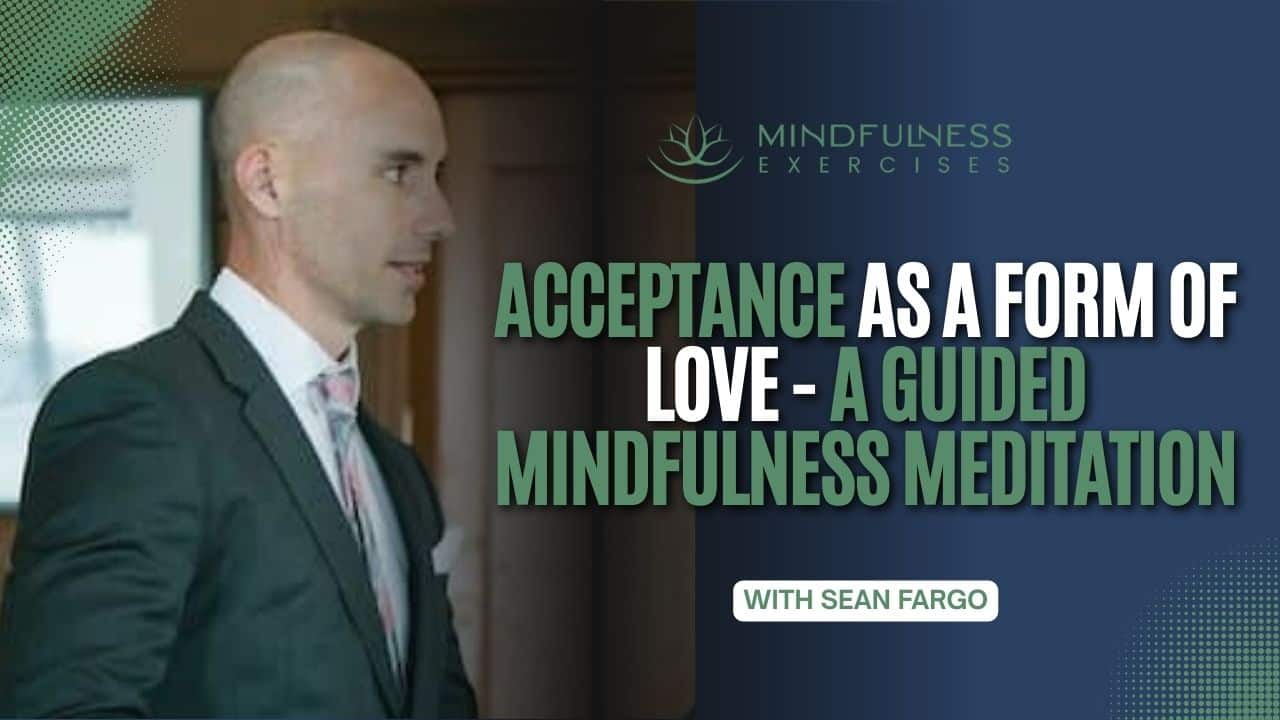
    Acceptance As A Form Of Love – A Guided Mindfulness Meditation

    SF
    Sean FargoPublished December 12, 2025 · 5 min read
    Acceptance As A Form Of Love – A Guided Mindfulness Meditation

    Listen to this episode

    Mindfulness Exercises Podcast

    Enjoying the episode?

    Follow the show in your podcast app. If this conversation supports your practice, a rating or review helps more listeners find it.

    Acceptance As A Form Of Love – A Guided Mindfulness Meditation — Tunein Logo

    TuneIn

    There are moments when the mind sprints ahead of us—into worry, planning, or rehearsing conversations that may never happen. Other times, it drifts backward, replaying scenes from the past with the same intensity as when they first occurred. For many of us, this loop can run for hours before we realize we’ve left the present moment entirely.

    In a recent episode of Mindfulness Exercises, Sean Fargo offers a gentle, grounded invitation back home to ourselves. Through a simple, spacious guided meditation, he teaches how acceptance—soft, honest, and unforced—can become a powerful form of love.

    This conversation is not about chasing calm or performing mindfulness “perfectly.” Instead, it opens a doorway into presence, showing us how awareness itself becomes supportive, healing, and quietly transformative.

    Sponsored by our Mindfulness Meditation Teacher Certification Program MindfulnessExercises.com/Certify

    Episode Overview:

    • Setting a compassionate intention for presence, healing, and growth
    • A gentle guided practice for grounding in the room, the body, and the breath
    • Understanding the difference between mindfulness, concentration, and visualization
    • Recognizing when we’ve slipped into rumination—and how to return
    • Using physical anchors like the feet, hands, and breath
    • Self-soothing gestures to support the nervous system
    • Meeting depression, fear, and sadness with acceptance
    • Why numbing through food, alcohol, or screens feels tempting
    • How acceptance encourages movement, choice, and care
    • Carrying mindfulness into simple daily activities
    • The surprising way acceptance becomes a quiet form of lov

    Show Notes:

    Finding Our Way Back: Why Acceptance Matters

    When Sean begins the practice, his invitation is simple: feel the room, find your seat, and meet your breath without force.

    It’s a reminder that mindfulness doesn’t start with changing anything. It begins with noticing. With honesty. With allowing.

    Many of us come to meditation hoping for calm, clarity, or escape from uncomfortable emotions. But as Sean explains, the real aim of mindfulness is far more grounded: to be with what’s true—pleasant, unpleasant, or neutral—with as much softness as we can.

    This softness is not passive. It is a form of courage. A willingness to witness our experience without immediately fixing, distracting, or numbing.

    Acceptance in this sense becomes a quiet act of love.Not indulgence. Not resignation.But presence.

    A Gentle Guided Meditation: Returning to the Body

    Sean opens the session by guiding listeners into a slow, steady settling. He encourages noticing:

    • the weight of the body on the chair
    • the rise and fall of the breath
    • the subtle contact points—feet on the floor, hands touching each other
    • the sense of the room around you

    These seemingly small details matter. They bring us out of mental time-travel and back into our direct, lived experience.

    Instead of fighting distraction, we allow attention to land where the body already is.

    As the breath becomes slightly more noticeable, Sean reminds us that there is no need to breathe in any special way. The breath guides us, not the other way around.

    Mindfulness vs. Concentration vs. Visualization

    One of the clearest parts of the episode is Sean’s explanation of the three practices many people confuse:

    Mindfulness

    Open, receptive awareness of what is happening right now—internally and externally.

    Concentration

    A steady narrowing of attention on a single object, such as the breath or a mantra.

    Visualization

    Intentionally imagining a scene or scenario to evoke certain qualities or insights.

    Mindfulness uses elements of concentration, but it leaves room for the experience to unfold. It’s not about holding attention tightly—it’s about returning gently, again and again.

    Recognizing Rumination and Reclaiming Presence

    Rumination can feel like falling down a well. One moment you’re brushing your teeth or drinking coffee, and the next you’re deep in an internal monologue about something that happened last week or might happen tomorrow.

    Sean describes rumination as the moment we forget we’re here.

    The solution isn’t force. It isn’t scolding ourselves. It isn’t pretending the thought didn’t happen.

    It’s a simple noticing: Oh, the mind wandered. And then an equally simple returning: Let me feel my feet again.

    This practice trains the nervous system to trust the present moment more than old storylines.

    Self-Soothing Through Touch and Breath

    One of the most accessible tools shared in the episode is the use of gentle touch:

    • placing a hand over the heart
    • resting palms together
    • lightly holding the forearm

    These small gestures can communicate something powerful to the nervous system:You’re safe. You’re here. You can soften.

    When paired with slow breathing, they become anchors—portable, discreet, and always available.

    Meeting Difficult Emotions with Softness

    cceptance doesn’t mean liking or approving of difficult emotions. It simply means turning toward them with honesty instead of bracing against them.

    Sean explains that emotions like sadness, fear, or depression carry physical signatures—tightness, heaviness, pressure—and mindfulness teaches us to meet those sensations with curiosity rather than collapse.

    This creates space.And in that space, we often find choice:Do I need support?Do I need rest?Do I need connection?Do I need movement?

    Acceptance becomes the doorway to care.

    Why We Numb—And What It Costs Us

    Sean also speaks to the very human urge to numb through food, alcohol, or endless scrolling. These strategies give momentary relief but quietly shrink our awareness over time.

    Numbing pulls us away from what is real—not because we are weak, but because we are trying to avoid pain without the tools to meet it.

    Mindfulness replaces that avoidance with presence.Not punishment. Not perfection.Just presence.

    And presence expands our capacity to feel, to choose, and eventually, to heal.

    Carrying Mindfulness Into Daily Life

    One of the most helpful parts of this episode is how Sean brings mindfulness off the cushion and into ordinary moments:

    • feeling your feet while washing dishes
    • taking one conscious breath before a meeting
    • noticing your posture while replying to an email
    • softening your jaw during a conversation
    • placing a hand on your heart before you respond instead of react

    These micro-moments build resilience. They stitch acceptance into the fabric of daily life.

    Acceptance as a Form of Love

    As the episode closes, Sean returns to the core invitation:Acceptance can be a profound expression of love—toward ourselves and others.

    Not the flashy kind of love.Not the romantic kind.Not the “everything is perfect” kind.

    But the steady, honest love that says:This is what’s here. I’m willing to meet it.

    It’s the love of presence.The love of truth.The love of not abandoning ourselves when things get difficult.

    A Final Reflection

    The episode ends with a simple question—one that stays with you long after the meditation ends:

    What small anchor will you use today to return to the present moment?

    Maybe it’s your feet on the ground.Maybe it’s your breath.Maybe it’s a hand over your heart.

    Whatever it is, let it be a reminder:You can return.You can soften.You can choose presence over rumination, again and again.

    And in that return, you may find that acceptance—gentle, spacious, honest—is one of the purest forms of love.

    Additional Resources:

    Insert Image

    Transcript

    Show transcript· 7 min read

    Welcome And Intent For Practice

    Speaker 1 · 0:50All right, welcome everyone. We'll be talking about different mindfulness practices, different mindfulness meditations, how they contextualize with other types of meditation. And ultimately, we're here to support you with your own quality of presence, with your healing, with your growth, your happiness, and to answer any questions that you have around mindfulness, your practice, how it relates to your life, how to teach mindfulness, how to lead meditation. So we're really here to support you with your practice. We will start with a brief guided practice that we can do to kind of settle in, get a sense of our experience right now, to meet our moment with honesty and acceptance and groundedness. So let's get started with a brief guided practice to just help us land and settle in. This will be a simple mindfulness practice where we'll start with grounding into the body, sense into um breathing, expand and to get a sense of our um emotional landscape a little bit. And probably sense into a little bit of peace, tranquility, maybe a little bit more perspective. So taking a moment just to kind of get a sense of the room around us, the space in front of

    Guided Body And Breath Awareness

    Speaker 1 · 2:36us and to our sides and behind us. Feeling our body on the ground or the seat. The head, the face, and we'll get to the same thing. To the rest of our lives listening to our bodies to let us know how to take care of ourselves. And our heart in the middle. And our belly in the middle. And slowly opening the eyes whenever you're ready.

    Softening Into Acceptance

    Speaker 1 · 22:08Without trying to push them away or hold on to them. And allowing them to be here, accepting their presence. Doesn't mean that we have to like them, but we're just accepting that they're here right now. And that usually creates for us to not be trapped by them or weighed down by them so much. And so for everyone that's a little different, depending on what it is that they feel. And then we segue into intention bringing this gentle embodied awareness to the rest of our lives. Why not? Why not have that intention?

    Speaker 2 · 23:29And listen to the body. What can I do to take care of myself? How can I bring this forward?

    Speaker 1 · 23:54For the benefit of ourselves and hopefully other people too. Hopefully animals and the universe. Spirits, etc. So that's a an example of a guided mindfulness meditation in which we're really bringing mindfulness, this you know, gentle awareness to our moment-to-moment experience, staying with this moment, continually sensing, continually opening to the unfolding energy of this experience without holding on to or trying to make it a certain way per se. So it's this mental awareness of different parts of our experience. Now we can bring this mindfulness to right now with our eyes open. We're listening to you know, guy on the internet right now. We can bring mindfulness to the space around us, to our day, outside of meditation. So mindfulness can be cultivated in meditation or out of meditation, you know, in daily life. And when we talk about meditation, we're really referring to these moments where we're kind of closing our eyes and really focusing on say our internal experience. Kind of in a quiet, uh secluded place, usually. So this is a mindfulness meditation, bringing this gentle awareness to our actual experience. But other kinds of meditations include visualizations or trying to imagine ourselves

    What Mindfulness Is And Isn’t

    Speaker 1 · 25:40in a certain place, which is a little different from mindfulness or concentration meditation, in which we could either be counting our breath or concentrating on each breath as a sequence of numbers. We can repeat phrases as a way to concentrate, or we can focus on one specific aspect of our experience and not like just the sensations of breathing at the nostrils, but only focusing on those sensations. That's a form of concentrating the mind on the one thing and one thing only, and we're concentrating on sounds or repeating sounds or incessant sounds. So there's different kinds of meditation practices out there, including mindfulness. So the practice we just did kind of helps us to come back to what's actually happening, what's actually here, so we can notice when we're remembering or ruminating. Let's say, oh, that's ruminating. We don't have to judge it as being good or bad, right or wrong. My friend remembering, my dear friend, the past. Can I come back to right now by sensing into something that feels safe, preferably related to actual physical sensations like

    Concentration And Visualization Explained

    Speaker 1 · 27:10breathing or feeling our feet on the ground as we walk, as we stand, as we sit. We can put our hand on our belly or over our heart to feel that contact. Feel the flesh, feel the connection of what's actually felt right now. Can put one of our hands over a cheek. I usually put my left hand left hand over my right cheek, and I there's a sense of tender connection. Oh yeah, it feels quite warm. Some people come back to the present by say indulging in food or you know, alcohol or things, by getting wrapped up in pleasurable sensations and over consuming something which can usually deaden our awareness or numb our awareness or bring us back to the present in a way that's a way to escape the emotions of the past or fears of the future. So kind of waking up to that, it's like, oh, yes, that rumination doesn't feel very good, it's usually unpleasant, or that fear of the future feels unpleasant. Doesn't mean it's bad or right or wrong, it's just unpleasant, and I get lost in it. But what happens when I come back to right now, to breathing this air right now, and exhaling and breathing? What happens when I really allow myself to connect with the fullness of breathing in this body right now? Feeling the fullness of this body, the sensations in the hands and the feet, receiving the sights all around me, the eyes, the textures, and the colors, and the lights, the energies. What happens when I connect with what I'm smelling right now? What can I smell? Right now I have this tea of our tea, hibiscus and green tea together, really smelling the fullness of that, maybe even smelling the cup, waking up to our senses, connecting to our senses, coming back to our senses, literally, feeling the points of contact with my body on the seat. Do I feel balanced? Do I feel upright? Sometimes we're struggling with depression, and there might be a lack of sensation, a lack of energy, stagnation. What does that feel like? It doesn't mean it's bad or wrong or good or right. It's just kind of a lack of energy right now. Very common. And so what happens when we kind of wake up to our senses and really allow ourselves to fully sense into our human senses, capacity to feel? Like what are the layers of feeling and energy? What happens if we wiggle a little bit? Noticing stuckness, flow, all these things. It's kind of listening to the body. Like, okay, what we're and usually what can I accept? Because oftentimes we get stuck when even just two percent of our experience doesn't feel acceptable. When we don't want to acknowledge something, we don't want to feel something. Maybe we were scared. Maybe we're

    Returning From Rumination To Senses

    Speaker 1 · 30:40sad. Can we accept fear? Can we accept sadness? Can we accept that something just isn't going the way we want to or the way we hope?

    30:49Okay.

    Speaker 1 · 30:50Can we accept this reality in some way by opening to it and saying, yes, this is here right now? May not be what I wanted, but it's here. And sometimes tears come and that's great. We can allow those tears to come. Sometimes a sense of spaciousness comes, or sometimes a new paradigm arises. It's like, oh, okay, this is the reality. How can I show up for this reality with a sense of soul or spirit or resilience or just love? So this training of mindfulness is a training in learning how to be with life, which is not easy all the time. And that's why it cultivates strength. When we cultivate mindfulness on purpose, especially in meditation, we're cultivating a resiliency, an ability to be with more ourselves, cultivating an ability to be with more of each other. We're cultivating an ability to be with more of life. And we're cultivating an ability to accept, which is really a form of love. And through that strength and that perspective, being able to be with things, we also have more spaciousness to know how to proceed with strength and vulnerability and wisdom.

    Share

    Continue reading

    • A Guided Journey Into Compassion And Calm

      A Guided Journey Into Compassion And Calm

      Read
    • A Guided Practice To Feel Grateful In Ordinary Moments

      A Guided Practice To Feel Grateful In Ordinary Moments

      Read
    • Following the Lights That Make You Shine

      Following the Lights That Make You Shine

      Read

    Professional training

    Accredited mindfulness teacher certification

    Trusted by teachers in 100+ countries

    Structured training, CE credits for eligible pay-in-full registrants, and support for teaching without self-doubt — after you have explored this episode.