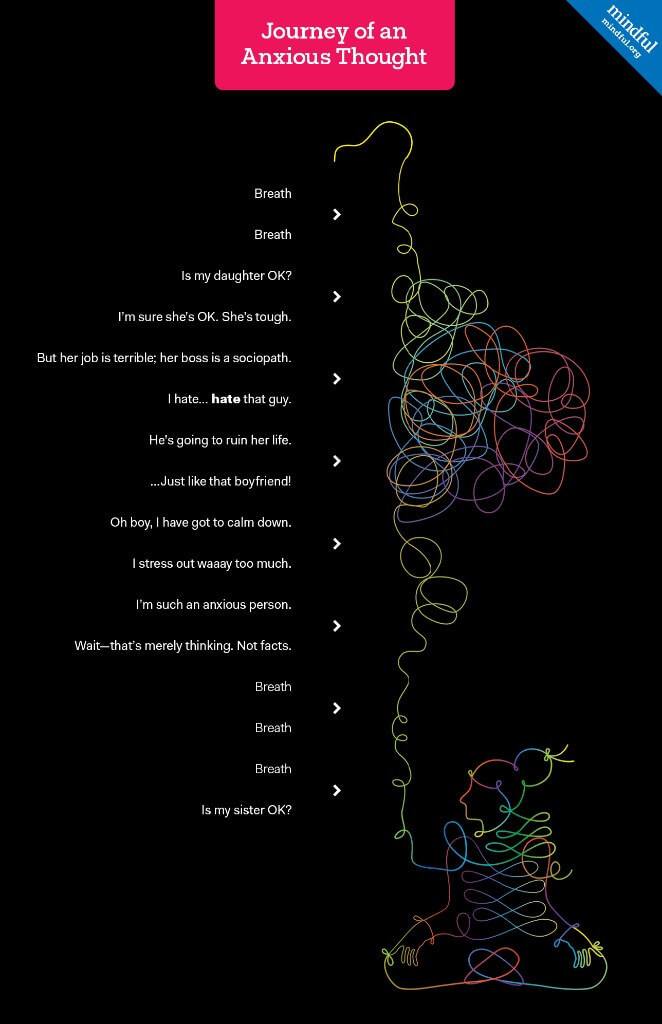
Anxiety can fully take over your mind and body. Increase clarity and ease of being with mindfulness practice and our free meditation for anxiety.
Dear friends,
Research suggests that people with higher levels of reported self-compassion are less likely to report depression and anxiety. The data showed that self-compassion may play the role of buffering the effects of rumination. With mindfulness practice, we can learn how to unhook from rumination and cut ourselves (and others) the slack requisite for increasing clarity and ease of being.
It should be fairly obvious that when we’re not taking care of ourselves—when we’re not sleeping, eating, or moving our bodies adequately—this creates imbalances that contribute to anxiety. Similarly, when we behave unethically, these actions stir our minds and bodies with the muddy raw ingredients of anxiety. When our parents told us to “clean up our act” as teenagers (or as adults), they were not just making an off-hand swipe at our misdeeds, they were (perhaps unintentionally) taking aim at the very heart of our well-being.
Anxiety is the “check engine light” on our psycho-physiological dashboard. It lets us know the system needs some balancing. Agitation is therefore not our enemy; ideally, we see it as a wake up call for mindfulness practice.
- Begin this practice by acknowledging the mere presence of anxiety—give a soft, slight internal nod to the thoughts, images, and sensations of worry and anticipatory angst.
- Rest in sensations of the breath. Let your attention drop gently onto wherever you feel feel the breath (e.g. nostrils, belly, or perhaps the toes for those more light on their feet).
- Penetrate the sense of anxiety in BOTH the body and mind on a deep inhale into the belly. Visualize the breath coming into and through the restlessness. The breath is not forcing the anxiety away, rather, it’s moving into it. Slow, deep belly breathing is important because anxiety often pulls us toward fast, chest-level breathing that actually sparks more physical sensations of anxiety.Slow, deep belly breathing is important because anxiety often pulls us toward fast, chest-level breathing that actually sparks more physical sensations of anxiety.
- Acknowledge the anxiety just as it is on the exhale. Don’t try to shove the anxiety out with a sigh or exasperated puffing. Again, stay with slow, deliberate breathing. Note the sensations and word-images as if jousting with them using a feather.
- Continue following the breath, circulating between penetration into the space of awareness with the in-breath, acknowledging what remains on the exhale.
- Don’t force or control. Follow the anxiety just as it is, and simply penetrate through it with slow, deep breathing. Allow awareness to seep into and around these thoughts, sensations, and images.
- Take inventory of what remains after your allotted meditation time. What is there to be witnessed, felt, and acknowledged “behind” the anxiety? Take action to care for what needs tending.
For this and other practices for anxiety, check out Mindful.org
With warmth and appreciation,
Sean Fargo
Founder, Mindfulness Exercises
As a friendly reminder, you can see each week’s free mindfulness exercises here.
Want to build your mindfulness habit? Join our free 28-Day Mindfulness Challenge.
More Free Meditations For Anxiety:
- OVERCOMING ANXIOUS THOUGHTS (Worksheet)
- TRANSFORMING ANXIETY (Worksheet)
- CALMING ANXIETY (Binaural Beat)
- HEALING SPIRIT: GUIDED MEDITATION (Video)
- ANXIETY & TRANQUILITY (Audio)