Listen now


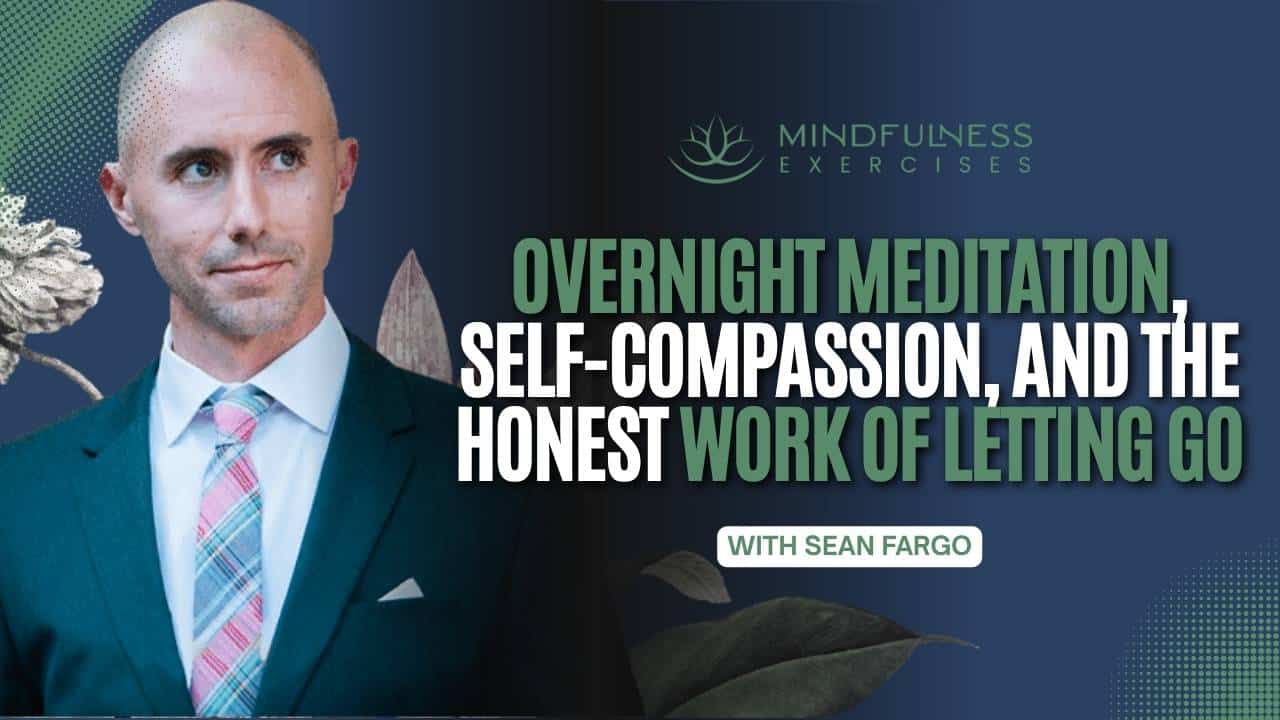
There is something uniquely revealing about staying with yourself through the night.
In the quiet hours—when distractions fade and the body begins to speak more loudly—meditation shifts from a technique into a relationship. What begins as a simple overnight sit can slowly unfold into something deeper: a lesson in pain, a practice of compassion, and an honest encounter with the parts of ourselves we often avoid.
This is where mindfulness becomes real—not polished or idealized, but lived.
Sponsored by our Mindfulness Meditation Teacher Certification Program
certify.mindfulnessexercises.com
Episode Overview:
Key Themes & Takeaways:
- Reflections from an overnight meditation and working with physical discomfort
- Shifting from labeling pain to naming direct sensations
- Expanding awareness through whole-body breathing
- Practicing self-compassion during difficult moments
- Integrating mindful movement into meditation
- Applying mindfulness to eating habits and cravings at home
- Using pause and reflection to understand impulses
- Exploring moderation as a balanced, skillful approach
- Practicing progressive muscle relaxation and cultivating wise effort
- Teaching and practicing mindfulness with humility and kindness
Show Notes:
When Stillness Becomes a Mirror
An overnight meditation invites us into extended stillness. And in that stillness, discomfort often arrives.
At first, it may be physical—a tightness in the back, numbness in the legs, restlessness in the shoulders. But beneath the surface, something more subtle is happening. We begin to notice how quickly the mind labels these sensations:
- “This hurts.”
- “I can’t do this.”
- “This needs to stop.”
What if, instead of labeling the experience as pain, we simply named what was actually there?
- Tingling
- Pressure
- Heat
- Pulsing
This shift—from judgment to observation—creates space. And in that space, something softens.
Naming Sensations Instead of Resisting Them
When we name sensations precisely, we step out of the story and into direct experience.
Pain, as a label, often carries resistance. But sensations themselves are constantly changing. By noticing their texture, movement, and intensity, we begin to see that even discomfort is not fixed—it arises, shifts, and fades.
This simple practice can transform how we relate to difficulty, both on the cushion and in daily life.
Breathing Through the Whole Body
As awareness deepens, the breath becomes more than just air moving in and out. It becomes a bridge.
Instead of focusing only on the nose or chest, we can expand our attention to include the whole body:
- Breathing into areas of tension
- Sensing the body as a unified field
- Noticing the tone of each moment—pleasant, unpleasant, or neutral
This broader awareness allows us to hold discomfort without becoming overwhelmed by it.
We’re no longer trapped inside a single point of pain—we’re held within a larger field of experience.
Self-Compassion: Including Yourself in the Practice
It’s easy to extend compassion outward—to others, to loved ones, even to strangers.
But in moments of discomfort, do we offer that same kindness to ourselves?
Self-compassion in meditation isn’t about fixing or escaping what we feel. It’s about meeting ourselves with the same care we would offer a friend:
- “This is hard right now.”
- “It’s okay to feel this.”
- “I can stay with this, gently.”
Compassion doesn’t remove pain—but it changes our relationship to it.
Mindful Movement as Part of Practice
Stillness doesn’t always mean staying frozen.
Sometimes, the most mindful choice is to move—slowly, intentionally, and with awareness.
Mindful movement can include:
- Adjusting posture with care
- Stretching gently between sits
- Walking meditation to reconnect with the body
Rather than reacting impulsively to discomfort, movement becomes part of the practice itself—a continuation of awareness, not a break from it.
Mindful Eating and the Pull of Temptation
The lessons of meditation don’t stay on the cushion—they follow us into everyday life.
At home, especially, we encounter another kind of discomfort: craving.
Mindful eating invites us to pause before acting:
- What am I actually feeling right now?
- Is this hunger, boredom, stress, or habit?
- What outcome am I hoping for?
By pausing, we interrupt the automatic loop and create the possibility for choice.
Working with Cravings: Pause and Reflect
Cravings often promise relief—but rarely deliver it in the way we expect.
A simple practice:
- Pause before acting
- Name what you’re feeling
- Reflect on the likely outcome
Will this action bring ease—or just temporary distraction?
Over time, this reflection builds clarity. And with clarity comes freedom.
Moderation as a Skillful Path
Letting go doesn’t always mean saying no.
Sometimes, the most balanced response is moderation—not indulgence, not restriction, but a middle path.
Moderation requires awareness:
- Knowing when something supports well-being
- Recognizing when it becomes excess
- Choosing intentionally, rather than reactively
This is a skill—and like all skills, it strengthens with practice.
Progressive Muscle Relaxation and Wise Effort
In longer meditation sessions, effort can become strained.
We try too hard to stay focused, to remain still, to “do it right.”
But mindfulness invites a different approach—wise effort.
One way to reconnect with this is through progressive muscle relaxation:
- Gently tightening and releasing different parts of the body
- Noticing the contrast between tension and ease
- Allowing the body to soften naturally
Effort becomes balanced—not too tight, not too loose.
The Quiet Power of Teaching with Humility
At its core, mindfulness is not about perfection—it’s about honesty.
Whether we’re guiding others or simply practicing for ourselves, the most meaningful approach is one rooted in humility.
To be a friend first:
- To listen rather than instruct
- To share from experience, not authority
- To meet others where they are
This same attitude can be turned inward.
We don’t need to be perfect practitioners—we just need to be present.
Letting Go, One Breath at a Time
Letting go is often misunderstood.
It’s not about forcing something away or pretending it isn’t there. It’s about loosening our grip—on sensations, on thoughts, on expectations.
Overnight meditation reveals this gently:
- Discomfort arises—and passes
- Cravings appear—and fade
- Emotions shift—without needing control
Through awareness, compassion, and balanced effort, we learn that we don’t have to hold on so tightly.
And in that release, we find something unexpected:
A quiet kind of ease.
A Gentle Invitation
Tonight, or whenever you next sit in stillness, try this:
Instead of trying to change your experience, simply stay with it.
Name what’s there.
Breathe with it.
Offer yourself kindness.
And notice what begins to soften—not because you forced it, but because you allowed it.
That’s where the real work happens. And also, where the real freedom begins.