🎉 $1,000 off Mindfulness Teacher Certification — annual sale ending soon

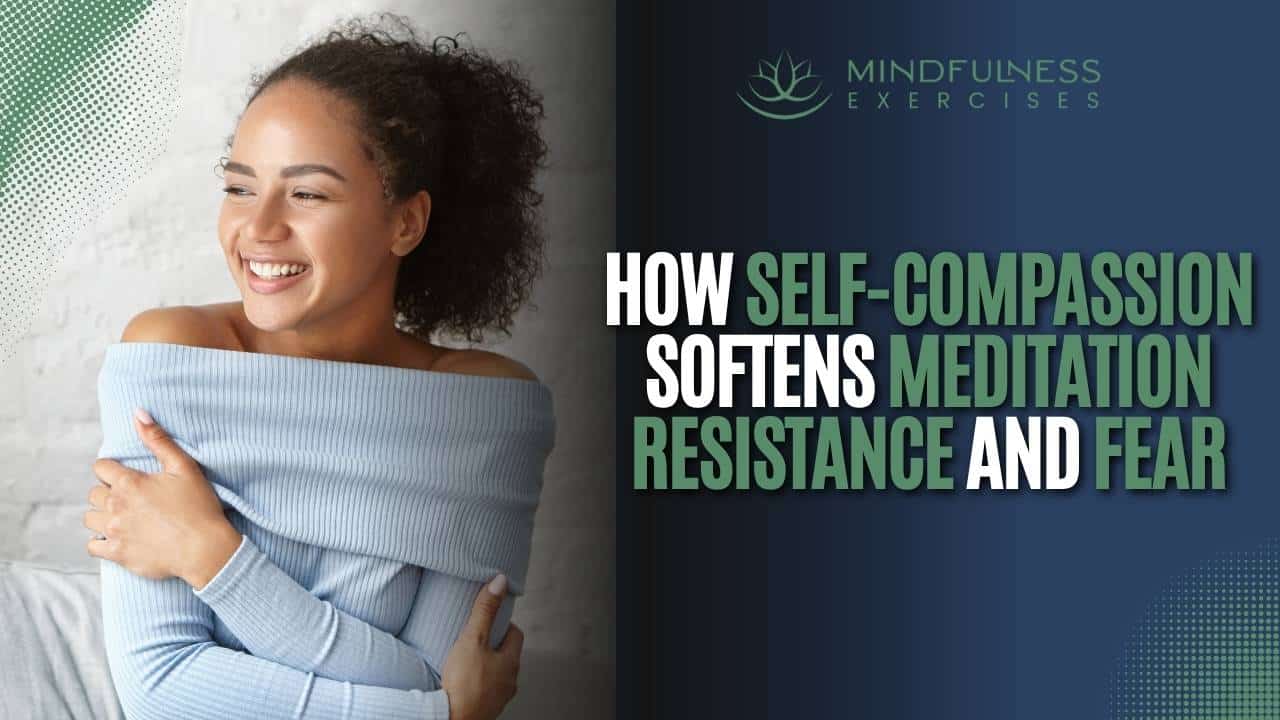
    How Self-Compassion Softens Meditation Resistance And Fear

    SF
    Sean FargoPublished March 27, 2026 · 1 min read
    How Self-Compassion Softens Meditation Resistance And Fear

    Loading episode player

    There is something uniquely revealing about staying with yourself through the night.

    In the quiet hours—when distractions fade and the body begins to speak more loudly—meditation shifts from a technique into a relationship. What begins as a simple overnight sit can slowly unfold into something deeper: a lesson in pain, a practice of compassion, and an honest encounter with the parts of ourselves we often avoid.

    This is where mindfulness becomes real—not polished or idealized, but lived.

    Transcript

    Show transcript· 9 min read

    Welcoming Resistance With Compassion

    Speaker 1 · 0:00Welcome to the Mindfulness Exercises Podcast. I'm Sean Fargo. Today we're going to be exploring what it means to meet resistance to this moment with a sense of compassion or care or gentleness. A lot of us when we carry resistance we hold on, we create barriers, we tighten, we distract and it's really tricky and sometimes really scary to meet our own resistance with compassion. Treating ourselves like we would treat someone else with a sense of kindness. Meeting ourselves as a friend. Kind of slowing down and meeting this moment in a friendly way. So this is where we're going to be exploring so that we can feel more ourselves again, a little bit lighter, a little bit freer and a little more friendlier.

    When A Client Refuses To Look

    Speaker 1 · 1:23Yeah, I'd just like to open it up to any comments, questions, requests, anything at all.

    Speaker 2 · 1:34I had a student for two times. She was very happy and everything. She invited me to give, to offer a demo to her insurance, the biggest general insurance in Italy. So I'm very honored. She wanted to stop because she said, Oh, I don't want to see anymore. Because each time I see something of myself, of herself. So I didn't know what to say. Because if she doesn't want to see, she doesn't want to see. I was surprised, yes, very surprised. I didn't show it, but I was very surprised because she was happy. Is this the same woman you have brought previously? Then suddenly she said, Oh, I want to stop because I don't want to see. She said she was seeing too much of herself.

    Speaker 1 · 2:27Oh.

    Speaker 2 · 2:29I didn't know what to say. I still can say something, but I don't know what to say exactly because actually we did only body scan. So she didn't want to. Kind of strong resistance at a certain point. What should I tell her? I mean, I don't think it's correct to convince. No?

    Speaker 1 · 2:50Correct.

    Speaker 2 · 2:51Yeah. Because she's already, so to say, convinced. Point is that she she has chosen not to see, not to sense, not to feel, not to be with herself. She said, Oh, I don't want to see, I don't want to be with myself.

    Speaker 1 · 3:09Most people don't. What they mean is they don't want to be alone with their thoughts. And you know, it can be scary. And you're correct in that it's not something we should try to convince them. And you have more of a relationship with her, so maybe you can find the right words here. But if it was me in your shoes, I would ask her what she means and say something like, Yeah, it's understandable that you don't really want to be with yourself right now. That's totally fine. What's coming up for you? Is there something that you're kind of afraid of holding or thinking? I'm guessing she knows what it is.

    Speaker 2 · 4:02I'm sure. You know, I should.

    Speaker 1 · 4:04Maybe there's some old trauma, maybe there's certain fears. And so we can ask very gently, what's coming up for you? We can ask if there are parts of the practices that you've done together that do feel safe. Are there parts of this that you like or that feel safe or that feel helpful?

    Speaker 2 · 4:29She said she was very content, very safe, very happy for that. But she didn't want to see herself. I guess at the age of 10, she lost her mother and she misses her a lot. But I didn't ask exactly, is this the reason?

    Speaker 1 · 4:48Yeah, and it's impossible for us to figure this
    Gentle Questions And Safer Options

    Speaker 1 · 4:52out. But maybe I'll just share a few things for all of us to consider when we approach or when we're speaking with a client who's not totally comfortable with proceeding. So maybe we can step aside from this specific client for now and just speak more generally about this type of situation. We can ask them what they're wanting. Are you wanting healing? Are you wanting physical ease in the body, less stress or anxiety? We can ask them what they're wanting. Like, what do you think would be a positive outcome with our work together? Like, I think that's a beautiful question at the start of any kind of coaching or counseling arrangement. Is like, what would you like out of our experience together? And really dive deep into what it is that they're really wanting. And sometimes we may need to ask that several times to really get deep down into what they're really looking for. What are their hopes for this type of work or work with you specifically? We can present a variety of practices and options. So we can present somatic-based practices like mindfulness of breathing, body scans, mindful walking. Some of us are yoga teachers, so we can bring mindfulness to yin yoga or other kinds of yoga. We can practice outside or inside. We can practice art-based practices like self-compassion, loving kindness, gratitude. Can even do like mindfulness-based practices around generosity, equanimity, and forgiveness. Usually with forgiveness, we want to do other practices first, like self-compassion and breathing. Forgiveness tends to be a little heavy, so kind of building our way towards the three classic forgiveness practices of forgiving others, asking for forgiveness, and forgiving self. We can present practices like mindfulness of sounds, tastes, smells, to practice coming back to this moment in a way that often feels safer. Our eyes are open, maybe we have a piece of chocolate or the smell of a candle, you know, something sometimes pleasurable, just coming to this moment, coming to our senses in a way that may feel quite pleasant. So, in other words, offering optionality can be helpful. Offering curiosity, like what is it that you really want? What are you curious about, or how might you envision our work resulting in? It's totally understandable that you may not want to be with yourself fully right now. Totally get it. A lot of us don't. I can assure you that our work together can be quite gentle, can be quite caring and accepting of whatever comes up, and at any point, if it feels like it's a little too much or different from what you're wanting, just let me know and we can chat about it. You don't really like my style, that's totally okay. There's lots of other mindfulness teachers out there with very different styles. And I encourage you to keep practicing in a way that feels right for you. And I'm happy to work with you on that. Sometimes it's helpful to share that there is research and science showing that these practices are quite effective, that we can all do them, but that we just need to find the right practices and to start slow. Kind of like going to the gym. We don't try to lift the heavyweights first. We start with what feels appropriate, and we know that it just takes practice. Yeah, and I think it's also helpful to not take these things personally because it's not really about us. I know. Even if it was, it's not a big deal. Like when I started working with people and they didn't want to continue, I was like, oh well, it must mean that I'm not a great teacher or I'm not sounding like Cartole or something like that. I don't know. Buy a cardigan sweater and have a foreign accent or something.

    Speaker 2 · 9:55But she invited me to uh her company. So it's very contradictory to my eyes. She didn't want to do it, but she invited me in June or July, she said. So to give a presentation, a demo, something like this. Maybe I'm too logical.

    Speaker 1 · 10:14It doesn't make sense to me, but well, I hope you don't lose any sleep over it.

    Speaker 2 · 10:20No, not for this. For this friend of mine, yes, I lost, but not for her. I didn't know how to handle the situation. I wanted to know why. That's all. And she said just I don't want to see. Yeah. That's all. I don't want to see. Okay. That's her right. By the way, it was for free, it's not for the money or something.

    Speaker 1 · 10:43Yeah. Thank you. Well, good

    Grief, Readiness, And Body Scan Myths

    Speaker 1 · 10:46luck. Hi, Kate.

    Speaker 3 · 10:48I just had some thoughts. I've worked in my professional life creating mental health and substance abuse interventions with people for HIV positive, who live out the street, and I've experienced a lot. And I can really appreciate a person's desire and seeing that a practice is really helpful for others, and not wanting to fully engage and do all the parts because I'm just not ready for it. I don't want to see these things yet. That's not the stage of life that I'm in, but I want others to access this. So I think it's an interesting combination. And I'm not sure that it's really unusual. I'm resonating with the person who you're talking about. And I could imagine myself five years ago kind of doing saying the same thing. Well, I'm literally creating interventions for others. I'm not ready to do this for myself.

    Speaker 1 · 11:43Yeah. Thanks, Kate. Yeah, Stephanie.

    Speaker 4 · 11:45I also wanted to add to that as well. It resonated with me from the perspective of your client. When my mother passed away in July of 2024, and I couldn't meditate for months because it was too painful. You had mentioned that her mother passed away. So maybe she's going through a grieving process and she just doesn't have the capacity to go there, you know?

    Speaker 1 · 12:09Absolutely. Yeah.

    Speaker 3 · 12:11One more thing. I had mentioned and working with some months in Cambodia, but they're pretty appalled. The only pushback where we were saying body scan, like you're doing bodies, you can't do body scan until you're years into this. Like, no, I don't think we're talking about the same body scan, but just to throw that in there also is kind of I don't know what to do about that. But what it was interesting, I was very surprised that they just thought that was a super advanced technique. Beginner and young people should be engaging in.

    Speaker 1 · 12:38Yeah. I think body scans are fine for beginners. I don't see that as necessarily as an advanced practice. You can get as advanced as you want with the body scan, but on our podcast, we've offered 30 different kinds of body scans, some quite appropriate for beginners.

    Share

    Continue reading

    • A Guided Journey Into Compassion And Calm

      A Guided Journey Into Compassion And Calm

      Read
    • A Guided Practice To Feel Grateful In Ordinary Moments

      A Guided Practice To Feel Grateful In Ordinary Moments

      Read
    • Following the Lights That Make You Shine

      Following the Lights That Make You Shine

      Read

    Professional training

    Accredited mindfulness teacher certification

    Trusted by teachers in 100+ countries

    Structured training, CE credits for eligible pay-in-full registrants, and support for teaching without self-doubt — after you have explored this episode.