
Listen now


Some mornings arrive with the kind of stress that settles into your shoulders before you’re even fully awake. Maybe you spilled coffee on your shirt, or your mind is already juggling three conversations that haven’t happened yet. The body tells the truth long before the mind catches up.
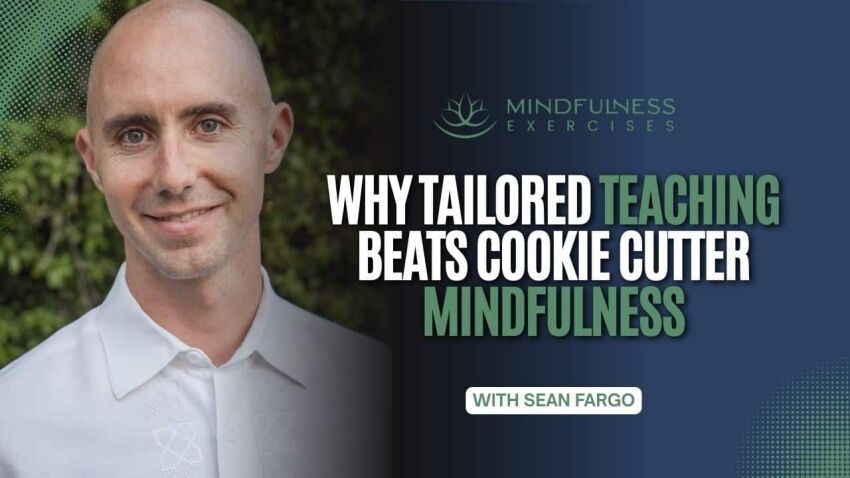
In a recent episode of Mindfulness Exercises, Sean Fargo starts with a morning like that—messy, rushed, human. And from that morning comes a powerful reminder for meditation teachers and facilitators everywhere: the most effective teaching isn’t the neatest or most polished. It’s the most relevant.
This episode is a grounding, refreshingly practical conversation about how to choose what to teach, how to listen deeply, and how to lean into flexibility rather than formulas. Whether you’re a new instructor or someone with years of guiding behind you, this is the episode that answers the question:
“What should I teach this group, right now?”
Sponsored by our Mindfulness Meditation Teacher Certification Program
certify.mindfulnessexercises.com
Episode Overview:
- Why relevance matters more than routine scripts
- A “stressful morning” story that reframes how we teach
- A body-based reset that clarifies next steps
- Trauma-informed principles for safer mindfulness spaces
- How short, respectful questions guide what to teach
- Cues that sound human, warm, and invitational
- Why short, concrete practices often work better than long, abstract ones
- Tailoring mindfulness for healthcare teams, caregivers, corporate groups, and teens
- A look inside Sean’s 900-minute plug-and-teach curriculum
- How to adjust tone, length, and focus—quickly and skillfully
- Practical tools teachers can use today
Show Notes:
Routine Is Comfortable—But Not Always Helpful
Many of us teach mindfulness the way we learned it: with a familiar sequence, a reliable script, a structure we can lean on. And there’s comfort in that.
But as Sean emphasizes, real people rarely arrive in neat, predictable states. Some are tired. Some are anxious. Some are grieving. Some are barely holding on.
So teaching from a premade script—even a good one—can sometimes feel like placing a template over someone’s lived experience. It fits in some places, and misses in others.
That mismatch is where mindfulness loses power. Relevance is what restores it.
The Body as a Compass: Listening Before Leading
Sean shares how a rushed, tight morning reminded him to pause, feel, and reset before teaching. It’s the same principle he encourages instructors to use with their groups.
Before deciding what practice to offer, ask:
- How is the body right now?
- What signals are showing up?
- Where is attention naturally drawn?
- What’s the emotional weather of the room?
These questions don’t require long check-ins. Sometimes the most useful assessment is a 10-second read of posture, energy, and tone.
The lesson?
Teaching begins with listening.
Listening to yourself.
Listening to your students.
Listening to the moment.
Why Trauma-Informed Teaching Matters
One of the most essential parts of the episode is Sean’s emphasis on trauma-informed mindfulness.
A trauma-informed approach isn’t a special module or a separate certification—it’s a stance. It’s a way of honoring the truth that we rarely know what someone is carrying.
Trauma-informed teaching includes:
- using invitational language (“if it feels supportive…”)
- avoiding commanding or clinical phrasing
- emphasizing choice and agency
- offering multiple options and anchors
- keeping everything adjustable
When teachers adopt this stance, they create a space where participants feel safe enough to explore without pressure.
Language Matters: Human, Not Clinical
Sean speaks to something many instructors struggle with: over-formal, stiff, or overly clinical cues.
Instead of:
“Bring your attention to your breath and observe without judgment…”
Try:
“Maybe notice how your breath feels right now, in your own way.”
Instead of:
“Scan your body from head to toe…”
Try:
“If it feels okay, you might check in with a few places in the body and see what’s there.”
Small shifts create a big difference. Warmth and humanity make mindfulness accessible.
People learn best from people, not scripts.
Short, Concrete Practices Often Work Best
One of the most surprising insights from Sean’s teaching experience is that short practices outperform long scripts far more often than teachers expect.
Especially for:
- overwhelmed parents
- corporate teams on tight schedules
- medical professionals on shift
- teens with limited attention
- caregivers who show up emotionally drained
A two-minute grounding practice may land more effectively than a 20-minute abstract one.
In these settings, less is not only more—it’s more humane.
Listening for Needs: The Art of Asking small questions
Sean’s approach to assessment is refreshingly simple: ask one or two brief questions that open a window into what people actually need.
Examples:
- “What kind of day has it been so far?”
- “What would feel supportive right now?”
- “More grounding or more openness today?”
- “Energy check: low, medium, or high?”
You don’t need an intake form.
You just need curiosity.
Adapting for Different Audiences: Practical Examples
Sean walks through common groups and the adjustments that make teaching feel relevant rather than generic.
Healthcare workers
- Keep it short.
- Emphasize grounding and body-based presence.
- Use steady, practical language.
Corporate teams
- Normalize distraction.
- Highlight stress relief, not spirituality.
- Offer techniques useful between meetings.
Caregivers
- Focus on compassion for fatigue.
- Keep practices restorative, spacious, gentle.
- Reinforce permission to rest.
Teens
- Make it relatable and concrete.
- Use shorter silences and accessible language.
- Give agency and options, not instructions.
The goal is always the same: meet people where they are.
A Plug-and-Teach Curriculum: 900 Minutes of Adaptable Training
Near the end of the episode, Sean introduces a powerful resource for teachers who want depth without reinventing the wheel:
A modular 900-minute curriculum
complete with:
- themed lessons
- slide decks
- teacher-depth dives
- step-by-step guidebooks
- student handbooks
- optional branding customization
The brilliance of this curriculum is flexibility.
You can:
- plug it in
- modify it
- re-sequence it
- shorten or lengthen sections
- fit it to your group’s real needs
It’s teaching support without rigidity—structure without pressure.
The Three-Part Formula for Effective Mindfulness Instruction
Sean’s central message comes down to a clear, practical model:
1. Assess
Check in. Ask small questions. Take in the energy and the moment.
2. Adapt
Shorten. Soften. Lengthen. Shift tone. Choose practices that match real needs.
3. Keep it Practical
Offer tools people can use today, not just concepts to admire.
When teachers practice this cycle, mindfulness becomes accessible for everyone—not just those who already feel comfortable sitting still.
A Final Reflection: Who Are You Tailoring For Next?
As the episode ends, Sean invites teachers to reflect on one simple question:
Who is your next audience—and how can you tailor your teaching to support them more fully?
Teaching mindfulness isn’t about perfect delivery. It’s about relevance. It’s about connection. It’s about shaping guidance to fit the living, breathing humans in the room.
When teaching becomes tailored, it becomes compassionate.
When it becomes compassionate, it becomes effective.
And when it becomes effective, it becomes a gift—one that people carry far beyond the session.
