
Listen now


Anger has long been misunderstood. Many of us grew up believing anger is something to avoid, suppress, or feel ashamed of. For some, “being nice” became a personality, not a preference—an identity rooted in survival rather than truth.
But what if suppressing anger doesn’t make us kinder? What if it makes us sicker?
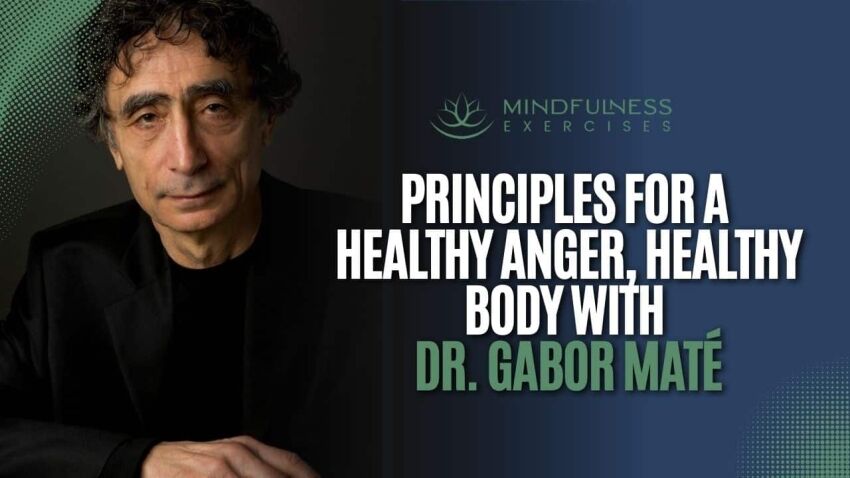
In this powerful conversation inspired by Dr. Gabor Maté, we explore the deep connection between healthy anger, honest boundaries, emotional regulation, and physical wellness. Drawing from affective neuroscience, trauma research, and mindfulness practice, this article guides you through understanding why suppressed feelings can silently weaken the immune system and how learning to express natural emotions—skillfully, calmly, mindfully—can change the trajectory of your health.
Sponsored by our Mindfulness Meditation Teacher Certification Program
certify.mindfulnessexercises.com
Episode Overview:
- Why chronic “niceness” can become harmful
- The neuroscience of anger, grief, fear, and care
- How the body mirrors emotional suppression
- Healthy vs. unhealthy anger
- How childhood conditioning shapes adult emotional habits
- Boundaries as acts of self-respect
- The link between suppression, inflammation, and disease
- Simple mindful practices to honor your truth
Show Notes:
The Misunderstood Emotion: Why Anger Isn’t the Enemy
In many cultures, anger is painted as destructive, unstable, or impolite. Children who show it are often labeled “difficult,” while adults who express it risk being seen as unprofessional or dramatic.
But Dr. Maté reminds us that anger is one of the core mammalian emotional systems. Like fear or care, anger evolved for a very specific purpose:
Healthy anger protects boundaries.
It communicates:
- “This crossed a line.”
- “Something is not okay.”
- “My well-being matters.”
When expressed proportionately and mindfully, anger isn’t harmful—it’s protective. It helps us stay connected to our integrity and prevents resentment, exhaustion, and emotional self-abandonment.
When “Being Nice” Hurts the Body
Many people believe kindness means not causing trouble, not disagreeing, and not expressing discomfort. But this form of “niceness” often emerges from childhood environments where:
- Love was conditional
- Attachment depended on compliance
- Emotional expression felt unsafe
- Conflict meant instability
In adulthood, these patterns turn into:
- Chronic people-pleasing
- Avoidance of conflict
- Silence in the face of discomfort
- Overworking to meet others’ expectations
- Migraines, chronic pain, digestive issues
- Burnout and emotional fatigue
The body keeps the score—especially when emotions don’t have room to move.
Research shared in the episode highlights:
1. People with ALS who expressed anger survived longer.
Not explosive rage—simply honest, straightforward emotional expression.
2. Women in unhappy marriages had higher mortality when they kept their feelings unspoken.
Silence becomes a stressor. Expression becomes a release.
The takeaway is profound:
Suppressing emotions forces the body to carry the weight the mind refuses to lift.
When your voice is quiet, your immune system may learn to quiet itself, too.
Healthy vs. Unhealthy Anger: A Mindful Distinction
Not all anger is the same.
Unhealthy Anger
- explosive
- punishing
- reactive
- fueled by fear or old wounds
This form disconnects.
Healthy Anger
- calm
- clear
- proportionate
- boundary-setting
- rooted in present reality
This form protects connection.
Mindfulness helps us tell the difference by slowing the space between sensation and reaction. With awareness, we can feel anger arise without letting it take over—listening to its message instead of acting from its intensity.
The Nervous System’s Role: Why Emotions Are Physiological, Not Just Psychological
The conversation also breaks down six major emotional systems found in mammals:
- Rage — boundary protection
- Fear — threat detection
- Panic/Grief — attachment needs
- Care — nurturing connection
- Seeking — curiosity and engagement
- Play — social bonding and creativity
None of these systems exist to cause chaos. They exist to keep us alive, connected, and attuned.
When anger is suppressed, these systems become imbalanced. Fear takes the wheel. Grief becomes buried. The care system gets overused in the form of people-pleasing.
Restoring emotional balance begins with allowing each system to do its job—including anger.
How to Honor Anger in a Healthy, Mindful Way
You don’t need to raise your voice to honor your boundaries. You don’t need to withdraw, explode, or create conflict.
Instead, Dr. Maté suggests a simple mindful process:
1. Name the feeling.
“I feel angry.”
Not: “You made me angry.”
This keeps ownership and clarity.
2. Identify the boundary that was crossed.
What exactly happened that felt untrue, hurtful, or misaligned?
3. Choose a proportionate, skillful action.
This may mean:
- stating a limit
- asking for space
- making a request
- saying no
- disengaging respectfully
Healthy anger keeps the action aligned with the situation—not magnified by old wounds.
How Childhood Survival Patterns Become Adult Burnout
Many adults who struggle with boundaries have a childhood history of:
- keeping quiet to feel safe
- being responsible for others’ emotions
- equating compliance with love
- fearing disapproval
- suppressing discomfort to maintain peace
These patterns become automatic. We call them “personality,” but they’re actually adaptive survival strategies.
When repeated over decades, they take a toll:
- chronic inflammation
- hormonal imbalances
- immune suppression
- emotional exhaustion
Mindfulness allows us to gently examine these old patterns without judgment, offering new choices in the present moment.
Why Listening to Your Body Is an Act of Self-Respect
The body whispers before it screams.
The early signs of emotional suppression often look like:
- tight jaw
- clenched stomach
- headaches
- fatigue
- irritability
- trouble sleeping
If ignored, these whispers can harden into chronic conditions.
Instead of pushing through, mindfulness invites us to pause:
- Where is my body saying “no”?
- What boundary is being crossed?
- What truth am I not letting myself speak?
This is not selfishness—it is self-attunement.
A Mindful Question to Carry With You
If there is one takeaway from this episode, it’s this:
Goodness is not self-erasure.
Goodness is self-respect.
You are allowed to speak up. You are allowed to protect your inner peace. You are allowed to honor your needs without apology.
Today, consider asking yourself:
What boundary will I protect—gently, clearly, mindfully?
Your body will thank you.
If This Resonated With You…
Share this article with someone who struggles with boundaries or emotional suppression.
Follow the podcast for more science-backed mindfulness tools.
Leave a review so more people can find these teachings.
Your voice—and your truth—matter.
