🎉 $1,000 off Mindfulness Teacher Certification — annual sale ending soon

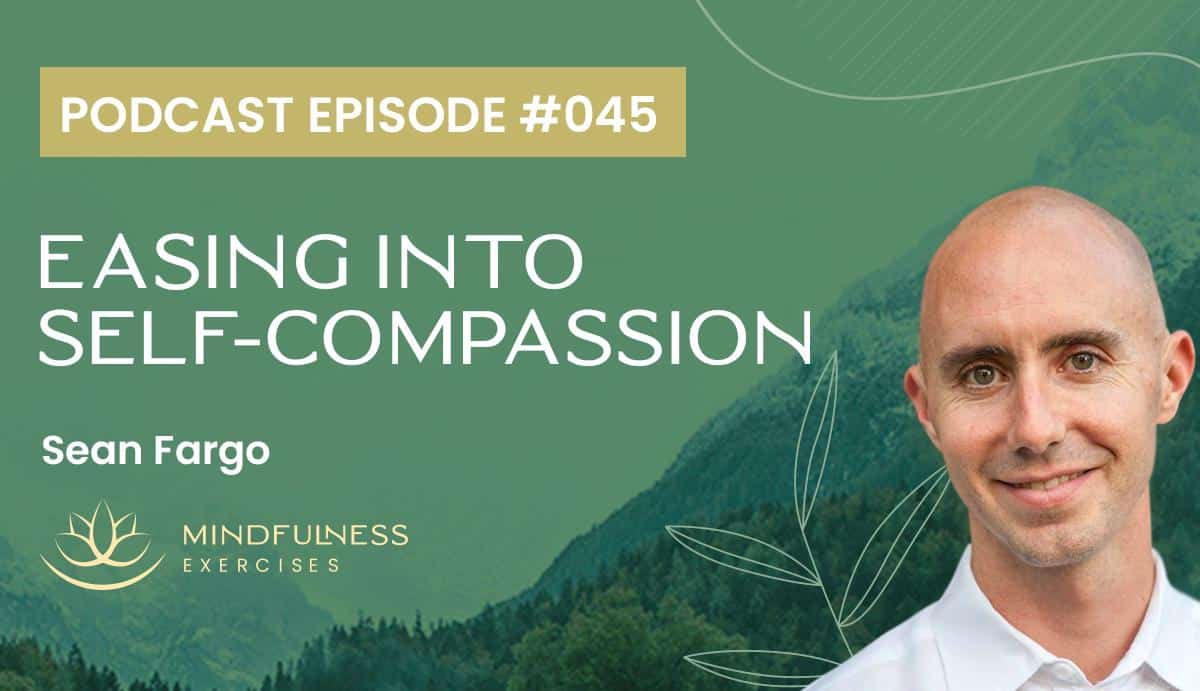
    Easing into Self-Compassion, with Sean Fargo

    SF
    Sean FargoPublished March 15, 2023 · Updated October 24, 2025 · 5 min read
    Easing into Self-Compassion, with Sean Fargo

    Loading episode player

    Easing into Self-Compassion, with Sean Fargo — Tunein Logo

    TuneIn

    Are you able to offer yourself loving-kindness in the midst of your moments of suffering? Sometimes, we find it far easier to extend compassion to others than to ourselves. But all beings everywhere are worthy of this grace, including us.  

    In this episode, Sean Fargo helps us better understand self-compassion – what it is, and also, what it is not. Sean explains that self-compassion is not an all-or-nothing endeavor, and offers advice on how we might begin to ease into this feeling of self-love.

    Sponsored by our Mindfulness Meditation Teacher Certification Program MindfulnessExercises.com/Certify

    What You’ll Learn in This Episode:

    • What self-compassion is, and what it is not
    • How it differs from self-care
    • Why it is not an all-or-nothing practice
    • Why it is an intermittent practice
    • How mindfulness can be a form of self-compassion
    • Where to begin if we’re struggling with self-compassion
    • The many ways we can sense into love and care
    • Why self-compassion doesn’t need to start with the self

    Show Notes:

    Common myths about self-compassion

    Compassion and loving-kindness are often lumped together, but unlike loving-kindness, compassion can only exist when suffering is present. It is the act of extending loving-kindness in the hopes of easing one’s suffering. Self-compassion, however, is not self-pity or self-esteem. It’s simply acknowledging when we’re hurting, and wishing ourselves well.

    “Compassion is love in the midst of suffering. And so, with self-compassion, it’s love in the midst of our own suffering. And that could be emotional anguish, it could be suffering around a physical pain, stress, anxiety, depression, craving, an addiction, trauma, grief, fear. So, there’s some level of suffering internally that we’re bringing care to.”

    How self-compassion differs from self-care

    Self-care is a buzzword that many people confuse with self-compassion. Going to the gym, eating more vegetables, or even setting boundaries are all healthy things to do. But self-compassion is linked to an internal feeling from the heart. It’s about relating to ourselves with care. 

    “Really what we’re getting at is less of the external and more of the internal. How are we relating to ourselves? Is there an actual feeling of care? Because we can go to the gym with a sense of fear that I’m not going to be good enough, or desire to be better than others. You know, we can go to the gym with this feeling of not really caring for how we actually are.”

    Self-compassion is not an all or nothing practice

    It’s easy to forget that there are layers to self-compassion. We can easily get overwhelmed by thinking it requires us to be fully self-accepting and unconditionally self-loving, right here and now. Instead, we can cultivate self-compassion in baby steps by offering ourselves just a little more warmth, care and support than we typically do. 

    “And we can titrate between the lightness and, let’s say, the heavy, or the superficial and the deep. Without judgment, just kind of finding whatever dance move feels appropriate. If we have space to go deeper and say, examine it, or feel it with a lot of focus, zero in on the physical sensations and the mental associations or beliefs or history, there’s a place for that. And, we don’t always have to do that.”

    Self-compassion as an intermittent practice

    Mindfulness is a practice we can do in each and every moment. Self-compassion, on the other hand, is care in the midst of suffering. Some Buddhist practitioners might say we’re always suffering (as in forgetting the nature of impermanence or interdependence), meaning we could practice all the time. Yet generally, self-compassion is something we practice intermittently. 

    “There’s no judgment that we should always be self-compassionate, because that would mean that we might have to artificially create suffering. So we don’t have to necessarily conjure up something. We can, in order to practice with it, but it’s more like intermittent practice. And so oscillating between joy and self-compassion and all the other emotions.” 

    Mindfulness as a form of self-compassion

    Self-compassion doesn’t need to be lovey dovey, glitter and rainbows. Self-compassion can be as simple as letting ourselves be mindful and present in this moment, without reacting to it. We may not like this moment, but acknowledging what is here and offering it our gentle, kind awareness is akin to practicing self-compassion. 

    “In many ways mindfulness of our suffering is self-compassion. Because we’re offering ourselves this non-judgmental, gentle awareness, some may say loving awareness, of how it feels. […] And we don’t have to use the word suffering, we can use stress or dis-ease or some other synonym – discomfort.”

    Where to begin if we’re having a hard time with self-compassion

    Many of us have a hard time with self-compassion, even when working with imagined scenarios. If this is the case, the suggestion is to practice with the most mild forms of suffering first. When experiencing mild discomfort, we can do our best to tend to ourselves as an acquaintance or as a friend, if not yet as a very close loved one.  

    “I encourage us to consider forms of suffering that are on the mild to medium side of things to practice with. Unless you have a lot of practice with self-compassion in which case we can move into heavier, more intense forms of suffering.”

    Self-compassion doesn’t need to start with the self

    Beginning with mild forms of pain is just one way we can ease into a self-compassion practice. In addition, we might foster familiarity with the sensation of care by working with an object other than the self. We can begin with a basic loving-kindness for others, a practice Sean describes in depth in a previous episode. We can also sense into what it feels like to be cared for by another.

    “Can we reflect on a person or an animal who cares for us? Who loves us? Maybe it’s a pet, maybe it’s someone who’s no longer around, maybe it’s someone who is around, or maybe it’s a spiritual figure, maybe it’s god, maybe it’s the Dalai Lama, just imagining him looking at you. But reflecting on someone or something that really cares about you. […] And can you be with that and open to that sense of care, let that in bit by bit.”

    Additional Resources:

    Sean Fargo

    About Sean Fargo:

    Sean Fargo is a former Buddhist monk and the founder of Mindfulness Exercises. The online platform, which has shared free and premium mindfulness resources with over 3 million people worldwide, has now certified over 500 Mindfulness Teachers.

    Sean is the lead instructor for the teacher training program, a unique self-paced approach which invites world-renowned mindfulness teachers to share their insights and experiences. Sean has taught mindfulness and meditation for corporations including Facebook, Google and Tesla and for health and government organizations, prisons and hospitals around the world.
    Transcript

    Show transcript· 11 min read

    Speaker 1 · 0:04Compassion is offering loving kindness in the midst of suffering. Sometimes it is far easier to extend compassion to others than to ourselves. But as humans, every one of us is worthy of compassion, including ourselves. Thankfully, compassion and self-compassion can be developed with practice. In this episode, Sean Fargo helps us better understand self-compassion, what it is, and also what it is not. Sean explains that self-compassion is not an all-or-nothing endeavor, and offers advice on how we might begin to dance with this feeling of self-love, to sense into it from many angles, and gently, mindfully feel our way into a deeper experience of self-care.

    Speaker 2 · 1:09There's lots of definitions out there, stemming back thousands of years, and there's like eight different definitions of compassion. And is it a verb? Is it a noun? There's a lot of myths around self-compassion. You know, is it the same as self-esteem? Is it like self-pity? Does it mean that I'm better than others or worse than others, or even the same as others? So there's lots of definitions and approaches. You know, with compassion, there's this sort of prerequisite for suffering. In other words, compassion is love in the midst of suffering. And so with self-compassion, it's love in the midst of our own suffering. And that could be emotional anguish, could be suffering around a physical pain, stress, anxiety, depression, craving, and addiction, trauma, grief, fear. So there's some level of suffering internally that we're bringing care to. And we can focus on the suffering heavily or lightly or barely acknowledge that it's there, but there's some element of suffering, and we're just kind of holding that with this tenderness, this gentle awareness, either with a hyper-focused lens, which we can go very deep with and can be very helpful. And sometimes it's just nice to hold it really, really, really, really lightly, and just kind of acknowledge that the suffering is there, and may I be well, may I, you know, find a little bit of ease here, or lightness, or humor, or just a simple sense of care, and we can titrate between the lightness and the say heavy, or the superficial and the deep, you know, without judgment, just kind of finding whatever dance move feels appropriate, you know. If we have space to kind of go deeper and say examine it or feel it with a lot of focus, zero in on the physical sensations and sort of the mental associations or beliefs or history. There's a place for that, and we don't always have to do that. You know, a lot of people think that self-compassion equals going to the gym, eating kale, but I mean, they can be healthy and they can be forms of self-compassion, but really what we're getting at is less of the external and more of the internal. Like, how are we relating to ourselves? Is there an actual feeling of care? Because we can go to the gym with a sense of fear that I'm not going to be good enough, or desire to be better than others, you know, we can go to the gym with this feeling of not really caring for how we actually are. Same thing with healthy eating, or there's all these externals that can seem like self-compassion, but if we're not really tending to ourselves with an actual sense of care, then it's not actually self-compassionate. So it's this internal feeling from the heart, you know, and there's layers. Just because we may not be hundred percent fully self-accepting or fully self-loving, it doesn't mean that we're not doing this right or that we're not good enough, you know.

    Speaker 3 · 5:55If I could care for me just a little bit more, what might that feel like? You know, if I could befriend this experience just a little bit more, what might that look like?

    Speaker 2 · 6:18And so it's this moment-to-moment cultivation, kind of in baby steps, it's not all or nothing, and most practitioners I know still have some dislike of themselves, or some feeling of unworthiness, or just needing to do a little bit more in order to feel good enough, or I need to keep doing things for others before I tend to myself, or before I befriend myself, or my suffering isn't as bad as most other people, you know. Who am I to give myself that care if other people are have it worse?

    Speaker 3 · 7:20So I'd say most of us have one or more of these thoughts, even if they're subconscious, and that's not something to judge.

    Speaker 2 · 7:38Can we hold that with this gentle awareness?

    Speaker 3 · 7:42Oh yeah, there is this belief, there is that thought. Yeah. That's that's here. That comes up sometimes. Can I hold that with gentle awareness? Can I hold that with the tenderness? How might I feel if I heard a loved one say that out loud? Can I offer myself that natural warmth that I would offer them? Even just even if a little bit. Can I get some of that too?

    Speaker 2 · 8:27You know, mindfulness is one of those some people say it's the only thing that we can always do. I mean, it's not easy to like sustain it, but it can be applied to any situation. But self-compassion is more of a temporary practice, you know, it's care in the midst of suffering. You know, when there's joy, self-compassion won't apply. You know, if there's happiness, then self-compassion is not really the most appropriate thing. And so there's no judgment that we should always be self-compassionate, because that would mean that we might have to artificially create suffering.

    Speaker 3 · 9:19So we don't have to like necessarily conjure up something. I mean, we can in order to practice with it, but it's more like intermittent practice, and so oscillating between joy and self-compassion and all the other emotions.

    Speaker 2 · 9:42Well, staying mindful, being present for how this feels, but many ways, mindfulness is a form of self-compassion, and self-compassion doesn't need to be lovey dovey, it can simply mean just tending to it without reacting and just kind of being with it, hanging out with it. We don't need to say I love you to it. Can I listen to it a little bit?

    Speaker 3 · 10:18And just kind of feel into it and see how it goes.

    Speaker 2 · 10:24And so with self-compassion, we want to go in baby steps, work with mild forms of suffering for a while, and then move into deeper forms of suffering.

    Speaker 3 · 10:41One may say that all of us inherently are always suffering.

    Speaker 2 · 10:48Well, maybe not always, but a lot of the time, with some form of stress or some form of disease, or some form of confusion, mild craving, even thinking where these separate autonomous beings who are independent from the world could be thought of as a form of suffering. But I encourage us to consider forms of suffering that are on the say mild to medium side of things to practice with, unless you have a lot of practice with self-compassion, in which case we can sort of move into heavier, more intense forms of suffering. You know, in many ways, mindfulness of our suffering is self-compassion, because we're offering ourselves this non-judgmental, gentle awareness.

    Speaker 3 · 11:50Some may say loving awareness of how it feels. When we're bringing mindfulness to our own suffering.

    Speaker 2 · 12:08We don't have to use the word suffering, we can use stress or dis-ease or some other synonym.

    Speaker 3 · 12:21And we can use words like acknowledge, allow. And if we're feeling a little bold that day, we can use the word accept. And it doesn't need to be a thousand percent acceptance. But at least a little bit of acknowledgement of what's here. And we can use words like befriend, but it doesn't have to be best friend. And be like, oh, acquaintance. Like, oh yeah, there's that feeling again. I'd rather it not be around, but it's here.

    Speaker 2 · 13:13So, you know, hopefully we won't let these terms get in the way. I'd rather just kind of dancing, playing, sensing into some form of dis-ease, discomfort, stress, confusion, fear.

    Speaker 3 · 13:40Just acknowledging it a little bit, and kind of titrating between acceptance or acknowledgement, friends or acquaintance, love, or just simple sense of care, well-wishes.

    Speaker 2 · 13:59For people who have a really hard time feeling anything around this, or you know, it's like, well, I imagine this scenario, that's not really working for me. You know, if it's me sharing this care for myself, that's not really working. I would just start with very basic loving-kindness practice for others, you know, and just kind of like sending to the heart in some way, in some capacity. Maybe it's gratitude practice. Take any road you can into the heart to see if you can foster a sense of care at all. You know, what do you love? I love G.I.

    Speaker 3 · 14:44Joe. Okay, great. Sharing care for G.I.

    Speaker 2 · 14:50Joe or appreciation for G.I. Joe.

    Speaker 3 · 14:53What does that feel like?

    Speaker 2 · 14:57You know, so tending the heart in ways that are a little bit easier and seeing if you can cultivate that sense of care. Maybe it's outward. And then, you know, going in baby steps towards compassion for others who you love, you know, who maybe went through a tough time or is going through a tough time. So self-compassion, again, it's not the easiest practice. And so we can start with loving-kindness, gratitude, just general appreciation, feeling that sense of care, you know, tending to the heart in that way, in ways that feel very pleasant, very relevant. You don't really hear this talked about much, but with self-compassion, it doesn't necessarily need to start with us. In other words, can we reflect on a person or an animal who cares for us, who loves us? Maybe it's a pet, maybe it's someone who's no longer around, maybe it's someone who is around, maybe it's a spiritual figure, maybe it's God, maybe it's the Dalai Lama, you're just imagining him looking at you, but reflecting on someone or something that really cares about you, and kind of looking into their eyes, and they're looking at you, caring for you.

    Speaker 3 · 17:00You know, and can you kind of be with that and open to that sense of care? Let that in bit by bit. And allow yourself to feel that care. Feel being cared for. You know, oftentimes I use my puppy.

    Speaker 2 · 17:49You know, she looks at me with these big puppy dog eyes, and it's like, oh my goodness. Or every once in a while my daughter will look at me with some affection.

    Speaker 3 · 18:00It's like, can I let that in too?

    Speaker 2 · 18:05Or I'll I don't think I have like memory of my father holding me, but I'll just kind of pretend, like, oh, here I am, five years old. What does that feel like to be held by my papa? Or what was an affectionate name that my mother called me when I was little? Like, how would she call me in an affectionate way?

    Speaker 3 · 18:34What was that word? Or people singing happy birthday to you? Can you open to that feeling and receive that?

    Speaker 2 · 18:53And so these are all ways to let love in, and we can either piggyback on that love that we're receiving and just kind of like sort of be included in that well-wishing for ourselves, and just kind of share in that care for me with others, yeah.

    Speaker 3 · 19:21I can kind of play with it, like dance, feel into it a little bit. Just kind of letting that sense of care in in the midst of what may be uncomfortable.

    Speaker 2 · 19:38Like this discomfort is here, and it's okay.

    Speaker 1 · 19:49Take a few deep breaths and reflect upon how you feel now. With caring curiosity, note what is arising in and around the heart or the belly. Perhaps you feel a bit of resistance, and that's okay. Perhaps you feel more spacious, having been invited to offer yourself more kindness and grace. The next time stress, pain, or suffering arises, remember this episode and that you too are worthy of the compassion you so readily offer to others. To strengthen self-compassion with a guided meditation. Listen to the episode titled Self-Compassion Meditation with Sean Fargo. To learn more about self-compassion from one of our guest teachers, listen to the episode Sharing Mindful Self-Compassion with Chris Germa. Thank you to Sean Fargo for this invitation. May we continue to dance with the act of self compassion, to play with all the ways in which, bit by bit, we can receive and give more love.

    Share

    Continue reading

    • Grounding Through Anxiety With Senses

      Grounding Through Anxiety With Senses

      Read
    • Shamatha Vipassana Explained For Modern Minds

      Shamatha Vipassana Explained For Modern Minds

      Read
    • How To Stop Believing You Are Not Enough

      How To Stop Believing You Are Not Enough

      Read

    Professional training

    Accredited mindfulness teacher certification

    Trusted by teachers in 100+ countries

    Structured training, CE credits for eligible pay-in-full registrants, and support for teaching without self-doubt — after you have explored this episode.