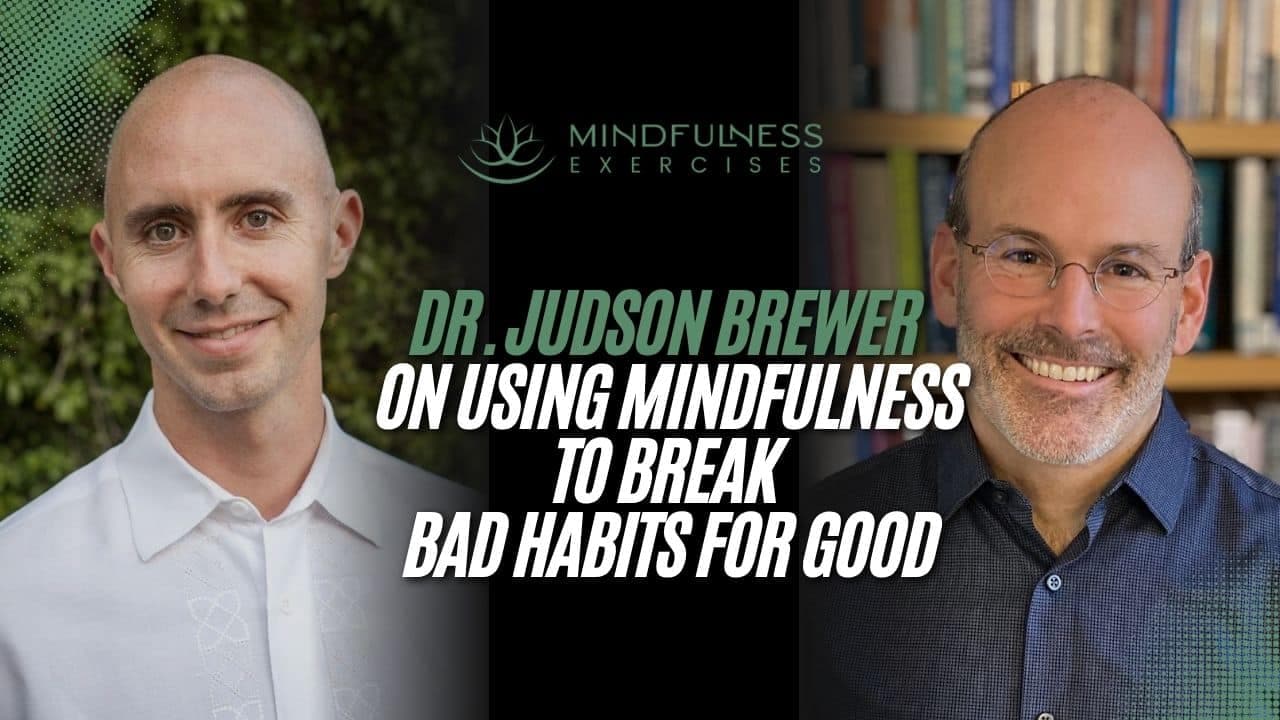
Speaker 1 · 0:00Welcome everyone. My name is Sean Fargo, founder of Mindfulness Exercises. Today, the honor of speaking with Judd Brewer, or Dr. Judd, as he's commonly known. Dr. Judd is the New York Times bestselling author and thought leader in the field of habit change and the science of self-mastery. He's written several best-selling books, including The Hunger Habit, Why We Eat When We're Not Hungry, and How to Stop. Also, Unwinding Anxiety. New science shows how to break the cycles of worry and fear to heal your mind. He also wrote The Craving Mind, from cigarettes to smartphones to love, why we get hooked, and how we can break bad habits. Dr. Judd has been a guest teacher for our mindfulness teacher certification program, giving workshops, habit change, and anxiety. And he shares some of the same mindfulness and meditation teachers that I have in my life. He's a dedicated mindfulness meditator and practitioner who really is a pioneer in learning the science of habit change, the craving mind, to help us to live with more peace and ease, non-clinging, so that we can feel more balanced and have more choice in our lives. He's an excellent teacher. He has a TED Talk online that has many, many, many millions of views. He's very personable, kind, and it's a real honor to speak with you again, Judd. For those of you who may not know, he's very passionate about understanding how our brains work, how to use that knowledge to help us to make deep and permanent change in our lives with the goal of reducing suffering in the world at large. He's the director of research and innovation at Brown University's Mindfulness Center, where he also serves as an associate professor in behavioral and social sciences at the School of Public Health and Psychiatry at the School of Medicine at Brown University. And also he's a research affiliate at MIT. Previously, Dr. Judd held research and teaching positions at Yale and the University of Massachusetts Center for Mindfulness. I highly encourage everyone listening to check out his website, drjudd.com, and to check out his books wherever you buy your books. And so, Dr. Judd, welcome to the podcast. It's an honor to see you again, and I'm looking forward to diving into your story a little bit. So welcome. Thanks for having me. Yeah. I'd like to start by learning a little bit about your personal journey with mindfulness and/or meditation. What started your journey with mindfulness?
Speaker 2 · 3:01Long story short, I was pretty stressed out at the end of college and the beginning of medical school. And I remember the summer before starting medical school, somehow the John Kubitzen's Full Catastrophe Living book landed in my lap. I read some of that and started listening to the cassette tapes of Guided Meditations my first day of medical school. It felt like a new chapter in my life and seemed like, you know, this was something new to try. Full disclosure, I'd falling asleep for probably six months, those first six months of listening to those meditations. But after a while, you know, started to get getting the hang of it. And one thing I realized was that medical school wasn't teaching me some of these fundamental truths about the mind. And so as I went through my MD PhD program, you know, over the next eight years, really got deeper and deeper into the practice and studying the Buddhist psychology underlying all of these practices. When I was went back into the wards at the end of medical school, started hearing my patients using very similar language around suffering. And at that time, I realized that it was, you know, for me, it was really important to combine my personal experience and exploration of Buddhism with my career. And so I shifted gears from doing molecular biology research to studying neuroscience and clinical trials and during residency, shifted my entire career, you know, my research focus, my career to studying mindfulness. So just bringing that personal understanding into the research sphere.
Speaker 1 · 4:39Yeah. And what a fortuitous time to have been, you know, in Massachusetts at that time when Doc when John Cabotzin is really, you know, providing a lot of research to the effects of mindfulness. Had you met him or were you just kind of aware of the book that was released? And what drew you to the book?
Speaker 2 · 4:58I don't remember what drew me to the book. I can't remember how it landed in my lap, honestly. But when I was in residency, so this is about 10 years after I'd started practicing myself, I was at Yale at the time. And I remember getting a you know a research week where we could go and do, you know, go to a conference or something. And so I ended up going down to Washington, DC, where there was a one of those mind and life conversations with the Dalai Lama. And I was really blown away by how people were moving this research into the mainstream. I've been told, you know, by people at Yale that, you know, it was going to kill my career if I studied this stuff. Because it was very early days, you know, even though John Covidson had been doing research since the 70s, you know, this is the early aughts, really hadn't taken off much. And there were very few institutions or even programs. You know, there were very few centers, for example. There was the Center for Mindfulness at UMass, Richie Davidson's group at Wisconsin, you know, was a pretty established group, but that was about it. There wasn't much going on. So I was really just trying to explore whether this was viable. And I remember talking to one of the people, I think, who had been on stage with the Dalai Lama, John Teesdale. This was just a couple of years after their real landmark study around mindfulness-based cognitive therapy for depression had come out. And they were just in the process of publishing the replication. And I asked him, you know, I was like, Can I do this? And he said, Yes. You know, this is you go for it. And so I remember saying, okay, I'm, you know, I'm all in. Never looked back. You know, I figured I'd rather fail at something that I was passionate about than succeed, you know, doing the usual stuff that that I'd been doing that many other people could do as well or better than I could.
Speaker 1 · 6:49Sure. It's really fascinating. When you started practicing mindfulness, you maybe half-jokingly said that you were kind of falling asleep a lot. And I'm sure you were super busy with your school work and you know, just ramping up your career. But what kinds of practices spoke to you the most, or which ones do you remember providing a lot of juice for you personally when you were starting out?
Speaker 2 · 7:16It's been a while. What I do remember is during boring medical school lectures that I would find myself going to breath awareness practice. And I remember thinking, well, at least I'm not going to completely waste my time in this lecture because I'm, you know, I'm at least doing some mindfulness training. Uh so that was that was something that was helpful early on. Although ironically, I remember also, geez, I don't remember when this was, maybe my second year of medical school. I went on my first seven-day silent meditation retreat. It was led by uh Bhante Gunaratna, who has a yeah, he's a center in West Virginia, I believe. And I remember by day three crying uncontrollably on the shoulder of the retreat manager because I was thinking, you know, I can I can get into medical school, but I can't pay attention to my breath. So I felt like there was something wrong with me. Yet, you know, it probably took me 10 years to realize that I was taking the Western, you know, grit your teeth and try to force it approach to meditation, which is the opposite of what it's about.
Speaker 1 · 8:21Yeah. And for context, Bhante Gunarotani, some people call him, wrote Mindfulness in Plain English, which is a seminal book for a lot of Westerners and highly recommended to anyone listening for a very accessible approach to mindfulness and how to weave it into daily life. That's really cool that you did a retreat with him. And yeah, day three is usually when the tears start shedding for a lot of people. For a lot of you listening, you know, I think it's really helpful to hear from, you know, Dr. Judd that, you know, a lot of us can treat meditation as a to-do or a chore, you know, a way to fix ourselves, quote unquote fix. But, you know, we can be mindful of that. You know, how are we treating mindfulness? Can we find some ease in it? You know, treat it as a journey and not an outcome. And we all have our challenges with meditation. The fact that you had a retreat manager to, you know, cry on their shoulder speaks to the need for community, the need for others who can support us on our path. And we can then, you know, support others on their path as well. Thanks for sharing that. I'm curious in a professional context, if you had ideas in the beginning about what kinds of practices may have the most potential in, say, a medical context or a secular clinical context for you know improving people's lives. Did you have a sense of a practice or a discipline that you thought had the most potential in the early days?
Speaker 2 · 9:56Well, I was pretty, I was more naive even than I am now. And so having been mostly steeped in the Theravada tradition, which I think spoke to me because it is a very kind of a scientific approach to experience. It's interesting there are these different schools that probably resonate with different people based on their personality and their conditioning. And this was the one that spoke to me the most. In our first randomized controlled trip, well, actually, this is even yeah, we did a couple of randomized controlled trials where you know brought in some of the practices that I learned and seemed to have, you know, have applicability to people with addictions. So for example, in our first study, we worked with people who were addicted to alcohol and cocaine and you know, brought in breath awareness, brought in a RAIN practice. This is this popularized by Tara Brock, you know, recognize, you know, allow and investigate, and and it has has morphed over the years, but back then it was described as non-identification. It was actually Michelle McDonald, I think, who'd first put this acronym out. And so we'd we'd brought that into some of our studies, also brought in loving kindness practice, which is really critical for people with addiction, where there's a lot of self-judgment, a lot of societal judgment. And I remember analyzing our first smoking study where we had brought these practices in. And I was thinking, oh, these formal meditation practices are going to be most helpful. And so we analyzed formal versus informal mindfulness practices. And it turned out that both were helpful, but most helpful were these informal practices. And it really kind of was a great humbling reminder that I can go in with certain ideas, but really it's about me setting up experiments that let the data speak, you know, let the data points speak for themselves. And it was really helpful because it opened up my eyes to what I was seeing clinically, but may not have been paying attention to enough, which is, you know, I had a lot of patients, whether it was I was working at the VA hospital at the time, so who were really, you know, they weren't set up to have some formal meditation practice, but they could learn to do an informal practice. And here, you know, I look to what the a lot of Tibetan teachers talk about in these short moments many times as a way to set up a habit. And that's what our data showed was, you know, having giving people skills that they could use in the moment that they had a craving for a cigarette, for example. Those skills were the ones that drove the biggest reductions in cigarette smoking, much more than formal mindfulness practices did.
Speaker 1 · 12:39And when you're saying informal practices, you know, earlier you you referenced, say, loving kindness practice, rain, which in some people may describe those as more like heart-centered practices. Are you saying that the informal practices were the heart practices or were they something different?
Speaker 2 · 12:59It's a good question. So the rain practice was one of these informal practices that people could bring into the moment that they had a craving. The more formal practices were things that we had set up, you know, and you can do loving kindness informally, of course, but we had set it up as, you know, a certain number of minutes that people would sit down and meditate and practice going through these phrases, much like the commentaries suggest. Also, breath awareness, you know, body scan, those are more, we just categorize those as formal practices, but our operational definition was just that somebody would sit down or lie down or you be in a sequestered environment to do them as compared to doing the practice on the fly.
Speaker 1 · 13:42Yeah. Yeah. Yeah. So that a rain practice that, as you said, Torah Brock is helped popularize, has been around for quite a while. You mentioned that you know, the breakdown of it and things a couple of the letters have morphed over the years a little bit. But generally speaking, you know, recognizing what's here, maybe just pausing and, you know, noting what's happening, you know, physically, mentally, emotionally. I'm the A. I've heard, you know, allow or accept different A's, but not fighting it, not resisting it, not judging it, but rather just kind of being able to be with it, maybe with some sense of gentleness. I like investigate, you know, unpacking it, sensing deeper, maybe asking some questions. Some people might journal. And then the N is, you know, you can take your pick, but I think early on it was non-identify with the emotion or the experience. It's not all of who I am, you know, I'm more than this, or you know, I'm not this thing right now, which is always changing anyway. But some people like nourish ourselves with kindness or, you know, attention or something that will help us to find comfort or ease or safety in that moment. And then nurture, I think, is another one that some people like, which is very comparable in my opinion to nourish.
Speaker 2 · 15:09But I'll just add there, yeah. Sorry to jump in. The one thing that we've used, and this was I pilot tested this in my clinic. The, and I'd also been doing some practice if in this tradition at myself at the time. So the Mahasi Saidao practice of noting, you know, also starts with N. And so we played with that and found that that was very accessible to people of any background, of any education level, et cetera. And it was really helpful for, you know, that the noting really literally helps people not identify with their experience. If you think of the, you know, in physics, they talk about the observer effect, or in psychology, they talk about the Hawthorne effect. By observing, you're going to affect the results. And I think that noting practice is a really good way of learning how to do that very quickly, where by noting our experience, we're less identified with it. And that can be really helpful for anyone ranging from struggling with addiction to anxiety.
Speaker 1 · 16:13Wow. I want to unpack that with you, say, in a in a clinical way, in noting, you know, do you note emotions, physical sensations, changing nature of things? But for context, for some of the listeners, I think it might be helpful that to hear that the noting practice has been around for centuries or millennia. I think. I don't I think Mahasi was not the first, but I believe it's been around for a long time. And is, you know, one of the early practices brought to the West. Mahasi came over and taught it and you know, influenced people like Jack Cornfield and Joseph Goldstein and Sharon Salzberg, who are, I believe, some of Jud's teachers and some of my teachers. And now there's a new wave of research, and maybe you can speak to this about social noting practice around not just noting internally, but noting interpersonally, you know, noting your experience in real time out loud and sharing it with others. I'd love to hear what types of noting practices if you've have you found helpful in terms of noting physical or emotional or mental thoughts and how that plays with, say, addiction and and the easing of cravings.
Speaker 2 · 17:29It's a great question. As a place to start, I have people start with their five senses plus thinking. And what I found is that it's it's easy to get caught up in the procedure when that doesn't need to happen. So if it one way to bypass that is to have people just note, you know, thinking, feeling, if they're feeling physical sensations, seeing, hearing, tasting, you know, et cetera. So they're five senses plus thinking until they get the hang of just noting, you know, it's like, oh, seeing, hearing, feeling, thinking, that type of thing. I've also found that I guess this may be a form of social noting. I've taught my patients to do ping pong noting. I don't remember who I learned this from originally, but basically two people who are basically just holding each other accountable. So one person notes, then the other person notes, then one person notes. And it doesn't matter what they're noting, it just matters that each one is the witness there and holding the space to practice noting together. So for example, couples can do it when they're your families can do it when they're driving, you know, if they're both in the front seats of the car. Patients have pointed out how it's helpful for if they get nervous with their partner driving, you know, and they both do noting practice together. It also helps somebody driving pay attention to what's happening in their experience, which is really helpful, you know, because often people zone out when they're driving. You know, that can be very helpful. Now, the from an addiction standpoint, I also find that it's extremely helpful with cravings. And I still remember, I think I wrote about this in the craving mind, but I remember a patient at the VA hospital who walked into my clinic one day and he walked into my office and he said, Doc, I feel like my head's going to explode if I don't smoke. You know, I never experienced chief complaint of head exploding before. So I went to my, you know, my fallback, my habit, which is to my whiteboard. It was right, you know, in my office. And I asked him to start noting. You know, I didn't say, you know, here's noting practice. I don't think he knew it at the time. Just said, Hey, just describe what your experience is like, you know, and and I gave him the parameters like, does it feel like tension or tightness? And is is the craving getting stronger or weaker? And so I just drew as he noted, you know, he's like, Oh, there's tightness, there's tension, there's burning. So it is getting stronger. And so I drew this arrow in and vertical upward on the board. And then at some point it kind of peaked and started declining. And at that point, his eyes got really wide. And I asked him what he just noticed. And he said, you know, I always smoke before the thing peaks because I feel like my head's going to explode. So I make sure my head doesn't explode. He said, This is the first time I noticed that these cravings come and go on their own. And that happened just spontaneously through us, you know, going through this noting practice together, where he was noting his experience and I was mapping it out on the board for him to realize, oh, these are these are not me. This is in, you know, this is not self. This is impermanent. It comes and goes. And the noting practice helped him really be with that experience rather than be identified with it.
Speaker 1 · 20:45So powerful. Yeah. And I think, you know, you mentioned earlier how what we're learning in physics can say validate what happens in these, say, Theravadan practices. You know, a lot of Theravadan monks and deep practitioners were former physics majors in college. And a lot of Theravada Buddhism is just about understanding the mind. That's really all it is. It's really not that belief base, it's just being curious about what's actually happening. And I think that lends itself well to people in medicine and working with mental health that the goal is the same, just to understand the mind and how we can be happy, basically, live with less suffering.
Speaker 2 · 21:30And didn't the wasn't the Buddha famous for saying, maybe even on his deathbed, you know, don't believe what I say, you know, don't see for yourself. Very evidence-based. Very evidence. Collect your own data.
Speaker 1 · 21:42That's right. Yeah. Be a lamp unto yourself. Yeah. Jed, I'm curious how the transition, by the way, I think the way that you helped that person whose head was going to explode was brilliant. It was, you know, you met him where he he was at, you worked with him, you know, in a very kind, just you know, accessible way. You didn't say, okay, now sit in an erect posture and we're going to do a noting practice, and you know, here are the steps. You just asked him, how does it feel? And it was a very organic way of teaching and inviting him to be present for his experience in a kind way. And so I'm I'm curious how the transition went for you from practitioner and researcher to teacher in teaching a lot of these practices. What was that transition like and and how did it go?
Speaker 2 · 22:36It was probably very gradual. I haven't really, this is a great question. I haven't really thought about it much. So we can kind of unpack it in real time. I remember certainly trying out some of these practices with my clinic patients and my infinite gratitude to my patients for letting, you know, being my guinea pigs for like, oh, let me try this practice, let me try this, you know. And I would use as a as a guideline, you know, if they if they remembered it and practice it before their next visit, then it was worth exploring. And if if they came back looking glassy-eyed when I said, How'd that go? Then I knew that that wasn't something that was going to be, you know, worth exploring. So I kind of pilot tested a lot of these practices for accessibility based on my VA patients. So I guess that was a piece of mini, you know, micro moments of teaching. And I remember I was still at Yale at the time and I was talking to Joseph about, you know, I think somebody had asked me to start a meditation group or something on campus. He said, Oh, yeah, yeah. I think, you know, I think you should do that. And I was like, I don't know if I, you know, if I'm qualified enough to do this. I, you know, I'd been only been practicing about 12 or so years at the time. I went ahead and he said, you know, just don't, he and several other teachers all independently say the same thing, which is just don't teach outside of your direct experience and you'll be fine, which is gold, right? So the best thing a doctor can say is, I don't know if they don't know. And I think that also translated into teaching for me. It was like, if I didn't know, I was like, okay, that sounds interesting. I don't know, you know, from my own direct experience, but that was really helpful. I learned later, uh, Jose Joseph jokingly said that you know, he had he had met some law students or something at Yale. And he's like, wow, those students really need a lot of help. So he kind of threw me into this crucible of there can be a lot of pressure on Canvas, let's just say. And so it was a great proving ground for kind of cutting my teeth on teaching. And I remember I would the group started out as a Sunday night group at the one of the chapels, and you know, I'd spend the week exploring a topic and then, you know, write write up kind of a short talk, you know, during Sunday, kind of like a sermon to so to speak. But it was really not, you know, there are parallels, but all the differences. And then, you know, the group just grew a bit. And you know, I learned a lot from that Sangha, and also you know, reminded me of a saying I learned in in my psychiatry training, which is, you know, your patients vote with their feet. So if you're if you're doing something that's working, people will continue to come back. And if not, you know, it's it's not gonna work out. And so there was something there where there was a mutuality around this need for sangha, for community, and then being able to speak a language, you know, this science and bring it together with direct experience and practice and even stories from my clinic that seemed to, you know, seemed to be a good mixture, a good formula for, you know, bringing, you know, my my first experiences of learning how to teach. And then it the more I could, and all my research is based on like testing these Buddhist theories, like, let's test this one. Oh, yeah, this is true too. You know, so the more I could bring the science in, the more I could bring together the language of science with the language of practice. And also the practice helped hone what questions I would ask scientifically. So kept the practices, the questions very pragmatic. You know, I had a research mentor, his name was Bruce Roundsville, who used to say, so what? You know, and he was a he was a psychiatrist, practicing psychiatrist as well as a really brilliant researcher. And that question always kept me grounded in like, how is this gonna help people? And I thought that was very helpful as well. And so bringing all of those together, you know, I think that really informed, you know, my research, my own personal practice, informed the teaching, but the teaching also fed back and informed the research and my clinical practice.
Speaker 1 · 26:41Beautiful. You know, you help a lot of people with addiction and unwinding anxiety, and there's you know, obvious parallels with Buddhism there. Did you kind of choose addiction because of its parallel with Buddhism in terms of you know calming the craving mind, which is you know directly from the you know, Four Noble Truths and the Eightfold Path? Was it because of that correlation, or was there something, say personal or some other reason why you kind of chose addiction as one of your specialties?
Speaker 2 · 27:18I'd like to say that I chose it, but I don't think that's true. I think it chose me. And what I mean by that is when I one started to see how Buddhism was describing addiction so much more clearly and pragmatically than what I'd been learning in the Western science med school residency. You know, I think they gave it valiant efforts, but really had had ignored the, you know, this fundamental science that had been there for 2,500 years. And so kind of seeing these parallels and asking these questions, like, wait, why don't we, why are we reinventing stuff or trying to, you know, discover new things when it might already be here? That was really bolstering for me, but also just the way that my patients spoke, I I could really relate to that. And on top of that, you know, there's people with addiction really suffer a lot. I mean, we all have addictions of some sort, yet the societal judgment and stigma that comes with addiction and self-judgment, you know, there's a lot of a lot of suffering there. And so I could, you know, really resonate with that and felt moved to help in whatever way I could. And on top of that, it helped me discover how many things I was addicted to myself. And so it just seemed like a commonality. We were all gonna link arms and march forward together. That's for sure.
Speaker 1 · 28:41Yeah. I, you know, to this day I find myself noticing addictive tendencies arising, you know, the flavor of the week or the flavor of the month, but still it's that sort of underlying sense of dis-ease or inability to be with what's kind of troubling me, either consciously or subconsciously, you know, past traumas that haven't been fully processed. And, you know, we all have our stuff. And I think that I agree with you. I think we all have addictions to something, whether they're stigmatized or not, you know, Netflix, wine, certain patterns that we have that don't quite serve us very well. I think that addiction is not just reserved for the people who, you know, drink a bottle of Jack Daniels every day. It's something we can all look at internally and find compassion for ourselves and for others because we do have this shared challenge. And I think it just it speaks to that need for care for ourselves and for others because life is hard and we all we all need help.
Speaker 2 · 29:52Yeah. Well, and I think there can be, you know, one thing that I realized in doing the research for my for the craving mind. My first book was realizing just the subtle levels that addiction can manifest, whether it's distraction, whether it's addiction to thinking, you know, boy, when I would go on long silent retreat, my my brain would perk up and say, Ooh, I get to think, you know. And it took me a while to realize that addictive pattern, but even addiction to, you know, romantic relationships. If you look at certain, you know, quote unquote personality disorders, you can see even borderline personality disorder as being an unstable, you know, the definitions, the unstable sense of self, where someone could be addicted to stability, for example, where they've they've gotten intermittent reinforcement around stable relationships in their lives, or look at narcissistic personality disorder, which is on the opposite end of that spectrum where they're so enamored with themselves. You know, they they create their environment to be surrounded by people who are going to give them praise and feed, you know, kind of feed that addiction. So there are so many ways that we can be subtly addicted to ourselves, you know, and and I think Buddha even highlighted this the self at a very fundamental level is an addiction because it causes suffering.
Speaker 1 · 31:17Totally, yeah. And conceit is one of the very final like fetters to unwind before enlightenment that sense of me or I amness. I remember I was on retreat once with Guy Armstrong, senior teacher at IMS and Spirit Rock, and I had been like furiously journaling and thinking about Buddhism on retreat. And Guy Armstrong said, Oh, those are the golden handcuffs. You think that this is forward-leaning and wholesome, and there's nothing inherently wrong with it per se, but it's so attractive, you know, golden that like it feels good and it feels wholesome, but it's also handcuffing you away from the present moment. Like you're you're attached to thinking, you're addicted to this thinking and contemplating that, you know, on retreat, how much have you actually been present? How much have you actually been here on retreat versus you know, thinking about you know, medta practice? You know, you're you're thinking a lot. And that's so these are the golden handcuffs. And it just speaks to this nuance of these layers of kind of grasping on to things at the sake of actually being here now and noticing what's here in the present moment. Jed, I'd love to segue into what you're teaching about now, what you're working on now. And I believe you've did you start a nonprofit around anxiety and and what's that about?
Speaker 2 · 32:50Yes. So the we we I co-founded a nonprofit called Mind Shift Recovery. Anybody can check it out. The website's mind shiftrecovery.org, and there's a free app called Mind Shift Recovery. And this was born out of kind of 20 years of waiting, of research, of practice, of clinical work. And what I mean by that is you know, my lab for the last 15 years has been developing and studying digital therapeutics. So we created apps for smoking, for eating, for anxiety. I never felt comfortable from an ethical standpoint of creating an app for addiction. It just felt like that was I needed to provide more than just an app. Over the years, we've been exploring a flipped classroom model where we pair an app with in-person or virtual support. And we've been training pure mentors, people who have gone through our mindshift recovery methodology, which is based on this, you know, 20 now two decades of research, where people can learn the methodology through an app so that the mentors aren't expected to be teachers. They're not expected to be therapists, all these things that often are laid at the feet of sponsors, for example, in 12-step programs, where they're just not trained for a lot of this. And that I've seen that lead, unfortunately, to a lot of problems. So here we can provide a very evidence-based curriculum, not expect peer mentors to teach that curriculum, but we can have peer mentors support each other through their own experience, right? Don't teach beyond your own experience. And importantly, we have very clear and very few rules for them. One is don't give advice, two is speak from your own experience. That gives a lot of guardrails, even those two rules. We have a lot of guidelines, but only two rules. And those rules really help keep folks from getting inadvertently getting into trouble where they might be going beyond what their own expertise is. If you don't go beyond your own experience, you're not going beyond your own expertise. And so we found that this can be a way to support people at scale. You know, mostly we're supported by donations, but also are, you know, working on government grants and things like that to support the programs. But the idea is to provide this free of cost because there are a lot of predatory addiction quote unquote services out there whose business models are based on people not getting better because if they come back to the rehab, then they get more money. And so I've also seen that, you know, with a lot of patients firsthand. We what really want to provide something that has enough of a foundation and has enough support that is really gonna help people and not create harm. You know, as a physician, I took a oof first do no harm. So it took 20 years or so before I felt comfortable putting this together. And now we've got something where we're we're getting some very nice proof of concept. And this is for any type of addiction. So typically people think of chemical addictions, you know, cocaine, alcohol, fentanyl, whatever, but we're actually able to extend this because it is a universal process, to porn addiction, to, you know, people getting being addicted to their news feeds, to even anxiety. We don't have time to talk about that today, but the anxiety was a whole interesting avenue of research that I didn't even know anxiety could be, you know, could become habitual, where people get literally, as some of my patients described it, they get addicted to worrying. And this can be, we can learn how this process works and learn how to work it. This was the whole basis for the unwinding anxiety book. But we can package all of this together in this free mind shift recovery app and then have people get peer support as well.
Speaker 1 · 36:29Beautiful. I'm at mind shiftrecovery.org right now, learning about it. And I I recommend that everyone listening or watching checks it out. We'll put links in the show notes and the descriptions. It looks like the mind shift method offers a three-step approach. Could you just quickly outline what that is and how the app sort of delivers that?
Speaker 2 · 36:50I'd be happy to. So the more we learn, the more things get condensed and simplified. You know, if something finds that it is multiplying because you have to keep adding in clauses or you know, caveats, then you probably haven't gotten out of fundamental truth. You know, I love this about Buddhism. There are four noble truths. There aren't 14 or 40 or 400, you know. And based on that, you know, the first we we call this gear, the gears process. Because I like to ride bicycles. So you can think of a gears as you know, in a car or bicycle, you shift into first gear to get going. And that first gear is just recognizing what the habitual behavior is. You know, it can be as simple as that. And in fact, we have a mapping process that people can get through mind shift recovery, or there's a we got a URL called mapmyhabit.com. So if somebody wants to download a free PDF to map their habits, they can that's an easier one to remember. So that's the first step, really, is just mapping out our habit loops. The second step is looking at is is cribbed straight from the poly canon, where we have people ask a simple question, what am I getting from this? And this comes from where the Buddha talked about exploring gratification to its end. You know, he talked about his enlightenment. He said, It wasn't until I explored gratification to its end that knowledge and vision arose, you know, that he basically got enlightened. And the idea there is if you look at it from a modern neuroscience standpoint, if something is rewarding to our brain, we're gonna keep doing it. If it's not, we're going to stop doing it. And the Buddha described this in terms of disenchantment. So if we explore gratification to its end and something's not helpful for us, we're going to become disenchanted. But we have to pay attention. That's where awareness is critical. And so that's the second step, which is have people ask, what am I getting from this? And feel into their direct experience, not just think about it. And then the third step is related to the second. So if we become disenchanted with our old habits, that gives room to become enchanted with new habits, which can simply be stepping out of the old one and on top of that, finding ones that are more rewarding. So, for example, if we have an addiction of any type, we can notice that craving and get curious about it, just like we spoke about with my patient whose head was going to explode, right? He got curious about his craving and he could notice that it passes. So, what feels better? Being curious or having a craving, right? It's a no-brainer. So we can train people in these, what I call these bigger, better offers, where they can learn to become more curious as the new habit. On top of this, they, if somebody has a habit of judging themselves, they can compare that to what it feels like to being kind to themselves. Again, no-brainer, kindness feels better. So that's the third step is just finding these bigger, better offers and then comparing them so that our brain, you know, our brain knows what to do. It's just a matter of bringing awareness to it and to the process.
Speaker 1 · 39:45Beautiful. Yeah, you're like just inviting people to notice for themselves what is your addiction or your habit. Where does that lead? And where is a bigger, but better offer? I don't mean to butcher it, but very simple. And we all need help doing these types of things. I'm looking at your app right now and it looks really cool. I'm going to share this with our community. I love the premise behind it. It looks like there's some live calls that are offered a lot of, yeah, like a step-by-step journey to help people through this. So yeah, for everyone listening, please check out mindshiftrecovery.org, whether you want to use it for yourself or with your clients, your students, or your colleagues. I think this seems like a very accessible approach to wellness. Dr. Jedd, thank you so much for your time today. It's really a pleasure to reconnect with you. I hope to speak with you again at some point, but I'm a big fan of your work and how you're going about things, really teaching with integrity and just being very vulnerable and authentic about your journey. It's really uh neat to listen to your journey of meeting mindfulness practice and then over time using it to help millions and millions of people in various ways. So it's an honor to speak with you again. Thank you so much for everything you're doing. Do you have any final words that you'd like to share before we fare each other well?
Speaker 2 · 41:06I guess I would just say don't underestimate the power of curiosity and kindness. Beautiful.
Speaker 1 · 41:13All right. Well, thank you, Dr. Judd. Thank you, everyone, for listening and watching and wish you well. Thank you.