
Listen now


Breath is always with us.It arrives before language, before memory, before identity—and yet, in the rush of modern life, it’s often the last thing we notice.
We gasp for it in moments of fear. We forget it in moments of distraction. And somewhere between those two extremes lies a powerful, living practice that has quietly helped humans heal, regulate, and reconnect for thousands of years.
In this episode of Breath That Changes Everything, we sit down with Anthony Abognano, founder of Alchemy of Breath, to explore the lineage, physiology, and inner work behind conscious connected breathing—a practice that goes far beyond relaxation and into transformation.
This conversation bridges ancient mindfulness teachings with modern nervous system science, weaving together personal stories, therapeutic insight, and deeply practical tools you can use immediately.
Whether you’re a therapist, coach, educator, parent, or simply someone longing for more steadiness in your body and clarity in your life, this breath may change everything.
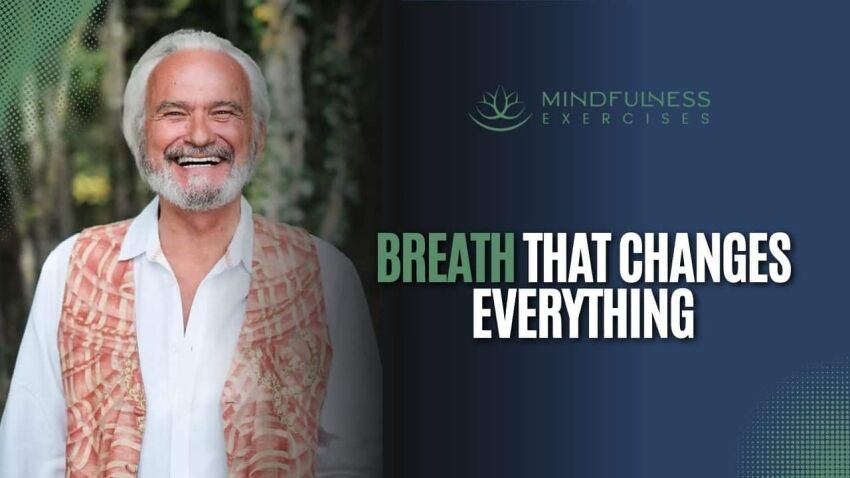
Sponsored by our Mindfulness Meditation Teacher Certification Program
certify.mindfulnessexercises.com
Episode Overview:
Topics Covered:
- The lineage from Anapanasati to conscious connected breathing
- Nervous system regulation and CO₂ physiology
- Facilitator training and inner work
- Holding space for trauma, grief, and end-of-life
- Breathwork in relationships, classrooms, and leadership
- The billion-breath vision for collective healing
Resources:
Visit Anthony’s work at Alchemy of Breath
Show Notes:
Breath as a Living Lineage
Long before breathwork studios and wellness trends, there was Anapanasati—the Buddhist practice of mindful breathing. At its core, Anapanasati is about awareness: noticing the breath as it is, without force or control.
Conscious connected breathing grows from this same root but follows a different doorway.
Rather than counting breaths or regulating the inhale and exhale, this practice invites continuity—a gentle, unbroken flow where the inhale rolls naturally into the exhale, and the exhale gives way to the next inhale.
No pauses.No forcing.No striving.
Just presence.
Anthony describes this not as a technique to master, but as a relationship to surrender—a way of letting the breath breathe you.
From Control to Surrender: Why This Breath Works Differently
Many traditional breathing practices focus on control: counting, holding, pacing. These methods can be incredibly helpful, especially for building awareness and discipline.
But conscious connected breathing works on a different layer of the nervous system.
As the breath becomes continuous, subtle physiological shifts begin to happen:
- Carbon dioxide levels gently change
- The frontal lobe quiets
- The thinking mind softens
- The body moves out of defense and into expression
This is why emotions, memories, and sensations can arise—not as something being forced open, but as something finally being allowed to move.
Anthony emphasizes that this isn’t about “fixing” trauma.It’s about creating safety—so the body can complete what it never had space to finish.
Holding Space: Why the Inner Work Matters
One of the most striking parts of this conversation is Anthony’s description of facilitator training at Alchemy of Breath.
Students don’t just learn how to guide sessions.They are asked to know themselves deeply.
This includes:
- Writing a full autobiography
- Exploring birth imprints and early conditioning
- Practicing in real-world environments early on
- Learning to sit with grief, trauma, and end-of-life experiences
Why?
Because when someone else is breathing through pain, fear, or loss, the facilitator’s nervous system becomes the anchor.
Presence can’t be faked.Stillness can’t be memorized.
It has to be lived.
Speaking From Stillness
In intense breathwork sessions, words matter—but not many of them.
Anthony shares how facilitators are trained to speak from stillness, not from urgency or ego. When guidance comes from a regulated place, the body receiving it feels safe enough to soften.
This is nervous system co-regulation in action.
It’s also leadership.
Whether you’re guiding a breathwork session, teaching a classroom, leading a team, or parenting a child, your internal state sets the tone long before your words do.
Everyday Miracles: Breath in Real Life
Some of the most powerful moments in this episode come from simple stories:
- Couples who interrupt conflict by taking ten conscious breaths together
- Classrooms that settle after recess with a shared breathing pause
- Practitioners who transform their own wounds into service for their communities
These aren’t dramatic breakthroughs.They’re quiet rewrites of how humans relate to stress, connection, and choice.
Breath becomes a bridge—between reaction and response, between isolation and presence.
The Hero’s Journey of the Breath
Anthony frames breathwork through a mythic lens: the hero’s journey.
We begin in the known world.
We encounter discomfort.
We descend inward.
We return changed—not fixed, but more whole.
Conscious connected breathing isn’t about bypassing pain.
It’s about learning how to stay.
And in staying, something alchemical happens.
A Billion Breaths: A Vision for Collective Regulation
Anthony shares a vision that feels less like a goal and more like a ripple:
Ten people invite ten more.Across nine waves.One billion conscious breaths.
Not as a movement fueled by urgency—but as a quiet re-education of the nervous system, one breath, one relationship at a time.
In a world shaped by speed, this feels radical.
How to Begin: Simple Practices You Can Try Today
You don’t need training or equipment to start exploring this work.
Here are three gentle entry points shared in the episode:
1. Try a Short Connected Breathing Sequence
Set aside 5–10 minutes.Breathe in through the mouth or nose.Let the exhale flow naturally into the next inhale.No pauses. No forcing.If emotions arise, stay with the breath.
2. Write Your Life Arc
Take a few pages and write your story—not to judge or analyze, but to witness.Where did your breath first learn to hold?Where did it learn to rush?
3. The Ten-Breath Reset
The next time tension arises with someone you love, pause and take ten conscious breaths together.Notice what changes.
A Final Invitation
Take a moment now.
Feel your breath.
Let it move without fixing it.
Then, if this practice resonated, share this episode with one person who could use a calmer nervous system today.
Breath is personal—but it’s never solitary.


