Listen now


There’s a quiet, persistent voice many of us carry—the one that says we’re not doing enough, not achieving enough, not being enough. It shows up in subtle ways: comparison, self-doubt, perfectionism, or that lingering sense that something is fundamentally off.
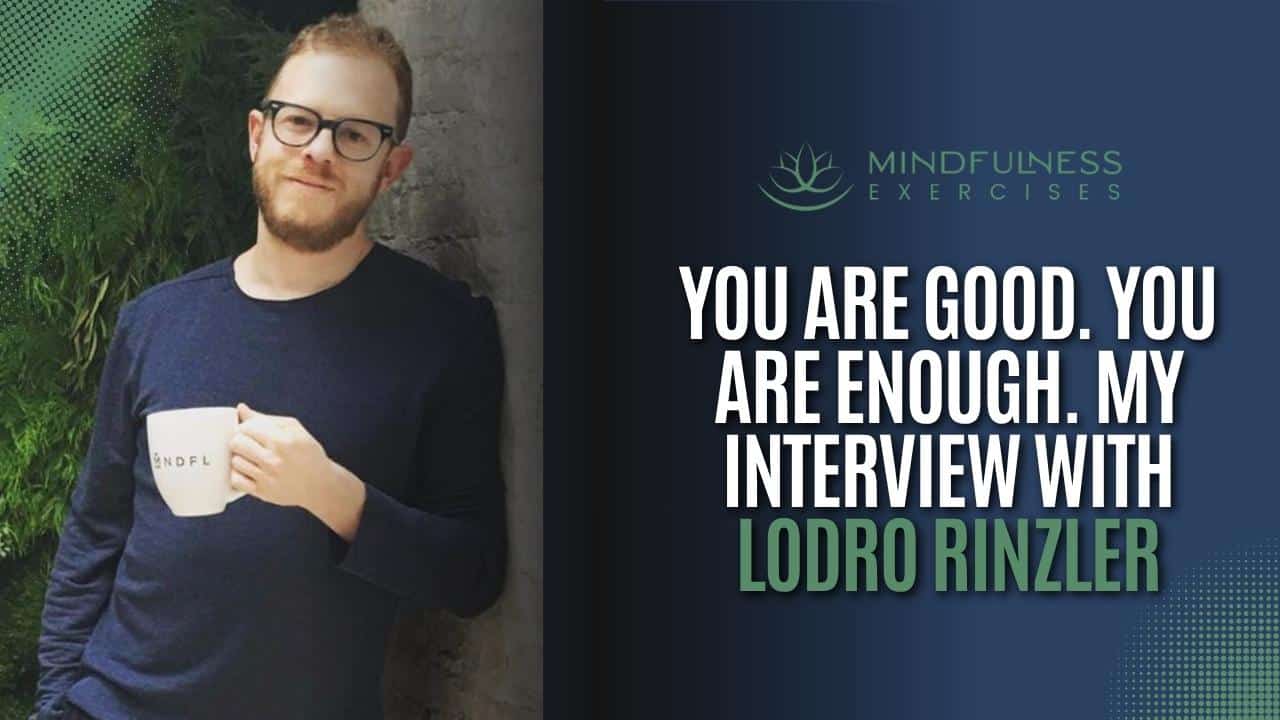
In a powerful conversation with Lodro Rinzler, we explore a radically different perspective—one rooted in Buddhist teachings of basic goodness. His message is both simple and deeply transformative:
You are not broken. You are not lacking. You are already enough.
This isn’t a feel-good affirmation. It’s a practice. A way of relating to yourself and the world that can shift how you experience everything—from your inner dialogue to your relationships and purpose.
Sponsored by our Mindfulness Meditation Teacher Certification Program
certify.mindfulnessexercises.com
Episode Overview:
Key Topics Covered:
- Why we feel fundamentally flawed—and how to shift that belief
- The Buddhist teaching of basic goodness
- Letting go of limiting self-stories
- Working skillfully with shame and self-doubt
- Cultural conditioning and the myth of “not enough”
- The role of meditation retreats and longer sits
- Aligning work and life with intention
- The Four Immeasurables (loving-kindness, compassion, joy, equanimity)
- A practical loving-kindness exercise for difficult relationships
- Imposter syndrome in mindfulness teaching
- Healthy regret vs. harmful shame
- A compassionate view of harmful behavior
Resources Mentioned:
- You Are Good. You Are Enough. by Lodro Rinzler
- Guided meditations and teachings available on his official website
Show Notes:
Why Do So Many of Us Feel “Not Enough”?
Modern culture subtly reinforces the idea that we must constantly improve ourselves to be worthy. Whether it’s productivity, appearance, success, or even spirituality, the message is often the same: you’ll be enough when…
According to Lodro Rinzler, this mindset forms what he calls a “cocoon of self-stories.” These stories define who we think we are—our limitations, failures, and identities.
But here’s the key insight:
These stories are not who we are. They are habits of thought.
Mindfulness allows us to step outside that cocoon—not by force, but through gentle awareness.
What Is Basic Goodness?
In Buddhist psychology, basic goodness refers to the inherent clarity, openness, and compassion within every human being. It’s not something you earn—it’s something you uncover.
Rather than treating goodness as an abstract belief, Lodro Rinzler encourages us to recognize it in ordinary moments, like:
- Pausing to take a conscious breath
- Noticing the warmth of sunlight
- Choosing kindness in a small interaction
- Letting go of a harsh thought
These moments aren’t trivial—they are direct experiences of your true nature.
From Self-Judgment to Self-Acceptance
One of the biggest obstacles to experiencing basic goodness is shame.
Shame tells us:
- “I am wrong.”
- “I am flawed.”
- “I need to hide.”
But mindfulness invites a different response: curiosity instead of judgment.
Instead of asking, “What’s wrong with me?”
We begin to ask, “What’s happening right now?”
This subtle shift creates space—and in that space, something powerful happens:
We stop fighting ourselves.
And when we stop fighting, we can begin to act with clarity and care.
Acceptance Isn’t Passive—It’s Powerful
There’s a common misconception that acceptance means giving up or becoming complacent.
In reality, acceptance is what makes meaningful change possible.
As Lodro Rinzler shares, when we stop resisting our experience, we gain the stability needed to respond wisely.
Acceptance allows us to:
- Acknowledge mistakes without collapsing into shame
- Learn from the past without being defined by it
- Take action aligned with our values
It’s not about settling—it’s about starting from truth instead of self-rejection.
Working with Shame, Regret, and Self-Doubt
Not all difficult emotions are the same.
Healthy Regret vs. Harmful Shame
Healthy regret says: “I made a mistake, and I can learn from it.”
- Shame says: “I am the mistake.”
Mindfulness helps us stay with regret long enough to learn—without slipping into shame.
This distinction is essential for growth. Without it, we either avoid responsibility or become trapped in self-criticism.
A Simple Practice: The Loving-Kindness Photo
One of the most practical tools shared in this conversation is a variation of loving-kindness meditation.
Here’s how it works:
- Picture someone you care about deeply
- Notice the natural warmth or goodwill that arises
- Now, gently bring to mind someone you struggle with
- Imagine them as a child—or in a moment of vulnerability
- Extend that same wish: May you be safe. May you be at ease.
This doesn’t excuse harmful behavior. Instead, it helps us see beyond fixed identities, reconnecting with the idea that everyone, at their core, shares basic goodness.
The Role of Stillness in a Distracted World
In a culture driven by speed and productivity, stillness can feel uncomfortable—even threatening.
But longer meditation sits or retreats offer something rare:
Perspective.
When we step away from constant stimulation, we begin to notice:
- How busy the mind really is
- How often we avoid discomfort
- How much space exists beneath the noise
Lodro Rinzler emphasizes that even brief moments of stillness can reconnect us to presence.
You don’t need a retreat to begin. You just need a willingness to pause.
Navigating Imposter Syndrome on the Path
Many mindfulness practitioners—and especially teachers—struggle with feeling like they’re not “good enough” to guide others.
This is often rooted in the same misunderstanding:
The belief that we need to be perfect before we can be of service.
But mindfulness isn’t about perfection—it’s about practice.
Showing up authentically, with humility and honesty, is far more powerful than presenting an idealized version of yourself.
Rethinking “Evil” Through a Mindfulness Lens
One of the more nuanced ideas explored is the concept of “evil.”
Rather than seeing it as a fixed trait, this perspective reframes harmful behavior as:
A disconnection from basic goodness.
This doesn’t remove accountability—but it does open the door to understanding, compassion, and the possibility of change.
Choosing Space Over Busy
Many of us fill our lives to avoid discomfort. But constant busyness often disconnects us from what truly matters.
What if instead of asking, “How can I do more?”
We asked, “What actually matters?”
Creating space allows us to:
- Align our work with intention
- Act from clarity rather than urgency
- Experience life more fully
Bringing It Into Your Daily Life
You don’t need to overhaul your life to begin experiencing basic goodness.
Start small:
- Take one conscious breath before responding
- Notice when self-criticism arises—and soften it
- Offer yourself the same kindness you’d give a friend
- Pause during your day and simply be
These moments may seem simple—but they are deeply transformative.
Final Reflection
The idea that you are already good—and already enough—can feel unfamiliar, even uncomfortable.
But it’s not something you need to believe right away.
It’s something you can practice noticing.
And over time, that practice becomes a lived experience.
Not because you’ve fixed yourself—
but because you’ve finally stopped trying to.