Listen now


What if the safest place you could find wasn’t somewhere new—but something you’re already doing?
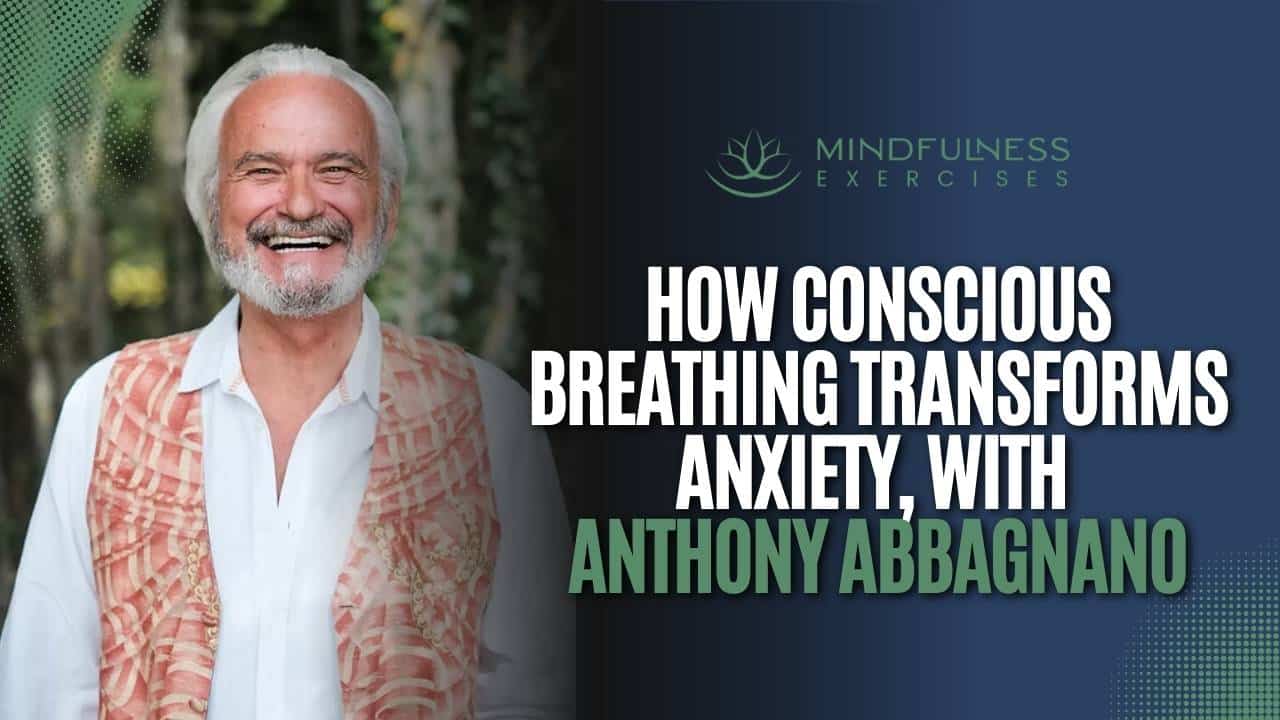
For many people living with anxiety, safety can feel elusive. The mind scans for threats, the body braces, and the breath—often unnoticed—becomes shallow, fast, or held. In this episode of the Mindfulness Exercises Podcast, we sit down with Anthony Abbagnano, founder of Alchemy of Breath and author of Outer Chaos, Inner Calm, to explore a deceptively simple truth: the breath you’re already taking can become a refuge.
This conversation is not about quick fixes or forcing calm. It’s about understanding how breathing patterns shape our nervous system, how conscious breathing can gently interrupt anxiety loops, and how reclaiming the breath restores a sense of choice when life feels overwhelming.
Sponsored by our Mindfulness Meditation Teacher Certification Program
certify.mindfulnessexercises.com
Episode Overview:
In this episode, you’ll learn:
- Why the breath can become a reliable place of safety
- How anxiety shows up in breathing patterns
- The difference between coping and true nervous system resolution
- Why hyperventilation isn’t a solo practice
- How Conscious Connected Breathing works
- A simple four-count breathing technique to calm anxiety
- How to build a personal “breath catalog” for everyday life
Show Notes:
The Breath as a Place of Safety
Anthony’s relationship with breath began early, shaped by moments of intensity and stillness. From a startling awakening during his time at boarding school to months of forced rest during a life-threatening illness, his journey revealed something most of us aren’t taught: the breath reflects our inner state—but it can also reshape it.
When anxiety takes hold, the body often behaves as if danger is imminent. Muscles tighten. Thoughts race. Breathing becomes rapid or restricted. What Anthony makes clear is that anxiety isn’t just “in the mind”—it’s a whole-body physiological response, and the breath sits right at the center of it.
By consciously working with the breath, we’re not suppressing anxiety. We’re meeting it from the inside out.
Understanding Conscious Breathing (And What It’s Not)
One of the most valuable parts of this conversation is Anthony’s clarity around what conscious breathing actually means—and what it doesn’t.
Not all breathwork is created equal.
He explains why hyperventilation is not a DIY practice, especially for people with anxiety or trauma histories. While some breathing methods are powerful when facilitated properly, attempting them without guidance can intensify symptoms rather than relieve them.
Instead, Anthony introduces Conscious Connected Breathing—a continuous, circular breathing pattern with no pauses between the inhale and exhale. Practiced intentionally and appropriately, this method allows emotions and stored stress responses to surface and resolve, rather than staying trapped in the body.
The key takeaway?
Breathwork isn’t about pushing harder—it’s about listening more closely.
The Nervous System Reset: Four In, Long Out
For listeners looking for something practical and immediately accessible, Anthony offers a grounding technique that’s especially effective during anxious moments:
Inhale for four counts.
Exhale longer than the inhale.
This extended exhale sends a clear signal to the nervous system: it’s safe to settle.
Unlike complex techniques, this pattern can be used anywhere—before a difficult conversation, during a panic spiral, or in moments of quiet overwhelm. It gently shifts the body out of fight-or-flight and back toward regulation.
Over time, these small resets add up. The breath becomes a familiar anchor rather than an afterthought.
Coping vs. Resolution: The “Octave” Metaphor
One of the most memorable insights from this episode is Anthony’s “octave” metaphor.
Coping, he explains, helps us function—but it doesn’t always complete the emotional cycle. Resolution, on the other hand, allows the nervous system to finish what it started.
An unresolved stress response is like a musical note left hanging, suspended without closure. Conscious breathing helps complete that octave, allowing the body to release what it’s been holding onto—sometimes for years.
This reframing is powerful, especially for caregivers, teachers, and mindfulness practitioners who may be highly skilled at coping but still feel stuck in recurring patterns of tension or anxiety.
Building a Personal Breath Catalog
Rather than prescribing a single “right” way to breathe, Anthony encourages listeners to catalog their breath.
Notice how your breath changes when you feel:
- Anger
- Fear
- Love
- Focus
- Fatigue
- Safety
By becoming familiar with these patterns, you can begin to rehearse supportive breathing states—practicing them when things are calm so they’re available when things are not.
This is how breath becomes a tool for agency. Not control—but choice.
From Reactivity to Response
At its core, this conversation is about shifting from survival mode to presence.
When anxiety runs the show, we’re often on the back foot—reacting, bracing, enduring. Conscious breathing offers a way back to the front foot: meeting uncertainty with curiosity, steadiness, and self-trust.
It doesn’t remove life’s challenges. But it changes how we meet them.
And sometimes, that makes all the difference.
A Final Invitation
If anxiety has ever made you feel disconnected from your body or from yourself this episode is a gentle reminder that support may already be within reach.
The breath doesn’t demand perfection.It doesn’t require belief.It only asks for attention.
Press play. Breathe along. And begin again—right where you are.