Listen now


Healing is often framed as a destination—something we achieve, complete, or finally check off a list. But what if healing isn’t about fixing what’s broken at all? What if healing is about learning how to be in relationship with pain in a new way?
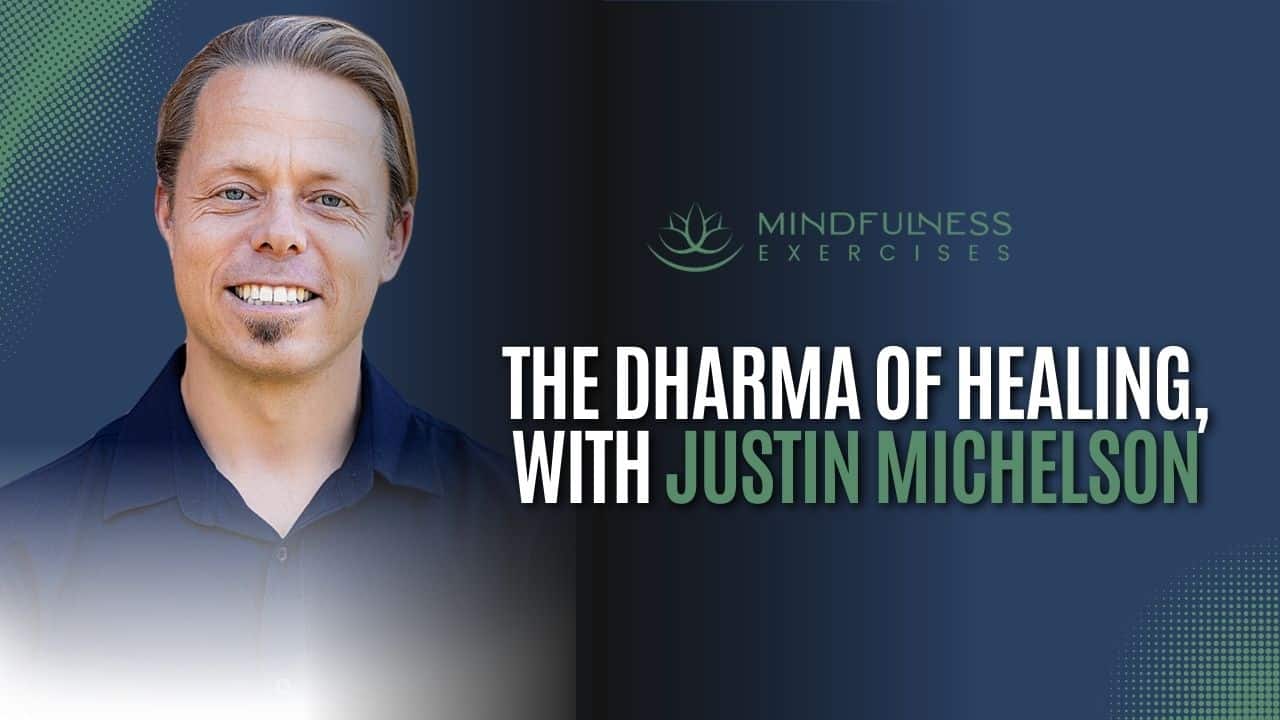
In this episode of the Mindfulness Exercises Podcast, we sit down with Insight Meditation teacher and author Justin Michelson to explore what he calls The Dharma of Healing—a deeply humane, compassionate, and spacious approach to stress, emotional pain, and trauma. Rather than striving to overcome suffering, Justin invites us to bow toward it with curiosity, kindness, and care.
This conversation is a gentle yet powerful reminder that healing doesn’t require force. It requires safety. It requires presence. And most of all, it requires compassion.
Sponsored by our Mindfulness Meditation Teacher Certification Program
certify.mindfulnessexercises.com
Episode Overview:
- Why healing is a relationship, not a goal
- How compassion creates safety for deep emotional healing
- The Four Turnings of the Wheel of Healing
- Why self-aversion functions like psychological autoimmunity
- How nature can support healing, even in urban settings
- The role of lineage, culture, and collective experience in personal pain
- Why teaching and healing are shared practices
Show Notes:
From Striving to Surrender: A Different Relationship with Healing
Justin’s journey into meditation began early, with his first class as a teenager. Like many sincere practitioners, he initially approached practice with effort and determination—a “warrior stance” aimed at conquering discomfort and mastering the mind.
Over time, however, life offered different lessons.
Through encounters with overwhelming energies, emotional pain, and the limits of striving, Justin discovered that force often deepens suffering rather than resolving it. Healing, he learned, comes not from pushing through pain, but from softening toward it.
This shift—from effort to surrender—became foundational to his teaching. Rather than asking, How do I get rid of this? the practice becomes, How can I be with this safely and kindly?
Healing as Relationship, Not Resolution
One of the central insights Justin shares is that healing is not a checkbox. It’s an ongoing way of relating to what hurts—physically, emotionally, and psychologically.
When we treat pain as an enemy, we often create a secondary layer of suffering: frustration, shame, or self-judgment. Mindfulness, when paired with compassion, allows us to stay present without turning against ourselves.
Healing, in this sense, becomes less about outcomes and more about how we meet each moment.
The Four Turnings of the Wheel of Healing
Justin offers a clear and practical framework he calls the Four Turnings of the Wheel of Healing. These stages aren’t rigid steps, but living dimensions of compassion that deepen over time.
1. Surface Compassion
This is the compassion we bring to everyday difficulties—the minor stresses, irritations, and emotional frictions of daily life.
Surface compassion might sound simple, but it’s profound. It includes:
- Pausing when stressed
- Noticing tension with kindness
- Allowing small moments of care to interrupt reactivity
These small acts build trust in the nervous system and lay the groundwork for deeper healing.
2. Depth Compassion
As safety grows, deeper layers naturally emerge—old grief, fear, or unresolved emotional pain.
Depth compassion means:
- Letting buried experiences surface at their own pace
- Staying present without overwhelm
- Offering kindness to parts of ourselves that learned to hide
This stage reminds us that healing doesn’t mean reliving trauma—it means creating enough safety for the body and heart to release what they’ve been holding.
3. Collective Compassion
Here, healing expands beyond the personal.
Collective compassion recognizes that much of what we carry was inherited—from family systems, culture, history, and society. Patterns of anxiety, shame, or disconnection often didn’t start with us.
This perspective reduces self-blame and invites a wider tenderness. We begin to see our struggles not as personal failures, but as human experiences shaped by larger forces.
4. Universal Compassion
At the widest turning of the wheel, compassion becomes spacious and inclusive.
Universal compassion allows us to rest in something larger than our individual stories—a benevolent field of awareness, connection, and belonging. Pain is still present, but it’s held within a larger context of meaning and care.
This stage offers a deep sense of being supported by life itself.
Self-Aversion as Psychological Autoimmunity
One of the most striking metaphors Justin shares is the idea of self-aversion as psychological autoimmunity.
Just as autoimmune conditions cause the body to attack itself, our minds often respond to pain by turning against ourselves. This instinct is ancient—it once helped us avoid danger—but when directed inward, it keeps wounds stuck.
Self-criticism, avoidance, and suppression all arise from this reflex.
The antidote isn’t analysis or control—it’s kind attention. When we meet pain with warmth rather than resistance, the autoimmune loop begins to unwind.
Letting Nature Support the Healing Process
Justin also speaks beautifully about nature as a teacher and ally in healing. While retreats in forests and mountains can be powerful, he emphasizes that nature is accessible everywhere.
For those living far from wilderness, simple practices can reconnect us:
- Feeling sunlight on the skin
- Noticing a single tree on a city street
- Listening to wind or rain
Touching soil, stone, or water
These sensory moments remind us that we are part of something larger—and that support doesn’t only come from within the mind.
Reciprocity, Belonging, and the Native Foods Nursery
Beyond meditation teaching, Justin tends a Native Foods Nursery, growing edible native plants. This work is not separate from his spiritual practice—it is the practice.
Tending plants becomes an expression of reciprocity: caring for the land that sustains us. It restores a sense of belonging that modern life often erodes.
Healing, in this context, is not just personal—it’s relational, ecological, and communal.
Teaching as Shared Practice
Justin’s approach to teaching is refreshingly grounded. He doesn’t position himself as someone who has “arrived,” but as a fellow practitioner walking alongside others.
The goal isn’t perfection. It’s resilience. It’s helping people remember their own inner wisdom and capacity for care—especially in a turbulent world.
A Gentler Path Forward
If you’ve been longing for practices that feel practical, humane, and spacious enough for real life, this conversation offers both a map and companionship.
Healing doesn’t require us to be fearless. It asks us to be kind.It doesn’t demand certainty. It invites curiosity. And it doesn’t happen alone—it unfolds in relationship, presence, and compassion.