📖 Free guide: How to Teach Mindfulness & Meditation

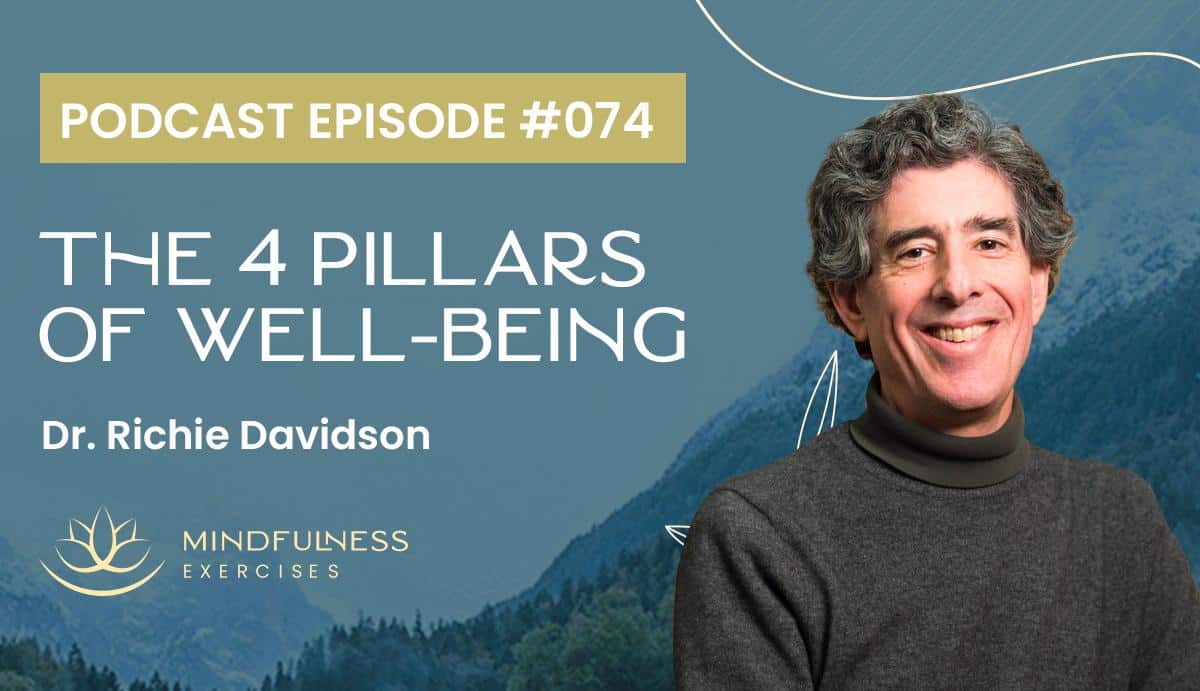
    The 4 Pillars of Well-Being, with Dr. Richie Davidson

    SF
    Sean FargoPublished October 4, 2023 · Updated October 24, 2025 · 7 min read
    The 4 Pillars of Well-Being, with Dr. Richie Davidson

    Loading episode player

    Podcast episode

    Listen for practical pillars of well-being you can return to.

    This episode page now gives listeners a clearer path into reflection, practice, and related podcast resources.

    The 4 Pillars of Well-Being, with Dr. Richie Davidson — Tunein Logo

    TuneIn

    Well-being can be an abstract term. We’ve all heard that things like eating well, exercising and meditating are good for us, but we might be unsure why, or if they even work. 

    For mindfulness and meditation researcher Dr. Richie Davidson, well-being is a measurable skill. And like any skill, it can be cultivated with practice. Well-being, he says, improves when we train in four specific areas: awareness, connection, insight and purpose.

    In this episode, Davidson introduces us to these pillars of well-being that, when nurtured, result in a life of greater comfort, health and happiness. To learn more about the science behind this transformation, listen to his previous episode, #051: The Modern Science of Mindfulness.

    Dr. Richard J. Davidson is a research professor of psychology and psychiatry and the Founder and Director of the Center for Healthy Minds at the University of Wisconsin-Madison. His non-profit, Healthy Minds Innovations, uses the discoveries and insights gleaned from research to create tools to help people around the world build skills of well-being.

    Sponsored by our Mindfulness Meditation Teacher Certification Program MindfulnessExercises.com/Certify

    What You’ll Learn in This Episode:

    • Why well-being is a skill like any other
    • The two kinds of learning necessary for cultivating any skill
    • The four key pillars of well-being
    • Why mindfulness is fundamental to our well-being
    • Why cultivating the four pillars is not about fixing ourselves
    • Why training our attention is critical to well-being
    • The most effective meditation style for well-being

    Show Notes & Quotes:

    Why well-being is best regarded as a skill

    Well-being, rather than just an accidental state of body or mind health, is a skill. When we practice the ingredients that comprise well-being, it improves. In this way, it is fundamentally no different than other skills. It is not part of our DNA. In fact, Dr. Davidson reminds us that there are many behaviors that are not part of our genome, and yet we partake in them because they benefit us. So, why not place more effort on intentionally cultivating well-being?

    “When human beings first evolved on this planet, none of us were brushing our teeth. And I bet every one of you brushes your teeth. […] This is not part of our genome, this is a learned behavior. We’ve all learned to do it because it’s important for our personal physical hygiene. And I think most people would agree their minds are even more important than their teeth. And yet vast percentages of the population don’t spend even as much time as they spend brushing their teeth nurturing their mind.”

    The two kinds of learning necessary for cultivating a skill

    When cultivating a skill, modern neuroscience indicates we must participate in two kinds of learning for enduring transformation to occur. The first is declarative learning. This is learning based on conceptual understanding, the type which is prioritized in our educational system. The second, procedural learning, is based on experiential understanding. This is the embodied wisdom we acquire through practice, and it’s equally important. 

    “Clearly the cultivation of mindfulness and other constituents of well-being cultivate both the declarative and the procedural aspects of this learning, and both are necessary. You can’t learn to practice mindfulness by simply going to lectures or reading a book. You all know that. And that’s true for all the other ingredients of wellbeing.”

    Four key pillars we can cultivate for well-being

    Dr. Richie Davidson and his team have identified four key pillars that, when cultivated, result in well-being. They are each supported by a body of scientific evidence that links them to improved quality of life. What’s more, they can each be cultivated with training and practice, and have been for thousands of years via contemplative traditions. 

    “Mindfulness is obviously a part of this, and a very important part, but it is one part. One of a number of other elements. And so one of the things I’d like to invite you to consider is that while mindfulness is necessary for a healthy mind and for human flourishing, it by itself is not sufficient.”

    Awareness and mindfulness as fundamental to well-being

    The first of the four pillars of well-being is awareness, the ability to choose where we place our attention. This is where we’d also put mindfulness, or what neuroscientists would refer to as meta-awareness. Mindfulness is the ability to know what our minds are doing, something that may be unique to human beings. Awareness is what makes the other key pillars – connection, insight, and purpose – possible to cultivate.

    “The moment we recognize that (the mind has wandered), that’s a moment of meta awareness. It’s a moment of awakening. And this is harnessing a really extraordinary capacity of our minds that we have which is to know what our minds are actually doing. Now lots of other creatures have awareness, but they don’t have meta-awareness. So this is something that is likely very distinctly human and, we think, a condition or a process which underlies all other forms of transformation. You’ve got to have meta-awareness for transformation.”

    Cultivating the four pillars is not about fixing

    When describing the pillars of insight and purpose, Dr. Davidson reminds us that the goal is not to rid ourselves of our inner voice, nor is it about changing what we’re doing in life. None of us needs fixing, as we are not inherently broken. The practice is to get curious and develop a deep, experiential understanding of who we truly are, and then to nurture that.

    “At the very extreme, we know that there are people who have a very negative narrative. They have negative self-beliefs. And they actually hold those beliefs to be a veridical description of who they are. And of course that is a prescription for depression. And so, again, part of well-being is developing a healthy relationship to this narrative.”

    The critical practice of bringing back a wandering attention

    Dr. Davidson mentions a 2010 study that found that at any given moment, roughly 47% of us are not paying attention to what we are doing. Improving upon this statistic, even if just a little bit, would change our world. All it would take is a little training. Davidson shares a quote from the 19th century American psychologist William James, who describes improving the faculty of bringing back a wandering attention as ‘the education par excellence.’ 

    “The fact that we don’t bring (educating attention) systematically into our schools is nothing short of criminal. This is a moral issue. We need to educate our children in this way, because educating attention is critical for everything else. And, we know how to do it, at least to some extent. So, this is something really central.”

    The most effective meditation you can possibly do

    We know from neurological studies that different meditations have different effects on the brain and body.  Each of the four pillars of well-being has a specific meditation practice that enhances it. Connection, for example, is enhanced by meditations on empathy and compassion while analytic meditation is particularly useful for cultivating insight. However, the best meditation is the one you are most likely to practice consistently – even if the style you practice changes from week to week, or over the course of a lifetime.

    “Ultimately, really, what’s important is that whatever it is that you do, that you do it on a consistent basis. That is really important. […] And one of the things, to remind all of you, is that please, consider going beyond simple, straight-forward mindfulness practices. There are other […] near-neighbors to mindfulness practices and with mindfulness, together, they can be, I think, even more helpful.”

    Additional Resources:

    Dr. Richard J. Davidson

    About Dr. Richie Davidson:

    Dr. Richard J. Davidson is a research professor of psychology and psychiatry and the founder & director of the Center for Healthy Minds at the University of Wisconsin-Madison. Dr. Davidson is a close friend of His Holiness the 14th Dalai Lama, who he credits for inspiring him to apply the tools of modern neuroscience to better understand positive traits such as kindness, compassion and happiness. 

    Dr. Davidson is best known for his studies on emotion, mindfulness and the brain. He has published over 400 research articles, edited 14 books, and authored 2 books of his own, “The Emotional Life of Your Brain” and “Altered Traits: Science Reveals How Meditation Changes Your Mind, Brain, and Body.” In 2000, he was the recipient of the American Psychological Association’s most distinguished award for scientific contribution. In 2006, Time Magazine named him among the world’s 100 most influential people.

    Dr. Davidson is the founder of Healthy Minds Innovations, which translates science into tools to cultivate and measure well-being. The non-profit takes the discoveries and insights gleaned from the Center for Healthy Minds and translates them into tools that help people around the world build skills of well-being.
    Transcript

    Show transcript· 15 min read

    Speaker 1 · 0:03Hello everyone. Today's a special day. I am extremely honored to have Dr. Richie Davidson join us today. He is the founder and director for the Center for Healthy Minds at the University of Wisconsin-Madison. He's been there since 1984. He's published more than 375 articles and 80 chapters and reviews, as well as he's edited 14 books. Many of you have read The Emotional Life of Your Brain and his latest book, Altered Traits, which was published a few years ago with Daniel Goleman. He's really best known for his groundbreaking work studying emotion and the brain. He's a friend and confidant of the Dalai Lama. He's a highly sought-after speaker and expert leading conversations on well-being on international stages, such as the World Economic Forum, where he serves on the Global Council on Mental Health. Time magazine named him one of the hundred most influential people in the world in 2006. He's one of the most influential people of my world. When I say he's a pioneer in this field of research on emotion and mindfulness in the brain, like it's hard to overstate that. I'm just very honored that he's here joining us today. I think he's gonna share a lot of valuable insights. He walks the talk. You know, when you see him on video, when you see him speak, you know he has a practice. Like there's a true presence to him, there's a depth to him. And to me, that's maybe the most important thing because he's sincere about his work and there's heart in what he's doing. So welcome, Dr. Richie Davidson. It's an honor to be here with you, and thank you so much for coming today.

    Speaker 2 · 2:11Well-being is best regarded as a skill, and it's a skill because we know that when we practice the ingredients that comprise well-being, well-being will improve. And it's a skill that's fundamentally no different than other kinds of skills. One of the things that I frequently remind people is that when human beings first evolved on this planet, none of us were brushing our teeth. And I'll bet every one of you brushes your teeth. And virtually every person spends a few minutes a day brushing their teeth. This is not part of our genome. This is a learned behavior. We've all learned to do it because it's important for our personal physical hygiene. And I think most people would agree that their minds are even more important than their teeth. And yet, vast percentages of the population don't spend even as much time as they spend brushing their teeth, nurturing their mind. And one of the things we know about skills is that there are two fundamentally different kinds of learning that are required for cultivating a skill. And this is something that we learn from modern neuroscience. There are two fundamentally different kinds of learning. One we call declarative learning, which is learning about stuff, conceptual learning. The second form of learning we call procedural learning. Procedural learning is acquired through practice, it is embodied, and it is represented in totally different brain circuits than declarative learning. And in order for true transformation, enduring transformation to occur, we need both forms of learning. Now, you all are a group that I think gets this intuitively and through your own practice, but clearly the cultivation of mindfulness and other constituents of well-being, we cultivate both the declarative and the procedural aspects of this learning. And both are necessary. You can't learn to practice mindfulness by simply going to lectures or reading a book. You all know that. And that's true for all the other ingredients of well-being. And so one of the challenges that we have, particularly in the West, is that the educational systems in the West privilege declarative learning. And so we need to incorporate procedural learning along with declarative learning in our educational systems from preschool through university. And this is something that we have been very involved with. So the framework that we've developed is focused on what we call the plasticity of well-being. And these are the key elements, the key pillars that meet several criteria. One is that they have a corpus of scientific evidence to suggest that they're related to well-being in a fundamental way, and that they can be changed through training. And the second important criterion is that there be practices that come from the contemplative traditions for each of these four pillars. And with all due respect, I want to underscore one point, and that is that mindfulness is obviously a part of this and a very important part, but it is one part, one of a number of other elements. And so one of the things I I'd like to invite you to consider is that while mindfulness is necessary for a healthy mind and for human flourishing, it by itself is not sufficient. So what are these four pillars of well-being? The first is awareness, which is where we would put mindfulness. And awareness includes our capacity to regulate our attention, which is something that mindfulness practices do. And it also includes another element which is also strengthened by mindfulness practices, which is so incredibly important. And that is what psychologists and neuroscientists call meta-awareness. And meta-awareness is knowing what our minds are doing. Now, you all are a group that I think intuitively understands that without necessarily having the word for it. But we've all had the experience of reading a book where we might be reading each word on a page, and after we read a page or two, we we have absolutely no idea what we've just read. At least I've had that experience. And the moment we recognize that, that's a moment of meta-awareness. It's a moment of awakening. And this is harnessing a really extraordinary capacity of our minds that we have, which is to know what our minds are actually doing. Now, lots of other creatures have awareness, but they don't have meta-awareness. So this is something that is likely very distinctly human and we think a condition or a process which underlies all other forms of transformation. You've got to have meta-awareness for transformation. Okay, what are the other pillars of well-being? The second pillar of well-being is connection, and connection is about the qualities which are important for healthy social relationships. Qualities like appreciation and gratitude and kindness and compassion and empathy, all part of connection. And we know that they can be directly strengthened through practice. The third pillar of well-being is insight. And insight is about curiosity about how the mind actually works, and particularly the narrative that we all carry around about ourselves. We all have a narrative, we all have this internal dialogue, and that's just part of being human. And the goal, so to speak, is not to get rid of this narrative, but it is to deeply understand the narrative and to perhaps through that change our relationship with the narrative. So the practice is not about fixing anything, it's really about getting curious about it and understanding it at a very deep experiential level. And at the very extreme, we know that there are people who have a very negative narrative, they have negative self-beliefs, and they actually hold those beliefs to be a veridical description of who they are. And of course, that is a prescription for depression. And so, again, part of well-being is developing a healthy relationship to this narrative. And finally, the last pillar of well-being is purpose. And purpose is about identifying our sense of direction in life, our core values, which give our life meaning. And it's not so much about changing what we're doing to do something more meaningful, but rather it's about finding meaning in the things that we are already doing. So, again, it's not about fixing anything, it's not about changing anything, it's simply about discovering what is really already there and nurturing that. So these are the four key pillars of well-being. So let me do a little bit of a deeper dive into awareness, which is really the heart of mindfulness, and share with you a quote from one of my Western intellectual heroes, William James. William James was America's first great psychologist. He wrote a two-volume tome that was published in 1890 called The Principles of Psychology. And he has a whole chapter on attention in this book. And he said the following He said the faculty of voluntarily bringing back a wandering attention over and over again is the very root of judgment, character, and will. No one is compost sui if he have it not. An education which should improve this faculty would be the education par excellence. But it is easier to define this ideal than to give practical directions for bringing it about. And I think if William James had more contact with the contemplative traditions, he would have instantaneously seen that if nothing else, the practices with which you're all familiar are practices that can educate attention. And attention is the building block for all other forms of learning. The fact that we don't bring this systematically into our schools is nothing short of criminal. I mean, this is a moral issue. We need to educate our children in this way because educating attention is critical for everything else. And we know how to do it, at least to some extent. So this is something really central to the whole rest of this. So I want to just tell you about one little study. This was a study published now 10 years ago, and it took advantage of the fact that we all are carrying around smartphones, and with participants' permission, they were texted at multiple points during a day, and they're asked three questions. First question, what are you doing right now? They had to check off on a list of activities. Second question, where is your mind right now? And the third question, right at this moment, how happy or unhappy are you right now? And they did this with about 3,000 people across the globe in many different countries. And guess how much the average percentage of time people reported that they were not paying attention to what they were doing. 47%. The average person reports that they are not paying attention to what they're doing 47% of the time. Now, one of the things that I have this strong conviction about, and I'm sure you all have the same conviction, is that we could do better. It's kind of astounding that it is what it is. And can you envision a world where if we made that number go down even by a little, what the benefits would be? I mean, it's just in productivity, in having a teacher show up for his or her students, having a doctor show up for her or his patients, having a parent show up for their children. So one of the important benefits of insight, we believe, has to do with mechanisms that are really important for resilience. Resilience is multidetermined, and resilience can be influenced by each one of the four pillars of well-being, by awareness, connection, insight, and purpose. But we think that insight particularly is important for resilience, and the capacity to recover quickly is a key ingredient of resilience. So, in part, resilience is the capacity to recover rapidly from adversity. It's not the only aspect of resilience, but it's really a key, a vital component of resilience. So I want to show you now the findings from a study that we did with long-term practitioners and with age and gender match controls. And we used something to really challenge them. You know how you can go to a cardiologist in order for them to fully assess your cardiovascular function, they may ask you to do a stress test, to go on a treadmill or an exercise bike to stress the heart. Well, we have to figure out ways of stressing the mind and the brain in ways that are ethical and responsible. And one of the ways we can do that, and that's valid, is pain. We've all had the experience of pain. It's something very basic to being human. And we can deliver a painful stimulus in the laboratory very safely. So that's what we did in this experiment. We use heat to do that. And I don't want to spend time describing the apparatus, it's a bit complicated, but it really is very effective and it's very safe. And I've had this done to myself many times, and it really feels like your skin is burning, but it's safe. So what we did is we gave people one experience of this pain, and then we brought them into the laboratory, put them in the scanner, and we told them that when they hear a tone, just a beep, they know that in 10 seconds they're going to get zapped with this painful stimulus. So the non-meditators hear the tone, and we're searching in the brain for the specific circuit that we know is responsive to physical pain. This has been very well studied. So we know exactly where to look in the brain. So here are the non-meditators, they hear this tone, they haven't gotten anything painful, and yet their brain responds as if they've just been zapped, but they haven't gotten any painful stimulus. Then the actual heat stimulus comes on and they further escalate their response, and then they have a very slow recovery because they know that this is going to happen again. What the long-term meditators show, and this is a study in which Mingarin Peshay participated, as well as other very long-term practitioners, they hear the tone, nothing, absolutely nothing, no significant activation in any of the pain relevant regions. Then when they actually get the zap of the painful stimulus, they show a big response. And in fact, in certain areas of the brain, their response is larger than among the non-meditators. They're totally open, their sensory channels are open. But what happens when the painful stimulus goes off? They come right back down to baseline and recover very quickly. This is the neural picture of resilience. Now, the most effective kind of meditation that you can possibly do is the meditation that you actually do. There are many different kinds of meditation, and they do have different effects on the brain and the body. And in the four pillars of well-being that I laid out awareness, connection, insight, and purpose, each of them have specific forms of meditation practice. And there are some forms of meditation, we include in our program, which are very rarely taught in the West and have been even more rarely studied. For example, analytic meditation. And when the Dalai Lama does meditation, he mostly does analytic meditation. He doesn't do the kinds of mindfulness practices that we're all familiar with. And analytic meditation is particularly important in cultivating insight. And it's just an example of very different kinds of meditation strategies, which are going to have different effects on the mind, the brain, and the body. And so ultimately, really what's important is that whatever it is that you do, that you do it on a consistent basis. That is really important. But one of the things that I think if you talk to long-term practitioners, what most of them report, first of all, is they never do just one kind of practice. They often do several kinds of practice. And the other thing is that over the course of their life, their practice evolves and changes. And what may be most helpful at a certain stage in life may transition to something else that is helpful at another stage of life. And so it's important not to be too attached, I think, to doing necessarily the same practice forever, although there are certainly basics that you probably would be doing forever, but to shake it up a little bit. And many of these practices can be enormously helpful in reducing the perceived social isolation. Even simple practices like appreciation practices, I find have been so helpful during the pandemic. I mean, each of us depends on so many others for our existence, and it's become kind of more stark during the pandemic period because our lives have been simplified in certain ways. We're dependent on healthcare providers, we're dependent on deliveries to our home, on our groceries, for our food supply. These are all people that are so important. And spending even a small fraction of time cultivating appreciation, finding appreciation for these people who are so important in enabling our lives during this time is an elixir. It really is. It can really help with problems with social isolation. You know, and one of the things to remind all of you, I said it before, but I'll say it again. Um, and that is that please consider going beyond simple, straightforward mindfulness practices. There are other like appreciation practices, they are so important, they're so easy to do, so accessible. And you can find them on our app and many other places too, but they're kind of near neighbors to mindfulness practices. And with mindfulness, together, they can be even, I think, more helpful.

    Speaker 1 · 22:34Dr. Richie Davidson, I really appreciate your time on behalf of all of us. Deep bows. Thank you so much. We're very, very grateful for your time today. Thank you, Richie.

    Share

    Continue reading

    • Grounding Through Anxiety With Senses

      Grounding Through Anxiety With Senses

      Read
    • Shamatha Vipassana Explained For Modern Minds

      Shamatha Vipassana Explained For Modern Minds

      Read
    • How To Stop Believing You Are Not Enough

      How To Stop Believing You Are Not Enough

      Read

    Professional training

    Accredited mindfulness teacher certification

    Trusted by teachers in 100+ countries

    Structured training, CE credits for eligible pay-in-full registrants, and support for teaching without self-doubt — after you have explored this episode.