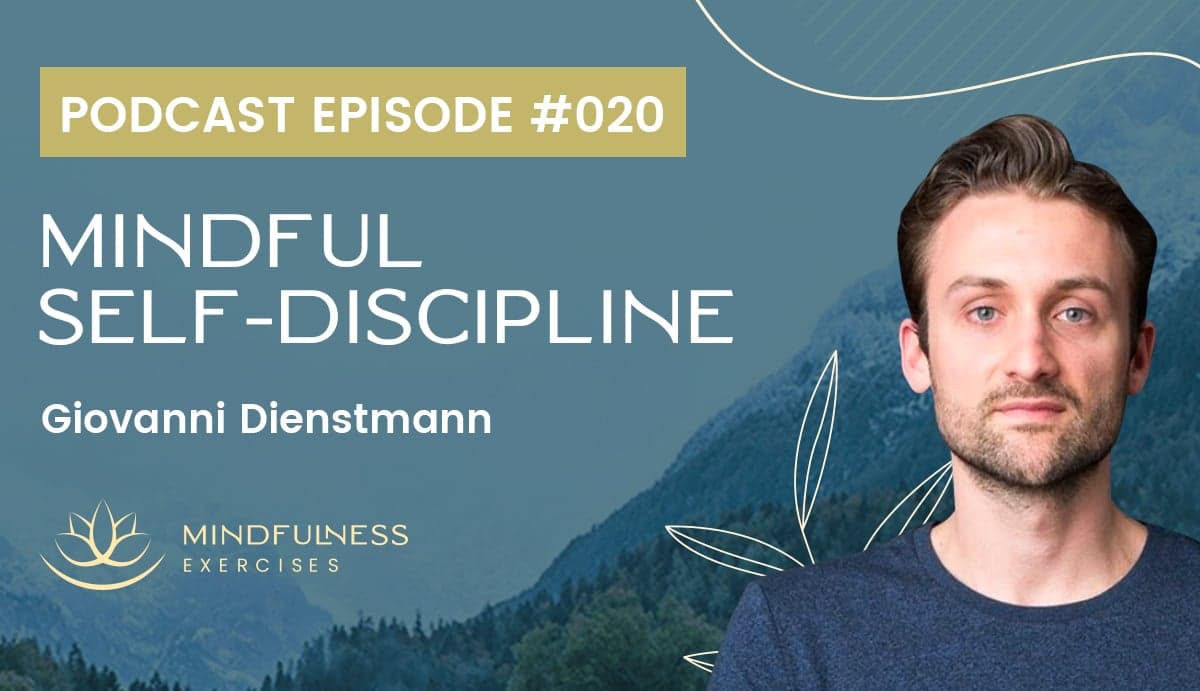
Speaker 1 · 0:04Hi everyone, welcome. My name is Sean Fargo, the founder of Mindfulness Exercises. Today I'm joined by a friend of mine, Giovanni Dinsman. He's the founder of Liveandare.com, and he's the new author of Mindful Self-Discipline, a wonderful book. And he's also the author of a really great book called Practical Meditations that I really recommend. But I highly recommend his website and his writings. And he's a meditation teacher, best-selling author, self-disciplined coach. He's helped hedge fund managers, CEOs, entrepreneurs, artists, pro athletes to live a more focused and disciplined life. He's been successfully coaching people to overcome distractions, procrastination, self-doubt, fear, and other forms of self-sabotage. As a meditation teacher, he runs liveandare.com, one of the five most visited meditation blogs on the internet. His first book, Practical Meditation, is available in eight different languages and has been popularly called the Meditation Bible. He's highly disciplined himself, wakes up really early every day and meditates and writes. He has over 10,000 hours of personal meditation practice and is sought-after consultant to award-winning meditation apps. His meditation programs have helped over 20,000 people to start a daily meditation practice, improve their psychological well-being, and master their minds. Giovanni, thank you for joining me today. Thank you, Sean. It's a pleasure to be here. Yeah, it's always a pleasure to speak with you. There was some quote near the beginning that if I lost everything in my life, if I lost my job, if I lost my possessions, if I lost, you know, everything in my life. But if I still kept mindful self-discipline, then I can get everything back. Yeah.
Speaker 2 · 2:25The idea is that self-discipline is the essential ingredient to achieve any goal. And the goals they come and go. You know, you achieve a goal for a while that feels amazing, and then you're kind of ready for something else. But the skill of self-discipline that you develop by seeking to double your business or make a million dollars, it's the same skill that you're gonna need if you want to attain enlightenment. It's the skill of keeping yourself on track with the habits that matter, of letting go of the things that are holding you back, you know, letting go of contradictory desires because we want to have the cake and eat it too. So, in a way, it's like the master key for any goal. So, yes, if I had to lose everything and keep just one thing, keeping self-discipline, and that includes awareness and willpower, that would allow me to achieve any goal, to get all those things back.
Speaker 3 · 3:15Beautiful.
Speaker 1 · 3:16So I'm curious how you might distinguish regular self-discipline with mindful self-discipline.
Speaker 2 · 3:26Yeah, good question. Self-discipline has two different elements to it, which is awareness and willpower. These are the two components, the two wings of this bird of self-discipline. And most books and videos and programs about self-discipline out there, they overly emphasize willpower. It's all about kind of mental toughness and pushing yourself to do things, a bit of the bulldozer approach. And I like to call this the military self-discipline. Now, the way that I teach self-discipline is awareness first. We emphasize awareness and then willpower. And when you do that, then practicing willpower becomes much easier. It becomes simpler. It feels like something that you want to do rather than something you're forcing yourself to do. So instead of willpower feeling like you know, pushing a boulder uphill, it's more like rolling a boulder downhill. It's a simple exercise of kind of reconnecting yourself to your purpose in that moment and taking action that advances your purpose, that advances your goals, action that is aligned with the person you want to be. And so that's the key difference between regular self-discipline and mindful self-discipline. It's easier for most people to practice, it's more sustainable, it's more approachable for most.
Speaker 1 · 4:45Great. Yeah, I think that a lot of people might beat themselves up with that military style of self-discipline that you talked about, and I think would really welcome a more mindful approach. I assume that you encounter a lot of people who want to create new habits and then other people who want to break bad habits. And so would the practices of mindful self-discipline vary depending on whether you want to create new habits or break old ones?
Speaker 2 · 5:19Some of the things that I talk about in the book are applicable to both cases. Both building habits and breaking habits require that you develop greater awareness and that you train your willpower. Both of them can be helped by you being in the right environment or making certain changes to your environment. But yes, there are some techniques that are different. So, for example, if you want to build habits, you need to make sure that you have the right cues or reminders, something that triggers you to do that habit. And if you want to break bad habits, then it's the opposite. You want to make sure that you remove all the triggers. So it's almost like two sides of the same coin. One of the techniques that I work with is called cognitive reappraisal, which is basically our ability to change the way we feel and think about things. So there's positive cognitive reappraisal and negative cognitive reappraisal. And that's a term from psychology for a technique that has been used by Buddhist monks and Stoics and yogis for many, many centuries. The idea is, for example, if you want to build a habit of eating salad and you hate salad, you don't like the taste. You could go and do what most authors in the space recommend, which is to add the reward that, like, hey, if you eat your salad, then you can go and have a piece of chocolate or something else. But the problem with that approach is that you are just doing that activity for something that is external to the activity. And over time it's not so sustainable. Now, with cognitive reappraisal, you learn to love the salad for its own sake. You teach yourself to enjoy the taste of the salad. So that would be a positive cognitive reappraisal. Depending on how you focus your attention and the self-talk in the moment that you are going through that activity, you can teach yourself, you can condition yourself to enjoy the things that are good for you. And the other side of this is negative cognitive reappraisal, in which you are teaching yourself to dislike the things that are not good for you. So, to use another food example, if you enjoy drinking soda and you want to stop, then negative cognitive reappraisal allows you to develop a distaste for that drink. And when that happens, you don't need to exercise willpower anymore to say no to it. The spell is broken, you're just not attracted to it anymore. And so, as you can see, depending if you want to build habits or break habits, you would use two different sides of the same techniques.
Speaker 1 · 7:47Right. With the salad example that you mentioned, learning to enjoy the salad, for an example like that, how much would you advise people to sort of tap into their future self of how the benefits may come with physical health and energy and vitality? Or how much would you encourage people to tap into the act of like really savoring the ingredients or the taste? Or how much would you tap into the emotions of the dangers of not eating salad? Can you walk me through maybe a few techniques that you might help people to really enjoy something that they think that they might not enjoy?
Speaker 2 · 8:38Okay. Let me just take a step back here and kind of reconnect your initial question of how is mindful self-discipline different from self-discipline? I believe that self-discipline should not be painful. I believe that self-discipline should be us coaching ourselves to be on track with the things that are actually good for us. Now, there is this quote on the Bhagavad Gita that says, that which is good for you in the beginning and not good for you at the end is not good for you. That which is not good for you in the beginning, but good for you at the end, that is good for you. And so that brings us to the topic of the future self. If we are more and more connected with our future self, if we have a more long-term focus in life, a more long-term perspective and awareness in life, then naturally we will bring a bit of those long-term consequences into the present moment when we are making a decision. And then the salad will feel more attractive and the soda will feel less attractive. So, yes, connecting to your future self and the long-term consequences of that action is one way to change how you feel about that activity. But in general, there are three different types of intrinsic rewards because our brain loves rewards. If the habit we want to create is rewarding, then that is a positive loop in the brain, and you will want to do it again to experience that reward. Now, as I said, most authors in this space they emphasize external rewards. But I like to emphasize internal rewards. They do take a little bit more work of awareness and using your mind to establish them. But once they are established, then you're good. Because if you learn how to enjoy going to the gym, if you love to go to the gym because you love how it feels during the activity and after the activity, you're not going to need any willpower to do that. You do it for its own sake, you enjoy it for its own sake, versus you doing it for something else, for an external reward. So the three types of internal rewards that I talk about, the first one is to learn to enjoy the activity itself. So using the salad example, you learn to enjoy the taste of salad. That when you put the salad leaves or the other elements of a salad in your mouth and you start chewing them, there are certain sensations. And you have been conditioned or accustomed to seeing those sensations as unpleasant. Now you can recondition yourself to seeing them as pleasant. So that is finding the reward in the activity itself. The second way would be to find the reward in how you feel right after the activity. So you can become more aware that right after eating salad, you feel so light and your body is happy with that, versus when you eat a steak for lunch. We need to become aware of it. We need to stop and become mindful of the difference in our state before, during, and after. But once we do that, then that activity becomes more rewarding because we know that the reward is coming right after it. We just need to be aware and pay attention to it. And the third type of intrinsic reward is enjoying the emotional satisfaction of having done something that is good for you. And that's where I would bring the idea of the future self. You know, maybe you have not learned how to enjoy the salad, and maybe you don't notice any difference after eating salad, but you know that eating salad is going to be good for you. It's going to be good for your health, it's going to help you live longer and feel lighter in your body and all of that. So you go and eat the salad and you bring to mind that feeling that I just did something good for me. I exercise a little bit of self-discipline, a little bit of willpower to do something that is good for me. My future self is going to be proud that I ate the salad instead of the hamburger. So these are the three different types of intrinsic rewards that we can attach to the habits we're trying to create.
Speaker 1 · 12:56Right. When we are savoring or noticing the emotional benefit or the short-term benefits, you know, when we're bringing to mind the intrinsic rewards, do you encourage people just to kind of be with that feeling for a little while? Do you encourage people to take it further by say talking about it or journaling about it or say deepening that experience through a meditation? Like, how would you encourage people to really fully experience that intrinsic reward?
Speaker 2 · 13:39I think all of the things that you mentioned are a really good idea and they work. I have created a guided meditation for the positive and negative reappraisal. And in that guided meditation, then I help them connect to find the pleasure in that activity and connect to it and stay with it a little bit longer. But I also like your idea of journaling. I think that that can be helpful.
Speaker 3 · 14:01Beautiful.
Speaker 1 · 14:03You know, we've been talking about salad as an example of something that, you know, most of us know is healthy for us, but we may not actually eat it very often. You know, with mindfulness, with meditation practice, I think most of us also know that you know it's good for us. It's like a salad for our minds or our bodies, where you know there's plenty of science showing the short-term and long-term benefits of it, but a lot of people find it hard to commit to a practice. Why do you think most people don't commit to a like a daily mindfulness meditation practice?
Speaker 2 · 14:49I think this is an expression of the general challenge to people committing to making change and creating habits. They struggle equally with you know doing a regular exercise or going to sleep always at the same time and all the other things that they know would be good for them. It all comes down to the same skill, which is the skill of self-discipline, whether you want to build a habit of exercise, meditation, journaling, writing a book, whatever it is. And then there are many challenges for that. You know, I like to always start by talking about the aspiration. The aspiration is your why. Like, why do you want to do a particular thing? And the stronger is your perception of that why, of that ultimate benefit, the easier it is for you to build that habit. So, someone who is trying to start a daily meditation habit just because they think it's good and it is, it's very different from a person who realizes that you know what, meditation is the key for me to become the person I want to be. Meditation is going to help me have greater control over my emotions, which means that I'm not gonna say things that I regret so often, and I'm going to be more calm and more confident at work, and I'll be able to focus better on my side project. And when you go through this exercise, I call it the black and white exercise, to link that particular activity to all the different areas of your life. How would that activity lift all the different areas of your life? And how skipping that habit is a form of limitation in all the different areas of your life. And so when you make this wider connection in your brain of how important that thing really is, then your motivation has just increased a lot. And that becomes a much more solid foundation for you to start to have it.
Speaker 1 · 16:31That makes sense. You know, a lot of people I think find mindfulness and meditation as a result of them kind of breaking down. They may be going through a really stressful time and they need something new to help them. Maybe they realize that some of their coping strategies just aren't sufficing anymore. And so a lot of people will come to mindfulness and meditation as a result of having gone through significant challenges. Other people may go to a yoga class or to a workshop when things are going relatively well and their life is kind of ho-hum, you know, things are going okay, and they might think, oh yeah, like I'll practice this mindfulness. Like this feels doable, and they may partake in it for a little bit because it feels relaxing and calming. Do you find that either levels of stress or happiness are uh more incentivizing for people to practice mindfulness? Do you feel like people want to be more self-disciplined with mindfulness as a result of them trying to cope with something stressful, or that it's easier without all the stress to take up a new practice because it feels good?
Speaker 2 · 18:09You know, that's a question that I've asked myself a lot, and I still reflect on this. My experience with people and teaching this and studying about these topics is that the negative motivation tends to be stronger. People are more motivated to take a medicine than to take a vitamin. And that is something to do with the negativity bias of our brain, that our brain pays a lot more attention to pain than it does to pleasure. It pays more attention to danger than it does to opportunity. So if there is a real problem and mindfulness is perceived as a way to help us solve that problem, I think that that person is going to be more motivated than someone that everything is going fine in their life, and mindfulness just kind of makes things a little bit better. I think that the first person is going to have more motivation and focus because he or she really needs it. In Buddhism, there's this expression, meditate as if your head is on fire. It's something that is incredibly difficult to do. But when your head is on fire, you're not thinking about lunch, you're not thinking about your to-do list, you're not rehearsing a conversation in your mind, you're just seeking water. And for those who practice meditation as a form of spiritual awakening, then they seek to have that type of intensity. For everyone else who is practicing meditation for the mental health benefits, the physical health benefits, focus, etc., arguably you don't need that level of intensity. But for me, so far it seems that pain is a greater motivator than pleasure or benefits.
Speaker 1 · 19:45Yeah, I think that echoes my experience in hearing a lot of people talk about their practice. I think they're yeah, maybe more incentivized to get rid of the pain than they are to eat the cotton candy. For me, this kind of ties in with say a purpose or aspiration for meditating. Say a lot of people might start practicing mindfulness to cope or to get through a tough time. But you know, usually those tough times are temporary. And so I'm curious what kinds of say aspirations or purposes you found to be healthy or helpful for people in sustaining a practice once their short-term pains and challenges are dealt with.
Speaker 2 · 20:46I think both of us as meditation teachers, we have seen this before where a person comes to meditation because they're not happy, they practice it for a few weeks, then they feel better, and then they stop practicing because the problem doesn't exist anymore. And then the problem comes back, and then they need to come back to the practice. So I think it's helpful to see meditation just as we look upon taking a shower. You know, it's something that we need to do daily, and it's important for maintaining life. The same thing with exercise, you know, it's something that is important for maintaining health and vitality. You don't need to want to become an athlete, but you will still need to do some sort of exercise. You don't need to want to become a Buddha or an enlightened being, but you will still need some form of meditation to help you be healthy and happy and focused and present. So I think the key here is to somehow tie in the practice of meditation to that person's deeper aspirations. And for some people, it's going to be about family life, for others going to be about career, for others, going to be about their business or wealth or whatever it is that the deeper longings that that person has, the deeper aspirations that person has. If you can see that meditation is something that is going to help you fulfill your deeper longings, then it makes sense to keep that practice. It's not something that you want to let go of because letting go of that means making your life harder.
Speaker 1 · 22:11Yeah. You know, a lot of parents are looking for ways that they can share mindfulness and meditation with their kids, and kids might even try it once or twice, but then stop making it a practice. Would the concepts of mindful self-discipline that are in your book and in your programs be applicable to children? Or how might you alter those for kids under, say, 12 or 14?
Speaker 2 · 22:55The principles are applicable, but you need to make some modifications, some adaptations. So maybe in the future I'll write a mindful self-discipline for parents or for kids. I don't know. But I think the easiest way to make your kids meditate is that you meditate daily yourself. And in that sense, yes, like applying those principles and building the habits that you would like your kids to have. That's the best thing because they want to imitate us, they're good at doing that. And when teaching meditation to them, then make it fun as much as possible. Make it short and make it simple. So that it's something that, okay, daddy does this or mommy does this. Let's go and sit and pretend we're being calm or whatever. And depending on their age, then there are some techniques that are more appropriate than others. But yeah, my daughter is now two and a half years old, so it's too early to teach her anything of the sort. But from time to time, I show her some deep breathing and she finds it fun and she tries to imitate like. And I said, Okay, you're feeling stressed now, just do this breathing. But yeah, in the next few years, as she grows up and I teach her or try to pass on these things to her, I will have a more hands-on experience of how that is like.
Speaker 3 · 24:05Beautiful.
Speaker 1 · 24:06So let's say someone says, Okay, I'm all in. I've found the aspiration or purpose that means the most to me. I really want to do this, I want to meditate to be healthy or happy or resilient or more loving. Now what? Like, which meditations do I start with? How much do I practice each day? When do I practice? What are your recommendations for building like a mindful, self-disciplined practice of meditating? Do you recommend certain hours of the day, durations of meditations? What kinds of meditations do you recommend to give us the best chance for sustaining our practice?
Speaker 2 · 24:56Yeah. There are many questions there, so let me try to address them all. The question of how long and when, I typically recommend the morning. I think that that's the best time to meditate. Everyone that I work with as a coach, I help them build the morning routine. And the morning routine is going to be different for every person. There's going to be different habits and activities depending on their aspirations. But two things that I recommend for everybody in a morning routine is a meditation practice, even if it's just 10 minutes, and day planning. Like these two things I think that everybody should do every morning. If that's not at all possible, and there are very few cases where that's not possible, then it's fine. You can meditate in the evening. The challenge with meditating in the evening is that you're typically more tired. You've had a whole day full of thoughts and worries and things to plan, and your mind and your body may not be in the best state to go deeper in meditation. And at that point, then meditation is more like a way to kind of relax and maybe make a transition from work life to normal life. But if you do it in the morning, then it's building up the mental states that are going to be more helpful throughout the day. So that's for the question as to when, as to the duration, I say to people, you can start with one minute, you can start with two minutes, it doesn't matter. But try to get to at the very least 10 minutes for training your awareness for the purposes of mindful self-discipline, at least 10 minutes. And then how long you should meditate depends on your goals. If you want meditation for physical health and well-being, mental health, I say take 10 to 20 minutes. If you want for personal growth and deeper ability to focus, etc., I would say 40 minutes. And if you want for spiritual awakening, then I'll say an hour. So depending on the type of goal, it would be a different length of time. And as to which meditation should they do, you know, that's an incredibly personal question. It depends on their personality, it depends on the phase they're in in life. Do they need more energy and more fire and motivation, or do they need more calming down and relaxation and letting go their personality, their goals? All of this will influence. What I do for people who come to me is that hey, this is a course with 14 different styles of meditation, these two courses, one after another. Go through these and see if you can find the one that works best for you. So I believe in people trying different forms of meditating and finding what works for them.
Speaker 1 · 27:22Beautiful. What are those courses you just referenced?
Speaker 2 · 27:26Sure. So it's the Limitless Life program. I've put all my meditation courses inside this program. It's a membership that people can join and get access to all of them.
Speaker 1 · 27:35Great. And we'll post a link to that here. Well, may you get everything that you want? Thank you for sharing this book and all these teachings. I encourage everyone to check it out, Mindful Self Discipline. You can go to mindfulselfdiscipline.com to learn more and to get the book. Read all the testimonials. There's also an app that you can download that can help you walk through it. Giovanni provides coaching on mindful self discipline. So encourage people to check it out because we all could use a little bit of self discipline for something. Giovanni, thank you so much for joining me today and thank you for sharing your teachings. Wonderful. Thank you, Sean.