📖 Free guide: How to Teach Mindfulness & Meditation

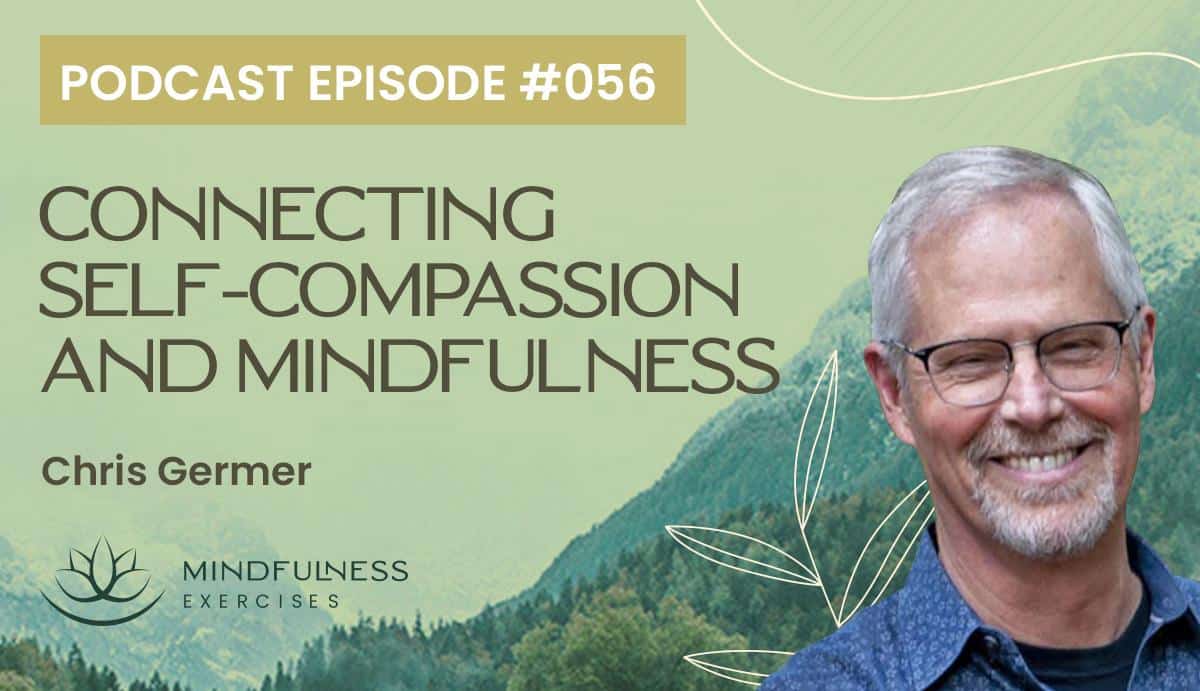
    Connecting Self-Compassion and Mindfulness, with Chris Germer

    SF
    Sean FargoPublished May 31, 2023 · Updated November 20, 2025 · 6 min read
    Connecting Self-Compassion and Mindfulness

    Loading episode player

    TuneIn

    Mindfulness and self-compassion go hand in hand. Each enhances the other. As practitioners and as teachers, however, understanding the differences between the two can help us discern when and how to most skillfully apply each for growth and healing.

    In this episode, we hear from Chris Germer, one of the world’s foremost experts on mindful self-compassion. Chris Germer, PhD is a clinical psychologist and lecturer on psychiatry at Harvard Medical School. In 2010, he co-developed the Mindful Self-Compassion (MSC) program with Kristin Neff. It has since been taught to over 250,000 people worldwide. Dr. Germer is the author of The Mindful Path to Self-Compassion and co-author of Teaching the Mindful Self-Compassion Program.

    Sponsored by our Mindfulness Meditation Teacher Certification Program MindfulnessExercises.com/Certify

    What You’ll Learn in This Episode:

    • Why it can be helpful to differentiate mindfulness from self-compassion
    • Why self-compassion is neither selfish nor self-centered
    • The one question that distinguishes self-compassion from mindfulness
    • How both uniquely regulate emotion
    • How mindfulness keeps us from mis-applying self-compassion
    • How self-compassion makes mindfulness possible amidst suffering
    • Why self-compassion is the first step in mindfully addressing trauma
    • How mindfulness and self-compassion enhance each other

    Show Notes:

    Discerning between mindfulness and self-compassion

    When fully expressed, mindfulness holds self-compassion within it, and vice versa. However, learning to differentiate between the two can help us understand when to apply one or the other. Dr. Chris Germer describes mindfulness as loving-awareness of our moment to moment experience, while self-compassion is applying this loving awareness to the one who is experiencing the moment.

    “When you’re fully mindful in the face of suffering you will be fully compassionate. If you’re also fully compassionate, your heart is like, really open, your attention will be open, your awareness will be refined, you will be mindful.”

    Why self-compassion is neither selfish nor self-centered

    Self-compassion is often misunderstood as being self-centered. It can at first seem at odds with our mindfulness practice, in which we work to overcome identification with the ordinary self. However, both mindfulness and self-compassion diminish the rigidity of the self, each in their own way.

    “Mindfulness dismantles the self by breaking down our experience moment to moment, or by looking at the machinery of perception. […] Compassion actually dissolves the self through warmth. One dismantles, one dissolves. So both diminish the dominance of the sense of self.”

    Self-compassion asks what I need in this moment

    Mindfulness is akin to asking the open-ended question, ‘What am I experiencing right now?’ Self-compassion, on the other hand, invites us to ask ourselves what we need most at this moment. Understanding the subtle difference between what we are experiencing and what we need helps reduce suffering by guiding our next action.

    “If you’re really struggling and somebody looks at you and says, ‘Oh I’m so sorry about what you’re going through, what do you need?’ And not just leave it at that, ‘What can I do for you?’ That’s really what compassion is about. Compassion is about responding to a person’s need when they’re suffering and also taking action.”

    The mechanisms of emotional regulation

    Both mindfulness and self-compassion contribute to emotional regulation, but each does so uniquely. Mindfulness downregulates emotional reactivity by inviting us to adjust what we’re paying attention to and how. Compassion regulates our emotions through care and connection. We can do this for ourselves, but we can also experience co-regulation through the warmth and care of another.

    “Compassion regulates emotion through care and connection […] and they’re a little different. Connection is the awareness that I’m not alone, that’s a powerful emotion regulation insight. And care, which is warmth and goodwill. So, when we experience warmth and goodwill, we downregulate difficult emotions.”

    The central paradox of self-compassion

    Self-compassion helps ease our suffering only if and when we let go of the idea that it is a cure. In other words, self-compassion functions to help soothe us when we offer ourselves kindness not to feel better, but simply because we feel bad. Mindfulness, in turn, can help us recognize when we are trying to use self-compassion as a means of fixing versus accepting.

    “Mindfulness allows us not to try to resist and manipulate our moment to moment experience. Because, if we start to use self-compassion to manipulate our moment to moment experience, it will not work. Our suffering will persist and amplify. But, if we have a foundation in mindfulness, and we can open to our experience just as it is, then what happens is compassion is a natural response.”

    An antidote to shame

    As our mindfulness deepens, it’s normal to become aware of past transgressions. Sometimes, this triggers the development of guilt, shame or self-loathing. When this happens, self-compassion can help us make space for our experience by holding space for us when our emotions feel too overwhelming. 

    “When we’re caught in the grip of intense and disturbing emotions like shame or terror it’s really really hard to be mindful of shame or terror other than to say, ‘this is shame of terror.’ But it’s got you. I found that the most effective way to actually move toward mindfulness in a situation like that was to hold myself as a broken, overwhelmed human being tenderly, with a great deal of love. And then lo and behold, everything started to change.”

    Addressing trauma by coupling self-compassion and mindfulness

    To address trauma, we must first feel safe. It is impossible for learning to take place while in a state of overwhelm. Thus, a mindful approach to trauma begins with self-compassion. We ask ourselves what we need to feel safe and note where we can find this sense of safety within our own body. 

    “The foundation of it is the question, ‘What do you need to feel safe, how safe do you feel, and do you feel ready to move into a challenge place, in other words a place of re-processing, or do we need now to go back to safety?’ So what’s fundamentally self-compassionate about this is that we are asking the question, ‘What do you need?’ And we actually need to ask the question, ‘What do you need, what do you need to feel safe?’ not just assume that we know. Ask it. Put the control of the treatment in the hands of the person who is traumatized and it’s going to go much more smoothly.”

    The synergy between mindfulness and self-compassion

    Those of us who practice or teach mindfulness will eventually find ourselves engaging with self-compassion. As our mindfulness deepens and grows, we become increasingly mindful of the space in which we’re holding ourselves and our experience. This space is not empty, but full of love.

    “There’s a beautiful synergy between warmth and space. Warmth creates space, like if space is mindfulness and warmth is compassion. Warmth creates space and space definitely creates warmth. So, to integrate those two is very powerful in practice.”

    Additional Resources:

    Connecting Self-Compassion and Mindfulness, with Chris Germer

    About Chris Germer

    Chris Germer, PhD, is an author, speaker, clinical psychologist and part-time lecturer on psychiatry at Harvard Medical School. In 2010, he and Kristin Neff co-developed the Mindful Self-Compassion (MSC) program, which has since been taught to over 200,000 people worldwide. The two have also co-authored two books on MSC, The Mindful Self-Compassion Workbook and Teaching the Mindful Self-Compassion Program. Chris is also the author of The Mindful Path to Self-Compassion. He spends most of his time lecturing and leading workshops around the world on mindfulness and self-compassion and maintains a small private practice in Arlington, Massachusetts, USA.
    Transcript

    Show transcript· 14 min read

    Speaker 1 · 0:04Chris Germer is one of the pioneers in mindful self-compassion. He and Kristen Neff have co-developed the Mindful Self-Compassion program. They've done so much research on compassion and self-compassion and really helped move the field forward. They co-authored two books on mindful self-compassion. I encourage you to get both of them. One is the Mindful Self-Compassion workbook, which I found is a great tool for myself, but also sharing some of these principles with others. But more appropriate, I think, for most of us in this group is a book called Teaching the Mindful Self-Compassion Program. Chris spends a lot of his time lecturing and leading workshops around the world on mindfulness and self-compassion. He's also the author of The Mindful Path to Self-Compassion. He maintains a small private practice in Arlington, Massachusetts. Chris, thank you so much for coming, and I'm looking forward to learning from you today.

    Speaker 2 · 1:12In my view, when mindfulness or compassion are in full bloom, full bloom, full compassion, full mindfulness, they are both there. That is to say, for compassion, you need suffering. But when you're fully mindful in the face of suffering, you will be fully compassionate. If you're also fully compassionate, your heart is like really open, your attention will be open, your awareness will be refined, you will be mindful. This is in the absolute state or in a very high level of compassion and mindfulness. But most of us are just not there. We live kind of ordinary lives. And so, you know, we feel aversion, we feel grasping, we feel confused. It's like basically the mind is, you might say, infiltrating our mindfulness and our compassion. So that's at the relative level. And at the relative level, I think it's really important to know the differences, some of the differences between mindfulness and compassion, so that you can know how and when to apply it. So mindfulness can be described as loving awareness of moment-to-moment experience. Loving awareness of experience, and self-compassion is loving awareness of the experiencer. In other words, the sentient being. And if you've been practicing in the wisdom tradition, most people kind of choke on that a little bit because we know that the sense of self is the source of untold, unnecessary suffering. So aren't we reifying the self when we say self-compassion? I'll get to this in a little while, but my experience is, and lots and lots of people's experiences, is that both compassion and mindfulness dismantle the self, but they do it in a different way. Mindfulness diminishes the rigidity of the self, but they do it in a different way. Mindfulness dismantles the self by breaking down our experience moment to moment, or by looking at the machinery of perception. Compassion dissolves the self. And we all know this. Like if you have had a real bad problem and you're struggling and you're ruminating, and somebody comes up to you and gives you a hug, and you really feel connected and understood. Isn't it so that your anguish begins to subside, your preoccupation diminishes, and you can begin to see things clearly again. This is how compassion works. It actually dissolves the self through warmth. One dismantles, one dissolves. So both diminish the dominance of the sense of self. Mindfulness asks, what do I know? Or what am I experiencing now? That's the question. Mindful question. What's happening? Self-compassion asks the question, what do I need? What do I need? This is really quite different. If you're really struggling and somebody looks at you and says, Oh, I'm so sorry that what you're going through, what do you need? And not just leave it at that. What can I do for you? So that's really what compassion is about. Compassion is about responding to a person's need when they're suffering and also taking action. So the self-compassion question is what do I need? Mindfulness is what am I experiencing, or what do I know? Another interesting difference is in emotion regulation. So mindfulness has been in the academic literature, particularly the psychological literature, since maybe the beginning 1989, 1990, so like 30 years. Compassion has really only been around much for 10 years or 15 years, more like 10. But both have been found to be powerful for emotion regulation. But they seem to work differently. Mindfulness regulates emotion through attention regulation, which is what are we paying attention to and how are we paying attention to it? You know, spacious, focus, what is the quality of your awareness? Mindfulness regulates emotion through attention regulation, whereas compassion regulates emotion through care and connection. Care and connection, and they're a little different. Connection is the awareness that I'm not alone. That's a powerful emotion regulation insight. And care, which is warmth and goodwill. So when we experience warmth and goodwill, we downregulate difficult emotions. What's interesting too is that actually the brain is only fully online for attention regulation when we're 27, and probably also for emotion regulation, to be honest. But other people have been regulating our emotions since birth through care and connection. So what we're doing with self-compassion is actually tapping this fundamental way of regulating emotion that we are familiar with since birth. So we have access to this. You will find that people who are very good at compassion for others, they might not actually be particularly compassionate to themselves, but if they want to, they can do it really well because they know how to be compassionate. So then it's just a question of redirecting that quality of care and connection. But perhaps the most essential, the most critical role of mindfulness in self-compassion is what we call the central paradox of self-compassion. And that is when we suffer, we give ourselves kindness not to feel better, but because we feel bad. This is the difference that makes all the difference. Mindfulness allows us not to try to resist and manipulate our moment-to-moment experience. Because if we start to use self-compassion to manipulate our moment-to-moment experience, it will not work. Our suffering will persist and amplify. But if we have a foundation in mindfulness and we can open to our experience just as it is, open to our experience just as it is, then what happens is compassion is a natural response. So a metaphor for this is a child with the flu. Say it's a five-day flu, everyone in the kid's school has had it already, yours is the last, day one, and your kid is crying in bed, oh mommy, I have a fever, a headache, I don't feel good. What do you do as a parent? You're nice to the kid. You're not nice to the kid thinking, oh, if I'm really nice to my child, then maybe my child will only have the flu for one day or two days. No. You know, it's a five-day flu. You're nice to the kid because the kid's suffering and there's like no agenda. You know, you feel the pain, you want to relieve it. So all of us have the flu. And it's a lifelong flu. And it's called suffering. We all suffer. Birth till death, we will always suffer. If you're enlightened, you too will suffer. You'll at least experience pain. You know, you can find a rock in your shoe. You can be fully enlightened, you find a rock in your shoe, that's a problem. You know, you got to get rid of it. So we're all suffering, but are we going to, every time we suffer, to immediately try to fix it, tweak the system in a way that it won't happen. And this is basically what the Buddha explains. Suffering is a part of living. If you think it shouldn't be so, plan to suffer. So, similarly, what we want when we practice compassion is we want to open to compassion in a mindful way, not take like a handful of compassion and hurl it at your suffering, thinking it's going to drive the suffering out. Your suffering is going to grab that compassion, it's going to hurl it right back. It's not going to work. So we give ourselves compassion not to feel better, but simply because we feel better. I think if nothing else, self-compassion is actually an antidote to shame. Even if you don't know you have shame, it can heal shame. It heals it from a positive perspective. Shame is a, as Carl Jung says, a soul-eating emotion. It goes straight to the core of who we are. Shame is a condemnation of the self. And when the sense of self is so shaky like that, there's no one home to make room for your experience. You're just not there. It's kind of like panic when somebody's in a panic state. It's impossible to hold your experience of panic when you are in a state of panic. So it's the main thing I learned, and this is what got me on the path to self-compassion, is that sometimes we need to hold ourselves as people. In other words, the sentient being, the self, as arbitrary and delusional as it is, we are living in this relative world. And that in the level of relativity, we must sometimes just hold ourselves before we can hold our experience. This to me was a revelation. And especially when we're caught in the grip of intense and disturbing emotions like shame or terror. It's really, really hard to be mindful of shame or terror other than to say, this is shame, this is terror, but it's gotcha. So I found that the most effective way to actually move toward mindfulness in a situation like that was to hold myself as a broken, wounded, overwhelmed human being tenderly with a great deal of love. And then, lo and behold, everything started to change. So that was my doorway to self-compassion. And we usually invite people in a class to bring to mind a problem you are having right now in your life. It could be a health problem, it could be a work problem, it could be a relationship problem, it could be worrying about somebody else. And we ask people to choose like a two or a three on a scale of one to ten, because if they choose a ten, they won't be able to do the exercise. And then we ask people to visualize that problem and to the extent that they can say this is uncomfortable. And then at that moment to begin to explore where in the body the discomfort is, and then at that point begin to relate to that part of the body and also in other ways self-compassionate. So we do draw people in with a mild to moderate problem that they have. But all this is in the interest of in daily life, we don't need to invite suffering. We don't ask people to do stuff like this as part of their meditation practice, like think of a problem. Life will deliver the problems to our doorstep. But do we have enough facility or habit with self-compassion that we can actually meet those problems in a self-compassionate way? So I think in a class, it's really important to ask people to think about a problem. It depends on also the exercise, like a self-compassion break, it's think about a current problem. When we do something on shame, we say think about a past problem that is over and done, that you do not need to do anything about anymore. But usually people can remember what that was like. So each exercise has its own different requirements for what is a good problem to work with. Some people don't like at all doing that. They just want more to deal with moment-to-moment experience and not conjuring something up. But there's a different purpose. Most of us are conjuring stuff up all the time. That's not pleasant. Usually when the mind wanders, it goes to problems from the past or future problems, and we get stirred up. Usually our challenge is to keep people from going to the 10 to try to stay at a three or a four. Most people are really good at it, thinking about difficult situations. And we just need to really keep them from getting too overwhelmed. Judy Herman talks about three stages of working with trauma. The first is safety, the second is reprocessing, and the third is integration. But what's important in the context of self-compassion is to know that self-compassion is really not all mind training. Mind training can be quite activating. And compassion training is more activating than mindfulness training because it drops us into the relational matrix of our lives. So for many people, mind training and self-compassion is just not the way to go. Then it's just really important to think about behavioral practice. And even more than that, if a person is in the early stages of healing trauma, to think about safety. How can I find safety? How can I find safety in the world? How can I find safety in my body? And then once safety is established, then we can move toward the trauma, toward unresolved experiences with compassion, but only when we know how to get back to safety. So the body is a very tricky place to go. I think ultimately healing trauma is most of the work occurs in the body, and frankly, I think it's safe best, because if you disengage from the body, basically we're more likely to get re-traumatized. So I think the body is essential, but I think also the body needs to be carefully worked with, first to find safety and second to reprocess. So I think when a person is traumatized, we want to ask, in terms of the what do I need question, the first question is really what do I need to feel safe? That's really essential. And once a person knows how to do that, then when we're working with trauma, to actually talk with the person who we're treating or working with, to ask them where they stand on a scale of one to ten in terms of safety, challenge, or overwhelm. Because when a person is in overwhelm, they learn nothing. When they're in challenge, they do learn, but often challenge goes into overwhelm. So the foundation of it is the question: what do you need to feel safe? How safe do you feel? And do you feel ready to move into a challenge place, in other words, to a place of reprocessing, or do we need now to go back to safety? So what's fundamentally self-compassionate about this is that we are asking the question, what do you need? And we actually need to ask the question, what do you need? You know, what do you need to feel safe? Not just assume that we know. Ask it. Put the control of the treatment in the hands of the person who's traumatized, and it's going to go much more smoothly. It doesn't take very long, it's sitting for 20 minutes, to bump up against difficult experience, memories, old traumas, worries, past, future. And definitely, if a person can bring their awareness back to the breathing, maybe even feel the soothing rhythm of the breath, that will allow us to be present with what's happening. However, we can also bring in an element of warmth. In other words, it is perfectly good meditation practice to visualize the eyes of a loved one. This is called loving-kindness meditation. You can also offer yourself, you can put a hand over the heart or someplace, and just imagine that kindness is flowing through your hands into your body, and then see what happens. Probably you'll become more mindful. Or you can ask yourself, what do I need right now? And then give yourself in words what you need. So we don't have to, when we sit in meditation, to simply endure. We can bring the kindness directly into our experience and see what happens. And inevitably, you will probably find there's a beautiful synergy between warmth and space. Warmth creates space. Like if space is mindfulness and warmth is compassion, warmth creates space. And space definitely creates warmth. So to integrate those two is very powerful in practice. And especially if you have students who have suffered, you know, there are a lot of therapists thinking, how can I introduce mindfulness in clinical practice? When your clients are suffering from intense and disturbing emotions, they need to be able to activate warmth for themselves, or they simply cannot do it. They will quit. It's too challenging. So this is a U-turn using the universal expressions.

    Speaker 1 · 19:51You know, I think many of us can agree that the more we teach mindfulness, the more we end up teaching self-compassion. And these practices are so helpful. I recommend everyone check out the Mindful Self Compassion workbook and teaching the Mindful Self Compassion Program, the Center for Mindful Self Compassion. It's been a pleasure and an honor to have you join us today, Chris. Thank you so much.

    Share

    Continue reading

    • Grounding Through Anxiety With Senses

      Grounding Through Anxiety With Senses

      Read
    • Shamatha Vipassana Explained For Modern Minds

      Shamatha Vipassana Explained For Modern Minds

      Read
    • How To Stop Believing You Are Not Enough

      How To Stop Believing You Are Not Enough

      Read

    Professional training

    Accredited mindfulness teacher certification

    Trusted by teachers in 100+ countries

    Structured training, CE credits for eligible pay-in-full registrants, and support for teaching without self-doubt — after you have explored this episode.