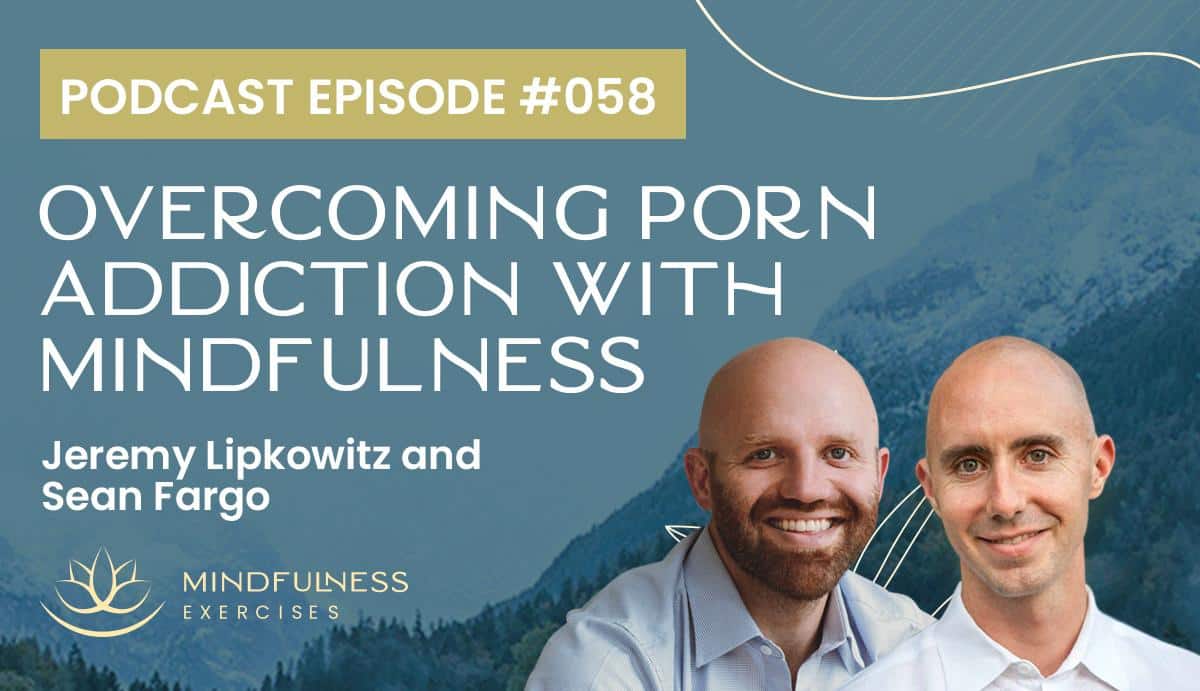
Speaker 1 · 0:03So today we're speaking with Jeremy Lipkowitz. He's a meditation teacher, mindfulness coach. He's a teacher who I've been following pretty closely and really admire his practice but also his style of teaching. Jeremy is also a digital habits expert who works with entrepreneurs and executives and leaders. He works a lot with porn addiction. He himself overcame addiction, shame, self-judgment, and depression in his early 20s with the help of mindfulness meditation. Mindfulness not only helped him let go of destructive behaviors, but it also allowed him to connect with deeper meaning and purpose in his life. For the past 10 years, Jeremy has been teaching mindfulness and emotional intelligence practices at universities, recovery centers, and companies throughout Asia and the US. He's also an ICF certified executive coach. He has several coaching certifications and is a certified teacher with the Search Inside Yourself Leadership Institute, the mindfulness-based emotional intelligence program born at Google, which I'm also a certified teacher as well. Jeremy, like me, also spent time living as a fully ordained Buddhist monk. I was in Thailand. Jeremy was in Myanmar or Burma and has that depth of practice with a little bit of this Buddhist roots or Buddhist approach. He now combines his science-based expertise with a hunger for personal development to help others be disciplined in their minds and achieve genuine inner peace and fulfillment. I will add that Jeremy Lipquitz is also a senior teacher for our Connect Community, a free online community where mindfulness practitioners can connect with each other, sit together, co-create community. Jeremy, welcome to the podcast. It's a pleasure to have you here.
Speaker 2 · 2:19Yeah, I'm happy to be here as well.
Speaker 1 · 2:21Great. So you've been working a lot with addiction, namely porn addiction. I know you've done a lot of work with, I think, screens as well, but we can say a lot about addiction. But I'm just curious what parts of your own story you can share around your addictions to things, and what might have been sort of near the root of that in your experience, and why you think there was this fuel for wanting something external and how you were unable to unravel that.
Speaker 3 · 2:58Yeah. You know, it's so fascinating with addiction that all addictions are very similar at the core level, at the root level. And it almost really doesn't matter what the behavior or the substance is. There are differences, there's some nuances in terms of how you work with different addictions just because of how they manifest. But at the root level, you know, all addictions are an attempt to escape some suffering, to, you know, run away, to numb out, or find some peace in a state of pain or suffering. It's an attempt to solve a problem that we're having. So whether it's porn or video games or junk food or Netflix or work or exercise, you know, all of these things can be addictions in terms of something that we use to escape a feeling and that has detrimental effects or consequences in our life. So for me, you know, I've had addictions throughout my life and they've come up in different ways. And I think a lot of people have addictions and it's on a spectrum, right? You know, for some people, it can be a very minor addiction where it is holding them back in some way, it's having some negative effects. It might not be the end of the world, it might not be ruining their life, but it's something that is kind of used as a way to avoid dealing with a problem or to numb out or escape. So for me, it often took the form of porn was one of them, you know, and that started at an early age, seven, eight, nine, started looking at lingerie catalogs and you get dial-up internet, and then it progressed. But it also took the form of junk food. You know, I remember when I was in middle school and had to walk home from school. And I remember that on the walk home from school, I would actually stop at like three different convenience stores because I would buy candy and junk food at each one. But I was so ashamed of how much candy I wanted that I would buy like a couple candy bars at one, and then I would walk a few blocks, you know, down and get a few more candy bars at another one. And so, you know, junk food, porn, video games later on, it turns into work addiction and wanting to get validation and all these things. A big part of addiction is the shame that around it, the self-judgment, the self-loathing, the sense of being broken or isolated. And so that's a huge one as well. And one of the things that I love about mindfulness practices is particularly when you infuse it with loving kindness and self-love and self-acceptance and self-compassion, it's a way to heal from one of the root causes of addiction and those behaviors is that shame in the sense of being broken or flawed in some way. And so for any addiction, whether it's someone working with porn or junk food or anything, alcohol, learning how to love yourself and say, I'm not broken, I am worthy of love. That's one of the first steps.
Speaker 1 · 6:00Yeah, and I think you're really touching on the root of a lot of people's addiction, because certainly shame is such an underlying root for a lot of addiction, and shame can touch on trauma as well. But so many people feel unworthy of love or not being good enough, not being smart enough, not being good enough looking, and they may have had some missing ingredients in their childhood or had some experiences in their childhood that led them to feel ashamed of themselves. And a lot of us cover that up or try to feed the missing hole in ourselves with these different addictions and might numb ourselves out or distract ourselves, as you said, from feeling this. And you know, I think shame is different than guilt. Guilt is more like I did something wrong, shame is more like I am wrong type of thing. And it's sad when we have this mistaken identity or this mistaken belief of ourselves, and I agree, I think these heart-based practices of loving kindness and self-compassion, self-forgiveness go a long way of helping us to feel worthy again of our own love and of other people's love. Would you be able to touch a little bit on some of these heart-based practices that you found to be helpful for you and in your work for others? Are there kind of specific flavors or phrases or practices that you found helpful for addressing shame with the heart?
Speaker 2 · 7:58Yeah.
Speaker 3 · 7:59One of the things about addiction that I like to just think about is addiction is, as you mentioned, around trauma, and a lot of addiction comes from trauma. And there's a misconception that you know it has to be a big trauma, trauma with a capital T, like something big happened in your life. But for many people, it's not some big event, it's micro trauma. Just like the small experiences of not getting your needs met when you were younger. Maybe you didn't get the support you needed, maybe your parents were absent, maybe you got bullied, and it's all these small events that can add up and make you feel like you're not safe and like you don't have what you need. And so that's what causes many of us to reach out for these soothing, self-medicating experiences that give us the dopamine, give us the feeling of safety and the feeling of control. And so when an addictive behavior crops up, what I like to kind of recognize is oh, this is a young part of me that is looking for safety. This is a part of me that is looking for security. And so to include kind of that visualization of a young child that's in pain, a young child that's suffering or alone or isolated. And in the same way that, you know, if you saw a young, helpless child on the street that was just like the cutest thing ever and was alone and homeless, and your heart would just reach out for that child and say, Oh, you poor thing, like let me protect you, let me care for you. And so one of the tools is like, can we learn to love ourselves in the same way? Can we learn to see ourselves as that hurt child that needs love and support? And so that's one of the ways you can kind of infuse a love and kindness practice for yourself is as you're doing a metta meditation or love and kindness meditation, and you're saying phrases like, may you be happy and peaceful, may you be safe, may you live with ease and well-being, whatever phrases you want to use to almost visualize sending it to your younger self and say, Hey, you know, I'm here for you, I care for you. And this is where a bit more of the compassion comes in is I care about your pain and your suffering. And may you be free from this pain and suffering. Or just, hey, I'm here for you, I care for you. And so that I found really helpful. A lot of the clients I work with find helpful as well is seeing that inner child within you that needs love and support. And it's not always easy to connect with. There can be a number of reasons, you know, especially as we talk about trauma, there can be a number of reasons why that's hard to connect with. So sometimes it's helpful to visualize someone that you know cares about you. You might call it a benefactor, but it might just be a relative that you really appreciate, a teacher that you've had that you know cares for you, someone that you instantly feel, that sense of warmth and love, and to use that person as a visualization and to imagine them sending that love to you. So there's a number of ways to tap into love and kindness. One of my teachers, Michelle McDonald, I remember being on a retreat with her once and we're doing a loving-kindness practice. And she said, you know, sometimes you have to interview different people for your visualization. Like you think, oh, okay, I've got the best person in mind to visualize for love and kindness. And then you do it and it feels like dry, it doesn't feel like it's infused with that loving kindness. And so you have to try out a few people and maybe someone that you didn't even think it would really work with. You're like, wow, I really feel that sense of love and kindness. I feel the compassion there. So those are just a few ideas about how to bring that in. But the main thing is recognizing that when you're in that place of addiction, you're in pain. And can you treat yourself the way you would treat a friend? Or can you treat yourself the way you would treat a young, helpless child?
Speaker 1 · 12:02Beautiful. What a wonderful practice. And I can just feel my heart tenderizing as you're talking about this. Yeah, last year I went on a retreat, and the retreat teacher asked me to bring a picture of my childhood self printed out. I didn't know why, but I brought it and we went through a similar exercise. And it was helpful to have a printout of what I looked like when I was a kid rather than me trying to imagine myself when I was three, but to have like a visual and I could connect with it and then internalize it. And it kind of helped that feeling grow a little bit more, you know, and different things will work for different people, but yeah, what a powerful way to help heal our childhood in some way by reconnecting with them. You know, a lot of the times when people connect with shame and when they cultivate this open heart and the sense of care for ourselves in the midst of this shame, in the midst of this addiction, and in the midst of this uh unworthiness, or this feeling of unworthiness, a lot of the time there's this sense of grief that comes up and the floodgates of tears can come up and we may carry judgments of grief itself as being weak. And so I wonder whether in your experience or with your work with your clients, I'm wondering if you have any thoughts about the arising of grief and how we may be able to meet it with the same warmth. And do you have any tips or tricks on meeting grief through this process?
Speaker 3 · 14:01Yeah, you know, grief, shame, sadness, anger, they're all natural responses to difficulties that we've had. We talked about trauma, and you know, often trauma involves other people. And so sometimes there's the anger and the hatred of what other people did to me. There can be the grief of a childhood where you didn't get what you needed. And these are really strong emotions and they can be very uncomfortable. And particularly in the context of meditation, it's like we don't want to sit with it. We want to run away, we want to stand up and end the meditation and go look at Netflix or Instagram and kind of avoid. It's like learning how to sit with those experiences, whether it's grief or anger or shame or sadness, and make space for it and kind of hold it. And for me, when I do it, I always visualize almost turning towards the emotion and hugging it, like putting my arm around it or hugging it and saying, just to the emotion itself, like, hey, you're safe here and I'm here for you. You know, that whole my old friend, or almost as if the emotion itself was a young child that was in pain, and just saying, hey, grief is here. Can I sit with this? Or, you know, I'm here for you. So seeing that as in some ways the purpose of training. It's so interesting, you know, we talk about mindfulness, and a lot of people think, okay, the purpose is to follow every breath and to be really concentrated. And I'm like, that's not the point at all. The point is learning how to have a better relationship with what's coming up for you. And if grief is coming up, don't worry about the breath. Let the breath go away and learn how to be in relationship to grief and learning how to make peace with your grief and comfort your grief and not suppress it, not push it away. So much of the suffering we experience is from either pushing things away that we don't want or grasping onto the states of mind that we do want. Like, oh, finally, concentration. Let me hold on to this forever. I need to be concentrated. And that just causes us to get wound up and tight. And in the same way, grief comes up and we're like, oh no, grief. I don't want grief. Push it away. But instead, it's like anything that arises, whether it's pleasant or unpleasant, can we learn how to sit with it? In meditation practice, sometimes we talk about this practice called Vedanas, or like the feeling tones of any experience. And one interesting way to practice meditation is just to notice what's the feeling tone of any experience that's coming up. And any experience, whether it's a mental experience, a visual experience, physical, has a feeling tone, meaning it's either pleasant or unpleasant or neutral. And the tendency of the mind when we're not paying attention is if something pleasant comes up, we want to, you know, grab onto it and hold on to it. And if something unpleasant comes up, we want to push it away. So grief comes up, it's unpleasant. And if we're not mindful, we think, oh, get out of here. Let me get back to my pleasant meditation. But a really cool way to practice is just to say, oh, this is unpleasant. And I can sit with it. I don't need to push it away. And so there's kind of two things that I'm offering here. One is the compassion of recognizing it's a difficult experience and saying, oh, okay, can I sit with this and I care for you and bringing that compassion into it? And the other is kind of the equanimity that we talk about of when something's difficult that's coming up, can you just say, Oh, this is unpleasant, but I don't need to push it away? Or, oh, this is pleasant, but I don't need to grasp onto it and try to hold it there. So both of those approaches, compassion and caring for it, and the equanimity, the wisdom of I don't need to do anything with this can be really valuable.
Speaker 1 · 18:02Sure. Yeah. Thanks for sharing that. So a lot of your work these days is around this addiction to porn, which is not really talked about very much in our society. And I get the feeling like it's a growing addiction. And I assume that the majority of people are male who are addicted to porn, although I imagine there are many women who struggle with this too. You know, porn is a relatively recent phenomenon, I would imagine. Maybe I'm wrong, but just with the internet, and also there's magazines and whatnot, but 500 years ago there wasn't the proliferation of maybe I'm naive, but it seems like porn is more of a recent thing, especially with cell phones and the internet and just people's ability to access pornography. And I imagine it can be so powerful of an addiction because it feeds into our primal nature of procreation. We have hormones raging, and so it I imagine it's quite powerful addiction that people would be struggling with, easy to access. And I imagine some people might not feel like what they're going through is an addiction. I think some people feel that way, but a lot of people who are technically addicted may not feel like it's an addiction because they're not getting drunk and it might not impact their work life or professional life to a large degree, usually, I would imagine. So it's kind of an interesting addiction to have. So I'm curious in the moments that we have left together, if you could talk a little bit about some of the peculiar or unique aspects of this type of addiction of pornography, and any interesting insights that might differ from another type of addiction, or is it just like any other addiction?
Speaker 3 · 20:29Yeah. So a few things you said, you know, some people might not know they have an addiction, right? And there's a couple of reasons. One is that for many people, it starts at such a young age and they've been using it almost every day since before they can really remember. Seven or eight years old, they might have started and using it every day. And so it's almost like that parable you ask a fish, how's the water? And they say, What water? And you ask a grown man, what are the consequences of porn on your life? And you're like, What consequences? Because it's just part of their life. Also, the effects of it can be very subtle and they're not immediate, you know, with alcohol, with hardcore drugs, you know, you might experience those consequences right away, or an hour later, or the next morning. With porn, it's changing you on a neurological level. And so we're seeing the negative effects or the consequences, maybe three months down the road, maybe a year down the road, and they're subtle but cumulative. So how they influence our intimacy, our sexual relationships, our partnerships, our ability to focus. There's so many ways that it affects us on a more subtle but gradual level. So that's just a little bit about that. You also mentioned is porn new? And it is both new and not new. It's not new in the sense that pornographic imagery has been around for hundreds, thousands of years. That's not new. Sex work has been around for thousands of years as well. So some of these things are not new, but what is new is modern day high-speed internet pornography that is different from things we've seen in the past. And in particular, what's different about it is the accessibility of it, the availability, the affordability, and the novelty of it and the anonymity as well. But what makes modern-day pornography so I don't want to say dangerous, but just so potentially addictive is that there's an infinite variety, relatively infinite variety of things that you can access. And so we actually see people who are watching eight or nine hours of porn per day because you can just keep finding new stuff to trigger your dopamine. You know, it's interesting with food addiction, you can only eat so much food before you get physically sick and your stomach just gets full. You can't just keep sitting there and eating more sugar. But with porn, you actually can just keep finding new content, new material, and you can sit there hitting your dopamine button for hours and hours on end because you're looking at new content. There's infinite novelty to sit there and trigger your dopamine system. And it's also what leads people into more and more extreme content. They get habituated with normal sex and normal porn, and then they need more and more extreme things to get the same level of excitement, the same level of dopamine. The other issue with porn is what we call the three A's of porn addiction, the accessibility of it. Everyone has a smartphone now. Every nine-year-old boy has a smartphone and can go into his bedroom and access Pornhub. So that's one thing. It's just highly accessible where it wasn't in the past. It's also incredibly affordable, which means it's actually free. So a lot of drugs you have to pay for. If you want alcohol, you have to go to the store and buy it. With porn, it's free and it's easily accessible. And then the third one is the anonymity. Alcohol, you have to go to a store, you have to go to a bar. Mostly people kind of know that you're using it. With porn, you can do it completely anonymous. And so those three A's are kind of the firestorm of porn addiction, why it makes it so addictive in our society. And like you said, it's not something that we talk about, and yet it's a huge issue. So many people struggle with it. And one of the reasons is that for some reason, sex and porn addictions are more shameful than other addictions. You know, people can openly talk about being an alcoholic and saying, yeah, I'm in recovery for being an alcoholic, I'm going to my 12-step program. It's very hard for people to admit porn and sex addiction because it feels for some reason more shameful, like, oh, I'm a pervert, I'm broken, you know, oh, if people knew they wouldn't want me to be around their kids, or it's very sensitive, even though so many people deal with this issue. It's not rare, it's not uncommon, it doesn't make you a pervert. It's just we are sexual beings. And this is one of the things I really try to stress in the work that I do is that sexuality is a beautiful part of being a human. And we don't want to suppress or deny our sexuality or shame our sexuality. And part of recovering from porn addiction is really embracing your sexuality and saying, no, my sexuality is not broken. My sexuality doesn't make me a bad person. I need to learn how to have a healthy relationship to this and actually embrace my sexuality. If I'm attracted to someone, that's a beautiful thing. It doesn't mean that I should then go grope them or indulge in unhealthy behaviors, but it's like the sexuality itself is beautiful. And as you mentioned, men don't have a lot of emotional support. For women, there's a lot of women's circles and women's groups, and going to therapy is more normalized. But because of the society we live in, the toxic masculinity, all the stuff, men don't have those emotional support groups in the same way. So for many men, there's no one to talk to about this. And on top of that, you know, it's kind of exacerbated by the fact that it's a shameful and sensitive issue that even if men do have a place to talk about it, it's very hard to open up about it. To say, yeah, I'm really struggling with porn addiction or I'm watching stuff that doesn't feel ethical. It's like there aren't these safe spaces for men to talk about. And it does affect men and women. And there's some nuance there as well. I'm not anti-porn. I think there's a lot of nuance to it. I think some people can have a healthy relationship to it. And it's never about the substance. Like I'm not anti-alcohol, I'm not anti-drugs. It's like, what's your relationship to this thing? And that's what I try to help people see. It's like you don't have to be anti-sex or anti-porn, it's anti-addiction.
Speaker 1 · 26:59Yeah. Thank you for sharing a lot of that nuance. And like you said, with the firestorm of conditions that are leading to this proliferation of porn addiction, it's alarming that so many people are so susceptible to this given the conditions of affordability and accessibility and anonymity and the lack of support definitely out there, and the shame, as you mentioned, around it. How can people get a hold of you? And what do you offer around supporting people with porn addiction?
Speaker 2 · 27:50I have a podcast that I host myself talking about this issue. It's called Unhooked.
Speaker 3 · 27:57So if you look unhooked and then my name, or even if you just search Unhooked on any of the podcast platforms, you'll find it. I also have an online course specifically geared towards helping people understand how to break free from digital addictions. So it goes through some of the habit science, understanding addiction, building a stronger mental foundation. And a big part of recovery, just a little side note, is building a more fulfilling life. That we know that a lot of addiction comes when we're not getting our needs met in terms of our relationships, of physical health, mental well-being. And there's some very interesting studies that point to that. And so, in order to actually recover, you can't just stop the behavior and just try to white knuckle it. You actually have to build the inner tools and the inner fulfillment so that you don't need addiction. You know, you don't need to escape. It's like building a life that you don't need to escape from. So, anyways, I talk about this in my online course. So people can find that. Just go to my website, which will link, I imagine. And then also I work with people one-on-one. So, you know, probably the best way to get support is that direct accountability, you know, having somebody in your corner to hold you accountable, but also to champion you and remind you of what's possible and give you that support when you need it. So I do one-on-one coaching work as well around this issue.
Speaker 1 · 29:22Beautiful. Jeremy, thank you so much for sharing your wisdom with us today around so many topics. We have his links to his offerings down below. Please check them out and subscribe to Unhooked wherever you get your podcasts. Jeremy, thank you so much for joining us today.
Speaker 3 · 29:47Thank you. It's been a pleasure.