🎧 New episode: Eyes-Open MindfulnessListen →

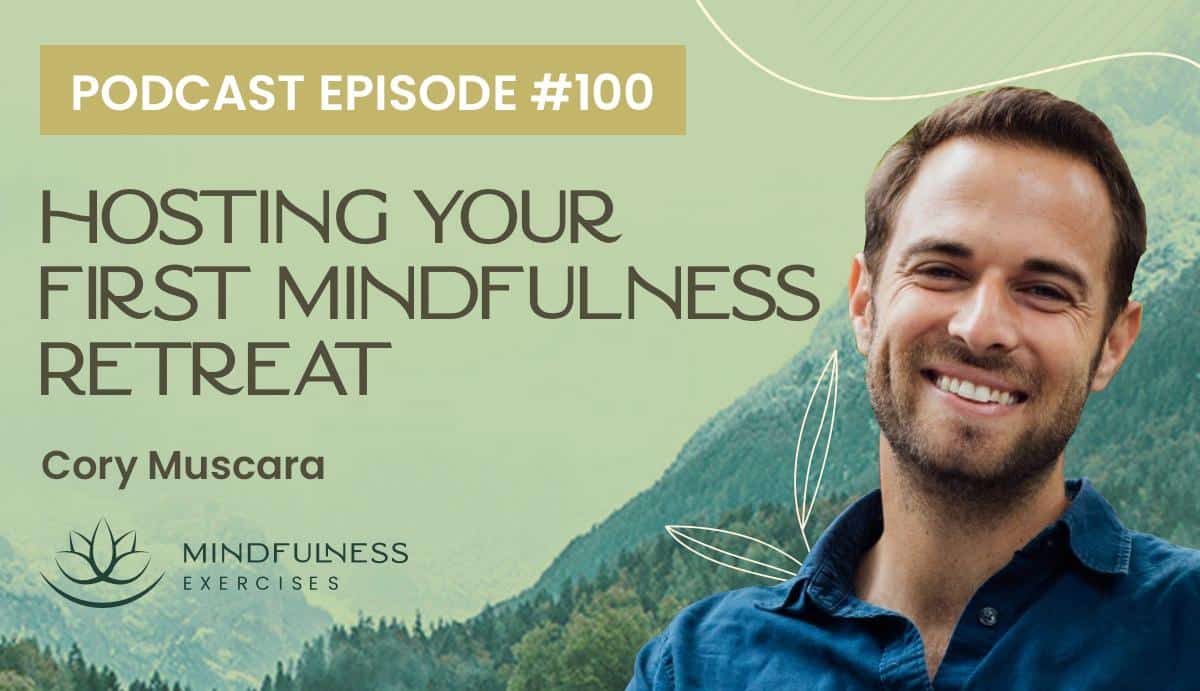
    Hosting Your First Mindfulness Retreat, with Cory Muscara

    SF
    Sean FargoPublished April 3, 2024 · Updated November 6, 2025 · 9 min read
    Hosting Your First Mindfulness Retreat, with Cory Muscara

    Loading episode player

    TuneIn

    Mindfulness retreats are a valuable opportunity to step away from routine and apply ourselves to deepening our mindfulness. We may devote a single day or multiple days to a retreat, either at home or at a retreat center. 

    Meditation teachers who have completed retreats of their own know full well the benefits of such focused attention on their practice. However, the thought of guiding others through this intimate, intense experience can be intimidating. 

    In this episode, we hear from meditation teacher and retreat leader Cory Muscara. Cory offers practical advice on leading meditation retreats and explains why it’s far more accessible than some mindfulness teachers may think.

    Sponsored by our Mindfulness Meditation Teacher Certification Program MindfulnessExercises.com/Certify

    What You’ll Learn in This Episode:

    • Why leading retreats is more accessible than you may think
    • Why leading a retreat is similar to teaching a workshop
    • How to navigate intense emotions on retreats
    • How retreats can be energizing for teachers
    • How to choose a retreat center
    • What to charge for your retreats
    • How to begin marketing your retreats
    • How to choose the ideal retreat schedule
    • Ways to get creative with retreat formats
    • What to consider regarding virtual retreats
    • How to encourage post-retreat practice

    Show Notes:

    Yes, you can lead a mindfulness retreat

    Some mindfulness and meditation teachers worry that although they’ve led classes, workshops, or courses, a retreat still feels overwhelming. You may feel you don’t have enough material for several days of instruction, or that the logistics of organizing a retreat are too daunting. Gather the courage to jump in, however, and you may see that leading a retreat is more accessible than you think.

    “You do it once, you figure it out, you make mistakes, and it’s not that bad. And so that can be done. If you can run a 3-hour workshop, you can run a retreat. It may be a provocative thing to say, but that was my orientation when I first started doing this. Because I was like, ‘Okay, what is a retreat? It’s essentially a series of 3-hour workshops.’”

    What’s different about guiding retreats

    Cory finds it helpful to break up his retreats into blocks of meditation, instruction, moments of silence, and meals. If you view a meditation retreat as a series of two-and-a-half-hour workshops, it’s no different than teaching a multi-session course. What does change is the intensity of emotion that can arise when the material is presented in a retreat format. For an experienced mindfulness teacher, however, this too can be met with embodied presence and ease.

    “It’s not like you’re going into unknown territory.The only thing that you might get more of is intensity of emotion, but you’ve already navigated that through your own practice. 

    You know how to navigate it in yourself.  And if you’ve been teaching – you won’t want to run a retreat unless you have some teaching experience, so that can become the foundation – but if you’re teaching, you’ve met people in their emotions. And you might have that turned up a little, but it’s a bit of a stretch for your teaching. So, it can be done and you just take it one block at a time.”

    The energizing effect of retreats

    Even after a 5-day meditation retreat, which requires considerable effort, Cory feels energized instead of depleted. A strong mindfulness practice, embodied presence, and healthy boundaries help him to meet the energy of others, without taking it on. 

    “I think the main thing I’m trying to say is, it can be fun. It doesn’t have to be this thing that we dread, and it doesn’t have to be looked at like, ‘Oooh, a lot of intensity.’ The intensity is only going to happen in a single moment, meaning, all you’re doing is just meeting people in single moments.”

    The business side of mindfulness retreats

    Cory is passionate about discussing the business side of retreats, something many teachers prefer not to share. By sharing this information in detail, he hopes to help more mindfulness teachers create a sustainable business. He breaks down the potential income one can earn from running a few 5-day retreats each year.

    “Of course it depends on who your students are, the demographic, affluence or not. And, you get to discern if you want to use scholarships or not, but that’s how I started.”

    Starting with your current community

    What worked well for Cory was to begin with an invitation-only meditation retreat for a small group of his most dedicated students. Because he was inviting students he already had a relationship with, he didn’t need to spend any money on advertising. He chose to make the retreat extra special, a high-end experience that was hard to say no to. 

    “In general, it’s going to be easier to get a few people to do something at a higher price tag than a lot of people to do something at a lower price tag. Just because you need a bigger audience and a bigger following to do the larger events. […] I said ‘Hey, this is a special invitation, would you like to come? These are the details.’ Most people are honored that you’re thinking of inviting them and if they’ve been with you, they want to go deeper.” 

    Marketing your meditation retreats

    With a social media following of nearly 700,000 people, Cory does little paid marketing. Mostly, he uses his email list to communicate with students. His mindfulness retreats have also grown through word of mouth. On his website landing pages, he finds it helpful to emphasize a range of retreat and self-care benefits, such as reduced stress and improved focus and performance. He finds this information is most easily digested when presented in bullet points.

    “People tend to really like ‘You’re gonna get the three steps to reducing stress. You’re going to get the five keys to relaxation.’ I’ve done landing pages without it and with it, and they just convert a lot better when you do it with it. So, it’s a marketing hump you have to get over and find your own voice in that. But yeah, people want bullet points. You know, I’m looking through this fast and just, ‘What am I going to get out of it? I don’t want to read a full thing.’”

    The ideal retreat schedule

    The first time Cory led a weekend meditation retreat he scheduled practices from Friday evening through Monday afternoon. Since then, he has revised this schedule to better accommodate people’s work lives. He’s gone through a similar process of trial and error with his other retreat formats. 

    “What I found is that a lot of people didn’t come because of that extra day, and there were a lot of people who can make it work because it was a weekend retreat and they can go straight from work to the retreat and then be done on Sunday. And so, I adjusted it to make it more accessible for people and what I found was that it seems to have been equally impactful, or not much was lost. And if anything, people really appreciate the punchy nature of it.” 

    Mindfulness retreats as a creative teaching space

    Cory describes meditation retreats as a playground. The longer format allows him to bring in new and different methods of teaching mindfulness, within a container of safety and care. He also invites teachers to be creative in how they structure retreats. This may mean hosting multi-day retreats at a community center, for example, but allowing people to return home to sleep. 

    “How can I curate the most impactful experience, to really take people deep and go into places they might not otherwise be able to go? And that one’s most fun for me. It’s very intimate, I know everyone who’s there. I can track them as we’re going through and they’re very full days. We start every morning at 7am and we go until 9:30, 10pm. So I am on that whole time and all break periods go to planning and prepping, but I love it.” 

    Considerations around virtual retreats

    Offering retreats in the virtual space makes them more affordable and accessible for people, but does warrant some special considerations. For example, you may want to focus on grounding, body-based practices to balance the potentially disconnected energy of meeting people online. It can also help to be especially aware of what your participants may be returning to outside of the sessions. 

    “I advertise that retreat as retreating into your life, because it’s different than an in person retreat where you’re stepping out of your normal context to go somewhere. It’s like, ‘Oh, this is happening in your home and then you go back to your relationship and making food and on technology.’ And I’ve been running those all through the pandemic, and oh, it’s just been incredible. I’ve been so happy with the impact it’s had for people.” 

    Encouraging continued practice

    You can help your participants sustain the benefits of longer meditations and day-long or multi-day sessions by providing them with resources or access to ongoing courses after their retreat. Offering people recordings of the retreat meditations can also help promote continued practice and integration. 

    “Part of (sharing resources and courses) does help with getting people to opt in because they feel like they’re getting a lot. But the big reason I do that is because I want people to follow up. And I created a lot of these courses so people would have something after an immersive experience, to ride the momentum of it and have this work to keep their practice going.”

    Additional Resources:

    Hosting Your First Mindfulness Retreat, with Cory Muscara

    About Cory Muscara:

    A graduate of the 2-year Spirit Rock Community Dharma Leader training, Cory also has several years of extensive professional training in Mindfulness-Based Stress Reduction (MBSR), completed certification with Mindful Schools and the Search Inside Yourself Leadership Institute, and has trained in Mindfulness-Based Inquiry, Breathworks Chronic Pain with Vidyamala Burch, the Trauma Institute led by Bessel Van der Kolk, and a relational meditation practice called “circling” through Circling Europe. 

    In 2012, Cory spent 6 months in silence, ordained as a monk under the late Sayadaw U Pandita within the Mahasi lineage of the Theravada tradition. Today, his meditations have been heard more than 25 million times in over 150 countries, and his goal is to share wisdom teachings in a practical and accessible manner.
    Transcript

    Show transcript· 14 min read

    Speaker 1 · 0:03So, welcome. I'm Sean Fargo. It's a real treat to welcome Corey Muscara here today. He is the author of Stop Missing Your Life: How to Be Deeply Present in an Unpresent World, a best-selling book. He is the mindfulness expert for Dr. Oz. He has been featured in Men's Health Magazine, Fast Company, the Huffington Post. He's the main teacher for mindfulness.com. He's a former Buddhist monk. He's a dedicated practitioner. He's been teaching online retreats lately. He's taught all sorts of in-person retreats. And I thought that he'd be a wonderful guest teacher to talk on this topic because it's not something that we've gone into a lot of detail in this program yet. So when we say retreat, we typically mean like either a really long day of practice or multiple days of practice. And oftentimes they're structured in a way where there's alternating periods of formal practice, like formal meditation. Screens are discouraged, making errands around town is discouraged, checking email, talking is generally discouraged. But a lot of it is kind of just limiting behavior. So just wanted to paint that context for some of you who may not know exactly what we're talking about when we talk about the word retreat here. It's different from a like a day-long or a class or a workshop. This is more like a longer period of intense practice. So it's an honor to welcome you, Corey, to chat about this topic. But Corey, welcome. It's an honor to have you today.

    Speaker 2 · 2:04When it comes to like, can I run a retreat? Like, you know, I've done workshops, I've done half day sessions, but a retreat feels like a big thing. What I'll say is the biggest thing about transitioning from that to a retreat is the hospitality side of things, is the navigating sleeping arrangements and people having stuff to say about that and check-in and all the procedural stuff with that. But you do it once, you figure it out, you make mistakes, and it's not that bad. And so that can be done. If you can run a three-hour workshop, you can run a retreat. Might be a provocative thing to say, but that was my orientation when I first started doing this. Because I was like, okay, what is a retreat? It's essentially a series of three hour workshops. And I was running MBSR groups that were about two and a half hours each. And then we'd have the day long in MBSR, which is like six hours, seven hours. It's like I can do that, right? And most of that silence, a combination of talking, small groups. Well, what is a retreat? You come in and you have a two and a half hour block on Friday night, Saturday morning, a two and a half hour block, lunch, two and a half hour block, dinner, two and a half hour block, morning meditation on Sunday morning. I can do that, two and a half hour block, two and a half hour block. And a lot of it was just content that I was taking from my MBSR course. I just condensed into a weekend retreat. So it's not like you're going into unknown territory. The only thing that you might get more of is intensity of emotion. But you've already navigated that through your own practice. Like you know how to navigate it in yourself. And if you've been teaching, and right, you don't want to run a retreat unless you have some teaching experience. So that can become the foundation. But if you're teaching, you've met people in their emotions. And you know, you might have that turned up a little bit, but it's a bit of a stretch for your teaching. So it can be done. And you just take it one block at a time. So instead of viewing this retreat as like a multi-day retreat, just view it as a bunch of two and a half hour blocks that you're stacking one after another after another after another, and just take care of each of those blocks. And then you get a break. So, whoa, that was intense. A lot of teaching. All right, we're doing this. And then you come back, another two and a half hour block. I have so much fun on retreats. I love them. I can't wait to go back to the next one, the online retreats, the in-person retreats. I feel energized at the end. And after a five-day retreat, I just want to do another five-day retreat. And so they can really be rejuvenating or energizing. But also, let me say, like, that's my disposition. My partner is an empath, and she has very different experience running this stuff. And she thinks I'm an android, like having that relationship to like an energetic experience that way. So I think the main thing I'm trying to say is like it can be fun. It doesn't have to be this thing that we dread. And it doesn't have to be looked at like, whoa, a lot of intensity. The intensity is only going to happen in a single moment, meaning, like, all you're doing is just meeting people in single moments. I found the access point to be let me do an invite-only retreat for a handful of people. It was eight people I started with and make it a five-day retreat for those who I already know, like have been with me for a while and want to go deeper and make it more of a high-end retreat. In general, it's going to be easier to get a few people to do something at a higher price tag than a lot of people to do something at a lower price tag, just because you need a bigger audience and a bigger following to do the larger events. And know that like you can hear it in the way I'm talking right now. I am talking about like the business side of things, which I am very passionate about talking to teachers very transparently about. I think it's something that is lacking for a lot of teachers and prevents them from actually creating sustainable businesses around this. So one of my passions is helping people develop the business model for their retreats. So those retreats, you'll see like my online retreat, I price at $200. Anyone who wants a scholarship immediately gets 50% scholarship just by sending me an email that says, like, hey, I need a scholarship. And I offer a scholarship to anyone for the in-person retreat as well, which is price anywhere from 400 to 1,000. And then the five-day retreat is price somewhere between 2700 and 3,500, depending on accommodation. If you already have a community and you've been teaching, getting people to sign up for this, it's not too hard. I didn't do any Facebook advertising, any marketing for my first retreats. I just reached out via email, handpicked people. I said, hey, this is a special invitation. Would you like to come? These are the details. Most people are honored that you're thinking of inviting them. And if they've been with you, they want to go deeper. And they don't need it to be fancy. Most people don't need it to be fancy. And everything kind of just grew organically. So the weekend retreat started at like 18 people and grew to 100, mainly through word of mouth. And so I did some Facebook advertising, but a lot of it was just through my email list, word of mouth, as social media grew, that helped with online retreats and such. But I did very little advertising for my retreats early on. And you can create a sustainable business with retreats. I mean, if you do the math around, let's just say a 10-person retreat where each person is paying, well, let's just say $2,000 base rate and it plus accommodations, which is your expenses. You know, $2000 times 10 is $20K. And so in a week, you can make that. And you can do that potentially a few times a year. And before you know it, you're looking at a $50,000 plus income with running a handful of retreats. And of course, it depends on who your students are, the demographic, affluence or not. And you get to discern if you want to use scholarships or not. But that's how I started. You know, I don't have the best landing pages, but if you want to look through my landing pages, the one on LI Mindfulness and then one on CoreyMuscara.com, you could see just sort of how I lay that out. I try to do a blend of making sure I address the person that might be interested in self-care, the person that's interested in stress reduction, the person that's interested in high performance and focus, the person that's interested in like the deeper stuff. And I'll try to just like include a variation of that in like the bullet points of what you might get out of a retreat. People tend to really like you're gonna get the three steps to reducing stress. You're gonna get the five keys to relaxation. I've done the landing pages without it and with it, and they just convert a lot better when you do it with it. So it's a marketing hump you have to get over and find your own voice in that. But yeah, people want bullet points. You know, I'm looking through this fast, just like, what am I gonna get out of it? I don't want to read a full thing. So um advertising it as like a form of mental fitness is one way that people tend to understand living on automatic pilot and a lot of the usual ways we understand. So the first time I read that weekend retreat, I did Friday evening through Monday afternoon. So it was two full days, Saturday, Sunday, and then Monday morning we finished at noon. And it was great. I loved it. But what I found is that a lot of people didn't come because of that extra day. And there were a lot of people who can make it work because it was a weekend retreat and they could go straight from work to the retreat and then be done on Sunday. And so I adjusted it to make it more accessible for people. And what I've found is that it seems to have been equally impactful or not much was lost. And if anything, people I think really appreciate like the punchy nature of it. So if you are looking to run a retreat, one model that works well does seem to be Friday evening through Sunday afternoon. Some people end their retreats around noon. I go to 430. So that's my like larger public offering. And I can hold like up to about 130 people at the retreat center I use. But I also do a more intimate retreat a couple of times a year for my students who have been with me for a longer period of time. And that's a five and a half day retreat. And I cap that at 16 people. I might bump that up to 20 moving forward, but that's a higher price retreat. Everyone who's there I know has experience. When I do open it up publicly, it's by application only. And that is more of a playground for me, more of a playground in the sense like I'm bringing in a lot of different stuff. And it's specifically designed to be like, how can I curate the most impactful experience to really take people deep and go into places they might not otherwise be able to go? And that one's most fun for me. It's very intimate. I know everyone who's there. I can track them as we're going through, and they're very full days. Like we start every morning at 7 a.m. and we go till 9:30, 10 p.m. So I am on that whole time and all break periods go to planning and prepping, but I love it. And the reason I bring that retreat up is because that's the one that I started with. So when I'm looking at retreat center rates, the place that I use on Long Island, Camp the Wolf, for cabin option, it's about $80 per night, and they're getting charged for two nights, and that includes food. Commuter option is $45 a day, and their highest accommodation is $100 per night. And I create my own prices where nobody knows the pricing of the accommodation that I'm paying. It's all just bundled into the larger price tag. When I do my five-day retreat, I'm looking at accommodations that have a nightly housing rate per person of somewhere between $120 and $160 per night, which tends to work well. And you can find a lot of those. Garrison Institute in upstate New York falls into that category. I've used the retreat center Pumpkin Hollow for a number of years. When it comes to how to find these places, start by just looking at retreat centers that maybe you have been to yourself over the years. But if you don't have those, making a social media post, say like I have a group of about 10 to 20 people, or maybe it is 100 people, and I'm looking for a space. It's going to be an overnight experience. I need a room. You might need cushions or mats if you don't have your own. Does anyone have a recommendation? And you'd be surprised who has access to these sorts of things. If you don't, there are different ways to do this though. Like it doesn't need to be an overnight retreat where everyone is sleeping there. You could do something, let's say you have a local Sangha, local community, and you make a deal with a yoga studio in maybe their back room for the five people you want to run a retreat for, and they go to bed at night in their home and you meet during the day in that space. So you could be really creative in that way. The online retreat, you know, it's a similar format. You can view my schedule at CoryMuscara.com forward slash retreat of like how I formatted that. They're relatively full days, but I make certain sessions optional and I advertise that retreat as retreating into your life because it's different than an in-person retreat where you're stepping out of your normal context to go somewhere. It's like, oh, this is happening in your home. And then you go back into your relationship and making food and on technology. I've been running those all throughout the pandemic, and it's just been incredible. I've been so happy with the impact it's had for people. One thing around that, because of the virtual thing, is if you were to do that, remind people that even though we're not in person, you are still in person. You are still in your body, and your experience of what is happening is still very much embodied. That is not virtual. The only thing that is virtual is like what is showing up in the seeing landscape. So when people can connect to their body as they're connecting virtually, it satisfies something deep in them in that way. Materials post retreat. I record all my sessions in the in-person retreat and give them to people afterwards. I just recorded on an iPhone, upload all of that. I give lots of meditations afterwards. And in my in-person retreat, usually like free access to my 31-day course. In the online retreat, if you look through like the bonuses, I give them like sleep course, guided meditations, 31-day course, access to mindfulness.com, like a lot. And part of that is it does help with getting people to opt in because they feel like they're getting a lot. But the big reason I do that is because I want people to follow up. And I created a lot of these courses so people would have something after an immersive experience to like ride the momentum of it and have the support to keep their practice going. So a lot of those are just one-time materials that you create, but then you can reuse them for all different things: workshops, retreats, in-person, online, and from a marketing perspective, they're really great for someone going, Well, you know, I sign up, I get this whole thing, and I get all of this. Like that makes a lot of sense. So they feel like they're getting a lot out of it, and they are.

    Speaker 1 · 16:08Seek out retreats, seek out retreat centers, do home retreats, and keep finding those ways to push the envelope with your practice. So that really helps us to um become better teachers, better practitioners, better people. So I highly encourage people to check out Corey's book, Stop Missing Your Life, attend a retreat with Corey, go to mindfulness.com. So thanks again, Corey. Really appreciate you being here. Thank you, everybody.

    Share

    Continue reading

    • Grounding Through Anxiety With Senses

      Grounding Through Anxiety With Senses

      Read
    • Shamatha Vipassana Explained For Modern Minds

      Shamatha Vipassana Explained For Modern Minds

      Read
    • How To Stop Believing You Are Not Enough

      How To Stop Believing You Are Not Enough

      Read

    Professional training

    Accredited mindfulness teacher certification

    Trusted by teachers in 100+ countries

    Structured training, CE credits for eligible pay-in-full registrants, and support for teaching without self-doubt — after you have explored this episode.